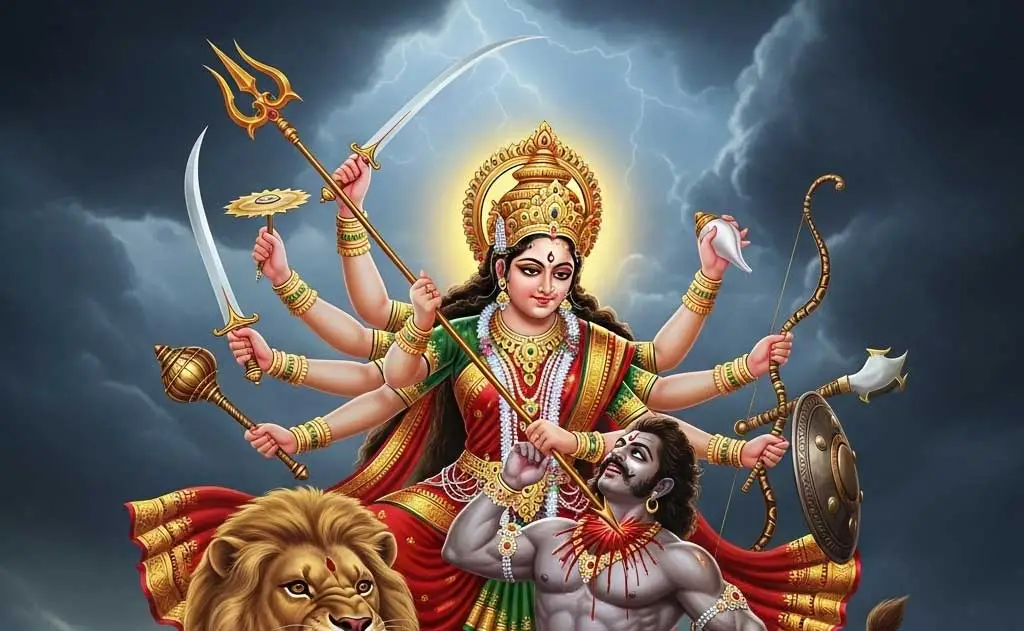
Navratri 2026 for Indian Women Abroad: A Practical Guide for the USA, Canada, UK and Australia
Navratri 2026 runs from Sunday 11 October. This one practical guide for Indian women in the USA, Canada, the UK and Australia covers local dates, time zones and calling family, a ten-minute puja before work, safe apartment altars, colours at the office, children and school, finding Garba and temple events, fasting with a job, loneliness and community, and Kanya Pujan abroad.
Navratri 2026 runs from Sunday 11 October. This one practical guide for Indian women in the USA, Canada, the UK and Australia covers local dates, time zones and calling family, a ten-minute puja before work, safe apartment altars, colours at the office, children and school, finding Garba and temple events, fasting with a job, loneliness and community, and Kanya Pujan abroad.
Quick answer: Navratri 2026 for Indian women abroad starts on Sunday 11 October 2026 in the USA, Canada, the UK and Australia. Drik Panchang lists Durga Ashtami on 18 October and Maha Navami on 19 October in the USA, Canada and the UK, and Dussehra on Tuesday 20 October. Keep worship short on workdays, use your local panchang for muhurats, and celebrate in the way that suits your life.
Celebrating Navratri far from home can feel both precious and lonely. You may be the person carrying the festival for your family, juggling a full-time job, school runs and a time difference with India. This guide brings practical ideas for all four countries together. Nothing here is compulsory: devotion, not perfection, is what the nine nights are about.
Navratri 2026 dates abroad: USA, Canada, UK and Australia
Short answer: Navratri begins on Sunday 11 October 2026 everywhere. In the USA, Canada and the UK, Drik Panchang lists Durga Ashtami on Sunday 18 October and Maha Navami on Monday 19 October, one day apart, while in India both fall on Monday 19 October. Dussehra is Tuesday 20 October. Australians should check Drik for their city.
| Observance | India | USA and Canada | UK | Australia |
|---|---|---|---|---|
| Navratri begins | Sun 11 Oct | Sun 11 Oct | Sun 11 Oct | Sun 11 Oct |
| Durga Ashtami | Mon 19 Oct | Sun 18 Oct | Sun 18 Oct | Check Drik for your city |
| Maha Navami | Mon 19 Oct | Mon 19 Oct | Mon 19 Oct | Check Drik for your city |
| Dussehra | Tue 20 Oct | Tue 20 Oct | Tue 20 Oct | Check Drik for your city |
Tithis are calculated for local sunrise, which is why dates abroad can differ from India. Never use India's muhurat times abroad; look up your own city on Drik Panchang or ask your temple priest. City-level detail is in our country guides: Navratri 2026 in the USA, Navratri 2026 in Canada, Navratri 2026 in the UK and Sharadiya Navratri 2026 in Australia.
Time zones and calling family in India
Many women like to join a parent's aarti on video or receive a grandmother's blessing on Ashtami. Plan the call around the time difference in October 2026:
- US and Canadian East Coast: India is 9 hours 30 minutes ahead. A morning call in India is your previous evening.
- US and Canadian West Coast: India is 12 hours 30 minutes ahead, so India's evening aarti is your early morning.
- UK: India is 4 hours 30 minutes ahead until the clocks go back on Sunday 25 October, after Navratri.
- Australia: Sydney and Melbourne are 5 hours 30 minutes ahead of India during daylight saving; Perth is 2 hours 30 minutes ahead.
North American clocks change on Sunday 1 November, so these gaps hold for the whole of Navratri there. A shared calendar reminder for the family call on Day 1 and on Ashtami makes it easier for everyone.
A ten-minute, office-friendly puja before work
Short answer: On workdays, keep a short morning routine of about ten minutes: wash, light a lamp or LED diya, offer a flower and water, chant the day's naam mantra eleven times, and say a quiet prayer. Keep the main puja, longer chanting and aarti for the evening or the weekend. Short worship done with love is complete.
- The night before: set out the flower, the lamp and the day's mantra on a card, and lay out your clothes.
- Morning: light the lamp, chant the naam mantra of the day's Goddess, and offer a fruit or a spoon of sugar as bhog.
- At work: a few minutes of silent japa on a commute or during a break is a lovely way to stay connected.
- Evening: the stuti, aarti and the full bhog, with the family if possible.
Day 1 is Sunday 11 October, devoted to Maa Shailaputri. Her naam mantra is ॐ देवी शैलपुत्र्यै नमः॥ (Om Devi Shailaputryai Namah). For all her mantras and a full vidhi, see Navratri 2026 Day 1: Maa Shailaputri; each day's post links to the next.
A simple Devi mantra for every day is the stuti from the Devi Mahatmya:
या देवी सर्वभूतेषु शक्तिरूपेण संस्थिता। नमस्तस्यै नमस्तस्यै नमस्तस्यै नमो नमः॥
Ya Devi sarvabhuteshu shakti-rupena samsthita, namastasyai namastasyai namastasyai namo namah. Meaning: "To the Goddess who abides in all beings in the form of power: salutations to her, again and again."
A home altar in an apartment or rented home
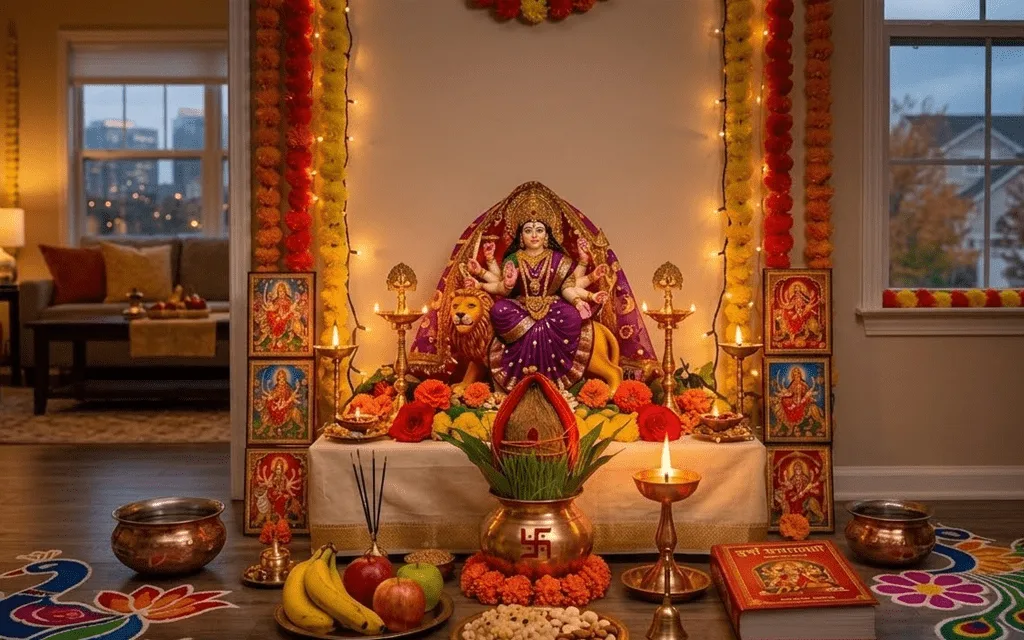
Short answer: A small shelf, a side table or a corner of a bookcase is enough. Cover it with a clean red or yellow cloth, place a picture of Maa Durga, a small kalash or bowl of water, flowers and a lamp. In rented homes many women use an LED diya, which is a sincere offering of light.
- If you use a real flame, put the diya on a metal plate, keep it away from curtains and directly under a smoke detector, and never leave it burning when you go out.
- An akhand jyoti (a lamp kept burning for nine days) needs constant supervision; many families abroad keep a lamp only during puja instead, or use an LED lamp for the unbroken light.
- Incense can trigger smoke alarms and bother neighbours; a single stick near an open window, or fresh flowers alone, is fine.
- Check your lease or building rules about open flames. Barley sprouts for Ghatasthapana can grow in a small tray on a windowsill.
Navratri colours at work
Short answer: The 2026 colours are orange, white, red, royal blue, yellow, green and grey for days 1 to 7, with purple, pink or peacock green for days 8 and 9 depending on the list. They are a popular tradition, not scripturally mandated. At work, one coloured item such as a scarf, shirt or stole is enough.
Many Indian colleagues abroad enjoy sharing a daily colour photo; keep it friendly and open to anyone who wants to join, and never feel obliged to take part. For the full day-by-day table, see Navratri 2026 colours: the 9 days list.
Children and school
- Most of Navratri 2026 falls on school days. Keep children's part simple: lighting the lamp with you, ringing the bell during aarti, or wearing a ribbon or T-shirt in the day's colour.
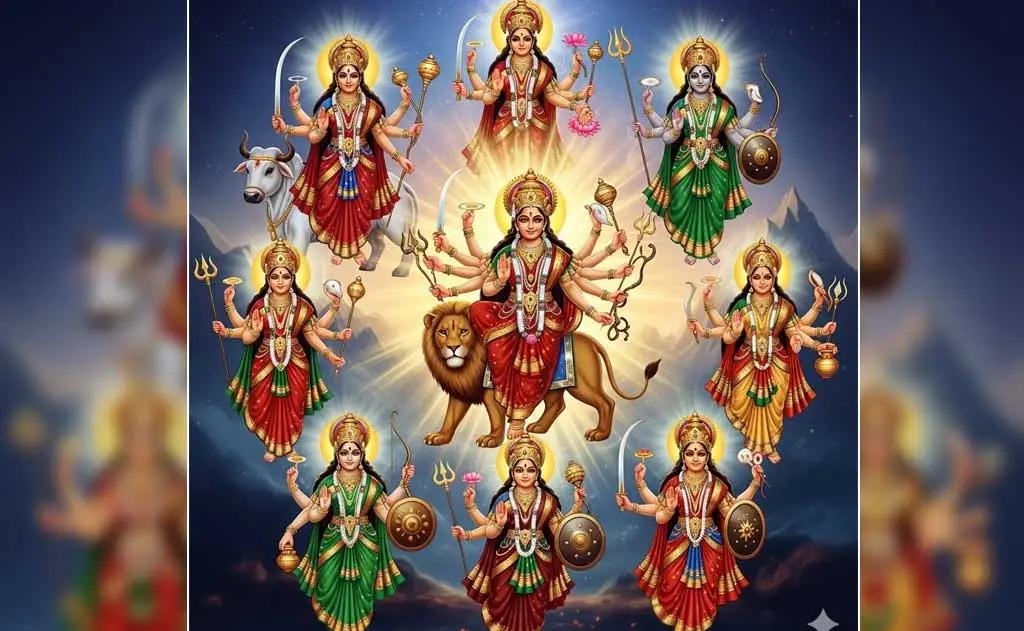
- If your child wants to talk about Navratri in class, a short story of Maa Durga, a picture of the nine forms or a dandiya stick makes a good show-and-tell. Check with the teacher first.
- If a weekday Garba night will run late, you may want to choose a weekend event for younger children.
- Tell the stories simply: the Goddess as a loving mother who protects goodness and gives courage.
Finding Garba, Dandiya and temple events
Short answer: Check your local Hindu temple or community organisation for its 2026 Navratri schedule, ideally on its official website or notice board. Many Garba and Dandiya nights abroad are held on weekends, so the event date may not match the tithi. Temples usually announce Ashtami, Navami and Dussehra programmes closer to the day.
Gujarati samaj groups, Bengali cultural associations for Durga Puja, Telugu groups for Bathukamma and South Indian temples for Golu and Ayudha Puja often publish their own programmes. If you are new to a city, temple volunteers are usually happy to help you find your community. We do not list events or prices; please confirm details directly with the organiser.
Fasting with a full-time job
Fasting practices vary by family, region and health, and fasting is never mandatory. Many working women abroad choose a partial fast: fruit and milk in the day and one sattvic vrat meal in the evening, or simply avoiding onion, garlic, grains or meat for the nine days. Batch-cooking vrat dishes on the weekend helps on busy days.
If you are pregnant, diabetic, elderly, on medication or unwell, or planning a fast for children, follow medical advice. Drink enough water, especially if you have a long commute.
Community, loneliness and looking after yourself
For many women abroad, Navratri brings memories of a mother's kitchen, a crowded pandal or a grandmother's songs, and it can feel lonely. That feeling is natural. A few gentle ideas:
- Invite one or two friends, from any background, for an evening aarti and prasad.
- Volunteer at your temple for an evening; it is a quick way to meet people.
- Start a small online group with friends in other cities to chant together on Ashtami.
- Record a parent or grandparent singing an aarti on a video call, so the family tradition stays with you.
- Rest. The Goddess is honoured by a steady, cheerful heart, not exhaustion.
Kanya Pujan abroad: inviting girls respectfully
Short answer: Kanya Pujan honours young girls as forms of the Goddess, commonly on Ashtami or Navami. Abroad, many families invite the daughters of friends, neighbours or temple families. Always ask the parents first, explain the custom simply, check for food allergies, keep it short and give a small gift. It is a loving custom, not an obligation.
- Ask well in advance, since Ashtami (18 October in the USA, Canada and the UK) falls on a Sunday this year and families make weekend plans.
- Explain that the girls' feet may be washed or touched with water and that they will receive food and a small gift; let parents and children say no without awkwardness.
- Offer familiar food alongside the traditional puri, chana and halwa, and check for nut, gluten or dairy allergies.
- If inviting girls is not possible, some families offer food at the temple or to a charity in the Goddess's name instead.
Frequently asked questions
When does Navratri 2026 start in the USA, Canada, UK and Australia?
Navratri 2026 begins on Sunday 11 October in all four countries, per Drik Panchang. In the USA, Canada and the UK, Drik lists Durga Ashtami on 18 October and Maha Navami on 19 October, with Dussehra on 20 October. In Australia, check Drik Panchang for your own city.
Can I do Navratri puja in the evening after work?
Yes. Many women abroad keep a short morning lamp and do the main puja, mantra and aarti in the evening. There is no rule that worship must be long or at one fixed hour for a home puja. For Ghatasthapana and other muhurats, check your local panchang.
Is it safe to light a diya in an apartment or rented home?
Use care. Many renters use an LED diya or electric lamp, which is a perfectly acceptable offering of light. If you light a real flame, place it on a metal plate away from curtains and smoke detectors, keep a window slightly open, and never leave it unattended. Check your lease or building rules.
Do I have to fast for Navratri if I work full time?
No. Fasting is never mandatory and practices vary by family, region and health. Many working women keep a partial fast, one sattvic meal, or simply avoid certain foods. If you are pregnant, diabetic, on medication or unwell, follow your doctor's advice first.
How do I find Garba or Dandiya events near me abroad?
Check your local Hindu temple or community organisation for its 2026 schedule, and look at their official website or notice board. Many events are held on weekends, so dates may differ from the tithi. Our country guides for the USA, Canada, the UK and Australia have more detail.
How can I do Kanya Pujan abroad if I have no young girls in the family?
Many families invite the daughters of friends, neighbours or temple families. Ask the parents first, explain the custom simply, keep it short, check food allergies, and offer a small gift. If it is not possible, some families do the puja symbolically or offer food at the temple instead.
Editor's note
Editor's note (6 October 2026): This page has been restored at its original address. India dates are from Drik Panchang, and Dussehra on Tuesday 20 October is also on the Government of India holiday calendar. Dates for the USA, Canada and the UK are from Drik Panchang's country listings; Australian readers should check Drik for their city. Time differences reflect daylight-saving rules in October 2026. Colours and fasting customs follow popular practice and vary by family. We do not list muhurat times, events or prices; please check your local panchang and your temple or community organisation.
Related guides
You might also like
Navratri Daily Routine for Women 2026: Morning Puja, Evening Prayer and a 9-Day Plan
Navratri 2026 for Women: Devi Worship, Daily Rituals, Colours, Fasting and Mantras (11–19 October)
Navratri Fasting Rules 2026: Vrat Food List, What to Eat and What to Avoid (11 to 19 October)