Ganga: A Symbol of Purity, Life, and Spiritual Devotion
In Hindu mythology, the Ganga is said to have descended from the heavens through the penance of King Bhagiratha to cleanse the souls of his ancestors.
In Hindu mythology, the Ganga is said to have descended from the heavens through the penance of King Bhagiratha to cleanse the souls of his ancestors. This celestial river flows from the sacred Himalayas, symbolizing purity and divine grace.
For countless Hindus, Ganga Jal (water from the Ganges) is considered holy and is often used in religious ceremonies. The river's waters are believed to:
Cleanse sins: Taking a dip in the Ganga is thought to purify one’s soul. Aid in liberation: Ritual immersion of ashes after cremation is believed to help the departed attain moksha. Bestow prosperity: Many pilgrims visit her banks, seeking blessings for health, wealth, and peace.
Spiritual and Cultural Importance of Ganga Maa
The riverbanks of the Ganga are dotted with countless pilgrimage sites and sacred temples, including:
Varanasi (Kashi): The spiritual capital of India, where evening aartis on the ghats create a mesmerizing atmosphere. Haridwar: One of the holiest cities where the Ganga enters the plains, revered for its cleansing properties. Rishikesh: Known as the yoga capital of the world, attracting seekers of peace and enlightenment.
Beyond religious importance, the Ganga supports millions of livelihoods, including agriculture, fisheries, and tourism.
The Sacred Bond Between Ganga and Kumbh Mela
The Kumbh Mela, the largest religious gathering on Earth, owes its existence to Ganga Maa. Held every 12 years at the confluence of the Ganga, Yamuna, and the mythical Saraswati rivers (Triveni Sangam) in Prayagraj, it is a grand spiritual event attracting millions of pilgrims.
Key Rituals at Kumbh Mela:
Holy Dips: Pilgrims take a sacred dip in the Ganga, believing it washes away sins. Spiritual Discourses: Saints and sages deliver teachings, spreading knowledge and wisdom. Religious Processions: Grand parades of sadhus, ascetics, and devotees fill the air with devotion.
The Kumbh symbolizes the eternal flow of wisdom, purity, and spiritual awakening, with the Ganga at its very heart.
The Call to Protect and Rejuvenate Ganga Maa
Despite her divine status, Ganga faces serious environmental challenges, including pollution, deforestation, and waste disposal issues. Ensuring her preservation is both a spiritual duty and a practical necessity for future generations.
Steps to Protect the Ganga:
Reduce Pollution: Discourage waste dumping into the river. Promote Clean Energy Projects: Use eco-friendly practices in industries along the Ganga basin. Sustainable Pilgrimage Practices: Encourage responsible tourism and rituals during events like the Kumbh Mela.
By safeguarding Ganga Maa, we protect the very soul of Bharat and uphold the sacred tenets of Sanatana Dharma.
A Tribute to Ganga Maa
Ganga Maa is the eternal thread connecting Bharat's past, present, and future. Her waters nourish our land, cleanse our spirits, and inspire devotion in millions. Without her, Bharat would lose not just a river but its spiritual identity, its sages, sacred teerthas, and cultural essence.
Let us honor, protect, and cherish her, ensuring she flows pure and divine for all time to come.
Explore more spiritual insights at Hindutone and join us in celebrating India's timeless traditions.
The Puranic Narrative: How Ganga Descended from Svarga to Earth
The story of Ganga's descent, known as the Gangavataran, is told in full detail in both the Valmiki Ramayana (Bala Kanda, chapters 38–44) and the Srimad Bhagavatam (Skandha 9). King Sagara's sixty thousand sons, consumed by pride, were reduced to ash by the gaze of the sage Kapila. Without a proper ritual cleansing, their souls remained trapped between worlds, unable to attain moksha.
It was Sagara's descendant Bhagiratha who undertook fierce tapasya — first propitiating Brahma to release Ganga from the heavens, then entreating Shiva to receive her force upon his matted locks, the Jata, so that the earth would not shatter under her torrential descent. This act of Shiva is commemorated in his epithet Gangadhara, 'the bearer of Ganga.' The river thereafter followed Bhagiratha's chariot, and the path she traced became the sacred course of the Ganga across the subcontinent.
The Bhagiratha episode is not merely mythological narrative; it encodes a theology of intercession and devotion. Liberation of the ancestors was made possible not by their own merit but by the selfless effort of a living descendant — a teaching about the power of shraddha, filial piety, and persistent spiritual striving.
Ganga in Vedic and Tantric Scripture: Beyond the Puranic Story
Ganga is mentioned by name in the Rigveda (Nadistuti Sukta, RV 10.75), where she appears first in a list of sacred rivers running from east to west — a geographic and spiritual map of Vedic civilization. The hymn addresses her alongside the Sindhu, Saraswati, and Yamuna, establishing that reverence for these rivers predates the Puranic literature by many centuries.
In Tantric tradition, Ganga is identified with the sushumna nadi, the central channel of subtle energy in the human body. The Kashi Khanda of the Skanda Purana states that Ganga flows not only through the physical landscape but also through the crown chakra (Sahasrara) of the realized yogi. This is why Varanasi — situated on the banks of the physical Ganga — is simultaneously understood as a city existing within the inner geography of consciousness.
The Devi Bhagavata Purana further describes Ganga as a form of the Goddess herself, born from the feet of Vishnu (hence the name Vishnupadi) and flowing through three worlds — hence she is called Tripathaga, 'she who travels three paths': Svarga (heaven), Prithvi (earth), and Patala (the underworld), where she flows as the Bhogavati river.
The Ghats of Varanasi: Architecture of Devotion on Ganga's Banks
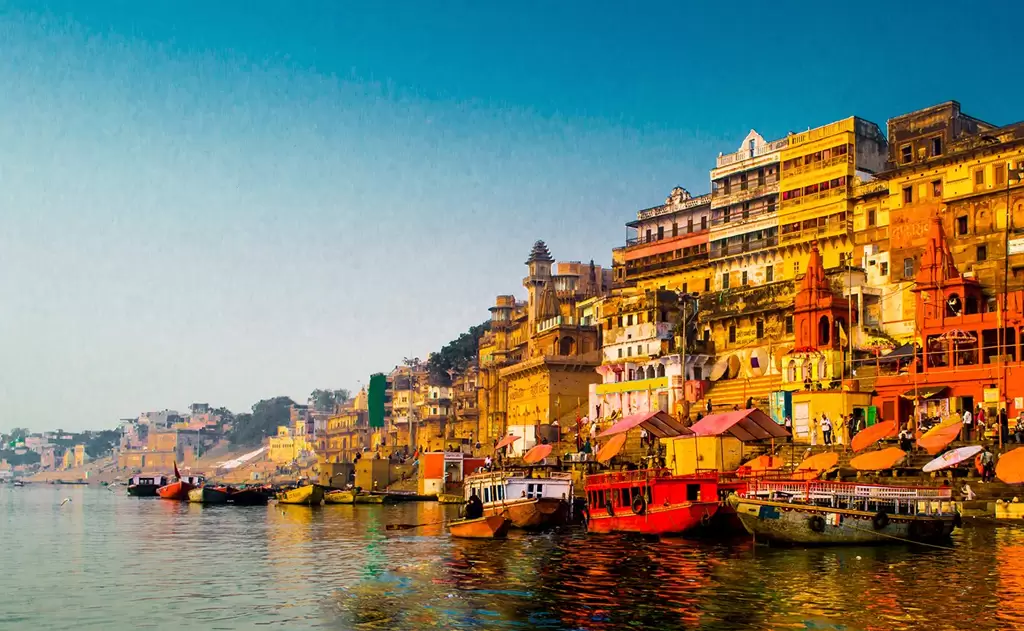
Varanasi, known in scripture as Kashi or Anandavana, contains eighty-four ghats stretching along the western crescent bank of the Ganga. Each ghat carries a distinct ritual identity. Dashashwamedha Ghat is the site of the famous Ganga Aarti performed every evening, named after the ten Ashwamedha yajnas said to have been performed there by Brahma. Manikarnika Ghat, considered the most sacred cremation ground in Hinduism, is believed to be the spot where Sati's earring (manikarnika) fell, and where cremation fires are said to have burned continuously for thousands of years.
Assi Ghat, at the confluence of the Ganga and the Assi stream, is traditionally the southern boundary of Kashi's sacred zone. Pilgrims undertaking the Panchakroshi Yatra — a circumambulation of Kashi's outer limits — begin and end their journey here. The Kashi Vishwanath Temple, dedicated to Shiva as the Lord of the Universe, stands just steps from the riverbank, reinforcing the inseparable bond between the city, the deity, and the sacred river.
Ganga Aarti: The Evening Ritual That Unites Fire, Water, and Devotion
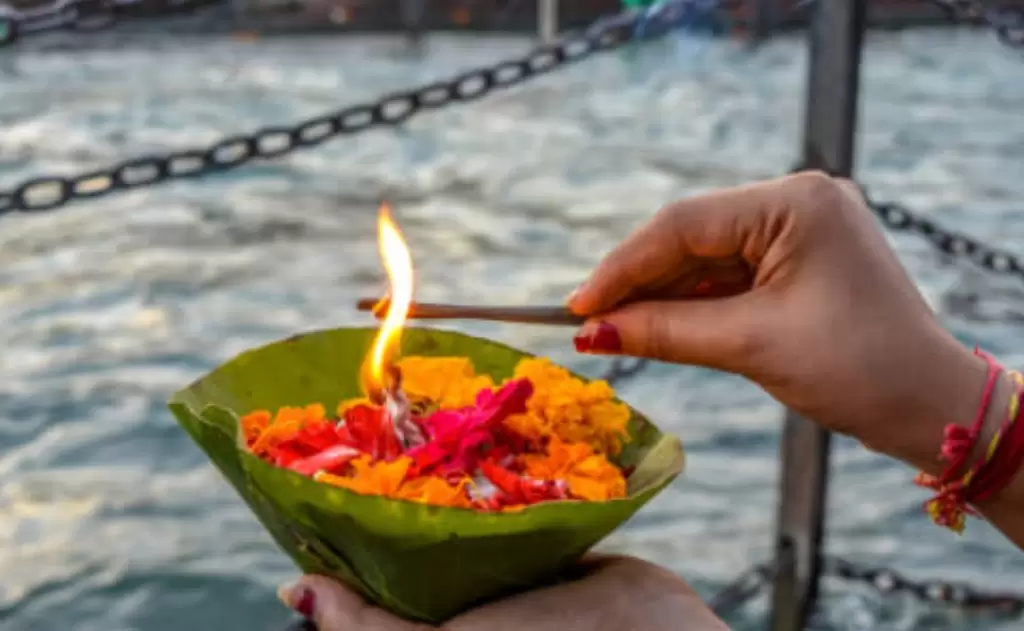
The Ganga Aarti performed nightly at Dashashwamedha Ghat in Varanasi and at Har Ki Pauri in Haridwar is one of the most visually and spiritually arresting rituals in the Hindu world. Priests known as Gangaputras — those who have inherited the right to perform this service — stand in formation along the ghat steps, each holding a large multi-tiered diya (oil lamp) called a panchamukhi or saptamukhi aarti lamp. The ritual follows a precise sequence: conch-blowing (shankha naad), camphor flame offerings (karpura aarti), incense, and the waving of yak-tail fans (chamara), all accompanied by Sanskrit mantras and devotional music.
The theological meaning of the aarti lies in the concept of naivedya and samarpana — offering the elements of fire and light back to the river-goddess who sustains all life. The Ganga is addressed directly through the Ganga Stotram, traditionally attributed to Adi Shankaracharya, whose opening verse 'Devi Suresvaree Bhagavati Gange' salutes her as the supreme goddess who grants liberation. Attending or even witnessing this aarti is considered meritorious, and thousands gather on the river's edge every evening to offer floating lamps (diyas) on leaf-boats, a practice called deepa visarjan.
Gangajal: Sacred Properties, Traditional Preservation, and Ritual Uses
Hindu tradition has long maintained that Gangajal does not putrefy even when stored for long periods, a property attributed to her divine nature and described in texts like the Mahabharata (Vana Parva). This claim has attracted scientific curiosity, and while HinduTone does not endorse specific scientific conclusions, it is worth noting that Gangajal is observed by traditional practitioners to remain ritually potable when stored in copper vessels — a practice aligned with Ayurvedic understanding of copper's purifying properties.
In ritual usage, Gangajal is indispensable across the life-cycle sacraments (samskaras). It is placed in the mouth of a dying person (antyesti preparation), used to sanctify the altar during any puja, sprinkled over prasad, and poured into the mouth of a newborn during the jatakarma samskara. Pilgrims traveling from distant parts of India often carry sealed copper or silver vessels of Gangajal back to their home temples, where it is mixed into the abhisheka of the presiding deity.
Haridwar, where the Ganga exits the Shivalik hills and enters the Gangetic plain, is the primary source from which Gangajal is collected for distribution across India. The spot called Har Ki Pauri — literally 'the footstep of Hari (Vishnu)' — is believed to bear the divine footprint and is the most auspicious collection point. During the month of Shravan, Kanwariyas (devotees of Shiva) carry freshly collected Gangajal on decorated wooden yokes across hundreds of kilometres to pour it over Shiva lingas at temples including Baidyanath Dham in Deoghar, Jharkhand.
Ganga as Eternal Mother: Her Role in Death, Ancestral Rites, and Moksha
In the Hindu understanding of death, the Ganga occupies a role unique among all sacred rivers. The Garuda Purana teaches that immersing the ashes (asthi visarjan) of the deceased in the Ganga, ideally at Prayagraj's Triveni Sangam or at Varanasi's Manikarnika Ghat, completes the soul's journey by dissolving the last material residue of the body into a medium directly connected to Vishnu and Shiva. Varanasi holds a special status: the Kashi Khanda asserts that Shiva himself whispers the Taraka Mantra ('Ram Nam') into the ear of every being who dies within the city limits, ensuring liberation regardless of prior karma.
The annual ritual of Pitru Paksha, a sixteen-day period in the Hindu lunar calendar dedicated to ancestral propitiation, sees millions converge on Gaya in Bihar and on the banks of the Ganga at Haridwar and Prayagraj to perform shraddha — offerings of water, sesame seeds, and barley made to the departed. This ritual, described in the Matsya Purana, is believed to satisfy the thirst of ancestors in the realm of Pitrs and release them toward higher realms.
The Ganga's identity as Ganga Mata — the Mother Ganga — thus transcends her function as a geographic feature. She is simultaneously the source of life (flowing from the Gangotri glacier at Gomukh in Uttarakhand), the sustainer of civilization along her course, and the final liberator of the soul. This triple function mirrors the Vedic understanding of the Divine Mother who creates, preserves, and ultimately dissolves all back into herself.
Also read: Ganga Stotram.
Frequently Asked Questions
Why is the Ganga considered sacred in Hinduism?
As commonly told, the Ganga descended from the heavens through King Bhagiratha's penance to cleanse the souls of his ancestors. She is revered as a symbol of purity and divine grace, flowing from the Himalayas.
How did Ganga descend to earth in the Gangavataran story?
As commonly told, Bhagiratha first propitiated Brahma to release Ganga from the heavens, then pleaded with Shiva to receive her force on his matted locks so the earth would not shatter. This is why Shiva is called Gangadhara, the bearer of Ganga.
What is Ganga Jal used for in Hindu rituals?
Ganga Jal is used to sanctify the altar during puja, sprinkled over prasad, and used in life-cycle sacraments (samskaras). Tradition holds that it stays ritually potable when stored in copper vessels.
When and where is the Ganga Aarti performed?
The Ganga Aarti is performed every evening at Dashashwamedha Ghat in Varanasi and at Har Ki Pauri in Haridwar. It includes conch-blowing, camphor flame offerings, incense and floating lamps on leaf-boats.
Why is Varanasi important on the banks of the Ganga?
Varanasi (Kashi) has eighty-four ghats, each with a distinct ritual identity. Manikarnika Ghat is considered the most sacred cremation ground, and the Kashi Vishwanath Temple stands just steps from the riverbank.
What is the link between the Ganga and the Kumbh Mela?
The Kumbh Mela is held every 12 years at the Triveni Sangam in Prayagraj, where the Ganga, Yamuna and the mythical Saraswati meet. Pilgrims take holy dips believing they wash away sins.
Share this with family and friends
Send it on WhatsApp, post it, or copy the link.
More from Spirituality
- Chilkur Balaji 'Visa Balaji' Temple: The 11 and 108 Pradakshina Custom Explained for NRIs
- Ekagrata (One-Pointedness): Yoga Concentration and Samyama Glossary
- Complete MBBS Once in Life: The Spiritual Meaning of Mahabharata, Bhagavatam, Bhagavad Gita & Ramayana
- Sri Medha Dakshinamurthy Swami Dhyanam | Meditation Sloka for Intelligence, Eloquence & Self-Realization
- What Is True Poverty? | Dharma Is the Greatest Wealth | Sanatana Dharma
You might also like
Hindu Rituals & Spiritual Practices for Modern Life: A Complete 2026 Guide
Kama Dahanam: A Tale of Love, Sacrifice, and Spiritual Discipline
Trees: Abodes of the Divine | Spiritual and Environmental Significance of Trees