The Divine Friendship of Krishna and Sudama – The Most Beloved Story of Akshaya Tritiya
"He did not come to ask for wealth. He came only to see his friend.And yet — the friend who is God gave him everything." Before the Story Begins — A Word About…
"He did not come to ask for wealth. He came only to see his friend.
"He did not come to ask for wealth. He came only to see his friend.
And yet — the friend who is God gave him everything."
Before the Story Begins — A Word About This Sacred Bond
There are stories that entertain.
There are stories that inspire.
And then there are stories that break you open — that reach into the deepest part of your heart and remind you what it means to love, to surrender, and to trust.
The story of Krishna and Sudama is that kind of story.
It is the story most intimately woven into the spirit of Akshaya Tritiya — because it is a living testimony to the very meaning of the word Akshaya. It shows us what happens when a soul offers the Lord everything it has, however small — and how the Lord, in His infinite grace, returns it multiplied beyond all imagination.
At HinduTone, we do not tell this story merely as mythology. We tell it as a mirror — so that you may see yourself in Sudama, and recognise Krishna in the grace that has quietly surrounded your life all along.
Come. Let us begin.
Part One — Two Boys, One Gurukul, One Friendship Born in God
Long, long ago, in the golden era when the earth still remembered the sound of divine footsteps, there was a gurukul — a forest school of sacred learning — presided over by the great sage Sandipani Muni.
To this gurukul came two boys from very different worlds.
One was Krishna — the son of Vasudeva, dark as the monsoon sky, eyes like lotus petals, with a smile that could dissolve mountains. Even as a child, something shimmered around Him — a quality the other boys couldn't quite name. They only knew that when Krishna was near, everything felt more alive, more beautiful, more whole.
The other was Sudama — the son of a poor Brahmin, slight and simple, with gentle eyes and a purity of heart so complete that even the forest birds seemed to trust him. He wore no ornaments. He had no royal lineage. He brought nothing to the gurukul except his sincerity and his love for learning.
The Day They Met
The two boys met on Sudama's first day at the gurukul.
The guru's wife — Mata Sushila — sent them both into the forest to collect firewood. The forest was deep and the afternoon sun was fierce. Midway through their task, the sky suddenly darkened. Rain came — not gently, but in great thundering sheets. The path home vanished. The two boys huddled together beneath a great banyan tree, shivering, with night falling around them.
Mata Sushila had packed a small pouch of roasted chickpeas (chana) for their journey. Sudama held it close. In the darkness, he considered eating it himself — but then he looked at Krishna, and something stopped him.
He offered the chana to Krishna.
Krishna ate with the delight of a child tasting nectar. They sat together through the stormy night — sharing food, sharing warmth, sharing stories — and by the time dawn broke and they found their way home, they were no longer two strangers.
They were friends. The kind of friends that are recognitions, not introductions — souls that have known each other across many lifetimes.
"This is how the greatest friendship in all the three worlds began — not in a palace, not in a ceremony — but in a forest, in a storm, with a handful of chickpeas offered in love."
Part Two — The Years Pass, The Worlds Diverge
Years passed in the gurukul. Krishna and Sudama learned the Vedas, the sciences, the arts of war and peace. They studied together, sang together, debated together. Their friendship deepened with each passing season.
But nothing in this world remains unchanged.
When their education was complete, the two friends parted ways — each carrying the other in his heart, each walking into a very different destiny.
Krishna's path led to Mathura, to Dwarka, to the great drama of the Mahabharata. He became King of Dwarka — a city of golden palaces and jewelled streets, a kingdom of unimaginable splendour. He became the charioteer of Arjuna, the beloved of the gopis, the Jagadguru — the teacher of the universe.
Sudama's path led to a small village, a thatched hut, and a life of beautiful, quiet poverty. He married a devoted woman named Susheela (also called Sushila). They had children. They lived on whatever came their way — sometimes a little, often nothing. Sudama spent his days in prayer, in teaching whatever small lessons he could offer neighbours, and in the quiet contemplation of the divine.
He never forgot Krishna.
Not for a single day.
Even as he watched his children go hungry, even as his home grew more threadbare, even as the years carved their lines into his face — Sudama held Krishna in his heart like a flame that never went out.
"Poverty could not touch what lived between them. Memory is the richest possession of a devoted heart."
Part Three — Susheela's Gentle Insistence
Years turned to decades. Sudama grew old in his poverty, but never old in his faith.
One year, the drought was long and the hunger was real. Susheela watched her children grow thin and her husband grow frail. She was not a woman who complained — but she was also not a woman who gave up.
One evening, as Sudama sat by their small lamp, eyes closed in quiet prayer, Susheela sat beside him.
"Prabhu," she said softly, "you have a friend."
Sudama opened his eyes and looked at her.
"A friend," she continued, "who rules over Dwarka. Who has more than enough for all the three worlds. I have heard it said that He is not just a king — He is the Lord Himself. And they say He loves His devotees as a mother loves her child."
Sudama was quiet for a long time.
"Go to Him," Susheela whispered. "Not for me. Not for the children. Go — simply to see your friend. Whatever He wishes to give, He will give. Whatever He does not give — that too will be His grace."
Something in Sudama stirred.
He had not allowed himself to think of going to Krishna. It felt presumptuous — as though he were using a sacred friendship for worldly gain. His pride as a Brahmin, his love as a friend, had kept him from ever asking.
But Susheela had not asked him to beg. She had asked him to go.
There is a difference.
"Go to Him simply to see your friend" — in these words, Susheela gave her husband the most profound spiritual teaching: approach the Divine not with a shopping list, but with a loving heart."
Sudama decided to go.
Part Four — The Poha in the Torn Cloth — The Most Sacred Offering in All the Universe
The question now was — how does a poor man visit a king?
Sudama had nothing to bring as a gift. In the tradition of the time, one did not visit a dear friend's home empty-handed. But what could he offer Krishna — who owned everything, who lacked nothing?
Susheela had an idea.
She went to the neighbours and asked — with great humility — for a small gift of poha (flattened rice, also called pauwa or aval). The neighbours gave willingly. She gathered perhaps a handful — just a few morsels — and tied them in a small piece of worn cloth.
It was nothing.
And yet it was everything.
Because it was offered in love. Because it was the best they had. Because in that small bundle of flattened rice, there was no pretension, no calculation — only the pure, aching love of a poor woman for her husband's famous friend, and a poor man's offering to the Lord of the universe.
Sudama tied the bundle inside his dhoti, close to his heart, and began walking toward Dwarka.
"What you offer God does not matter as much as how you offer it. The hand that gives from emptiness with a full heart is dearer to the Lord than the hand that gives from fullness with an empty heart."
The walk to Dwarka was long. Sudama's feet ached. His sandals were worn. The roads were dusty and the sun was unforgiving. But with every step, his heart grew lighter — because every step was bringing him closer to Krishna.
He didn't think about his poverty.
He didn't rehearse speeches about his need.
He only thought of Krishna's face — and smiled.
Part Five — The Arrival at Dwarka — When God Ran to the Door
Dwarka.
Sudama stood at the gates of the golden city and looked up. He had heard stories — but stories had not prepared him for this. Towers that seemed to touch the sky. Streets paved with what appeared to be light itself. Soldiers, elephants, chariots, merchants, musicians — all moving in a great, golden flow.
And he — a barefoot Brahmin in a worn dhoti, carrying a small bundle of flattened rice — stood at the threshold.
The guards stopped him.
"Who are you?" they asked. "What is your business here?"
"I am Sudama," he said simply. "I am a friend of Krishna."
The guards looked at each other. A friend of the King? This man?
But something in Sudama's eyes — some quiet certainty, some light that poverty hadn't managed to dim — made them hesitate. They sent word inside.
And then something extraordinary happened.
Krishna heard the name — and He ran.
Not walked. Not summoned a servant. Not sent a response.
He ran — through the corridors of His golden palace, past astonished ministers and wide-eyed servants — ran to the gate where His old friend stood.
Those who were present that day would speak of it for the rest of their lives. The King of Dwarka, the Lord of the universe — running to embrace a poor Brahmin at His gate.
Part Six — The Embrace That Shook the Heavens
When Krishna saw Sudama, He stopped.
For a moment, neither spoke.
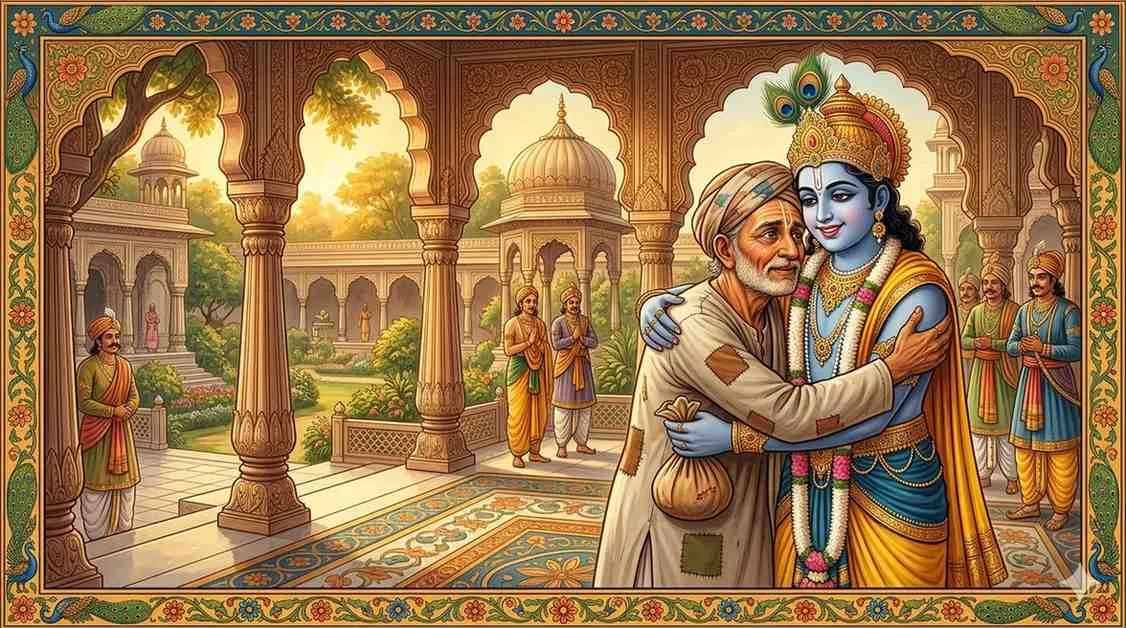
And then Krishna stepped forward and took his old friend in His arms — and held him the way the ocean holds the shore, completely, endlessly, without hesitation.
The servants and courtiers who watched were stunned into silence.
Krishna was weeping.
The Lord of the universe — who had lifted Mount Govardhan on His little finger, who had spoken the Bhagavad Gita on the battlefield of Kurukshetra, who commanded countless worlds — was weeping at the sight of His poor friend.
He led Sudama inside, seated him on His own throne, and called for Rukmini Devi — His divine queen — to personally wash Sudama's feet.
Rukmini — the most exalted woman in all the three worlds, the goddess of royal grace — came forward and bathed the cracked, dusty feet of a poor Brahmin. She did it with the same care and reverence as a devotee washes the feet of a deity.
Because she understood what Krishna understood.
In Sudama, Krishna saw every devoted soul that has ever walked toward God with love and empty hands.
"The moment Sudama entered Dwarka, heaven itself leaned down to watch. For it is a rare sight — a man who comes to God asking nothing, and a God who gives everything."
Krishna then sat beside Sudama, fed him with His own hands, and they talked — the way only two people can talk when time has passed but the love hasn't.
They spoke of the gurukul. Of the storm. Of the banyan tree. Of the chana they had shared as boys. Of teachers and teachings. Of all the years that had passed.
Part Seven — The Poha — The Most Tender Moment
As they spoke, Krishna's eyes drifted to the small bundle tied close to Sudama's chest.
"What is that, my friend?" Krishna asked.
Sudama's face fell. The bundle — which had seemed precious when Susheela tied it — now felt unbearably small. A handful of plain, dry flattened rice. For the King of Dwarka. He was ashamed.
He hid it slightly with his hand.
"Nothing, Kanha," he said softly. "It is nothing."
But Krishna's eyes were gentle and knowing.
"Nothing?" He reached forward and took the bundle from Sudama's hands — easily, lovingly, the way you take something precious from a child who doesn't know how precious it is.
He unwrapped the worn cloth.
He looked at the small mound of plain poha.
And His face — the face that commands the cosmos — lit up with absolute delight.
"Mitra!" He exclaimed. "You have brought me my favourite! You have brought me the offering of your heart!"
And then — in front of all His queens and all His court — the Lord of the universe ate the poha with both hands.
One fistful.
Then another.
Rukmini Devi — watching from nearby — quietly reached forward and stopped His hand before the third. She had understood something: every fistful of that humble offering that Krishna consumed was being converted into immeasurable divine grace flowing back toward Sudama's home. She stopped at two — because two fistfuls were already more than enough to transform Sudama's entire world.
"He who had tasted the nectar of Vaikuntha, who had drunk from the lips of devotion across all the three worlds — ate dry, plain poha with the joy of a child. Because it was given in love. And to God, love is the only flavour."
Tears rolled down Sudama's face.
He had come with nothing and had somehow — in this moment — given the Lord of the universe something that pleased Him completely.
Part Eight — The Night in Dwarka — No Question Asked, No Boon Sought
That evening, Sudama was given a chamber fit for royalty. He bathed in perfumed water. He was dressed in fine garments. He ate at Krishna's table.
And all through the night, as the two friends talked and laughed and remembered — Sudama never asked.
Not once.
Not for gold. Not for a house. Not for food for his children. Not for relief from poverty.
Every time his mind moved in that direction, his heart pulled it back. I have not come to ask. I have come to love. Whatever He wishes — He will give. Whatever He does not give — I will return to my hut grateful for this one night.
This is the spiritual pinnacle of the entire story. This is the moment that makes Sudama not just a poor man, but a Maha Bhakta — a great devotee.
He had complete faith. Complete surrender. Complete love without expectation.
And Krishna — who knows every thought that crosses every mind — saw all of this.
He saw Sudama's restraint.
He saw Susheela's faith.
He saw the children sleeping hungry.
He saw the cracked walls of the hut.
He saw decades of devotion lived in quiet poverty.
And He decided — without being asked — to give.
Part Nine — The Journey Home — The Greatest Surprise in Devotional History
The next morning, Sudama bid farewell to his dearest friend.
Krishna embraced him one last time. His eyes held something — some warmth, some secret, some smile that Sudama couldn't quite read.
Sudama walked away from Dwarka the same way he had arrived — on foot, wearing simple clothes, with an empty bundle.
But something was different now.
His heart was full. Not with gold or grain — but with the memory of Krishna's face, Krishna's tears, Krishna's laughter, Krishna's joy at the poha.
This is enough, Sudama thought, walking along the dusty road. I have seen my friend. This alone was worth a lifetime.
He didn't even notice, at first, that the road was changing.
The familiar fields of his village were there — but somehow, they looked different. Greener. More luminous. As though the light had changed.
He rubbed his eyes and walked on.
And then he stopped.
Where his thatched hut had stood — there was now a palace.
Not a large palace. Not a Dwarka. But a beautiful, gracious home — strong and spacious, with clean courtyards, flowering trees, and an open door.
And standing at that door — Susheela — dressed not in worn cotton but in a simple, clean saree, her face shining with a peace he hadn't seen in years.
She ran to him.
"Prabhu!" she cried. "What happened? Look — look what has happened while you were gone!"
Sudama looked around — slowly, carefully, barely trusting his eyes.
The hut was gone. The poverty was gone. The children — well-fed, well-clothed — came running to embrace him.
And yet — no one had seen anyone come. No cart arrived with treasure. No messenger appeared from Dwarka. No explanation. No announcement.
Krishna had given everything — silently, secretly, while Sudama's back was turned — without making His friend feel like a recipient of charity.
This is the grace of the Lord who loves with absolute dignity.
"He did not send gold. He transformed the home itself. He did not make Sudama a wealthy man — He restored his life to wholeness. And He did it without Sudama ever having to ask."
Sudama stood in his new courtyard, and he understood.
The two fistfuls of poha.
Every grain — returned a thousandfold.
Not because Sudama asked. Not because he bargained or prayed with conditions. But because he came with love, offered what little he had, and trusted the rest to God.
He sat down in his courtyard, looked up at the sky, and folded his hands.
He did not say "thank you for the house."
He said — "Thank you, Kanha. Thank you for letting me see Your face."
The Connection to Akshaya Tritiya — Why This Story Lives on This Day
The story of Krishna and Sudama is eternally associated with Akshaya Tritiya because it is the greatest living example of what this sacred day means.
Akshaya — that which does not diminish.
Sudama's offering of poha was the most diminished thing imaginable — a few grains of flattened rice, tied in a torn cloth. And yet, because it was offered on this sacred day with a pure heart, it became Akshaya — it multiplied into a lifetime of abundance.
This is the promise at the heart of Akshaya Tritiya:
"What you give on this day — however little — will be received by the Lord as though it were everything. And what He gives in return is beyond all calculation."
The story also teaches us that the real gift Sudama brought was not the poha.
It was his friendship. His love without expectation. His willingness to be vulnerable — to walk to his friend's door with empty hands and a full heart.
And in doing so, he became an eternal symbol of the highest bhakti — devotion that does not depend on outcome.
Lessons From the Story — What Sudama Teaches Every Devotee
[image: 🙏] 1. Come to God as a Friend, Not a Petitioner
Sudama didn't compose a prayer. He didn't come with a list. He came as a friend visits a friend. The Divine responds most deeply to those who approach with love, not transaction.
[image: 🌾] 2. Offer What You Have, Not What You Wish You Had
The poha was humble. The intention was pure. God does not weigh offerings by their market value — He weighs them by the love they carry.
[image: 🤫] 3. Trust Without Demanding to See the Result
Sudama asked for nothing. He didn't monitor the outcome. He simply loved and let go. This is the supreme spiritual practice — saranagati (total surrender).
[image: 💛] 4. God's Grace Often Arrives in Your Absence
Sudama's home was transformed while his back was turned. Sometimes, the blessings we seek are already being arranged by the universe — precisely because we stopped chasing them.
[image: 🌊] 5. Real Wealth Is the Experience of Divine Love
Sudama's first response upon seeing his transformed home was not joy at the riches — it was gratitude for having seen Krishna's face. This is the teaching of a lifetime.
A Devotional Reflection — For Every Soul Who Has Walked to God Empty-Handed
How many of us are Sudama?
Walking the long road to the Divine — feeling inadequate, feeling poor, feeling that what we have to offer is too small, too plain, too broken to be worthy of God's attention?
How many of us hold our small bundle close to our chest — ashamed of our offering — and say, "It is nothing, Lord. Never mind."
Akshaya Tritiya asks us to untie that cloth.
To place whatever we have — our grief, our love, our imperfect prayer, our worn-out hope — in the hands of the One who receives everything as though it were gold.
Because to God, your sincere offering is always the most precious thing in the room.
And just as Krishna ran to the door when He heard Sudama's name — He runs to you too, the moment you take even one step toward Him.
"You do not have to arrive at God's door wealthy. You do not have to arrive perfect. You only have to arrive — with love. The rest is His."
Akshaya Tritiya Ritual — Honouring the Spirit of Sudama
On this Akshaya Tritiya, we invite you to bring the spirit of Sudama into your worship:
- [image: 🌾] Offer poha to Lord Krishna — a handful of flattened rice, sweetened with jaggery or plain, placed lovingly before His image. In this simple act, you re-enact the most sacred offering in devotional history.
- [image: 💛] Give food to the hungry — in the tradition of this day, feed someone who is genuinely in need. This is Sudama's offering reversed — you become the Lord's hands.
- [image: 📿] Chant the Sudama Stotra or Krishna's names — 108 repetitions of "Om Namo Bhagavate Vasudevaya" creates a vibrational field of grace around your home.
- [image: 🪔] Light a lamp for a friend — Akshaya Tritiya celebrates friendship as divine. Light a lamp in gratitude for the true friends in your life.
- [image: 🌿] Write a letter of gratitude to God — not a list of requests. Just thanks. For what you have. For what you are. For all that has quietly, invisibly been arranged for you.
Closing — The Story That Never Ends
The story of Krishna and Sudama is called Akshaya for a reason.
It does not end.
Every year on Akshaya Tritiya, it is told again — in temples, in homes, in the hearts of mothers who tell it to their children, in the quiet of a devotee's prayer. And each time it is told, it gives something new. To a child, it teaches friendship. To a young person, it teaches humility. To someone struggling, it teaches trust. To someone grieving, it teaches that God's love is not contingent on our prosperity or our perfection.
This story is the living proof that devotion, when it is pure, is never wasted.
Not a grain of it.
Not even a handful of poha.
May this Akshaya Tritiya remind you — as it reminds us — that you are already seen. Already loved. Already held in the hands of the One who once ran to the door at the sound of His friend's name.
[image: 🙏] Jai Shri Krishna. Akshaya Tritiya ki Shubhkamnayein.
Explore more devotional stories, sacred narratives, and spiritual wisdom at HinduTone.com — where every story is a path to the Divine.
Frequently Asked Questions
What is the story of Krishna and Sudama?
Sudama, Krishna's poor childhood friend, visited him with only a humble handful of beaten rice, too shy to ask for help. Krishna received him with overwhelming love and, unasked, blessed him with boundless prosperity.
Why is this story linked to Akshaya Tritiya?
Akshaya means 'that which never diminishes'. Sudama's tiny, sincere offering was returned multiplied beyond imagination — showing that on Akshaya Tritiya the smallest devotion offered with love yields eternal, ever-growing fruit.
What lesson does the story teach?
That the Lord values the devotion behind a gift, not its size; that true friendship and surrender ask for nothing; and that grace flows freely to the humble heart. Giving without expectation is the surest path to abundance.
How can devotees honour it on Akshaya Tritiya?
Offer simple food and charity to the needy, worship Krishna and Lakshmi-Vishnu, and reflect on humility and selfless giving. Many begin new, virtuous ventures on this day, trusting that good begun now will grow and never fade.
You might also like
The Story Behind Akshaya Tritiya – Why It's Called Eternal Day
Krishna Avatar — The Eighth Incarnation of Vishnu: Bhagavad Gita, Mahabharata, Vrindavan Leelas & Eternal Wisdom for 2026
Hare Krishna Maha Mantra: Meaning & Benefits