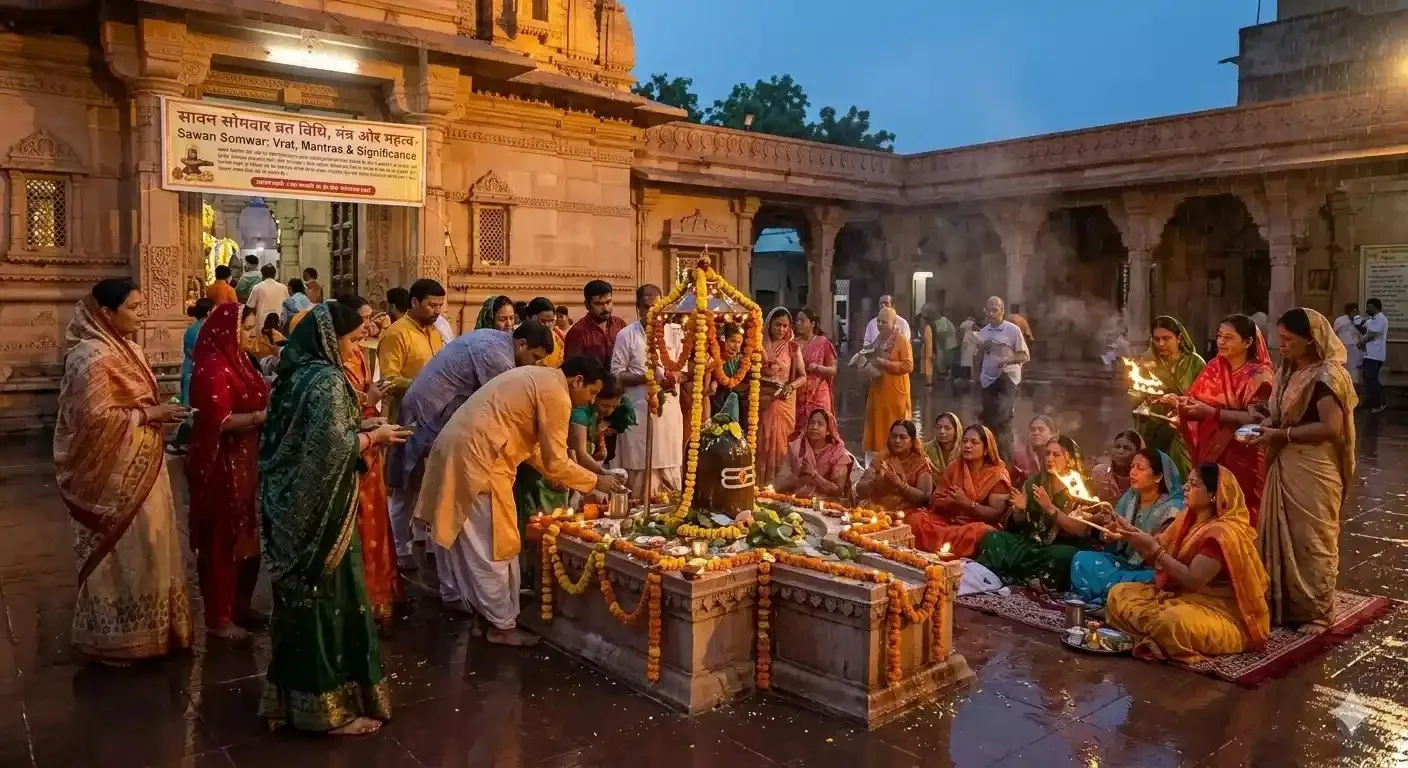
Om Namah Shivaya: 108 Times Chanting Benefits & Method — Complete Panchakshara Mantra Guide
Complete guide to Om Namah Shivaya — the five-syllable Panchakshara Mantra. Sanskrit + Roman + word-by-word meaning, cosmic significance, 108-times tradition explained, step-by-step chanting method, scientific research, NRI guide, FAQ.
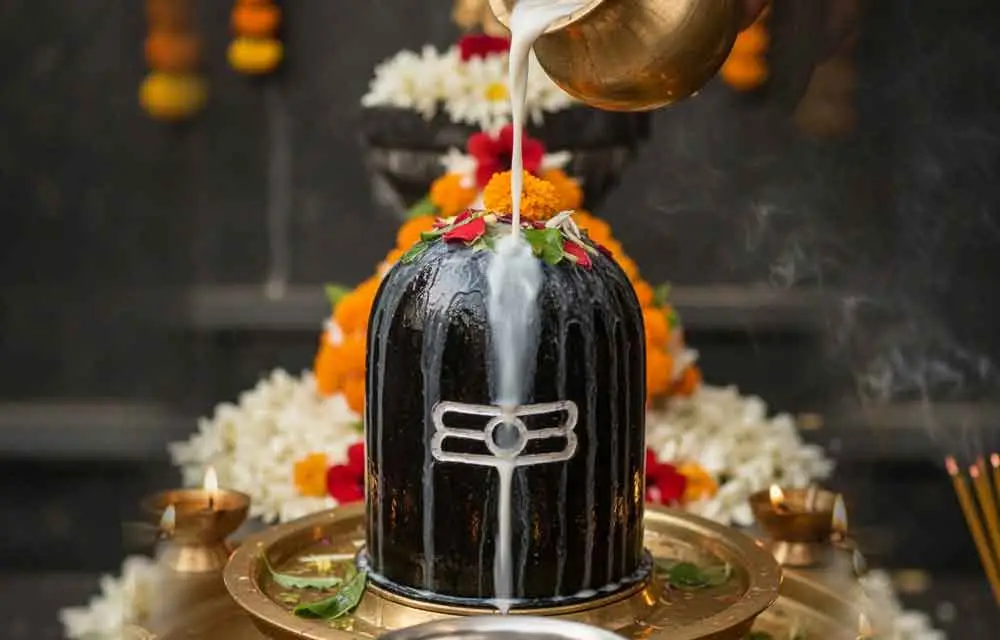
Complete guide to Om Namah Shivaya — the five-syllable Panchakshara Mantra. Sanskrit + Roman + word-by-word meaning, cosmic significance, 108-times tradition explained, step-by-step chanting method, scientific research, NRI guide, FAQ.
Of all the mantras in Sanatana Dharma, none is more universally chanted — by saints in Himalayan caves, by householders in Indian villages, by NRI families on Monday mornings, by yogis at the start of every asana practice — than the simple, profound, five-syllable Panchakshara Mantra: "Om Namah Shivaya." Translated as "I bow to the auspicious one — Lord Shiva," this mantra captures the entirety of Shaivite devotion in a single breath.
This complete HinduTone guide covers everything about Om Namah Shivaya — the meaning of each syllable, the cosmic significance of the five letters (Na-Ma-Si-Vā-Ya), the 108-times chanting tradition, why 108 is sacred, how to use a Rudraksha mala, best times to chant, modern scientific research, regional variations, NRI practice guide, and answers to the most frequently asked questions.
🔱 Om Namah Shivaya 🔱
The Mantra
Sanskrit
ॐ नमः शिवाय
Roman Transliteration
Om Namah Shivaya
Pronunciation Guide
- Om (ॐ) — "Aum" — extended A-U-M sound; let it resonate in your chest, throat, and head
- Namah (नमः) — "Na-mah" — emphasis on "mah", the "h" is a soft visarga (breath)
- Shivaya (शिवाय) — "Shi-vā-ya" — three syllables with a long "ā" in the middle
The complete chant: O-mm Na-mah Shi-vā-ya — total of 5 sacred syllables (panch-akshara) preceded by the primordial Om.
Word-by-Word Meaning
- Om (ॐ) — The primordial sound; the cosmic vibration from which all creation emerges
- Namah (नमः) — "I bow / I salute / I offer reverence"
- Shivaya (शिवाय) — "To Shiva" — the auspicious one, the supreme reality
"Om. I bow to Lord Shiva."
In just five syllables, the devotee acknowledges the cosmic Om, performs the act of surrender (bowing), and dedicates that surrender to Lord Shiva — the auspicious, the formless, the supreme. This is the entire essence of Bhakti yoga compressed into a mantra a child can learn in one minute.
The Cosmic Significance of the Five Syllables
The Panchakshara Mantra is not just a name — it is a cosmological formula. Each of the five syllables (Na-Ma-Si-Vā-Ya, the actual Panchakshara) corresponds to one of the five elements (Pancha-bhuta), to a specific finger of the hand, to a cardinal direction, and to a particular aspect of Shiva's grace.
- Na (न) — Earth element, the thumb, root chakra, gross body, Shiva's "Ishana" face
- Ma (म) — Water element, the index finger, sacral chakra, life force, Shiva's "Tatpurusha" face
- Si (शि) — Fire element, the middle finger, solar plexus, mind, Shiva's "Aghora" face
- Vā (वा) — Air element, the ring finger, heart chakra, vital breath, Shiva's "Vamadeva" face
- Ya (य) — Space (ether) element, the little finger, throat chakra, consciousness, Shiva's "Sadyojata" face
When a devotee chants "Om Namah Shivaya" 108 times, they are simultaneously activating all five elements, all five chakras, all five fingers (the body's subtle energy channels), all five directions, and all five faces of Shiva — a complete cosmological invocation.
Why 108 Is Sacred
The number 108 is the most sacred number in Hindu, Buddhist, and Jain traditions — and the standard count for a single mala (rosary) round of chanting. The reasons for its sanctity span astronomy, anatomy, and metaphysics:
- Astronomy — The diameter of the Sun is ~108 times the Earth's diameter; the distance from Earth to Sun is ~108 Sun diameters; the distance from Earth to Moon is ~108 Moon diameters
- Sanskrit — There are 54 letters in Sanskrit; each has a masculine (Shiva) and feminine (Shakti) form; 54 × 2 = 108
- Astrology — 12 zodiac signs × 9 planets = 108; or 27 nakshatras × 4 padas = 108
- Ayurveda — 108 marma (vital) points in the human body
- Meditation — 108 sacred sites in India (the Divya Desams of Vishnu); 108 Upanishads
- Numerology — 1 (one) represents Brahman (the absolute), 0 (zero) represents emptiness/maya, 8 represents infinity — together 108 represents the union of the absolute, the relative, and the eternal
Chanting any sacred mantra 108 times completes one cosmologically significant round. A standard Rudraksha mala has exactly 108 beads (plus a "meru" or "guru" bead at the top) for this reason.
How to Chant — Step-by-Step Method
Preparation
- Take a bath and wear clean, preferably white clothes
- Sit on a clean asana (yoga mat, blanket, wooden plank, or kusha grass mat) facing East or North
- Light a ghee or sesame oil diya and one stick of natural incense
- Place a Shiva Linga or image of Lord Shiva before you
- Apply vibhuti (sacred ash) and a small kumkum mark on your forehead
- Take three deep breaths through both nostrils to calm the mind
- Hold a Rudraksha mala in your right hand (the gold standard for Shiva mantras; a Tulsi mala is acceptable if Rudraksha is unavailable)
Holding the Mala Correctly
Tradition dictates the precise way to hold and operate the mala:
- Right hand only — the mala is held in the right hand; left hand is considered impure for mantra japa
- Position — between the thumb and middle finger; the index finger represents ego and is therefore not used
- Direction — start at the bead next to the Meru (guru) bead and move bead-by-bead toward the Meru
- Movement — pull each bead toward you with the thumb; the chant should complete on each bead, and the bead should move only after the chant completes
- Crossing the Meru — never cross the Meru bead; when you reach it, turn the mala around and start back the other direction for the next round
- Drape — keep the mala covered with a cloth (mala thaila) when not in use; do not let it touch the floor or other impure objects
The Chanting Process — 108 Times
- Take Sankalpa (declaration): "I, [your name], chant the Panchakshara Mantra 108 times for [purpose — peace, health, family, spiritual progress, liberation]"
- Chant "Om Namah Shivaya" once aloud as an invocation
- Begin japa — chant the mantra slowly and clearly with each bead
- Maintain steady rhythm; close your eyes if it helps focus; keep spine straight
- Let the chant fill your awareness — push out wandering thoughts gently as they arise
- When you reach the 108th bead (just before the Meru), pause for 30 seconds in silence
- Visualize Lord Shiva's blessings flowing into you from His third eye
- Bow to the Shiva Linga and chant "Om Shanti Shanti Shantih" three times to conclude
- Dedicate the merit: "May all beings benefit from this devotion. May all be happy. May all be free from suffering."
The Three Levels of Practice
Vaikhari Japa (Audible Chanting)
At the first level, chant the mantra aloud at moderate volume. The sound vibration alone carries spiritual potency. Recommended for the first 6-12 months. The acoustic resonance of "Om Namah Shivaya" in the chest cavity is itself a form of meditation.
Madhyama Japa (Whispered Chanting)
At the intermediate level, whisper the mantra — soft enough that only you can hear it, but with active lip and tongue movement. Builds inner focus. Recommended for years 1-3 of practice.
Manasika Japa (Mental Chanting)
At the advanced level, chant entirely in the mind — no lip movement, no audible sound. The vibration becomes purely internal. The mantra and the meditator merge. This is the deepest form, said to grant the merit of all three combined.
When to Chant
Best Times of Day
- Brahma Muhurta — 4:00-6:00 AM, the most spiritually powerful window of the day
- Sunrise — auspicious for setting positive intention for the day
- Pradosh Kala — 1.5 hours before sunset to 1.5 hours after sunset, especially on Pradosham days
- Midnight (Nishita Kala) — especially on Maha Shivratri
- Bedtime — chanting before sleep brings peaceful, devotional dreams
Best Days of the Week
- Monday (Somavar) — most sacred day for Lord Shiva; ideal for intensive 1008-times chanting
- Pradosham (13th lunar day) — twice monthly
- Maha Shivratri — once yearly, all-night chanting
- Saturday — for relief from Shani Dosha
- Daily — establishing a continuous daily practice is the foundation of any sadhana
How Many Times
- Minimum daily — 5 times (one minute of practice; suitable for absolute beginners)
- Standard daily — 11 times (the most common count for busy lives)
- Regular sadhana — 108 times (one mala) daily
- Deep practice — 1008 times daily for 40-day cycles
- Special occasions — 100,000 times during a Purascharana (intensive spiritual retreat); 1.25 crore times for a Maha-Purascharana
Benefits of Chanting Om Namah Shivaya 108 Times Daily
Spiritual Benefits
- Direct connection with Lord Shiva — the most accessible deity, Bholenath
- Destruction of accumulated sins (papa-nashanam)
- Steady progress toward moksha (liberation)
- Awakening of the dormant divine potential (Kundalini, in advanced sadhakas)
- Recognition of the inner Shiva — the formless, immortal Self
- Detachment from ego and worldly desires
- Deep, abiding inner peace independent of external circumstances
Mental Benefits
- Reduction of anxiety, worry, and mental restlessness
- Improved focus and concentration
- Better sleep quality and reduced insomnia
- Emotional resilience during difficult periods
- Sharper memory and cognitive function
- Reduction of negative thought patterns
- Greater empathy and compassion toward others
Physical Benefits
- Lower cortisol (stress hormone) levels — verified by clinical research
- Better cardiovascular health — improved heart rate variability
- Stronger immune system — fewer minor illnesses
- Improved breathing patterns — natural pranayama embedded in the chanting
- Reduced blood pressure in regular practitioners
- Better digestion and energy levels
Worldly Benefits
- Removal of obstacles in important undertakings
- Family harmony and reduced household friction
- Career advancement through increased clarity and decisiveness
- Marital harmony — couples who chant together report stronger bonds
- Protection from negative influences, evil eye, and black magic
- Increased financial stability (especially when chanted during Lakshmi puja times)
- Healing of relationships with parents, children, and spouses
Modern Scientific Research
Beyond scriptural authority, modern research has documented measurable effects of mantra chanting:
- A 2019 study in the Indian Journal of Psychiatry found that 20 minutes of daily mantra chanting reduced cortisol levels by 28% over 8 weeks
- Brain imaging studies (NeuroImage, 2020) showed that mantra meditation activates the default mode network — the brain area associated with self-awareness and inner peace
- Heart rate variability (HRV) — a key marker of autonomic nervous system health — improved by an average of 17% in subjects practicing daily mantra japa over 12 weeks
- Telomere length (a biomarker of cellular aging) was preserved better in long-term mantra practitioners — suggesting actual anti-aging effects
- Anxiety and depression symptoms reduced by 35-45% in clinical trials where mantra chanting supplemented standard treatment
While these findings don't prove the spiritual claims of mantra tradition, they establish that the practice produces measurable improvements across multiple physiological and psychological systems.
Common Mistakes to Avoid
- Chanting mechanically without devotion — the mantra needs your heart, not just your mouth
- Counting wrong — use a mala properly; don't shortcut the counting
- Stopping when life improves — the protection comes from consistent ongoing devotion
- Comparing your practice with others — everyone's path is unique
- Treating the mantra as a magic spell — it is a spiritual practice, not a quick fix
- Chanting after non-vegetarian food or alcohol on the same day — disrespectful to the practice
- Crossing the Meru bead on the mala — turn the mala instead
- Letting the mala touch the floor or impure objects
- Skipping practice during difficult times — those are exactly when the mantra is most needed
Regional Variations Across India
North Indian Tradition
North Indian Shaivites chant "Om Namah Shivaya" with prominent emphasis on the Om — extending it for 2-3 seconds before the rest of the mantra. Common during Sawan Mondays (Shravan month) and Maha Shivratri. The "Bol Bam" tradition in Bihar and UP combines Om Namah Shivaya with the Kanwar Yatra (water pilgrimage from Ganga to Shiva temples).
South Indian Tradition
Tamil Shaivism considers the Panchakshara (Na-Ma-Si-Vā-Ya, the five letters excluding Om) as the supreme mantra. Saint Thiru-jnana-sambandar composed entire hymns dedicated to it. Telugu and Kannada Shaivites use the mantra extensively in daily abhishekam at home and temple. Kerala's Sopana Sangeetham tradition has unique melodic renderings of the mantra.
Kashmiri Shaivism
Kashmiri Shaivism, the most philosophically refined Shaivite school, treats "Om Namah Shivaya" as a portal into the recognition of one's own innermost identity as Shiva. The mantra is layered with Trika (threefold) interpretations and is central to advanced spiritual practices.
Bengal & Eastern India
Bengali Shaivites combine Om Namah Shivaya with the Tara mantra in some Tantric traditions. Odisha's Lingaraj temple has unique mantra-recitation patterns that integrate Vaishnava and Shaiva elements.
For NRI Hindus — Daily Practice Worldwide
Om Namah Shivaya transcends geographic boundaries. NRI Hindus across the USA, UK, Canada, UAE, Australia, Singapore, and elsewhere chant the mantra with full devotion, often in conditions that ancient devotees never imagined.
- Morning commute — many NRIs play recordings of Om Namah Shivaya during their drive to work
- Bedtime practice — 11 chants before sleep brings peaceful dreams
- Family practice — teach children from age 4-5; they grow up with Shiva as a familiar friend
- Group chanting on Mondays — most Hindu communities in NRI hubs hold weekly group sessions
- During major life events — births, illnesses, deaths, marriages — the mantra is the universal Hindu prayer
- Apps and recordings — HinduTone, plus streaming services, make 24/7 mantra access possible
Combining with Other Practices
Om Namah Shivaya is the foundation; it pairs powerfully with deeper Shaivite practices:
- Morning Brahma Muhurta — 108 chants + Lingashtakam recitation
- Monday (Somavar Vrat) — 108 or 1008 chants + Bilvashtakam offering
- Pradosham (twice monthly) — Continuous chanting during the Pradosh Kala window
- Maha Shivratri (annual) — All-night chanting through four prahara
- During illness — Combine with Maha Mrityunjaya Mantra for protection and healing
- During grief — Use the mantra as a continuous internal companion
- Career stress — 21 chants at start and end of workday creates spiritual bookends
- Before/after surgery — Chant before sleep, family chants during the procedure
Famous Devotees and Their Practice
- Adi Shankaracharya — composed the Shiva Panchakshara Stotram (eight-verse hymn celebrating the Panchakshara) and chanted Om Namah Shivaya throughout his life
- Saint Thiru-jnana-sambandar (7th century Tamil Shaivite) — credited with mass propagation of Panchakshara devotion across South India
- Sant Eknath (Marathi saint) — wrote extensively on the mantra's ability to transform ordinary householders into liberated souls
- Swami Sivananda Saraswati (20th century) — taught that Om Namah Shivaya alone, chanted with sincere devotion, is sufficient for liberation
- Sri Ramakrishna Paramahamsa — chanted the mantra in his early years; later integrated it into his broader divine experience
- Paramahansa Yogananda — wrote in "Autobiography of a Yogi" about the practical applications of Om Namah Shivaya for modern seekers
More stotrams to read
Frequently Asked Questions
Q1. Can anyone chant Om Namah Shivaya?
Yes — the mantra is universally accessible regardless of caste, gender, age, language, or religious background. No initiation, qualification, or special prerequisite is required. Even non-Hindus benefit from the practice. The Shiva Purana explicitly states the mantra's open accessibility.
Q2. Is Om Namah Shivaya safe for children?
Absolutely. Teaching children Om Namah Shivaya from age 3-4 is a beautiful Hindu tradition. The sound vibration alone benefits the child's nervous system, builds spiritual roots, and provides a lifelong mental anchor for stressful moments.
Q3. Can women chant during menstruation?
Strict traditional schools advise women to chant mentally only (manasika) during menstruation. More inclusive traditions permit full chanting at any time. Choose based on your sampradaya and personal comfort.
Q4. What if I cannot afford a Rudraksha mala?
Use a Tulsi mala (also auspicious), a wooden mala, or simply count on your fingers. The mala is a helpful tool but not strictly required. Lord Shiva sees the heart, not the rosary material.
Q5. How long until I see benefits?
Subtle benefits — calmness, better sleep, reduced anxiety — often appear within 7-14 days of daily practice. Significant benefits — health improvements, family harmony, removal of obstacles — emerge over 40-90 days. Major spiritual transformation unfolds over years of steady practice.
Q6. Should I chant out loud or silently?
Beginners start with audible chanting (vaikhari) to internalize the rhythm and pronunciation. Once comfortable (typically after 1-6 months), transition to whispered (madhyama), then eventually to mental (manasika). Many advanced practitioners alternate all three throughout the day.
Q7. Can I chant Om Namah Shivaya during walking or driving?
Yes — informal chanting during commute, walking, or routine tasks is highly recommended. It transforms ordinary moments into spiritual moments. Make sure the activity doesn't require your full attention (e.g., heavy traffic driving is unsafe for mental chanting).
Q8. What if I miss a day?
Don't try to "make up" by doubling the next day. Simply resume your regular practice. Lord Shiva is Bholenath — the most forgiving and accessible deity. He understands human imperfection. Consistency over years matters more than perfection on any single day.
Begin Your Om Namah Shivaya Practice Today
You don't need anything more than what you have right now to begin. No temple, no priest, no expensive ritual items, no special qualifications. Just five seconds to chant "Om Namah Shivaya" with sincere intent — and you have begun the most powerful, most accessible, most transformative spiritual practice in all of Sanatana Dharma.
Start with 11 chants tomorrow morning. Add a few more each week. Within three months, you'll be doing 108 daily without effort. Within a year, the mantra will feel like a steady internal heartbeat. Within a few years, the boundary between you and the mantra dissolves — and the recognition dawns that the entire universe has been chanting Om Namah Shivaya all along.
🔱 Om Namah Shivaya — Har Har Mahadev 🔱
Related Reading on HinduTone
- How to Chant Lingashtakam on Monday – Complete Guide
- Bilvashtakam Lyrics, Meaning, and Monday Puja Guide
- Maha Mrityunjaya Mantra: Lyrics, Meaning & How to Chant
- Best Shiva Songs and Bhajans for Monday Morning – NRI Guide
- Somavar Vrat Katha: The Complete Monday Fast Story
- Pradosham: Complete Guide to Monday Shiva Puja
- Maha Shivratri 2026 Complete Puja Guide
- Shiv Tandava Stotram: Lyrics, Meaning & Power
You might also like
Maha Mrityunjaya Mantra: Lyrics, Meaning, Benefits, and How to Chant — Complete Guide
How to Chant Lingashtakam on Monday: A Complete Guide for Every Hindu
Bilvashtakam Lyrics, Meaning, and Monday Puja Guide – Complete Shiva Devotional