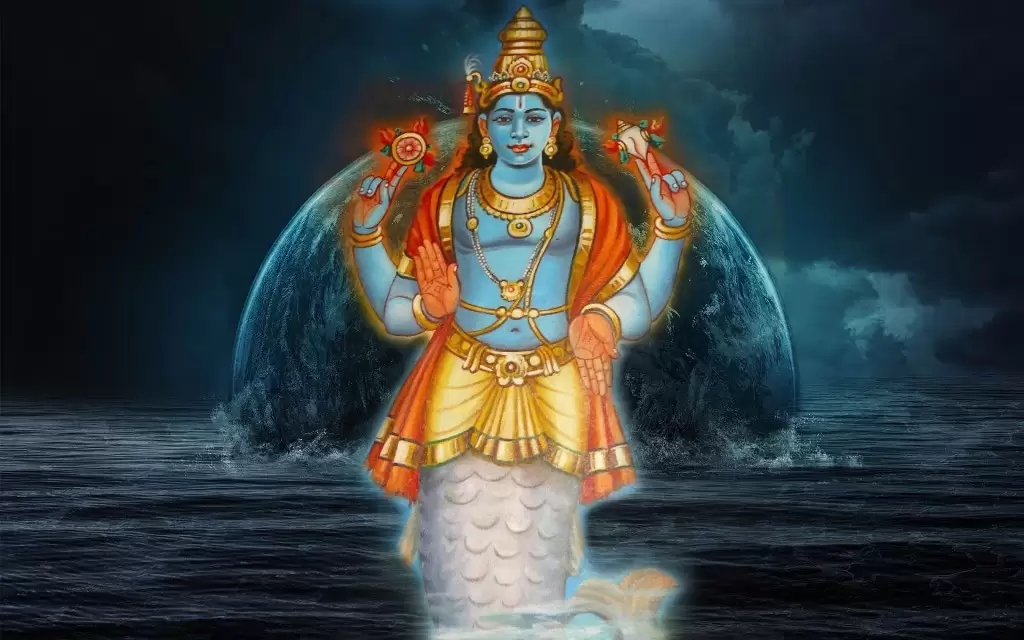
Krishna Avatar — The Eighth Incarnation of Vishnu: Bhagavad Gita, Mahabharata, Vrindavan Leelas & Eternal Wisdom for 2026
Krishna Avatar — Vishnu's eighth incarnation, Mathura birth, Vrindavan childhood, Radha love, Mahabharata diplomacy, Bhagavad Gita teaching, Dvaraka, eternal wisdom.
Krishna Avatar — Vishnu's eighth incarnation, Mathura birth, Vrindavan childhood, Radha love, Mahabharata diplomacy, Bhagavad Gita teaching, Dvaraka, eternal wisdom.
Quick Answer: Krishna — born in Mathura to Devaki and Vasudeva, raised in Vrindavan by Yashoda and Nanda — is the eighth of Vishnu's ten avatars and Hindu tradition's most multidimensional divine figure. His life spans the playful Vrindavan childhood with Yashoda, the devotional Vraja years with Radha and the gopis, the diplomatic role in the Mahabharata war, the foundational teaching of the Bhagavad Gita to Arjuna on the Kurukshetra battlefield, and his sovereignty over Dvaraka as king. Unlike Rama (the Maryada Purushottama who lived strict dharma), Krishna represents Leela Purushottama — the supreme play of the divine in human form, where divinity engages every dimension of human experience. The Bhagavad Gita (Krishna's 700-verse teaching to Arjuna) is among world spirituality's most influential texts. Janmashtami (his birthday — August 22, 2026) is celebrated globally; ISKCON (Hare Krishna Movement, founded 1966 by Srila Prabhupada) has carried Krishna devotion to all continents.
1. The Mathura Birth and Prophecy
In the Dvapara Yuga, Mathura was ruled by the tyrant Kamsa, who had imprisoned his own father Ugrasena to seize the throne. Kamsa was the half-brother of his cousin Devaki.
At Devaki's wedding to Vasudeva (of the Yadava clan), a celestial voice prophesied: "Kamsa, the eighth child of this couple will be your destroyer."
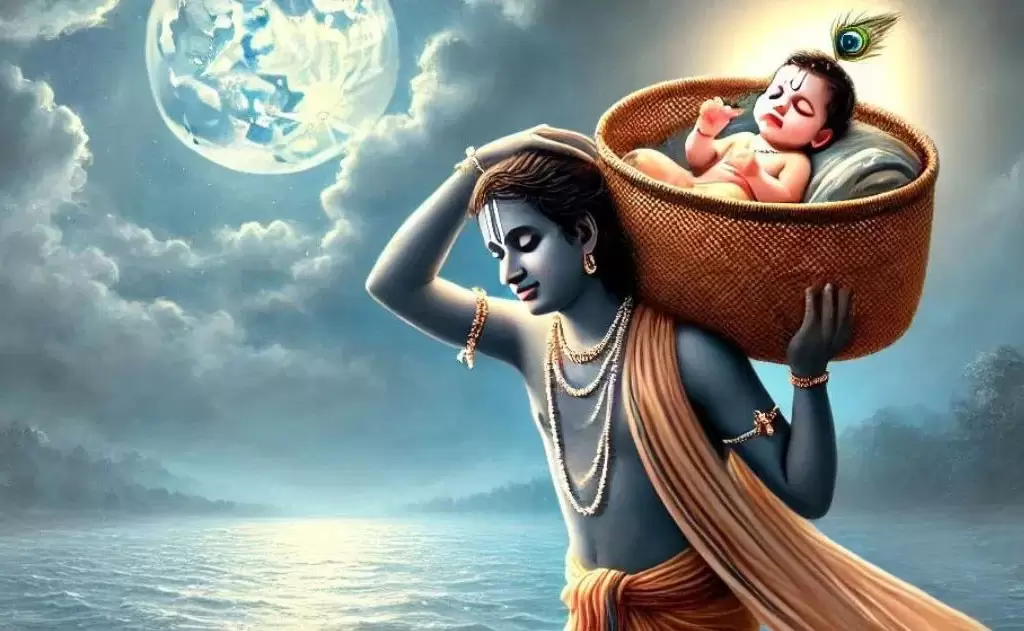
Kamsa imprisoned Devaki and Vasudeva. He killed each of their newborns in succession — the first seven. When the eighth child was born — Krishna — Vasudeva miraculously escaped the prison; doors opened; chains fell. He crossed the Yamuna river in flooding monsoon waters (Sheshanaga the divine serpent sheltered the baby from rain) to Gokul, where he exchanged Krishna for the newborn daughter of Yashoda and Nanda Maharaj. Yashoda woke not realising the swap; Vasudeva returned to prison.
Kamsa came to kill what he believed was the eighth child. The "daughter" rose into the air as Yogamaya and announced: "The one destined to kill you is already born in Vraja."
Krishna's life as a divine child in Vrindavan began.
2. Yashoda's Krishna — The Divine Child in Vrindavan
The Vrindavan years are among Hindu narrative's most beloved chapters. Krishna grew up as Nanda Maharaj's son and Yashoda's beloved boy, surrounded by the cowherds (gopas) and gopis (cowherd girls) of the Vraja region.
His childhood leelas (divine play) include:
- Putana — the demon-wet-nurse who tried to poison the baby and was killed in the attempt
- The yogurt-stealing pranks — Krishna would steal butter and yogurt from neighbours' homes; Yashoda's binding of him to a mortar (the Damodara episode)
- The Kaliya nag — Krishna danced on the heads of the giant serpent that poisoned Yamuna's waters
- Govardhan-lifting — when Indra threatened Vraja with deluge, Krishna lifted Govardhan hill on his finger to shelter villagers (this story is foundational; see Section 4)
- The raas leela — the cosmic dance with the gopis in moonlit Vrindavan, the supreme symbol of divine-devotee love
3. Radha and the Gopis — The Supreme Bhakti
Radha — Krishna's beloved — represents the supreme model of devotional love. The Radha-Krishna relationship is not framed primarily as marriage but as the eternal love between the soul (jeevatma) and the supreme (paramatma). Radha's longing for Krishna, Krishna's responsiveness, the gopis' devotion — these form the philosophical core of the Bhakti tradition (devotional Hindu path).
The Bhakti movements of medieval India — Chaitanya, Vallabha, Meera, Tulsi, the Alvars — all draw deeply on Radha-Krishna theology. Modern ISKCON places Radha-Krishna at the centre of devotional practice.
Note: Radha is not mentioned in the original Bhagavata Purana; her veneration emerged most strongly in later (10th-12th century) traditions. The Vaishnava acharyas Jayadeva (12th century, Gita Govinda), Chaitanya (15th century), Vallabha (15th-16th century) consolidated Radha worship.
4. Govardhan Hill and Kamsa's Defeat
When the Vraja villagers prepared for the annual Indra puja (worship of the rain god), Krishna told them to worship Govardhan hill instead — the source of their pasturelands and prosperity.
Indra, enraged, sent a deluge to destroy Vraja. Krishna lifted Govardhan hill on his little finger and held it for seven days while all the villagers, cattle, and animals sheltered beneath. Indra surrendered; the rain stopped. The Govardhan Puja (one day after Diwali) commemorates this event.
When Krishna and his brother Balarama reached adolescence, they were summoned by Kamsa to Mathura. There Krishna defeated Kamsa's elephant Kuvalayapida, defeated the wrestlers Chanura and Mushtika, and finally killed Kamsa himself — fulfilling the original prophecy. Ugrasena was restored as king of Mathura. Devaki and Vasudeva were freed.
5. Dvaraka — The Kingdom of Krishna
After Kamsa's defeat, Krishna faced repeated attacks from Jarasandha (Kamsa's father-in-law and king of Magadha). To protect his people, Krishna eventually relocated the Yadava clan to a new city he built on the western coast — Dvaraka (in modern-day Gujarat). Dvaraka became Krishna's kingdom and his base for the later Mahabharata-era events.
Krishna had 8 principal queens (including Rukmini and Satyabhama) and traditionally 16,108 queens (after rescuing 16,100 captive princesses from the demon Narakasura — the origin of Diwali's Naraka Chaturdashi). His sons and grandsons including Aniruddha and Pradyumna were central figures in the post-Kurukshetra period.
6. The Mahabharata — Diplomacy and War
The Mahabharata epic centers on the conflict between the Pandavas (Yudhishthira, Bhima, Arjuna, Nakula, Sahadeva) and the Kauravas (Duryodhana and his 99 brothers). Krishna was the cousin and ally of the Pandavas (his aunt Kunti was their mother).
Krishna's role in the Mahabharata was primarily diplomatic and instructive:
- The diplomatic mission to Duryodhana — Krishna travelled to Hastinapura on the eve of war to seek peaceful settlement; his offer (just 5 villages for the Pandavas) was rejected by Duryodhana
- Charioteer to Arjuna — Krishna agreed to be Arjuna's charioteer rather than fight himself; his entire army went to the Kauravas
- The Bhagavad Gita — on the eve of battle, when Arjuna collapsed in despair at fighting his own kin, Krishna delivered the Bhagavad Gita's 18 chapters
- Strategic counsel — multiple times during the 18-day war, Krishna's counsel determined Pandava victory
The Pandavas won at Kurukshetra; Yudhishthira became king of Hastinapura. The Kali Yuga began.
7. The Bhagavad Gita — Supreme Teaching
The Bhagavad Gita ("Song of the Lord") is Krishna's 700-verse teaching to Arjuna, set in the moment between two opposing armies on Kurukshetra. The Gita addresses the central human question: how does one act rightly under conditions of extreme moral complexity?
The 18 chapters cover:
- Arjuna's despair (Arjuna Vishada Yoga)
- The eternal nature of the soul (Sankhya Yoga)
- Action without attachment (Karma Yoga)
- Knowledge and the divine descent (Jnana Karma Sanyasa Yoga)
- Renunciation through action
- Meditation
- Knowledge of the absolute
- Liberation through dedication
- The royal secret (Raja Vidya Yoga)
- Divine manifestations (Vibhuti Yoga)
- The cosmic form (Vishvarupa Darshana Yoga) — Krishna's universal form
- Devotion (Bhakti Yoga)
- The field of action and the knower
- The three gunas
- The supreme self (Purushottama Yoga)
- Divine and demonic qualities
- The three types of faith
- Liberation through renunciation (the final synthesis)
The Gita's teachings — nishkama karma (action without attachment), the three yogas (karma, bhakti, jnana), the eternal soul doctrine, the surrender of all dharmas in the final verse — have shaped Hindu thought for 2,500+ years. The Gita is among the most-translated and most-read spiritual texts globally.
8. Krishna's Departure
After the Kurukshetra war, Krishna ruled Dvaraka. The Yadava clan eventually fell into internal conflict; Krishna foresaw the dissolution. While resting under a tree in a forest, Krishna was accidentally shot in the foot by a hunter named Jara (who mistook Krishna's foot for a deer). Krishna left his body, returning to Vaikuntha. Dvaraka was submerged by the ocean shortly thereafter.
Krishna's departure marks the formal beginning of the Kali Yuga — the present cosmic age (which began approximately 3,102 BCE per traditional reckoning).
9. Major Krishna Temples and Festivals
Tier 1 — Cultural landmarks
- Krishna Janmabhoomi Mandir, Mathura — Krishna's traditional birthplace
- Vrindavan temples — Banke Bihari, ISKCON Vrindavan, Sri Krishna Balaram Mandir, Govind Dev Ji, Radha Raman, Radha Vallabh
- Dwarakadhish Temple, Dwarka, Gujarat — Krishna's kingdom; one of the four Char Dham sites
- Jagannath Temple, Puri, Odisha — Krishna as Jagannath; Rath Yatra
- Udupi Sri Krishna Matha, Karnataka — established by Madhvacharya
- Guruvayur Temple, Kerala — major Krishna pilgrimage site
- ISKCON Bhaktivedanta Manor, UK — major UK Krishna temple
- ISKCON Houston, USA — major US Krishna temple
Major festivals 2026
- Janmashtami / Krishna Janmashtami — Krishna's birthday — August 22, 2026 (Saturday)
- Govardhan Puja — one day after Diwali — November 9, 2026
- Radhastami — Radha's birthday — September 19, 2026
- Gita Jayanti — celebrating the Gita's teaching — December 10, 2026
- Holi — associated with Krishna-Radha leela — March 4, 2026
10. Lessons for NRI Hindus in 2026
Lesson 1: Action without attachment
The Gita's central teaching — karmanye vadhikaraste, ma phaleshu kadachana — is the most practical Hindu philosophical doctrine for modern professionals. Do your work fully; release attachment to outcomes. H1-B holders, performance-review-anxious tech workers, NRI parents pushing children — the teaching reframes the entire stress equation.
Lesson 2: The divine plays — Leela
Unlike Rama's strict dharma, Krishna's life is leela — divine play. Krishna's mischief in Vrindavan, his diplomatic cunning in the Mahabharata, his Gita teaching, his Dvaraka kingdom — every dimension of human experience is sanctified by his engagement. The teaching: full human engagement, including playfulness, can be divine.
Lesson 3: The personal relationship with God
Krishna's relationships — with Yashoda as mother, with Radha as lover, with Arjuna as friend, with Sudama as childhood friend — model how the divine can be encountered in personal relationship. NRI Hindus often default to abstract Hindu philosophy; the Krishna tradition offers profoundly personal devotion.
Lesson 4: The supreme teacher
The Bhagavad Gita establishes the pattern of the supreme guru-shishya relationship. Krishna's response to Arjuna — patient, comprehensive, leading him through stages from despair to clarity — models the work of all great teaching. NRI Hindus in mentoring roles, raising children, leading teams can draw on this template.
Lesson 5: Diplomatic restraint with strategic action
Krishna's diplomacy in the pre-war Mahabharata negotiations — offering peace, accepting the impossibility of peace, then engaging full strategic action — models a mature ethical sequence. Modern NRI Hindus navigating workplace, family, and political conflicts can draw on this pattern: try peace first, prepare for action if peace fails.
Lesson 6: Cosmic perspective on individual struggle
The Vishvarupa darshan in Gita chapter 11 — Krishna revealing his cosmic form to Arjuna — places individual struggle within cosmic context. For NRI Hindus overwhelmed by current crises, reading the Gita's chapter 11 expands perspective in a way few other texts can.
Lesson 7: Surrender to the divine
The Gita's final verse — sarva-dharman parityajya, mam ekam saranam vraja — articulates the supreme teaching of surrender. Not abandoning ethical action, but releasing the entire weight to the divine. For NRI Hindus carrying multi-generational stress, this teaching offers genuine relief.
11. Mantras, FAQs
Mantras
Krishna bija mantra:
Om Krishnaaya Namah
Maha Mantra (the Hare Krishna mantra):
Hare Krishna Hare Krishna, Krishna Krishna Hare Hare
Hare Rama Hare Rama, Rama Rama Hare Hare
Krishna Gayatri:
Om Devakinandanaaya Vidmahe
Vasudevaaya Dhimahi
Tanno Krishnah Prachodayat
Dasavatara Stotra verse for Krishna (Jayadeva, on Krishna in his Kaliya context):
Vahasi vapushi vishada vasanam jaladaabham
Hala-hatibhiti-militam Yamunabham
Kesava dhrita Haladhara rupa Jaya Jagadisha Hare
(Note: Some traditions count Balarama as the avatar here; others count Krishna directly. The Bhagavata Purana counts Krishna himself.)
FAQs
Q: Is Krishna the supreme deity or one of many?
A: Traditions vary. Gaudiya Vaishnavism (ISKCON's lineage) holds Krishna as Svayam Bhagavan — the source of all avatars, the supreme personality of Godhead. Other Vaishnava traditions hold Vishnu as supreme with Krishna as avatar. Both views are accepted in Hindu civilisation.
Q: Was Krishna historical?
A: Hindu tradition holds Krishna as historical. Archaeological evidence at Dvaraka (submerged structures off Gujarat coast) and Mathura has been interpreted as supporting historical Krishna. Western academic scholarship treats the Krishna stories as having historical-mythological mixture.
Q: When is Janmashtami 2026?
A: Saturday, August 22, 2026 (midnight transitioning to August 23).
Q: How can NRIs visit Vrindavan-Mathura?
A: Mathura is 150 km south of Delhi; Vrindavan is adjacent. Standard combined visit takes 2-3 days. Plan around Janmashtami for the festival experience, or visit other times for calmer darshan.
Q: What's the difference between ISKCON and other Krishna traditions?
A: ISKCON (founded 1966 by Srila Prabhupada) is one branch of Gaudiya Vaishnavism (the Chaitanya lineage). Other Krishna traditions include Madhva sampradaya (Udupi), Vallabha sampradaya (Pushtimarg), Nimbarka sampradaya, and many regional traditions. All worship Krishna; theologies vary.
Q: Is Radha a separate goddess or just Krishna's consort?
A: In Gaudiya theology, Radha is regarded as the supreme feminine principle — equal to or even surpassing Krishna in devotional power. Other traditions emphasize Lakshmi as Krishna's primary consort. Radha worship is particularly strong in Vrindavan and ISKCON-affiliated traditions.
Q: What's the best translation of the Bhagavad Gita?
A: Many excellent translations exist. Recommendations: Eknath Easwaran (most accessible), Swami Prabhupada (devotional ISKCON), Swami Chinmayananda (commentary-rich), Stephen Mitchell (literary), Annie Besant (classic Theosophical). Each carries different emphases.
Final Words
Krishna Avatar represents Vishnu's most comprehensive engagement with the human condition. Where Rama lived strict dharma, Krishna engaged the full spectrum of human experience — childhood mischief, romantic love, family bonds, political diplomacy, military strategy, philosophical teaching, sovereign rule. The Bhagavad Gita is his sustained teaching to humanity through the figure of Arjuna; the Vrindavan leelas are his sustained demonstration that the divine can play in human form.
For NRI Hindus in 2026, Krishna offers the most accessible entry into devotional Hindu life. The Bhagavad Gita can be read in 1-2 weeks at one chapter per day. The Maha Mantra can be chanted by anyone, anywhere, in any condition. The Janmashtami midnight celebration is observed by millions worldwide. The Krishna stories — Yashoda's love, Radha's longing, Arjuna's transformation — speak directly to the inner life regardless of cultural distance from India.
Yada yada hi dharmasya glanir bhavati Bharata
Abhyutthanam adharmasya tadatmanam srjamy aham
(Whenever dharma declines and adharma rises, then I incarnate myself.) — Bhagavad Gita 4.7
Hare Krishna! Hare Krishna! Krishna Krishna Hare Hare! Jai Vishnu Avatar 8 of 10!
HinduTone Editorial Team · Tags: Krishna Avatar, Bhagavad Gita, Mahabharata, Vrindavan, Radha Krishna, Mathura, Dvaraka, Janmashtami, Govardhan, ISKCON, Dasavataram
Frequently Asked Questions
What is Krishna Avatar?
Krishna — born in Mathura to Devaki and Vasudeva , raised in Vrindavan by Yashoda and Nanda — is the eighth of Vishnu's ten avatars and Hindu tradition's most multidimensional divine figure. His life spans the playful Vrindavan childhood with Yashoda, the devotional Vraja years with Radha and the gopis , the diplomatic role in the Mahabharata war , the found
What are the key points about Krishna Avatar?
Unlike Rama (the Maryada Purushottama who lived strict dharma), Krishna represents Leela Purushottama — the supreme play of the divine in human form, where divinity engages every dimension of human experience. The Bhagavad Gita (Krishna's 700-verse teaching to Arjuna) is among world spirituality's most influential texts.
Why does Krishna Avatar matter in Hinduism?
It deepens a devotee's connection with Lord Krishna and with the values of Sanatana Dharma — clarity, devotion and dharmic living.
How can devotees apply Krishna Avatar in daily life?
By reflecting on its teaching, incorporating the related practices or observances into daily routine, and approaching it with sincere devotion and understanding.
You might also like

Kalki Avatar — The Tenth Incarnation of Vishnu: Prophecy, Signs of Kali Yuga, Sambhal Birthplace & The End of the Cosmic Cycle
Buddha Avatar — The Ninth Incarnation of Vishnu: Hindu Perspective on Siddhartha Gautama & Bridge Between Sanatana Dharma and Buddhism
Rama Avatar — The Seventh Incarnation of Vishnu: Ramayana, Ayodhya, the Ideal Man & Eternal Dharma Lessons for 2026