Buddha Avatar — The Ninth Incarnation of Vishnu: Hindu Perspective on Siddhartha Gautama & Bridge Between Sanatana Dharma and Buddhism
Buddha Avatar — Vishnu's ninth incarnation per Hindu tradition. Siddhartha Gautama's life, Hindu-Buddhist theological relationship, Bodh Gaya, modern significance.
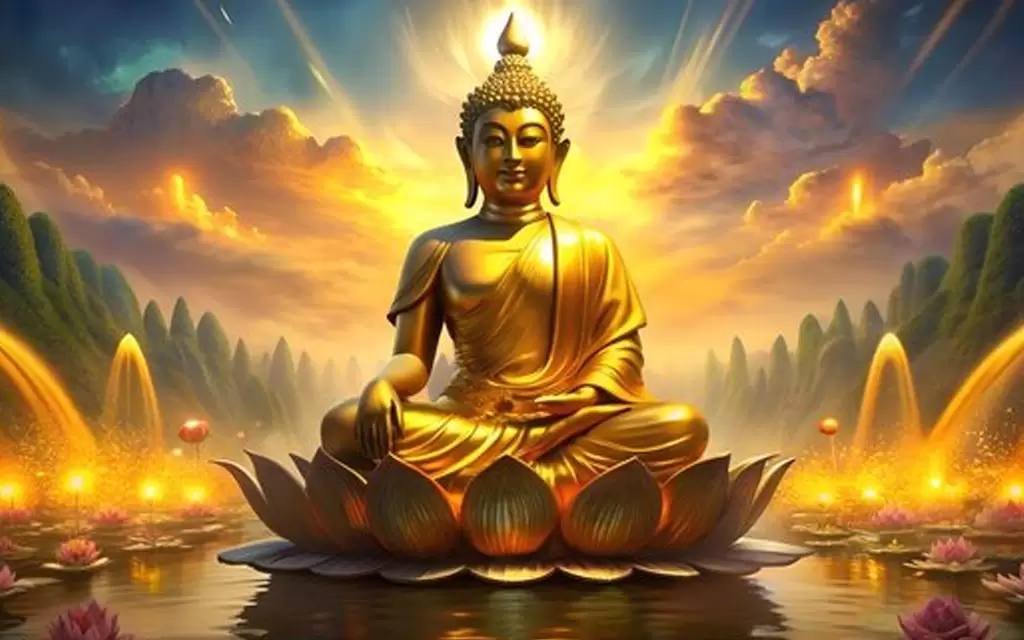
Buddha Avatar — Vishnu's ninth incarnation per Hindu tradition. Siddhartha Gautama's life, Hindu-Buddhist theological relationship, Bodh Gaya, modern significance.
Quick Answer: In Hindu tradition, Gautama Buddha (Siddhartha Gautama, c. 563-483 BCE) is recognised as the ninth of Vishnu's ten avatars. This identification — present in the Bhagavata Purana, Gita Govinda, and most major Vaishnava traditions — distinguishes Hinduism from Buddhism, which does not regard the Buddha as a Vishnu incarnation. The Hindu tradition holds that Vishnu took the Buddha form to redirect humanity away from corrupted Vedic ritual practices (particularly excessive animal sacrifice) and toward principles of compassion, non-violence (ahimsa), and inner spiritual practice. The Buddha's Four Noble Truths and Eightfold Path offer practical liberation teachings; the Buddha's emphasis on compassion (karuna) transformed both Asian spirituality and modern global mindfulness culture. Major pilgrimage sites include Bodh Gaya (enlightenment site, Bihar), Sarnath (first teaching, near Varanasi), Lumbini (birthplace, Nepal), and Kushinagar (parinirvana, Uttar Pradesh).
1. The Hindu Identification of Buddha as Vishnu Avatar
The traditional Hindu position is that the Buddha is Vishnu's ninth descent (avatara). This identification appears in:
- Bhagavata Purana (Skandha 1, Chapter 3)
- Gita Govinda by Jayadeva (12th century) — explicitly lists Buddha as the ninth avatar
- Devi Bhagavata Purana
- Most Vaishnava sampradayas today
Why did Vishnu manifest as Buddha? Different Hindu sources give different reasons:
- To redirect humanity away from the excessive animal sacrifice that had corrupted Vedic ritualism by the Buddha's era
- To teach compassion and inner practice when external ritualism had become hollow
- To prepare humanity for the coming Kali Yuga's intensification
- To demonstrate that liberation does not require complex Vedic ritual but can be achieved through right mindfulness, right action, right intention
The Hindu reading is therefore: the Buddha's teaching is true and Vishnu-given, even though the Buddha himself did not affirm Hindu metaphysics (gods, soul-doctrines, atman-Brahman framework). The apparent contradiction is, in Hindu thought, intentional — Vishnu chose to deliver teaching framed in a way most accessible to those of his era.
2. Siddhartha Gautama's Life
Birth (c. 563 BCE): Siddhartha was born in Lumbini (modern-day Nepal) to King Suddhodana and Queen Mayadevi of the Shakya clan. His father, hoping to keep him from the spiritual path, surrounded him with luxury and shielded him from suffering.
The Four Sights: As a young adult, Siddhartha encountered (according to tradition) four sights that transformed him — an old person, a sick person, a corpse, and a wandering ascetic. He realised the universality of suffering and the need to seek the way beyond it.
The Great Departure (age 29): Siddhartha left his palace, his wife Yashodhara, his newborn son Rahula, and his royal life. He sought teachers, undertook six years of severe ascetic practice, and ultimately rejected extreme austerity as insufficient.
Enlightenment (c. 528 BCE, age 35): Siddhartha sat in meditation under a Bodhi tree at Bodh Gaya (Bihar). After seven weeks of meditation and Mara's (the demon's) attempted distractions, he attained complete enlightenment (Sambodhi). He became the Buddha — the Awakened One.
First Teaching at Sarnath: Near Varanasi, the Buddha gave his first teaching to the five ascetics who had been his companions. This first sermon, the Dhammachakkapavattana Sutta (Setting the Wheel of Dharma in Motion), established the Four Noble Truths.
45 Years of Teaching: The Buddha taught for 45 years across the Ganges valley. He established the Sangha (monastic order), accepted disciples of all castes (breaking the rigid caste exclusion of the era), and developed the framework for both monastic and lay practice.
Parinirvana (c. 483 BCE, age 80): The Buddha entered Mahaparinirvana at Kushinagar (Uttar Pradesh).
3. The Four Noble Truths and Eightfold Path
The Buddha's central teaching distilled to two foundational frameworks:
The Four Noble Truths
- Dukkha — Suffering exists; it is the foundational condition of unawakened existence
- Samudaya — Suffering has a cause; primarily craving and attachment
- Nirodha — Suffering can cease; cessation is possible
- Magga — There is a path to the cessation of suffering — the Eightfold Path
The Eightfold Path (Ashtangika Marga)
- Right View (Samma Ditthi)
- Right Intention (Samma Sankappa)
- Right Speech (Samma Vaca)
- Right Action (Samma Kammanta)
- Right Livelihood (Samma Ajiva)
- Right Effort (Samma Vayama)
- Right Mindfulness (Samma Sati)
- Right Concentration (Samma Samadhi)
The teaching is psychological and ethical — addressing the actual mechanism of suffering and offering practical practice (rather than philosophical doctrine alone).
4. The Sangha and the Spread of Buddhism
The Buddha established the Sangha — monastic community of bhikkhus (monks) and bhikkhunis (nuns). Initially small, the Sangha became the institutional carrier of Buddhist teaching for the centuries that followed.
Emperor Ashoka (3rd century BCE) converted to Buddhism after the bloody Kalinga war. He sent Buddhist missionaries across Asia — Sri Lanka, Burma, Thailand, Central Asia, China. Buddhism became a pan-Asian religion within centuries of the Buddha's death.
The major branches:
- Theravada — preserves the oldest texts (Pali Canon); dominant in Sri Lanka, Burma, Thailand, Cambodia, Laos
- Mahayana — emphasises Bodhisattva path and compassion for all beings; dominant in China, Japan, Korea, Vietnam
- Vajrayana — incorporates tantric practices; dominant in Tibet, Mongolia, Bhutan, parts of Nepal
In India, Buddhism flourished until ~12th century CE, then declined dramatically (due to Islamic invasions, Brahmanical opposition, internal decay). In modern India, the Buddhist population has grown again — partially through Dr. B.R. Ambedkar's 1956 mass conversion of Dalits (who saw in Buddhism an escape from caste).
5. The Adi Shankara - Buddha Relationship
Adi Shankaracharya (8th century CE), the great Advaita Vedanta acharya, played a complex role in the Hindu-Buddhist relationship:
- Shankara debated Buddhist scholars extensively and contributed to the intellectual decline of Buddhism in India
- Yet Shankara's Advaita philosophy was deeply influenced by Buddhist epistemology (some critics called him a "crypto-Buddhist")
- The Hindu tradition has subsequently held that Shankara's task was to "absorb" Buddhism's truths back into Vedanta rather than to suppress them
The historical relationship between Hinduism and Buddhism in India is therefore not pure opposition but a complex co-evolution. Many of Buddhism's insights — non-violence, compassion, meditation centrality — became more deeply integrated into Hinduism after the Hindu-Buddhist period of contact.
6. Hindu-Buddhist Theological Differences
Despite the avatara identification, significant theological differences exist:
- Atman (soul) · Eternal, identical with Brahman (Advaita) or part of Brahman (Vishishtadvaita) · Anatta — no permanent self
- God / supreme being · Brahman / Vishnu / Shiva / Devi as ultimate · Buddha did not affirm a creator god; later Mahayana developed more theistic frameworks
- Liberation · Moksha — union with or relationship to Brahman · Nirvana — cessation of suffering, blowing out of craving
- Path · Karma yoga, bhakti yoga, jnana yoga · Eightfold Path, meditation, ethical conduct
- Caste · Historically structured (though debated in scripture) · Explicitly rejected; egalitarian sangha
Modern Hindu thinkers and Buddhist thinkers continue to engage these differences with varying degrees of harmonisation, contestation, or peaceful difference.
7. Major Buddhist Pilgrimage Sites
The four most sacred Buddhist sites:
- Lumbini, Nepal — Buddha's birthplace
- Bodh Gaya, Bihar — Buddha's enlightenment site
- Sarnath, near Varanasi — Buddha's first teaching
- Kushinagar, Uttar Pradesh — Buddha's parinirvana
Additional important sites:
- Rajgir, Bihar — Vulture Peak; multiple Buddha teachings
- Nalanda, Bihar — ancient Buddhist university (5th-12th centuries)
- Sanchi, Madhya Pradesh — Ashoka's stupa
- Ajanta and Ellora, Maharashtra — Buddhist cave temples
- Dharamshala, Himachal Pradesh — Tibetan Buddhist centre + Dalai Lama's residence
For NRI Hindus and Buddhist-curious travellers, the Buddhist Circuit of Bihar (Bodh Gaya, Rajgir, Nalanda, Vaishali) offers profound pilgrimage experience.
8. Modern Lessons — Buddha in 2026
Lesson 1: Acknowledge suffering before solving
The Buddha's first truth — dukkha — is the acknowledgment that suffering is real, structural, not just personal failure. For modern NRI Hindus dealing with anxiety, depression, immigration stress, family pressure: the first move is not problem-solving but acknowledgment that the difficulty is real.
Lesson 2: Investigate the causes, not symptoms
The Buddha's second truth — that suffering has identifiable causes — is the foundation of all psychological work. Rather than fighting symptoms, investigate the underlying craving/attachment generating them. This is the same insight modern cognitive-behavioural therapy uses.
Lesson 3: Right Mindfulness in the age of distraction
The Eightfold Path's "Right Mindfulness" (sati) has become the modern world's most-adapted Buddhist teaching, underlying the global mindfulness movement. For NRI Hindus, this is a recovery of contemplative practice that was also central to Hindu tradition before being overshadowed.
Lesson 4: Compassion as practical orientation
The Buddha's karuna (compassion) is not abstract feeling but practical orientation toward reducing the suffering of all beings. NRI Hindus engaged in social work, healthcare, mental health, charity — the Buddha's framework articulates a familiar Hindu impulse with particular clarity.
Lesson 5: Question the inherited
The Buddha's most radical move was questioning the Vedic ritual system of his era. The lesson is not necessarily to question Hinduism today, but to engage one's tradition with discernment — recognising what is essential vs accumulated cultural form.
Lesson 6: The middle way
The Buddha rejected both luxury and extreme asceticism in favour of the middle way (Madhyama Pratipada). For NRI Hindus oscillating between materialist over-engagement and ascetic-ideal under-engagement, the middle way is the practical sustainable path.
9. Mantras, FAQs
Mantras
Buddha bija mantra (Hindu tradition):
Om Buddhaaya Namah
The traditional Buddhist refuge (in Pali):
Buddham Sharanam Gacchami
Dhammam Sharanam Gacchami
Sangham Sharanam Gacchami
(I take refuge in the Buddha, in the Dharma, in the Sangha.)
Dasavatara Stotra verse for Buddha (Jayadeva):
Nindasi yajna-vidher ahaha shruti jatam
Sadayahrdaya darshita pashu ghatam
Kesava dhrita Buddha sharira Jaya Jagadisha Hare
(O Keshava, who in the form of Buddha condemned the harm to animals in Vedic sacrifices, with a heart of compassion — victorious is the Lord of the universe.)
FAQs
Q: Is the Buddha a Hindu or a Buddhist?
A: Historically, he was raised in the Indian-Vedic cultural milieu (not yet "Hindu" in modern sense). He founded what became Buddhism. The Hindu tradition retrospectively claims him as Vishnu's ninth avatar; Buddhists do not accept this identification.
Q: When is Buddha Purnima 2026?
A: Vaisakha Purnima — Friday, May 22, 2026 (the same day as Vesak — birthday, enlightenment, and parinirvana day commemorated together).
Q: Can NRI Hindus visit Buddhist pilgrimage sites?
A: Absolutely. Many NRI Hindus visit Bodh Gaya as part of the broader Bihar Buddhist circuit. The Mahabodhi Temple in Bodh Gaya is open to all.
Q: Why don't all Hindu traditions include Buddha as 9th avatar?
A: Some lists substitute Balarama (Krishna's brother) as ninth, with Krishna as eighth — this is more common in Bengali Vaishnavism and some other regional traditions. Most pan-Indian lists include Buddha.
Q: Are there Buddha temples in NRI cities?
A: Yes — major Buddhist centres exist in most large US, UK, Canadian, Australian cities. Hindu temples occasionally include Buddha shrines. Tibetan Buddhist centres are particularly numerous.
Q: Can a Hindu practice Buddhist meditation?
A: Generally yes — many modern Hindus integrate Vipassana, Zen, or Tibetan meditation practices alongside or instead of traditional Hindu meditation. The Vipassana Research Institute (Igatpuri, Maharashtra) attracts many Hindu practitioners.
Q: Is Dr. Ambedkar's conversion to Buddhism relevant?
A: Highly relevant in modern Indian politics and religion. Dr. B.R. Ambedkar (Indian Constitution architect) converted to Buddhism in 1956 with hundreds of thousands of Dalits. This Neo-Buddhist tradition (Navayana) is a significant Indian religious movement in 2026.
Final Words
Buddha Avatar represents one of Hindu tradition's most theologically generous acts: the acknowledgment that a teacher who explicitly did not affirm Hindu metaphysics could nonetheless be Vishnu's manifestation, and that his teachings — though differently framed — carry divine truth. This is the Hindu civilisational pattern of inclusive recognition rather than exclusive rejection.
For NRI Hindus in 2026 — living among multiple religions, often in interfaith relationships, raising children who will encounter many traditions — the Buddha avatar identification models something profound: you can affirm your own tradition while recognising divine action in another tradition. You can be a Hindu and respect, learn from, and honour the Buddha. You can visit Bodh Gaya as both Vishnu's devotee and the Buddha's devotee. The boundaries are not contradictions; they are different expressions of the same supreme reality.
The Buddha's teaching of compassion, mindfulness, and the middle way is among the most practical spiritual frameworks available to modern people. Its global spread — from Asia through Europe, Americas, Australia — has perhaps brought Hindu-rooted insights to a wider audience than Hinduism itself.
Om Buddhaaya Namah. Buddham Sharanam Gacchami. Jaya Jagadisha Hare!
Jai Buddha Bhagavan! Jai Vishnu Avatar 9 of 10!
HinduTone Editorial Team · Tags: Buddha Avatar, Siddhartha Gautama, Vishnu Avatars, Bodh Gaya, Sarnath, Lumbini, Four Noble Truths, Eightfold Path, Hindu Buddhist Relationship, Dasavataram
Frequently Asked Questions
What is Buddha Avatar?
In Hindu tradition, Gautama Buddha (Siddhartha Gautama, c. 563-483 BCE) is recognised as the ninth of Vishnu's ten avatars .
What are the key points about Buddha Avatar?
This identification — present in the Bhagavata Purana, Gita Govinda, and most major Vaishnava traditions — distinguishes Hinduism from Buddhism, which does not regard the Buddha as a Vishnu incarnation. The Hindu tradition holds that Vishnu took the Buddha form to redirect humanity away from corrupted Vedic ritual practices (particularly
Why does Buddha Avatar matter in Hinduism?
It deepens a devotee's connection with Lord Vishnu and with the values of Sanatana Dharma — clarity, devotion and dharmic living.
How can devotees apply Buddha Avatar in daily life?
By reflecting on its teaching, incorporating the related practices or observances into daily routine, and approaching it with sincere devotion and understanding.
You might also like

Kalki Avatar — The Tenth Incarnation of Vishnu: Prophecy, Signs of Kali Yuga, Sambhal Birthplace & The End of the Cosmic Cycle
Krishna Avatar — The Eighth Incarnation of Vishnu: Bhagavad Gita, Mahabharata, Vrindavan Leelas & Eternal Wisdom for 2026
Rama Avatar — The Seventh Incarnation of Vishnu: Ramayana, Ayodhya, the Ideal Man & Eternal Dharma Lessons for 2026