Parashurama Avatar — The Axe-Wielding Warrior-Sage: Story, the Kshatriya Annihilation, Coastal Geography & Modern Significance
Parashurama Avatar — Vishnu's Brahmin warrior-sage incarnation. Story of his mother Renuka's killing, the 21-time Kshatriya annihilation, coastal land creation.
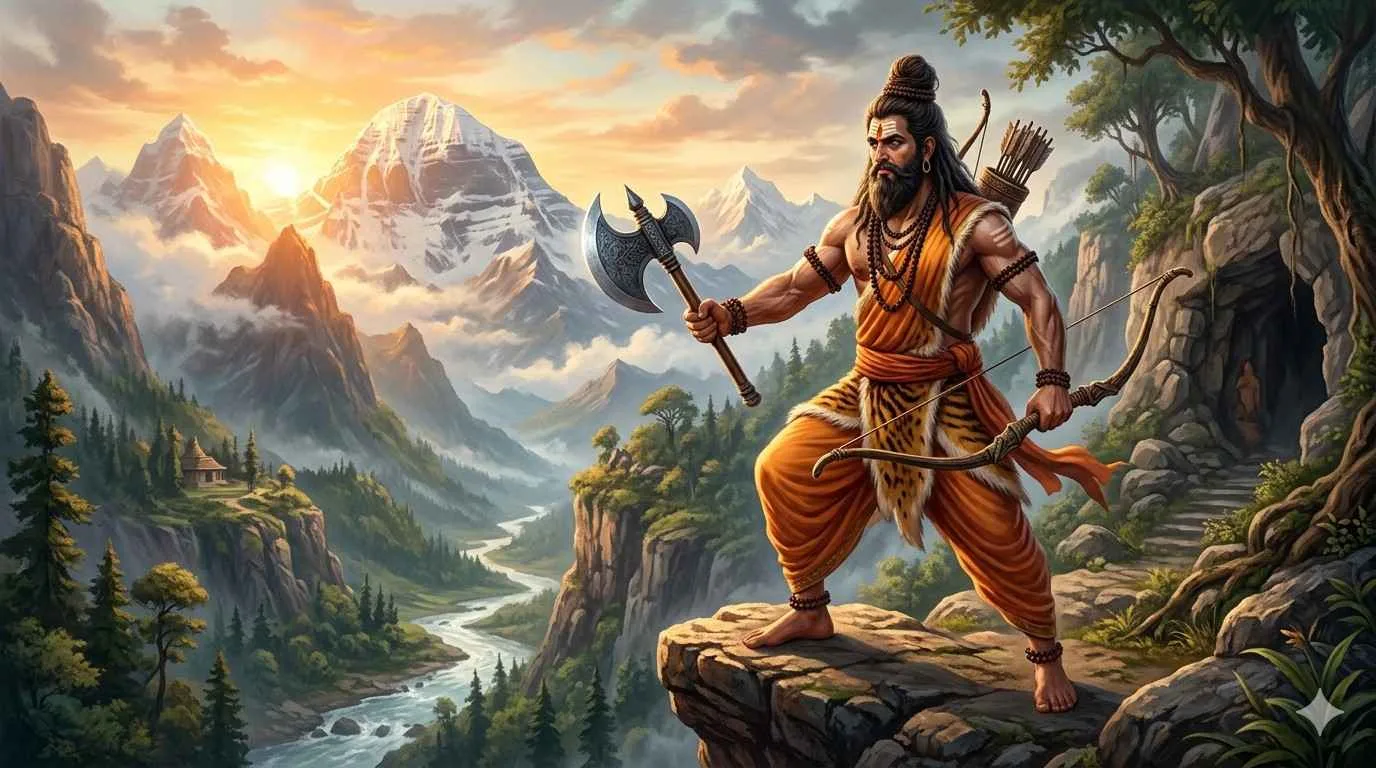
Parashurama Avatar — Vishnu's Brahmin warrior-sage incarnation. Story of his mother Renuka's killing, the 21-time Kshatriya annihilation, coastal land creation.
Quick Answer: Parashurama — Parashu (axe) + Rama — is the sixth of Vishnu's ten avatars and the only avatar still believed to be present on Earth (a Chiranjivi — immortal being living through cosmic cycles). Born to sage Jamadagni and Renuka of the Bhrigu lineage, Parashurama was initially a peaceful Brahmin scholar. After the unjust killing of his father by the Kshatriya king Kartavirya Arjuna (Sahasrarjuna, the thousand-armed), Parashurama undertook the 21-time annihilation of the Kshatriya class — a story understood symbolically as the destruction of corrupted ruling powers. Other major stories: the killing and resurrection of his mother Renuka, the creation of Konkan-Kerala coast by throwing his axe into the sea, the teaching of Bhishma and Karna in the Mahabharata, and his eventual transfer of his weapons to Lord Rama (the seventh avatar). Parashurama is regarded as the patron saint of Konkan, Kerala, and Tulu-speaking regions.
1. Birth and Early Life
Parashurama was born to Sage Jamadagni (a great Brahmin rishi of the Bhrigu lineage — making Parashurama also called Bhargava Rama) and his wife Renuka (a princess of the Suryavanshi lineage who married Jamadagni). The family lived a forest-ashram life on Mount Mahendra.
Parashurama's early years were standard Brahmin upbringing — Vedic study, mantra recitation, fire rituals, philosophical inquiry. However, he received intense weapons training as well, particularly devotion to Lord Shiva who eventually granted him the divine axe (parashu) that became his iconic weapon. Hence the name Parashu-Rama — Rama of the axe.
This combination — Brahmin learning + warrior skill — makes Parashurama unique among Hindu sages. The tradition classifies him as a Brahmakshatriya (Brahmin-warrior), and many of his stories revolve around the proper relationship between the priestly and warrior orders of society.
2. The Renuka Episode — Mother's Killing and Resurrection
This is among the most psychologically complex stories in the Hindu Puranas. The standard version:
Renuka was famed for her sati (chastity) — so devoted to Jamadagni that she could carry water in pots made of unbaked clay (a feat said to require absolute purity of mind). One day, while collecting water, she observed a Gandharva couple making love by the riverbank and felt a momentary attraction. The clay pot dissolved in her hands.
When Renuka returned to the ashram empty-handed, Jamadagni — through his rishi-vision — saw what had occurred. Outraged at this lapse in her sati, he ordered his sons to behead their mother. The four older sons refused; Jamadagni cursed them to lose their minds.
When Parashurama returned, his father ordered him: "Kill your mother."
Parashurama, trained in absolute obedience to his guru-father, picked up his axe and killed Renuka. Jamadagni, impressed by his son's obedience, offered Parashurama a boon. Parashurama asked for two things: (1) restore his mother to life, (2) restore his brothers' minds.
Jamadagni granted both boons. Renuka was restored to life with no memory of her killing.
This story has been interpreted theologically, philosophically, and from feminist perspectives. The traditional Hindu reading emphasises Parashurama's obedience to his father (paternal authority) combined with the wisdom to seek his mother's restoration. Contemporary readings often critique the violence done to Renuka. Both readings are part of the living tradition.
3. The Conflict with Sahasrarjuna
Sahasrarjuna (Kartavirya Arjuna) was the thousand-armed Kshatriya king of the Haihaya dynasty — extraordinarily powerful through tapas-granted boons. While hunting in the forest, he visited Jamadagni's ashram. Jamadagni, with his Kamadhenu (the divine cow of plenty), provided an extraordinary feast for the king and his entire army.
Sahasrarjuna recognised Kamadhenu as the source of the magical abundance and demanded the cow. Jamadagni refused. Sahasrarjuna's army took Kamadhenu by force, killed Jamadagni's sons who tried to defend the cow, and killed Jamadagni himself.
When Parashurama returned to find his father dead and Kamadhenu stolen, his grief and rage were cosmic. He vowed to annihilate the Kshatriya class that had grown corrupt and tyrannical.
Parashurama pursued and killed Sahasrarjuna in single combat — the thousand-armed king felled by Parashurama's axe.
4. The 21-Time Kshatriya Annihilation
Parashurama's vow extended beyond Sahasrarjuna. He declared he would annihilate all corrupted Kshatriyas across the cosmos. Per the Hindu tradition, he carried out this annihilation 21 times — each time, after defeating the Kshatriya forces, new ones would emerge (born to surviving Kshatriya women, or from various sources), and Parashurama would have to repeat the action.
The number 21 is symbolic — not necessarily 21 literal events but a representation of the cosmic-scale, repeated nature of the action. The teaching: when Kshatriya (ruling) power becomes corrupt, periodic violent reset is required.
After the 21st annihilation, Parashurama performed a great Yajna and donated the entire earth to Sage Kashyapa, then retired to perform tapas at Mount Mahendra.
Note: The Kshatriya annihilation story has been read in multiple ways. Some traditions emphasise the punishment of corrupt Kshatriyas (not all Kshatriyas); some see it as a metaphor for the periodic correction of corrupt ruling-class power; some literalist readings hold to the literal annihilation. Modern Hindu thinkers continue to engage these interpretations.
5. The Creation of Konkan-Kerala Coast
After his retirement, Parashurama is said to have created the Konkan and Kerala coasts by throwing his axe into the Arabian Sea from the Western Ghats. The sea receded; the new coastal land emerged.
Parashurama then settled Brahmins in this new land. The Konkani Saraswat Brahmins, Namboothiri Brahmins of Kerala, and Tulu Brahmins of coastal Karnataka all trace their origin to Parashurama's settlement. The entire coastal strip from Goa through Kerala is known traditionally as Parashurama Kshetra — Parashurama's land.
This narrative is geographically significant: the Konkan-Kerala coastal region's existence is mythologically attributed to Parashurama. Major temples along this coast — particularly Kerala's Shiva temples and the famous Sabarimala — are linked to Parashurama's settlement of the region.
6. Parashurama in the Mahabharata
Parashurama appears throughout the Mahabharata:
- Teacher of Bhishma: Bhishma learned warfare from Parashurama; Bhishma's combat with Parashurama later in his life is among the great inconclusive duels of Hindu epic literature.
- Teacher of Drona: Drona received weapons and knowledge from Parashurama; this knowledge was passed to the Pandavas and Kauravas in the Mahabharata war.
- Teacher of Karna: Karna received the supreme Brahmastra weapon-knowledge from Parashurama by representing himself as a Brahmin (Karna was a Kshatriya). When Parashurama discovered the deception, he cursed Karna to forget the mantra at the moment of greatest need — which played out tragically in Karna's death during the Mahabharata war.
Parashurama's presence across Treta Yuga (Rama's era) and Dvapara Yuga (Krishna's era) confirms his Chiranjivi (immortal) status — he is one of the Sapta Chiranjivi (seven immortal beings) per Hindu tradition.
7. Major Parashurama Temples
Tier 1 — Cultural landmarks
- Sri Parashurama Temple, Pajaka Kshetra, Karnataka — believed to be near Parashurama's birthplace
- Parashurama Temple, Chiplun, Maharashtra — major Konkan pilgrimage site
- Parashurama Kshetra, Thiruvallam, Kerala — one of the few Parashurama-specific temples in Kerala
Tier 2 — Major community temples
- Parashurama Temple, Lote, Maharashtra (Khed)
- Sri Parashurama Sannidhi at Kasaragod, Kerala
- Mahendra Mountain (Tamil Nadu/Odisha border) — Parashurama's traditional tapas location
- Various temples along Konkan-Kerala coast with Parashurama shrines
Parashurama is also venerated at Lord Shiva temples (his weapon-guru) — particularly in the Konkan and Kerala regions.
Outside India
- Konkani and Kerala diaspora temples (USA, UAE, Australia, UK) feature Parashurama veneration
- Onam celebrations have Parashurama elements
8. Modern Lessons — Parashurama in 2026
Lesson 1: Anger has its place when injustice is total
Parashurama is depicted in icons as a deeply wrathful figure. His axe is always in hand. The teaching: the Hindu tradition does not romanticise non-violence into universal pacifism. When injustice reaches certain thresholds — particularly when the ruling class becomes deeply corrupt — wrath and corrective force are valid. This balances Mahatma Gandhi's later non-violence framework.
Lesson 2: Brahmin and Kshatriya virtues can coexist
Parashurama models the Brahmakshatriya — the figure who combines priestly learning with warrior capability. For modern NRI Hindus, the lesson is direct: spiritual practice and worldly capability are not opposites. Be both. Read the Gita; also build the career. Chant the mantra; also negotiate the deal.
Lesson 3: Some corruptions require generational corrective action
Parashurama did not annihilate the Kshatriyas once — he did so 21 times. The teaching: systemic corruption sometimes re-emerges and requires repeated intervention. Modern NRI Hindus engaging in advocacy, organisational reform, or family-pattern interruption should expect that the work is not one-shot.
Lesson 4: Father's command vs mother's life — moral complexity
The Renuka episode contains real moral complexity. Parashurama obeyed his father; he also restored his mother. Both were not simple. The teaching: Hindu ethics is not a simple rule-following framework. Genuine moral situations sometimes require holding seemingly contradictory duties simultaneously.
Lesson 5: Even the immortal teacher eventually transfers power
Parashurama eventually transferred his weapons to Lord Rama (the next avatar). The teaching: even those with the longest tenure and greatest accumulated authority must eventually pass it on. For aging NRI generation Hindus, the lesson applies to family business, community organisations, and institutional positions.
Lesson 6: Land can be created through dharmic action
The Konkan-Kerala coast was created (in tradition) by Parashurama's axe-throw. The teaching: the dharmic action of an individual can reshape the very landscape of subsequent generations. NRI Hindus building communities, institutions, businesses, and families in foreign lands are engaged in this same kind of land-creation work.
9. Mantras and Practice
Parashurama bija mantra:
Om Bhargavaaya Namah
Om Parashuramaaya Namah
Parashurama Gayatri:
Om Jamadagnayaaya Vidmahe
Mahaviraya Dhimahi
Tanno Rama Prachodayat
Dasavatara Stotra verse for Parashurama (Jayadeva):
Kshatriya rudhira maye jagad apagata papam
Snapayasi payasi shamita bhava tapam
Kesava dhrita Bhrigupati rupa Jaya Jagadisha Hare
(O Keshava, who in the form of Parashurama washed the world of its sin in the blood of Kshatriyas and cooled the world's burning — victorious is the Lord of the universe.)
Practice for devotees:
- Recite Parashurama mantras when facing injustice that requires resolute action
- Observe Parashurama Jayanti (Vaisakha Shukla Tritiya — Akshaya Tritiya day — typically late April / early May)
- Konkan-Kerala diaspora maintain Parashurama veneration as patron saint
- Visit Konkan-Kerala coastal temples if travelling in the region
10. FAQs
Q: When is Parashurama Jayanti 2026?
A: Vaisakha Shukla Tritiya — coincides with Akshaya Tritiya — Tuesday, April 28, 2026.
Q: Is Parashurama actually alive today?
A: Per Hindu tradition, yes — he is one of the Sapta Chiranjivi (seven immortals), believed to live in tapas in remote Himalayan or Mahendra-mountain regions, awaiting the dawn of Satya Yuga to serve as guru.
Q: How do we reconcile the killing of mothers and the 21-time Kshatriya annihilation with non-violence?
A: Hindu ethics is contextual rather than absolute. Parashurama's actions are read in light of specific dharmic violations that preceded them. The tradition holds that violent corrective action by an avatar against deeply corrupted forces is dharmic — though always also tragic. Mahatma Gandhi's later non-violence is a different ethical framework but does not invalidate Parashurama's avatar significance.
Q: Why don't more Hindus worship Parashurama as primary deity?
A: His wrathful aspect and the moral complexity of his stories make him a more specialized rather than mainstream object of worship. He is more often worshipped in specific regional traditions (Konkan, Kerala, Tulu) and by Brahmin lineages tracing descent through Bhrigu.
Q: What is Parashurama Kshetra?
A: The Konkan-Kerala coastal strip — from Goa through Kerala — traditionally considered created by Parashurama and settled by Brahmins under his patronage.
Q: How is Parashurama related to Lord Rama (the seventh avatar)?
A: When Lord Rama broke Shiva's bow at Sita's swayamvara, Parashurama appeared to test him. After Rama proved his divine identity, Parashurama transferred his Vishnu-energy and weapons to Rama, retiring from active cosmic intervention.
Q: Are Saraswat Brahmins of Konkan descended from Parashurama?
A: Tradition holds that the Brahmins of Konkan, Kerala, and Tulu regions — including Saraswat Brahmins, Namboothiri Brahmins, and Tulu Brahmins — trace their origin to Parashurama's settlement of the coast.
Final Words
Parashurama Avatar represents one of Hindu tradition's most demanding teachings: that genuine dharma sometimes requires the willingness to do what seems undharmic, that systemic corruption may require sustained corrective force, and that even the most rigorous Brahmin scholarship is incomplete without the capacity for warrior action when circumstances demand it.
For NRI Hindus in 2026 — building careers in environments that test ethics, raising children in cultures different from their own, advocating for community in often-hostile political climates — Parashurama is the avatar of resolute action. Not the avatar of constant warfare, but the avatar of being ready when the moment requires it. His axe is always in hand because dharma requires preparation. His Brahmin scholarship is undiminished because action does not negate study.
The Konkan-Kerala coast — created by Parashurama's axe and settled by Brahmins he placed there — is the largest tangible legacy of any avatar's action. The land itself is his creation. His descendants live on his coast. His mantras still echo in his temples. The Chiranjivi continues.
Om Bhargavaaya Namah. Jaya Jagadisha Hare!
Jai Parashurama! Jai Bhargava! Jai Vishnu Avatar 6 of 10!
HinduTone Editorial Team · Tags: Parashurama Avatar, Bhargava Rama, Jamadagni, Renuka, Sahasrarjuna, Kshatriya Annihilation, Konkan Kerala Origin, Chiranjivi, Saraswat Brahmins, Dasavataram
Frequently Asked Questions
What is Parashurama Avatar?
Parashurama — Parashu (axe) + Rama — is the sixth of Vishnu's ten avatars and the only avatar still believed to be present on Earth (a Chiranjivi — immortal being living through cosmic cycles). Born to sage Jamadagni and Renuka of the Bhrigu lineage, Parashurama was initially a peaceful Brahmin scholar.
What are the key points about Parashurama Avatar?
After the unjust killing of his father by the Kshatriya king Kartavirya Arjuna (Sahasrarjuna, the thousand-armed), Parashurama undertook the 21-time annihilation of the Kshatriya class — a story understood symbolically as the destruction of corrupted ruling powers. Other major stories: the killing and resurrection of his mother Renuka, th
Why does Parashurama Avatar matter in Hinduism?
It reflects core values of Sanatana Dharma and offers practical and spiritual guidance that remains relevant across generations.
How can devotees apply Parashurama Avatar in daily life?
By reflecting on its teaching, incorporating the related practices or observances into daily routine, and approaching it with sincere devotion and understanding.
You might also like
Matsya Avatar — The First Incarnation of Vishnu: Story, Significance, Sacred Geography & Lessons for 2026
Varaha Avatar — The Boar Incarnation of Vishnu: Rescue of Earth from Hiranyaksha, Cosmic Geography & Significance
Narasimha Avatar — The Man-Lion Incarnation of Vishnu: Prahlada's Devotion, Hiranyakashipu's Defeat & Complete Story