Sundar Pichai & Satya Nadella — Hindu Values in Tech Leadership: How Two Indian-Born CEOs Lead Google and Microsoft With Dharmic Principles
Sundar Pichai (Google/Alphabet CEO) and Satya Nadella (Microsoft CEO) — the two Indian-born Hindu leaders running global tech giants. Hindu values shaping their leadership.
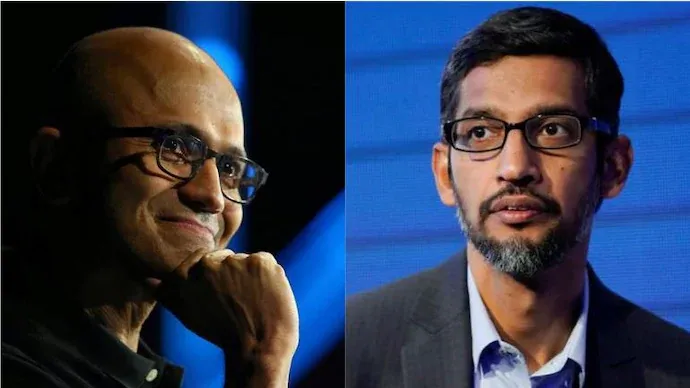
Sundar Pichai (Google/Alphabet CEO) and Satya Nadella (Microsoft CEO) — the two Indian-born Hindu leaders running global tech giants. Hindu values shaping their leadership.
Quick Answer: Sundar Pichai (b. 1972) is the CEO of Google and Alphabet since 2015 (Alphabet CEO since 2019), and Satya Nadella (b. 1967) is the CEO of Microsoft since 2014 — making them simultaneously the two most powerful corporate executives of Indian origin in world history. Both were born in Tamil Nadu (Pichai in Madurai) and Andhra Pradesh (Nadella in Hyderabad) respectively, educated in Indian institutions before moving to the United States for graduate studies, and have led their companies through transformative periods including the AI revolution. Beyond corporate achievement, both have explicitly drawn on Hindu values — particularly the Bhagavad Gita, empathy, dharmic action, and long-term thinking — in their leadership philosophies. Satya Nadella's 2017 book "Hit Refresh" explicitly engages spiritual themes; Sundar Pichai's leadership style has been described as quietly dharmic. Together they represent the maturation of Indian-American leadership in global technology — the realisation of what Vivekananda's 1893 Chicago address presaged.
1. Sundar Pichai — Madurai to Google CEO
Born June 10, 1972 in Madurai, Tamil Nadu, to Regunatha Pichai (an electrical engineer at GEC) and Lakshmi Pichai. The family lived modestly in a two-room apartment in Chennai. Sundar shared a room with his younger brother; the family did not own a refrigerator or a car. His mother stenographed his school notes. He was 12 when the family got their first telephone.
Education:
- Jawahar Vidyalaya, Ashok Nagar, Chennai (secondary school)
- Vana Vani School, IIT Madras campus (Class 12)
- IIT Kharagpur — Bachelor's in Metallurgical Engineering (1993)
- Stanford University — Master's in Materials Science (1995)
- The Wharton School, University of Pennsylvania — MBA (2002)
Career path:
- Applied Materials and McKinsey & Company (early career)
- Joined Google in 2004 — assigned to Google Toolbar; led the team that ultimately built Google Chrome browser (launched 2008)
- Led Google Chrome OS, Android (succeeding Andy Rubin in 2013)
- Made CEO of Google in 2015 when Larry Page restructured the company as Alphabet
- Made CEO of Alphabet (parent company) in 2019
Under Pichai's leadership, Google has navigated the AI revolution (launching Gemini AI), the antitrust scrutiny from US and EU regulators, the post-pandemic remote work reorganisation, and the layoffs of 2023-2026. Alphabet's market capitalisation under his leadership has crossed $2 trillion.
2. Satya Nadella — Hyderabad to Microsoft CEO
Born August 19, 1967 in Hyderabad, Andhra Pradesh (now Telangana), to Bukkapuram Nadella Yugandhar (an IAS officer in the Indian Administrative Service) and Prabhavati (a Sanskrit lecturer). His mother's deep Sanskrit knowledge shaped his early intellectual environment.
Education:
- Hyderabad Public School, Begumpet (where Microsoft's later CEO Sundar's contemporary Shantanu Narayen of Adobe also studied — three IIT/HPS contemporaries became Fortune 500 CEOs)
- Manipal Institute of Technology, Karnataka — Bachelor's in Electrical Engineering (1988)
- University of Wisconsin-Milwaukee — Master's in Computer Science (1990)
- University of Chicago Booth School of Business — MBA (1997)
Career path:
- Sun Microsystems (early career)
- Joined Microsoft in 1992
- Various roles across Microsoft including Server and Tools (revenue grew from $4B to $20B+), Bing search, Microsoft Business Division
- Cloud and Enterprise Division head (2011-2014)
- Made CEO of Microsoft in February 2014
Under Nadella's leadership, Microsoft has transformed from a relatively stagnant PC-era company to a leading cloud and AI enterprise. Azure cloud services have grown into a major competitor to Amazon Web Services. The OpenAI partnership (and Copilot integration into Office, Windows, GitHub) has positioned Microsoft as a leader in the AI era. Microsoft's market capitalisation has crossed $3 trillion under his leadership — at times briefly becoming the world's most valuable company.
3. The Indian-American CEO Phenomenon
The 2020s have seen unprecedented Indian-American leadership in global technology:
- Sundar Pichai — Google/Alphabet
- Satya Nadella — Microsoft
- Shantanu Narayen — Adobe (CEO since 2007)
- Arvind Krishna — IBM (CEO since 2020)
- Parag Agrawal — Twitter/X (CEO 2021-2022)
- Indra Nooyi — PepsiCo (CEO 2006-2018; pioneered the Indian-American CEO era)
- Multiple other Fortune 500 CEOs of Indian origin
This concentration is not accidental. Common factors:
- Strong STEM education in India (IITs, IIITs, BITS, top engineering colleges)
- Quantitative discipline developed in Indian educational system
- Family culture of academic emphasis
- Language English providing a global communication advantage
- Network effects — earlier Indian-American CEOs mentoring next generation
- Hindu cultural values — long-term thinking, family-as-team, humility — that translate well to corporate leadership
4. Hindu Values in Pichai's Leadership
Sundar Pichai's leadership style — described by Google employees and outside observers — combines:
Empathy and listening
Pichai is known for spending time genuinely listening to employee concerns. In numerous interviews, he has described his upbringing's emphasis on patient consideration of others' perspectives — a quality echoed in the Bhagavad Gita's teachings on equanimity.
Long-term thinking
Google's investments in AI research (especially DeepMind, Brain, the broader AI infrastructure) have been multi-decade bets. Pichai's willingness to invest in long-term projects without immediate returns reflects a thoughtful, multi-generational orientation.
Quiet confidence
Unlike some tech CEOs who lead through public personality, Pichai has consistently preferred quieter leadership. His public statements are measured; his Twitter (now X) presence is minimal; his focus is execution rather than performance.
Family connection
Pichai has spoken of his parents' values — his mother's commitment to his education, his father's willingness to sacrifice for his learning, his shared room with his brother. These family bonds clearly anchor his identity even at Google scale.
Respect for tradition
Pichai has made multiple references to Hindu and Indian cultural roots in interviews. He has attended major Indian community events; participated in Indian-American philanthropy; maintained connections with IIT Kharagpur alumni networks.
5. Hindu Values in Nadella's Leadership
Satya Nadella's leadership — and his explicit articulation in his book "Hit Refresh" (2017) — has been more visibly informed by Hindu and broader spiritual themes:
Empathy as core leadership principle
Nadella's signature leadership emphasis is empathy. He has connected this directly to his life experiences — particularly raising his son Zain, who lived with cerebral palsy and other significant health conditions until his passing in 2022. Nadella has explicitly drawn from his Hindu upbringing's teachings on compassion and detachment from outcomes.
"Hit Refresh" and the Bhagavad Gita
In his 2017 book "Hit Refresh," Nadella explicitly references Hindu thought including the Bhagavad Gita's framework of action and detachment. He has spoken about his reading of Indian philosophy, including the Upanishads, alongside other intellectual traditions.
Growth mindset
Nadella popularized the concept of "growth mindset" within Microsoft (drawn from Carol Dweck's work). The teaching maps onto Hindu philosophy's emphasis on karma as cultivation — actions performed today determine the conditions of tomorrow; we are continuously building the person we are becoming.
Sanskrit influences
Nadella's mother Prabhavati was a Sanskrit lecturer. Sanskrit-informed thinking is visible in his strategic articulation — particularly his preference for elegant, multi-dimensional framings over simplistic single-issue thinking.
Customer obsession
Nadella has redirected Microsoft's culture from technical-arrogance to customer-empathy. The teaching: success follows from serving others, not from imposing on them. This is a deeply dharmic orientation translated into corporate strategy.
6. Comparison — Two Different Styles, Common Roots
- Public style · Quieter, more reserved · More visibly spiritual; explicit in writings
- Leadership emphasis · Execution and long-term technical excellence · Empathy, growth mindset, cultural transformation
- Public communication · Minimal personal exposure · Frequent media engagement; books
- Hindu reference style · Cultural / family-rooted · Explicit philosophical reference
- Company focus · Search, AI, Android, Chrome · Cloud, AI (with OpenAI), Office, Azure
Both share:
- Tamil/Telugu Indian roots (Pichai Tamil; Nadella Telugu)
- Modest middle-class upbringing
- IIT-or-equivalent engineering plus US graduate education
- US tech industry career progression
- Promotion within company rather than external hire to CEO
- Hindu cultural identity carried into corporate leadership
7. The Bhagavad Gita and Modern Tech Leadership
Both Pichai and Nadella's leadership styles — and that of many other Indian-American tech leaders — reflect implicit or explicit Bhagavad Gita teaching. Specifically:
Karmanye Vadhikaraste — Action Without Attachment
The CEOs of Google and Microsoft must make decisions affecting billions of users and millions of employees, with outcomes that no individual can fully control. Acting fully while releasing attachment to specific outcomes — the Gita's teaching of nishkama karma — is functionally necessary at this scale.
Sthitaprajna — The Steady-Minded Leader
The Gita's description of the sthitaprajna (one of steady wisdom) — unmoved by praise or blame, by gain or loss — describes the temperament that survives multi-year tech industry cycles, AI disruption waves, regulatory scrutiny, and competitive pressure.
Swadharma — Your Own Duty
The Gita's emphasis on swadharma (your own particular duty) rather than paradharma (someone else's) suggests that the CEO should focus on what they alone can do — strategic direction, cultural leadership, key personnel — rather than micro-managing technical decisions that their teams should own.
Lokasamgraha — Welfare of All
The Gita's teaching that one acts not just for personal liberation but for the welfare of all beings (*lokasamgraha*) maps onto the responsible-tech narrative — the CEO whose decisions affect global users carries a duty broader than shareholder return.
8. Critique and Complexity
The Sundar Pichai / Satya Nadella narrative deserves nuanced engagement, not uncritical celebration:
Layoffs and worker conditions
Both Google and Microsoft conducted significant layoffs in 2023-2024 — Microsoft 10,000+, Google 12,000+. These decisions, while perhaps strategically necessary, involved real human costs. The dharmic implications are complex.
Antitrust and competition
Both companies face significant antitrust scrutiny in US, EU, India, and other jurisdictions. The CEO's role in either defending or accepting regulatory interventions has dharmic dimensions.
AI ethics
Both companies are at the forefront of AI development — with profound implications for employment, information ecosystem, social media, and human consciousness. Whether their AI strategies are dharmically aligned remains an open question that Hindu thinkers should engage seriously.
Treatment of Indian employees
Significant numbers of Indian-American employees at Google and Microsoft have, over the years, raised concerns about advancement opportunities, caste-based microaggressions, and other issues. The Indian-CEO leadership has not always resolved these tensions.
Political alignments
Both CEOs have navigated complex political environments — US elections, Indian political shifts, EU regulation. The dharmic positioning is rarely simple.
The Hindu critique of corporate leadership tradition (drawn from texts like the Arthashastra and the Mahabharata) acknowledges these complexities — leadership at scale involves real moral compromises. Recognising the Hindu values both CEOs bring is not the same as endorsing every corporate decision they have made.
9. Lessons for NRI Hindus in 2026
Lesson 1: Cultural roots are competitive advantage
For NRI Hindus building careers in tech and beyond, the Indian cultural background — STEM-emphasis, family discipline, Hindu values — is not a barrier to integration but an asset to be deployed.
Lesson 2: Quiet excellence outperforms loud claims
Both Pichai and Nadella demonstrate that quiet, sustained excellence reaches higher than loud self-promotion. The Hindu cultural tendency toward modesty often serves NRI professionals well over the long term.
Lesson 3: Empathy is a leadership skill
Nadella's empathy-centred leadership has transformed Microsoft. The teaching: emotional intelligence and genuine care for others is not "soft" but is the most powerful leadership lever at scale.
Lesson 4: Take the long view
Both CEOs lead multi-decade projects (AI development, cloud infrastructure, organisational transformation). NRI Hindu professionals who orient toward long-term outcomes rather than quarterly results align with the deepest Hindu wisdom.
Lesson 5: Family ground matters
Both CEOs remain anchored in family. Nadella's experience raising Zain shaped his leadership. Pichai speaks frequently of his parents. The teaching: do not let career ambition crowd out family ground.
Lesson 6: Civilisational pride is appropriate
The achievement of Indian-Americans at the top of global technology should be celebrated, not minimised. The visibility of Pichai and Nadella legitimises NRI Hindu professional aspiration globally.
Lesson 7: Critical assessment alongside admiration
The teaching of mature Hindu civilisational thought is to admire genuine achievement while maintaining critical assessment. Pichai and Nadella deserve admiration AND complex ethical engagement — both, not either-or.
10. FAQs
Q: Is Sundar Pichai a practising Hindu?
A: He has identified culturally with Hindu heritage in multiple interviews. His specific religious practice is private. He has attended Indian-American community events and supported Indian philanthropy.
Q: Is Satya Nadella a practising Hindu?
A: He has explicitly drawn from Hindu philosophy (Bhagavad Gita, broader Indian thought) in his book and speeches. His religious practice is private. His mother was a Sanskrit lecturer.
Q: What's the salary of Google and Microsoft CEOs?
A: Both receive nine-figure compensation packages, with most value coming through equity. Specific recent figures vary by year. Both have been among the most-compensated US CEOs.
Q: Why are there so many Indian-American CEOs?
A: Combination of strong Indian educational foundations (especially IITs), English-language capability, US graduate education accessibility, network effects of earlier Indian leadership, and Hindu cultural values that translate well to corporate leadership.
Q: What is Sundar Pichai's birth town?
A: Madurai, Tamil Nadu, though he was raised primarily in Chennai.
Q: What is Satya Nadella's birth town?
A: Hyderabad, Andhra Pradesh (now Telangana).
Q: Have they returned to India?
A: Both visit India regularly — for company business, for family, for cultural events. Neither has relocated permanently to India.
Q: Have they contributed to Hindu causes?
A: Both have contributed to various educational, healthcare, and cultural initiatives in India. Specific gifts to specifically-Hindu institutions are less publicly documented; both tend toward broader Indian civilisational philanthropy.
Final Words
The leadership of Sundar Pichai at Google/Alphabet and Satya Nadella at Microsoft represents an unprecedented moment in modern history: two Indian-born, Hindu-cultured leaders simultaneously running the world's two largest technology companies during the AI revolution's defining era.
Beyond personal achievement, their leadership matters for what it demonstrates: Hindu civilisational values — empathy, long-term thinking, dharmic action, modesty, family grounding — can succeed at the very highest levels of global enterprise. The 1893 Chicago address by Swami Vivekananda — claiming Hindu civilisation's relevance to the modern world — finds part of its fulfillment in the 2026 reality of Pichai and Nadella's positions.
For NRI Hindus in 2026 — children of immigrants, building careers in foreign lands, sometimes wondering whether their cultural background is asset or liability — Pichai and Nadella's lives are encouraging proof. The values your grandmother taught you in Madurai or Hyderabad scale, when applied with discipline and genuineness, to the corner office of the world's most powerful companies.
The work ahead is to use those positions of power dharmically — and that is the question both leaders, in their different styles, continue to navigate.
Yogah karmasu kaushalam.* — Bhagavad Gita 2.50
Yoga is skill in action.
Pranam to the Indian-American tech leadership generation. Jai Hind. Jai Sanatan Dharma.
HinduTone Editorial Team · Tags: Sundar Pichai, Satya Nadella, Google CEO, Microsoft CEO, Indian-American CEOs, Hindu Tech Leaders, Bhagavad Gita Business, Silicon Valley Indians, Empathy Leadership, NRI Inspiration
Frequently Asked Questions
What is Sundar Pichai & Satya Nadella?
1972) is the CEO of Google and Alphabet since 2015 (Alphabet CEO since 2019), and Satya Nadella (b. 1967) is the CEO of Microsoft since 2014 — making them simultaneously the two most powerful corporate executives of Indian origin in world history.
What are the key points about Sundar Pichai & Satya Nadella?
Both were born in Tamil Nadu (Pichai in Madurai) and Andhra Pradesh (Nadella in Hyderabad) respectively, educated in Indian institutions before moving to the United States for graduate studies, and have led their companies through transformative periods including the AI revolution. Beyond corporate achievement, both have explicitly drawn
Why does Sundar Pichai & Satya Nadella matter in Hinduism?
It reflects core values of Sanatana Dharma and offers practical and spiritual guidance that remains relevant across generations.
How can devotees apply Sundar Pichai & Satya Nadella in daily life?
By reflecting on its teaching, incorporating the related practices or observances into daily routine, and approaching it with sincere devotion and understanding.
You might also like
Complete MBBS Once in Life: The Spiritual Meaning of Mahabharata, Bhagavatam, Bhagavad Gita & Ramayana
Karma, Rebirth, and Remembrance of God – Why Worship God Even During Good Times?

Illness – Banana Stem | A Divine Experience from Kanchi Paramacharya Vaibhavam