Shivashtakam (Prabhum Prananatham Vibhum Vishvanatham): Full Text with Meaning
The Shivashtakam beginning 'prabhum prananatham vibhum vishvanatham' is an eight-verse hymn to Lord Shiva with a phalashruti, every verse ending 'shivam shankaram shambhum ishanam ide'. Here is the complete text in Devanagari and IAST from sanskritdocuments.org, with our own plain-English meaning of each verse and when it is traditionally recited.
Quick answer: The Shivashtakam beginning 'prabhum prananatham vibhum vishvanatham' is a hymn of 8 verses and a phalashruti to Lord Shiva. Every verse ends 'śivaṃ śaṅkaraṃ śambhum īśānam īḍe' ('I praise Shiva, Shankara, Shambhu, Ishana'). It is recited on Mondays, Pradosham and Shivaratri, and in Karthika Masam.
Last updated: 21 October 2026. The Sanskrit below is the complete text published by sanskritdocuments.org (file shiva8_1.itx; no composer, transliterator or proofreader named), converted to Devanagari and IAST by software from the source, with no word typed by hand and no letter changed. Our own plain-English meaning follows every verse.
Shivashtakam: full text with meaning
Each verse appears in Devanagari and then in IAST transliteration, followed by its meaning. Each verse heaps up names and images of Shiva in the accusative ('the Lord who ...') and then completes the sentence with the refrain, 'I praise'.
Opening
॥ अथ श्री शिवाष्टकम् ॥
|| atha śrī śivāṣṭakam ||
Meaning: Now begins the Sri Shivashtakam.
The Lord of all (verses 1 to 4)
Verse 1
प्रभुं प्राणनाथं विभुं विश्वनाथं जगन्नाथनाथं सदानन्दभाजम् ।
भवद्भव्यभूतेश्वरं भूतनाथं शिवं शङ्करं शम्भुमीशानमीडे ॥ १॥
prabhuṃ prāṇanāthaṃ vibhuṃ viśvanāthaṃ jagannāthanāthaṃ sadānandabhājam |
bhavadbhavyabhūteśvaraṃ bhūtanāthaṃ śivaṃ śaṅkaraṃ śambhumīśānamīḍe || 1||
Meaning: The Master, the Lord of life, the all-pervading Lord of the universe, the Lord even of Jagannatha (Vishnu), who ever shares in bliss; the ruler of what was, is and will be, the Lord of all beings: I praise Shiva, Shankara, Shambhu, Ishana.
Verse 2
गले रुण्डमालं तनौ सर्पजालं महाकालकालं गणेशाधिपालम् ।
जटाजूटगङ्गोत्तरङ्गैर्विशालं शिवं शङ्करं शम्भुमीशानमीडे ॥ २॥
gale ruṇḍamālaṃ tanau sarpajālaṃ mahākālakālaṃ gaṇeśādhipālam |
jaṭājūṭagaṅgottaraṅgairviśālaṃ śivaṃ śaṅkaraṃ śambhumīśānamīḍe || 2||
Meaning: Who wears a garland of skulls at his throat and a net of serpents on his body, who is death to Mahakala (death itself), protector of Ganesha and the leaders of his hosts; who is vast with the waves of the Ganga in his matted locks: I praise Shiva, Shankara, Shambhu, Ishana.
Verse 3
मुदामाकरं मण्डनं मण्डयन्तं महामण्डलं भस्मभूषाधरं तम् ।
अनादिह्यपारं महामोहहारं शिवं शङ्करं शम्भुमीशानमीडे ॥ ३॥
mudāmākaraṃ maṇḍanaṃ maṇḍayantaṃ mahāmaṇḍalaṃ bhasmabhūṣādharaṃ tam |
anādihyapāraṃ mahāmohahāraṃ śivaṃ śaṅkaraṃ śambhumīśānamīḍe || 3||
Meaning: A mine of joy, the ornament that adorns all ornaments, the great circle of the cosmos, who wears ash as his decoration; without beginning and without end, who takes away great delusion: I praise Shiva, Shankara, Shambhu, Ishana.
Verse 4
वटाधोनिवासं महाट्टाट्टहासं महापापनाशं सदासुप्रकाशम् ।
गिरीशं गणेशं महेशं सुरेशं शिवं शङ्करं शम्भुमीशानमीडे ॥ ४॥
vaṭādhonivāsaṃ mahāṭṭāṭṭahāsaṃ mahāpāpanāśaṃ sadāsuprakāśam |
girīśaṃ gaṇeśaṃ maheśaṃ sureśaṃ śivaṃ śaṅkaraṃ śambhumīśānamīḍe || 4||
Meaning: Who dwells at the foot of the banyan tree, whose laughter rolls like thunder, who destroys great sin and shines forever; the Lord of the mountain, Lord of the ganas, the great Lord, Lord of the gods: I praise Shiva, Shankara, Shambhu, Ishana.
Shiva with Parvati, the trident and the bull (verses 5 to 8)
Verse 5
गिरिन्द्रात्मजासंग्रहीतार्धदेहं गिरौ संस्थितं सर्वदा सन्नगेहम् ।
परब्रह्मब्रह्मादिभिर्वन्द्यमानं शिवं शङ्करं शम्भुमीशानमीडे ॥ ५॥
girindrātmajāsaṃgrahītārdhadehaṃ girau saṃsthitaṃ sarvadā sannageham |
parabrahmabrahmādibhirvandyamānaṃ śivaṃ śaṅkaraṃ śambhumīśānamīḍe || 5||
Meaning: Half of whose body is taken by the daughter of the king of mountains (Parvati), who dwells on the mountain as his home for ever; who is worshipped by the supreme Brahman, Brahma and the other gods: I praise Shiva, Shankara, Shambhu, Ishana.
Verse 6
कपालं त्रिशूलं कराभ्यां दधानं पदाम्भोजनम्राय कामं ददानम् ।
बलीवर्दयानं सुराणां प्रधानं शिवं शङ्करं शम्भुमीशानमीडे ॥ ६॥
kapālaṃ triśūlaṃ karābhyāṃ dadhānaṃ padāmbhojanamrāya kāmaṃ dadānam |
balīvardayānaṃ surāṇāṃ pradhānaṃ śivaṃ śaṅkaraṃ śambhumīśānamīḍe || 6||
Meaning: Who holds a skull and a trident in his two hands, who grants their desire to those who bow at his lotus feet; who rides the bull and is the chief of the gods: I praise Shiva, Shankara, Shambhu, Ishana.
Verse 7
शरच्चन्द्रगात्रं गुणानन्द पात्रं त्रिनेत्रं पवित्रं धनेशस्य मित्रम् ।
अपर्णाकलत्रं चरित्रं विचित्रं शिवं शङ्करं शम्भुमीशानमीडे ॥ ७॥
śaraccandragātraṃ guṇānanda pātraṃ trinetraṃ pavitraṃ dhaneśasya mitram |
aparṇākalatraṃ caritraṃ vicitraṃ śivaṃ śaṅkaraṃ śambhumīśānamīḍe || 7||
Meaning: Whose body is bright as the autumn moon, the vessel of virtue and bliss, the three-eyed, the pure, the friend of Kubera (lord of wealth); whose wife is Aparna (Parvati), whose deeds are wonderful: I praise Shiva, Shankara, Shambhu, Ishana.
Verse 8
हरं सर्पहारं चिता भूविहारं भवं वेदसारं सदा निर्विकारम् ।
श्मशाने वसन्तं मनोजं दहन्तं शिवं शङ्करं शम्भुमीशानमीडे ॥ ८॥
haraṃ sarpahāraṃ citā bhūvihāraṃ bhavaṃ vedasāraṃ sadā nirvikāram |
śmaśāne vasantaṃ manojaṃ dahantaṃ śivaṃ śaṅkaraṃ śambhumīśānamīḍe || 8||
Meaning: Hara, who wears serpents as a necklace and roams the cremation ground; Bhava, the essence of the Vedas, ever changeless; who dwells in the cremation ground and burned Manmatha, the god of love: I praise Shiva, Shankara, Shambhu, Ishana.
Phalashruti (verse 9)
Verse 9 (phalashruti)
स्तवं यः प्रभाते नरः शूलपाणे पठेत् सर्वदा भर्गभावानुरक्तः ।
स पुत्रं धनं धान्यमित्रं कलत्रं विचित्रं समासाद्य मोक्षं प्रयाति ॥ ९॥
stavaṃ yaḥ prabhāte naraḥ śūlapāṇe paṭhet sarvadā bhargabhāvānuraktaḥ |
sa putraṃ dhanaṃ dhānyamitraṃ kalatraṃ vicitraṃ samāsādya mokṣaṃ prayāti || 9||
Meaning: The person who, devoted to Bharga (Shiva), recites this hymn every morning, O holder of the trident, gains sons, wealth, grain, friends, a wife and many wonders, and goes to liberation.
Colophon
॥ इति शिवाष्टकं सम्पूर्णम् ॥
|| iti śivāṣṭakaṃ sampūrṇam ||
Meaning: Thus ends the Shivashtakam.
The images of Shiva in this hymn
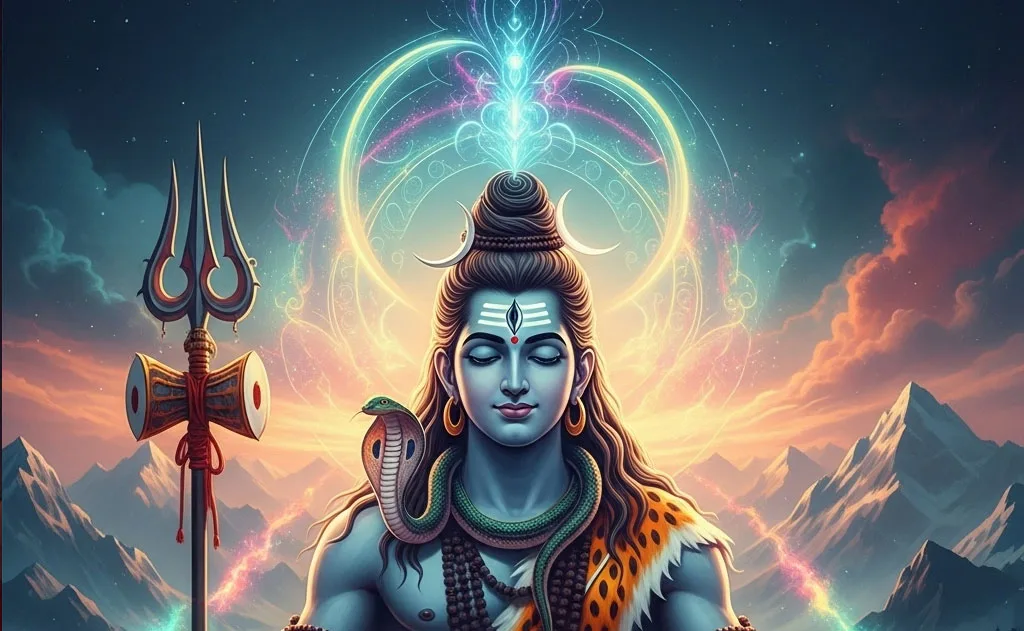
The Shivashtakam is a gallery of Shiva's many forms: the cosmic Lord of past, present and future; the ascetic with ash, serpents and skulls; Dakshinamurti seated under the banyan tree; Ardhanarishvara, half Parvati; and the Lord who burned Kama. Read more on our Shiva hub.
| Verse | What it shows |
|---|---|
| 1 | Lord of life and of the universe, Lord of past, present and future |
| 2 | garland of skulls, serpents, the Ganga in his matted locks |
| 3 | ash-adorned, without beginning or end, remover of delusion |
| 4 | seated under the banyan tree, thunderous laughter, Lord of the mountain |
| 5 | sharing his body with Parvati, worshipped by Brahma and the gods |
| 6 | skull and trident in hand, riding the bull, granting desires |
| 7 | moon-white, three-eyed, friend of Kubera, husband of Aparna |
| 8 | dweller in the cremation ground, burner of Kama, essence of the Vedas |
When is it traditionally recited?
- On Mondays: Shiva's day. See the guide to Monday in Hinduism and the Monday rituals guide for NRI families.
- On Pradosham and Shivaratri: see the Pradosham guide; the next Masik Shivaratri is Saturday 7 November 2026, and Karthika Masa Shivaratri falls on Monday 7 December 2026 (dates for India; check your local panchang).
- In Karthika Masam: on the Karthika Somavarams of 2026, Mondays 16, 23 and 30 November and 7 December.
- In the morning: the phalashruti itself speaks of reciting it at daybreak (prabhāte).
How to recite it at home
- Light a lamp before a Shiva lingam or an image of Shiva, and offer water, milk or a few bilva leaves.
- Recite the opening line and the eight verses; the family can join in the refrain.
- End with the phalashruti (verse 9) and aarti.
- On a longer day, add the Bilvashtakam, the Lingashtakam or the 108 names of Shiva.
- Close with 'om namah shivaya' a few times; see our Panchakshara mantra guide.
Pronunciation help
- The metre is bhujangaprayata: each line is four groups of 'da-DUM-DUM' (short, long, long), as in 'pra-bhuṃ prā-ṇa-nā-thaṃ'.
- A line over a vowel (ā, ī, ū) means it is held twice as long; ṃ is a nasal hum; ś and ṣ are both 'sh' sounds.
- 'Īśānam īḍe' is said 'eeshaanam eede', with the ḍ softly curled back.
Traditional beliefs about the Shivashtakam
Devotees traditionally believe that reciting the Shivashtakam with devotion:
- brings the grace of Shiva, who 'grants their desire to those who bow at his feet' (verse 6);
- helps to loosen 'great delusion' (verse 3), the attachments that cloud the mind;
- is especially fruitful in the early morning, as the phalashruti says.
These are matters of faith, not guarantees of family, wealth or any outcome.
Tips for NRI families
- Sing it to the beat. The 'serpent's gait' rhythm is easy for children to clap along to.
- Use the table. Ask children to find each image of Shiva (the moon, the Ganga, the trident, the bull) in a picture at your home shrine.
- Go further. Try the Rudrashtakam, the Shiva Panchakshara Stotram, the Kalabhairava Ashtakam or the Kashi Vishwanathashtakam.
Frequently asked questions
Who composed the Shivashtakam?
Popular books often attribute it to Adi Shankaracharya, but the sanskritdocuments.org text we use names no composer: it has no Author field and its colophon says only 'iti Shivashtakam sampurnam'. We therefore give no composer.
What does the refrain mean?
'Śivaṃ śaṅkaraṃ śambhum īśānam īḍe' means 'I praise Shiva (the auspicious), Shankara (who brings welfare), Shambhu (the source of joy) and Ishana (the ruler)'. All four are names of the one Lord.
Is this the same as the Rudrashtakam?
No. The Rudrashtakam of Tulsidas ('namamiisham ishana nirvanarupam') is sometimes also called a Shivashtakam, and there are several other hymns with this name. This page gives the one that begins 'prabhum prananatham'. See our separate Rudrashtakam page.
When is it traditionally recited?
On Mondays, Pradosham, Masik Shivaratri (Saturday 7 November 2026 in India) and the Karthika Somavarams of 2026 (Mondays 16, 23 and 30 November and 7 December), and on any day after lighting the lamp before Shiva.
How long does it take?
About three minutes. The metre (bhujangaprayata, the 'serpent's gait') has a steady rolling beat that makes it easy to sing together.
What does the phalashruti promise?
Verse 9 says that one who recites it every morning with devotion gains family, wealth and friends and finally liberation. Devotees traditionally believe it brings Shiva's grace; it is an act of faith, not a guarantee of any worldly result.
Editor's note (21 October 2026)
This page was published on 21 October 2026 at the address readers and search engines were already requesting. The Sanskrit is the full text of Shivashtakam 1 on sanskritdocuments.org (file shiva8_1.itx). The file names no composer, transliterator or proofreader, so we name none, although the hymn is often attributed to Adi Shankaracharya in popular books. sanskritdocuments.org has several other hymns called Shivashtakam, but they are different texts, so there is no second copy of this one to compare with, and no letter is changed. Some readings are kept exactly as printed: verse 3 'anādihyapāraṃ' (anādiṃ hy apāram), verse 4 'sadāsuprakāśam', the spaces in verse 7 'guṇānanda pātraṃ' and verse 8 'citā bhūvihāraṃ', and verse 9 'śūlapāṇe', which we read as an address to Shiva ('O holder of the trident'); many editions print 'śūlapāṇeḥ' ('the hymn of the trident-holder'). The meanings are our own.
Related guides
Share this with family and friends
Send it on WhatsApp, post it, or copy the link.
You might also like
Durgashtakam (Katyayani Mahamaye): Full Sanskrit Text with Meaning
Ganeshashtakam (Yato Anantashakteh) from the Ganesha Purana: Full Text with Meaning
Kashi Vishwanath Ashtakam (Gangataranga Ramaniya Jatakalapam): Full Text with Meaning