
Pradosham: Complete Guide to Monday Shiva Puja on the 13th Lunar Day
Complete guide to Pradosham — the sacred 13th-lunar-day evening window for Lord Shiva worship. Covers all 7 weekday variants (Soma, Bhauma, Saumya, Guru, Shukra, Shani, Ravi Pradosham), Pradosh Kala timing, the cosmic Halahala story, step-by-step puja procedure, Pradosha Stotra, NRI guide, and FAQs.
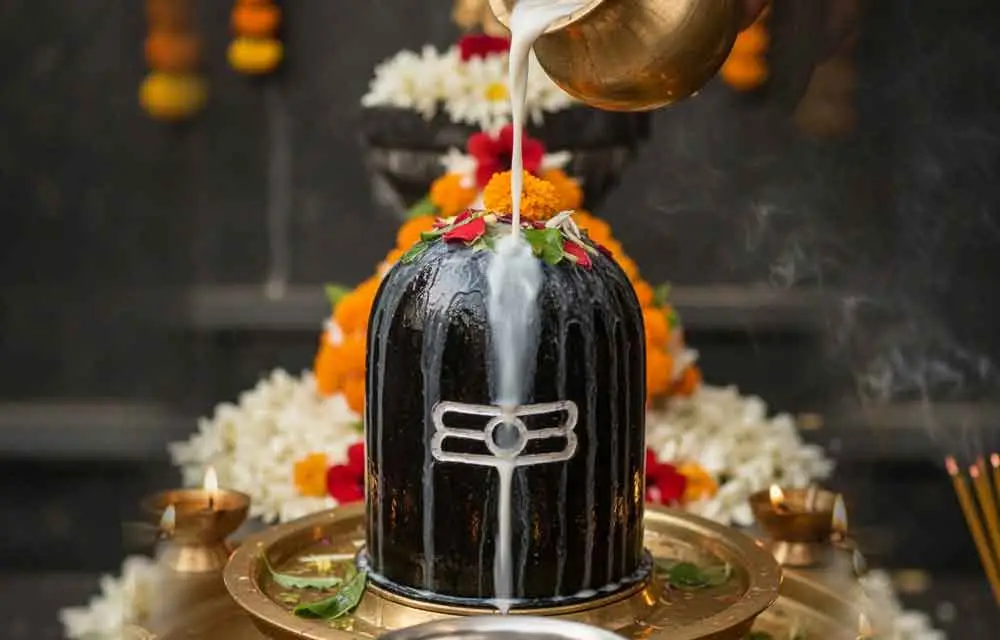
Complete guide to Pradosham — the sacred 13th-lunar-day evening window for Lord Shiva worship. Covers all 7 weekday variants (Soma, Bhauma, Saumya, Guru, Shukra, Shani, Ravi Pradosham), Pradosh Kala timing, the cosmic Halahala story, step-by-step puja procedure, Pradosha Stotra, NRI guide, and FAQs.
Of all the recurring spiritual occasions in the Hindu calendar dedicated to Lord Shiva, none is more revered — or more universally observed — than the Pradosham. Falling twice a month at the precise moment of evening twilight on the thirteenth day (trayodashi) of each lunar fortnight, Pradosham is considered the singular window when Lord Shiva dances in joy at Mount Kailash, accompanied by Parvati, Nandi, and all the devatas. Devotees who worship during this brief sacred hour are said to receive the merit of an entire year of devotion in a single evening.
This complete HinduTone guide covers everything you need to know about Pradosham — the cosmological story behind it, the precise timing rules, the powerful Soma Pradosham (Monday + Pradosham combination), step-by-step puja procedure, the Pradosha Stotra, regional variations across India, NRI practice guide, scriptural authority, and answers to the most frequently asked questions.
🔱 Om Namah Shivaya 🔱
What Is Pradosham?
The Sanskrit word Pradosham (pra-dosha) translates roughly as "the removal of evil/sin/darkness" — "pra" meaning "intensely or completely" and "dosha" meaning "fault, blemish, or impurity." The compound implies the time during which faults are removed by divine grace.
In practice, Pradosham refers to two things:
- Pradosham Day — The 13th tithi (lunar day) of each fortnight of the Hindu calendar. This means Pradosham occurs twice every month — once in the Shukla Paksha (waxing fortnight) and once in the Krishna Paksha (waning fortnight).
- Pradosh Kala — The specific twilight window each Pradosham day, when Shiva is said to be most accessible. This window is approximately 1.5 hours before sunset to 1.5 hours after sunset (roughly 4:30 PM to 6:30 PM in most Indian latitudes, varying by season).
The Cosmological Story Behind Pradosham
The deepest scriptural account of Pradosham comes from the Skanda Purana. It tells of the great Samudra Manthan — the cosmic churning of the milk ocean by the devas (gods) and asuras (demons) to obtain Amrit, the nectar of immortality.
Mount Mandara served as the churning rod, and the great serpent Vasuki as the rope. As the devas and asuras pulled Vasuki back and forth, churning the cosmic ocean, many precious treasures emerged: the celestial cow Kamadhenu, the wish-fulfilling tree Kalpavriksha, the goddess Lakshmi, the divine physician Dhanvantari, and many others. But just before the Amrit arose, something terrible emerged from the depths — Halahala, a poison so virulent that it threatened to destroy all three worlds.
The devas and asuras both panicked. They ran in every direction, leaving the cosmic work incomplete. In their desperation, they fled to Lord Shiva at Mount Kailash and begged Him to save creation. Out of His infinite compassion, Lord Shiva accepted the Halahala into His own throat. Mother Parvati immediately pressed His throat with her hands to prevent the poison from reaching His stomach (which would have harmed creation itself). The Halahala remained locked in His throat, which turned blue — earning Shiva the name Neelakantha (the blue-throated one).
At the exact moment of evening twilight on the trayodashi (13th lunar day) that this great act of cosmic compassion occurred, all the gods and devotees in Kailash gathered to thank Lord Shiva. Parvati, overjoyed and grateful, placed Shiva on Nandi (the sacred bull) and the entire heavenly court erupted in celebration. Lord Shiva, also moved by His own act, danced the cosmic dance of joy — the Pradosha Nritya. This twilight celebration is reenacted in subtle vibration every fortnight on the 13th lunar day at the same hour — and this is the Pradosham window.
The scripture states:
"During Pradosham, all 33 crore devatas leave their celestial abodes to join Shiva at Kailash for the cosmic celebration. A devotee who worships Shiva during this window receives the blessings of all 33 crore devatas simultaneously."
How to Calculate Pradosham Timing
The exact Pradosh Kala depends on your local sunset time (which varies by latitude, longitude, and season). The general rule:
- Pradosh Kala begins approximately 1.5 hours before sunset
- Pradosh Kala peaks at the moment of sunset
- Pradosh Kala ends approximately 1.5 hours after sunset
- Total window: ~3 hours straddling the moment of sunset
For example, in Hyderabad/Bengaluru/Chennai (around 17.5°N latitude):
- Summer Pradosh Kala — approximately 5:00 PM to 8:00 PM
- Winter Pradosh Kala — approximately 4:30 PM to 7:30 PM
For NRI devotees in colder climates (UK, Canada, USA East Coast):
- Winter — Pradosh Kala may start as early as 3:00 PM and end by 6:00 PM (very short sunset window)
- Summer — Pradosh Kala extends from 7:00 PM to 10:00 PM (long evening twilight)
HinduTone publishes precise daily Pradosh Kala timings for major cities. Always cross-verify with the daily Drik Panchang for your specific city before performing the puja.
Types of Pradosham — All 7 Variants
While every Pradosham is powerful, certain combinations of weekdays + Pradosham create especially potent occasions. The seven traditional types are:
1. Soma Pradosham (Monday + Pradosham)
When Pradosham falls on a Monday — the day already sacred to Shiva — the combined power is considered the most spiritually transformative window in the Hindu calendar. Soma Pradosham is regarded as equivalent to performing 1,000 Shiva pujas in a single evening. Devotees fast all day, observe complete silence after sunset, and chant the Pradosha Stotra at the precise Pradosh Kala moment. Many serious Shiva sadhakas plan their major spiritual goals around Soma Pradosham observances.
2. Bhauma Pradosham (Tuesday + Pradosham)
When Pradosham falls on a Tuesday (ruled by Mangal/Mars), the puja is said to grant protection from accidents, conflicts, and Mangal Dosha (Mars affliction in Vedic astrology). Devotees with martial professions, athletic pursuits, or surgical procedures often observe Bhauma Pradosham for divine protection.
3. Saumya Pradosham (Wednesday + Pradosham)
Wednesday is ruled by Budha (Mercury). Saumya Pradosham is observed by students, scholars, business professionals, and writers seeking divine blessings for wisdom, intelligence, and successful communication. Speech-related afflictions and Budha Dosha are addressed through this Pradosham.
4. Guru Pradosham (Thursday + Pradosham)
Thursday is the day of Guru/Brihaspati (Jupiter). Guru Pradosham grants the blessings of wisdom, expansion, marriage (for unmarried women), and spiritual progress. The traditional belief is that all guru-related obstacles dissolve on this Pradosham.
5. Shukra Pradosham (Friday + Pradosham)
Friday is sacred to Goddess Lakshmi and the planet Venus (Shukra). Shukra Pradosham combines Shiva and Lakshmi worship — it is observed by those seeking wealth, marital happiness, and beauty in life. Couples often observe Shukra Pradosham together for relationship harmony.
6. Shani Pradosham (Saturday + Pradosham)
Saturday is ruled by Shani (Saturn) — the karmic judge. Shani Pradosham is one of the most powerful days for relief from Saturn afflictions (Sade-sati, Ashtama Shani, Shani Dosha). Lord Shiva is the only deity who can pacify Lord Shani, who is Shiva's devotee. Devotees suffering from Saturn-related troubles flock to Shiva temples on Shani Pradosham.
7. Ravi Pradosham (Sunday + Pradosham)
Sunday is the day of Surya (Sun). Ravi Pradosham grants blessings for health, vitality, leadership, and divine grace. Family heads, professionals in leadership roles, and those seeking recognition observe Ravi Pradosham.
Maha Pradosham — The Special Combinations
Beyond the weekday variants, two specific Pradoshams every year are designated Maha Pradosham (Great Pradosham) — falling in the months of Margashirsha (Nov-Dec) and Magha (Jan-Feb). On these days, Pradosham worship is considered to grant the merit of thousands of regular Pradoshams. Many major Shiva temples — including the 12 Jyotirlingas — hold elaborate Maha Pradosham celebrations.
The Pradosha Stotra — Sacred Hymn
The most beloved hymn recited during Pradosham is the Pradosha Stotra composed by Adi Shankaracharya. It contains 12 verses praising Lord Shiva dancing at Mount Kailash during the Pradosha hour. Here is the opening verse and its meaning:
Opening Verse
जय देव जगन्नाथ जय शङ्कर शाश्वत । जय सर्वसुरा-राधय सर्वसुर परारथः ॥
Jaya Deva Jagannatha · Jaya Shankara Shashvata · Jaya Sarvasura-aradhya · Sarvasura-paraarthah
Meaning: Victory to the Lord of the universe! Victory to Shankara, the eternal! Victory to the one worshipped by all the gods, who fulfills the highest purposes of the gods!
The Pradosha Nritya Visualization
During Pradosh Kala, devotees are instructed to visualize Lord Shiva dancing at Mount Kailash, accompanied by Nandi (the cosmic bull) and surrounded by celestial musicians and dancing devatas. Goddess Parvati sits on Nandi watching her divine consort in joy. Crores of celestial beings have gathered. The entire universe pauses in reverence. This visualization (dhyana) is itself a sadhana — a meditative practice that yields transformative merit.
Step-by-Step Pradosham Puja
Preparation (Before Pradosh Kala)
- Fast from sunrise on Pradosham day — observe a partial fast with fruits, milk, or one phalahar meal
- Wake before sunrise. Bathe and wear clean clothes (preferably white)
- Clean the puja altar; arrange the Shiva Linga, water, milk, honey, ghee, curd, sugar (for Panchamrita Abhishekam)
- Gather: Bilva leaves, white flowers (avoid red), kumkum, vibhuti, sandalwood paste, camphor, incense, diya with sesame oil or ghee
- About 1.5 hours before sunset, take a second bath if possible — this prepares you for the Pradosh window
During Pradosh Kala (Beginning ~1.5 Hours Before Sunset)
- Light the diya and incense to mark the start of the sacred window
- Sit before the Shiva Linga, close your eyes, and take a sankalpa: "On this sacred Pradosham, I, [your name], dedicate this worship to Lord Shiva."
- Visualize Shiva dancing at Kailash. Allow this image to fill your awareness.
- Perform a small Abhishekam — water, milk, honey, curd, ghee, sugar, then a final water rinse. Chant "Om Namah Shivaya" with each pour.
- Apply vibhuti and a small mark of kumkum to the Linga; sandalwood paste also.
- Offer Bilva leaves — minimum 21, ideally 108, in multiples of 3. Recite the Bilvashtakam if you have time.
- Recite the Lingashtakam or the Pradosha Stotra (or both).
- At the exact moment of sunset, light camphor and perform aarti, slowly circling the flame around the Linga while chanting "Om Jai Shiv Omkara."
- After sunset, sit in silent meditation for at least 15-20 minutes. This is the most sacred part of the entire window.
- Conclude with a brief mantra japa: "Om Namah Shivaya" at least 108 times (or as many as you can).
After Pradosh Kala
- Slowly break the fast with sattvic food — avoid heavy meals, onion, garlic, non-vegetarian, alcohol
- Distribute prasadam (the Abhishekam water — Panchamrita) to family members
- Maintain silent contemplation through the evening, going to bed early
- Some devotees observe complete silence (mauna) from sunset until next morning sunrise
Pradosham at Major Shiva Temples
The most powerful Pradosham experiences in India are at the 12 Jyotirlingas and other major Shiva shrines:
- Kashi Vishwanath, Varanasi — the elaborate Pradosham aarti is one of the most powerful religious experiences in Hinduism
- Trimbakeshwar, Maharashtra — Pradosham observance includes special abhishekam and Bilva offerings
- Bhimashankar, Maharashtra — known for its Soma Pradosham celebrations
- Grishneshwar, Maharashtra — Maha Pradosham draws thousands of devotees
- Somnath, Gujarat — Pradosham aarti at the original Jyotirlinga
- Mahakaleshwar, Ujjain — the famous Bhasma Aarti tradition extends to special Pradosham observances
- Omkareshwar, Madhya Pradesh — Pradosham parikrama (circumambulation) of the island
- Kedarnath, Uttarakhand — Pradosham in the high Himalayan shrine
- Vaidyanath, Jharkhand — Pradosham healing observances
- Nageshwar, Gujarat — Pradosham aarti with Tantric overtones
- Rameshwaram, Tamil Nadu — Pradosham + 22-well snanam combined sadhana
- Bhuvaneshwar, Odisha (Lingaraj) — Pradosham observances with Jagannath-Shiva integration
Pradosham for NRI Hindus
NRI Hindus across the USA, UK, Canada, UAE, Australia, and Singapore can observe Pradosham at home with equal devotion. The key adaptations:
- Calculate Pradosh Kala using your local sunset time — use HinduTone's Pradosham widget or apps like Drik Panchang for accuracy
- Set up a home puja altar with a Shiva Linga (idol or printed image) and the standard puja items (available from Indian grocery stores in your city)
- Source Bilva leaves from Indian stores or grow a Bilva tree at home (suitable for tropical/subtropical climates; conservatory plant for colder climates)
- Stream HinduTone's Pradosham bhajan playlist during the puja
- Join NRI Hindu community Pradosham gatherings — many temples in the USA (BAPS Mandirs, Hindu Temple of Atlanta, Hindu Temple Cultural Center Bothell), UK (Leicester, Birmingham, Wembley), Canada (Brampton, Surrey), and UAE (Dubai BAPS Mandir) hold formal Pradosham programs
- Maintain the fasting and discipline tradition even abroad — your home becomes a Shiva temple during Pradosh Kala
Benefits of Pradosham Observance
Spiritual Benefits
- Equivalent to performing 1,000 regular Shiva pujas (especially on Soma Pradosham)
- Direct connection with Lord Shiva during His cosmic dance hour
- Blessings of all 33 crore devatas accumulated in a single window
- Destruction of accumulated sins (papa-nashanam) of multiple lifetimes
- Steady progress toward liberation (moksha)
- Awakening of inner intuition, devotional fervor, and spiritual contentment
Astrological & Worldly Benefits
- Relief from planetary doshas — especially Shani Dosha, Mangal Dosha, Kala Sarpa Dosha, Pitra Dosha
- Marriage for unmarried women (especially on Guru Pradosham)
- Marital harmony and longevity of spouse
- Family prosperity, removal of financial obstacles
- Protection from accidents, illness, and unforeseen calamities
- Mental peace, calm, and freedom from anxiety
Health Benefits
- Weekly/fortnightly fasting promotes autophagy and cellular regeneration
- Evening puja and meditation reduce cortisol and improve sleep quality
- Devotional discipline strengthens willpower and emotional regulation
Common Pradosham Mistakes to Avoid
- Treating Pradosham as just another puja — the cosmic significance and visualization (Shiva dancing at Kailash) are essential
- Missing the exact Pradosh Kala window — performing the puja in the morning instead of evening loses the primary benefit
- Breaking the fast before completing the puja — eat only after the aarti and silent meditation
- Skipping the silent meditation after sunset — this is the most spiritually potent part of the entire observance
- Performing Pradosham puja with red flowers, onion, garlic, or non-vegetarian food in the home — these are inauspicious during Pradosh Kala
- Not consulting the daily Drik Panchang for the exact Pradosh Kala timing in your location
- Conflating Pradosham with regular Mondays (Somavar Vrat) — both are sacred but distinct practices
Pradosham vs Other Shiva Observances
- Pradosham — Twice monthly (13th lunar day) evening window — for Shiva worship during Shiva's cosmic dance hour
- Somavar Vrat — Every Monday — dedicated Monday devotion to Shiva
- Maha Shivratri — Once yearly (Phalguna month) — the great night of Shiva worship, lasting all night
- Sawan Somavar — Mondays of Shravan month (July-August) — most spiritually potent Mondays
- Karthik Somavaram — Mondays of Karthika month (Oct-Nov) — South Indian tradition
Pro Tip: For maximum spiritual benefit, combine practices — observe Somavar Vrat every Monday, attend Pradosham worship twice a month, fast and night-vigil on Maha Shivratri, and intensify all of these during Shravan/Karthika months.
Frequently Asked Questions
Q1. Can women observe Pradosham?
Absolutely. Pradosham worship is open to all devotees regardless of gender. Married women particularly observe Pradosham for their husband's long life and family prosperity, drawing on Parvati's example.
Q2. Can I observe Pradosham without going to a temple?
Yes. A home Shiva Linga and the sincere observance of Pradosh Kala with the prescribed puja is equally powerful. Visiting a temple is wonderful when possible but not mandatory.
Q3. What if I cannot fast due to health reasons?
Health comes first. A symbolic observance — light puja, recitation of mantras, and silent meditation during Pradosh Kala — is fully accepted by Lord Shiva. Diabetic and pregnant devotees should not observe strict fasts.
Q4. How long does the Pradosh Kala window last?
Approximately 3 hours total — 1.5 hours before sunset through 1.5 hours after sunset. The most sacred sub-window is the 30 minutes straddling the exact moment of sunset.
Q5. Is Pradosham always on the 13th lunar day?
Yes — Pradosham always falls on Trayodashi (13th lunar day) of both fortnights (Shukla Paksha and Krishna Paksha). The weekday varies, creating the seven variants (Soma Pradosham, Bhauma Pradosham, etc.).
Q6. Can I observe Pradosham every fortnight?
Yes, and it's highly encouraged. Twice-monthly Pradosham observance is one of the most powerful spiritual practices in Hinduism. Many sadhakas maintain this practice for years and report transformative results.
Q7. What is the difference between Pradosham and Pradosh Vrat?
Pradosham refers to the cosmic day and time window itself. Pradosh Vrat is the specific religious vow of fasting + puja observed on Pradosham days. The two are related but distinct — Pradosham is the occasion; Pradosh Vrat is the practice.
Q8. Why is Soma Pradosham (Monday Pradosham) the most powerful?
Both Monday and Pradosham are independently sacred to Lord Shiva. Their combination compounds the divine energy — the day of Soma (Shiva's ruling day) meets the hour of Shiva's cosmic dance. Devotees report extraordinary spiritual experiences on Soma Pradosham nights.
Plan Your Next Pradosham Today
Pradosham is one of the most accessible and powerful spiritual practices available to every Hindu — and yet many devotees miss it because they do not know when it occurs or what to do during the sacred window. Now you know.
Check the upcoming Pradosham dates for the next 30 days. Mark them in your calendar. Plan your fast, your puja items, your moment of silence at sunset. Lord Shiva, dancing at Mount Kailash with all the gods watching, awaits your devotion.
🔱 Om Namah Shivaya — Har Har Mahadev 🔱
Related Reading on HinduTone
- How to Chant Lingashtakam on Monday – Complete Guide
- Bilvashtakam Lyrics, Meaning, and Monday Puja Guide
- Best Shiva Songs and Bhajans for Monday Morning – NRI Guide
- Somavar Vrat Katha: The Complete Monday Fast Story
- Om Namah Shivaya: 108 Times Chanting Benefits & Method
- Maha Mrityunjaya Mantra: How to Chant and Its Benefits
- Maha Shivratri Complete Puja Guide with Mantras
You might also like
Bilvashtakam Lyrics, Meaning, and Monday Puja Guide – Complete Shiva Devotional
Kalabhairava Ashtami 2026: Puja Vidhi, Mantras & Rituals (June 8)
Somavar Vrat Katha: The Complete Monday Fast Story for Lord Shiva Devotees