
Somavar Vrat Katha: The Complete Monday Fast Story for Lord Shiva Devotees
Read the complete Somavar Vrat Katha — the traditional Monday fast story for Lord Shiva. Includes Solah Somavar (16 Mondays) guide, rules, benefits, regional variations, NRI practice guide, and FAQs.
Read the complete Somavar Vrat Katha — the traditional Monday fast story for Lord Shiva. Includes Solah Somavar (16 Mondays) guide, rules, benefits, regional variations, NRI practice guide, and FAQs.
Among the most beloved devotional practices in Sanatana Dharma is the Somavar Vrat — the sacred Monday fast dedicated to Lord Shiva. Observed by millions of Hindus across India and worldwide, this weekly fast is more than a ritual; it is a deeply personal vow of devotion, discipline, and surrender to Mahadeva.
Central to the Somavar Vrat is the Somavar Vrat Katha — the traditional story (katha) that devotees read or recite at the end of the fast. This complete guide from HinduTone presents the full katha (with both the popular merchant-version and the king-version), the step-by-step method of observing the Vrat, scriptural authority, regional variations across India, benefits, and how NRI Hindus can observe the practice abroad.
🔱 Om Namah Shivaya 🔱
What Is Somavar Vrat?
The word Somavar comes from the Sanskrit "Soma" (the Moon — also a name for Lord Shiva, who wears the crescent moon) and "Vāra" (day). Thus Somavar means "the day of Soma" — Monday — and Vrat means a religious vow or fast. Somavar Vrat is the practice of observing a partial or complete fast on Monday in dedication to Lord Shiva and Goddess Parvati.
The Vrat is mentioned in the Skanda Purana, Shiva Purana, and Linga Purana as one of the most powerful weekly practices for spiritual progress, marital harmony, family well-being, and liberation (moksha).
Three Main Forms of Somavar Vrat
- Saptah Somavar Vrat — A single Monday fast, observed when a devotee needs Shiva's blessings for a specific purpose.
- 16 Somavar Vrat (Solah Somavar) — A series of 16 consecutive Monday fasts, the most popular form. Traditionally observed for marriage, fertility, family prosperity, and the removal of obstacles.
- Shravan Somavar — Special Monday fasts observed during the holy month of Shravan (July–August), considered the most spiritually potent month for Shiva worship.
Why Monday Is Sacred to Lord Shiva
Monday's sanctity to Lord Shiva is rooted in several theological and cosmological reasons:
- Chandra Connection — Monday is governed by the Moon (Chandra/Soma). Lord Shiva wears the crescent moon on His matted hair and is called Chandrashekhara — "the one who bears the moon." The day of Soma is naturally the day of the Soma-bearer.
- Parvati's Penance — Hindu tradition holds that Goddess Parvati observed rigorous Monday fasts to win Lord Shiva as her husband. Every devoted woman observing Somavar Vrat re-enacts and inherits Parvati's devotion.
- Cosmic Auspicious Day — In Vedic astrology, Monday's ruling planet (Moon) influences emotions, water, mind, and intuition. Worshipping Shiva on Monday harmonizes these inner faculties.
- Scriptural Authority — The Shiva Purana (Kotirudra Samhita) explicitly states that fasting on Monday and worshipping the Linga grants the fruit of all yagnas and pilgrimages combined.
- Pradosh + Somavar Combination — When Pradosham (13th lunar day) falls on Monday, it is called Soma Pradosh — one of the most powerful days in the entire Hindu calendar for Shiva worship.
The Complete Somavar Vrat Katha — Traditional Story
The most popularly recited Somavar Vrat Katha is the story of a wealthy merchant whose Monday devotion was tested by life's most painful trials. The tale is from the Skanda Purana and has been preserved in oral and written tradition for centuries. Here it is, rendered for modern devotees:
The Merchant of Sundernagar
Long ago, in the prosperous city of Sundernagar, there lived a wealthy merchant named Dharmendra. He was renowned for his honesty, his generosity, and his prosperous trade across many lands. Yet despite all his wealth and standing, his heart was heavy. He and his wife, Sushila, had no children. Year after year they prayed, they fasted, they performed yagnas — but no child blessed their home.
One day, an old wandering sage came to their door. Dharmendra welcomed the sage with great respect, washed his feet, offered him food, and listened humbly as the sage spoke. The sage said:
"Dharmendra, your wealth is great, but you have not yet won the favour of Lord Shiva. Observe the Somavar Vrat — fast every Monday, worship the Shiva Linga with Bilva leaves, listen to His name, and feed those in need. Do this with full faith for 16 consecutive Mondays, and your sorrow shall be lifted."
Dharmendra and Sushila bowed to the sage and immediately resolved to begin the Vrat the following Monday. They observed each Monday with discipline — bathing before sunrise, applying vibhuti and rudraksha, fasting until evening, visiting the Shiva temple, offering Bilva leaves and water, reciting "Om Namah Shivaya" a thousand times, and feeding eleven Brahmins at sunset before breaking the fast.
The Blessing
On the sixteenth Monday — the final fast — they completed the Udyapan (concluding ceremony) with great devotion. They distributed clothes, food, and gold to the needy. They performed Abhishekam to a Shiva Linga at the temple with milk, honey, ghee, curd, and sugar. They prostrated and prayed with tears.
That night, Sushila dreamed of Lord Shiva and Mother Parvati. The Lord smiled at her and said:
"Daughter, your devotion has pleased me. You shall bear a son of great wisdom and prosperity. But know this — his life shall be short. Yet your continued devotion to me will protect him beyond what any human can do."
In time, a beautiful son was born to them. They named him Shankara, after the Lord. Dharmendra and Sushila continued their Monday devotion through all the years of raising the child. Shankara grew into a handsome, learned, virtuous youth. But as he reached his twelfth year, the secret warning of the dream returned — Sushila was constantly anxious.
The Test
At twelve years, the family priest informed Dharmendra and Sushila that Shankara's horoscope showed his lifespan was nearing its end. Sushila wept inconsolably. Dharmendra remembered Lord Shiva's promise — that her devotion would protect the child. They redoubled their Somavar Vrat with even greater intensity.
Shankara himself was sent to the city of Kashi (Varanasi) for higher studies, to study the Vedas under a great teacher. On the way, in a forest, he met a beautiful princess named Gauri-vati whose father had pledged her in marriage to whoever first arrived bearing the sacred kalash (water pot). Shankara fulfilled the test innocently and was married to her.
On their wedding night, Shankara confided in Gauri-vati that his lifespan was foretold to be short. Gauri-vati, herself devoted to Shiva, vowed to observe the Somavar Vrat from that day forward. The next morning, Shankara left for Kashi to complete his studies, while Gauri-vati remained at her father's palace, observing the fast for her husband's long life.
The Miracle
A year passed. On the day Shankara's foretold lifespan was to end, he was studying near a Shiva Linga at the famed Vishwanath Temple in Kashi. At the appointed moment, Yamaraja — the lord of death — appeared with his messengers to claim Shankara's soul.
But Lord Shiva Himself appeared from the Linga, His third eye blazing. He said to Yamaraja:
"This child belongs to me. His mother's Somavar Vrat for sixteen years and his wife's Vrat for the past year have earned him my protection. You shall not touch him."
Yamaraja bowed and withdrew. At that very moment, three thousand miles away, both Sushila and Gauri-vati received divine visions of Lord Shiva bestowing blessings. The astrologer's prediction was rendered false through the power of the Vrat.
Shankara returned home with Gauri-vati after completing his studies. The family was reunited. They prospered, lived to a ripe old age, and Shankara became one of the most respected and learned men of his time. To this day, the descendants of Dharmendra and Sushila observe the Somavar Vrat in remembrance of Lord Shiva's grace.
Alternative Katha — The King's Story
A second well-known version of the Somavar Vrat Katha is the story of King Chandrasena of Mauritius (Mukhdeshwar in some texts), a great king who lost his throne and family due to misfortune. On the advice of a sadhu, he and his queen observed the 16 Somavar Vrat with full faith. By the sixteenth Monday, his kingdom was restored, his queen bore an heir, and his name became eternally associated with Shiva's grace. Both stories carry the same message — the persistent Monday devotion to Lord Shiva yields miraculous results in the lives of those who observe it with sincerity.
How to Observe the Somavar Vrat — Step by Step
Preparation the Sunday Before
- On Sunday evening, mentally prepare and take a sankalpa (resolution) for the next day's fast
- Avoid heavy or non-vegetarian food on Sunday evening
- Plan your puja items: Shiva Linga (idol or image), Bilva leaves, water, milk, honey, ghee, curd, sugar, kumkum, vibhuti, diya, incense, white flowers
- Sleep early so you can wake up in Brahma Muhurta (4-6 AM)
The Monday Morning Routine
- Wake before sunrise. Bathe and wear clean white or yellow clothes (avoid red, which is not for Shiva worship)
- Apply vibhuti (sacred ash) and a small mark of kumkum on the forehead
- Clean the puja altar and place the Shiva Linga or image at the center
- Light the diya and incense
- Take the formal Sankalpa (declaration): "On this sacred Monday, I, [your name], dedicate this fast and worship to Lord Shiva and Goddess Parvati for [state your purpose]."
- Perform Abhishekam — bathe the Linga in sequence: water, milk, honey, curd, ghee, sugar, then final water (Panchamruta + Shuddhodaka)
- Apply vibhuti and a small kumkum mark to the Linga; apply sandalwood paste
- Offer Bilva leaves while reciting "Om Namah Shivaya" or the Bilvashtakam (one leaf per shloka)
- Offer white or yellow flowers; avoid red
- Chant the Lingashtakam — the eight-verse Shiva hymn — at least once (three times is ideal)
- Perform aarti with camphor while chanting Om Jai Shiv Omkara
- Read or recite the Somavar Vrat Katha aloud
- Distribute prasadam from the Abhishekam (Panchamruta) to family members
During the Day
- Keep your mind on Shiva — chant "Om Namah Shivaya" silently while working
- Read scriptures: Shiva Purana, Bhagavad Gita, or any Shiva stotra
- Avoid arguments, harsh words, anger
- Avoid grain-based meals — observe a "phalahar" diet (fruits, milk, nuts, sabudana, kuttu/buckwheat preparations)
- Some observe a complete fast (nirjala or with only water); others allow milk, fruits, and one phalahar meal — choose what suits your health
- Avoid sleeping during the day
- Visit a Shiva temple if possible, especially during Pradosh Kala (evening twilight)
Breaking the Fast (Evening)
- After sunset (or after evening puja for Pradosh Kala), perform a second short Shiva puja
- Light the diya again; offer Bilva and flowers
- Recite the Vrat Katha one more time
- Feed Brahmins or needy people (anywhere from 1 to 11 individuals, traditionally 11 on the 16th Monday)
- Break the fast with sattvic food — typically rice, dal, sabzi, and fruits
- Offer gratitude to Lord Shiva for granting the day's strength
The 16 Somavar Vrat (Solah Somavar) — Special Long-Form Practice
Among all forms of Somavar Vrat, the 16-Mondays vrat (Solah Somavar) holds a unique place. The practice is structured around sixteen consecutive Mondays, each carrying specific intentions:
- Mondays 1-3 — Purification and Sankalpa, intensified devotion
- Mondays 4-7 — Specific prayers for chosen purpose (marriage, fertility, family welfare, business growth)
- Mondays 8-11 — Intensified discipline (some observe nirjala fast on these days)
- Mondays 12-15 — Deep contemplation of Shiva's qualities
- Monday 16 — Udyapan — concluding ceremony with feeding 11 Brahmins, donation of new clothes, gold, dakshina, and final Abhishekam
When and Why to Start: Traditionally, the 16 Somavar Vrat is started in the months of Shravan (July-August) for maximum spiritual potency, or in Chaitra (March-April) for the start of the Hindu new year. However, any Monday in any month can mark the beginning if the devotee's intention is sincere.
Benefits of Somavar Vrat
Spiritual Benefits
- Direct connection with Lord Shiva on His ruling day
- Accumulated merit of penance, charity, and yagna performance
- Destruction of accumulated sins (papa-nashanam)
- Steady progress toward liberation (moksha)
- Awakening of intuition and inner clarity
Worldly Benefits
- Marriage for the unmarried — especially for women seeking a virtuous spouse, following Parvati's example
- Fertility and progeny — childless couples have observed the Vrat for centuries with reported success
- Marital harmony and longevity of spouse
- Family prosperity, wealth, and removal of business obstacles
- Recovery from chronic illness
- Protection from evil influences, black magic, and astrological doshas (especially Chandra Dosha, Pitra Dosha)
- Mental peace, calm, and reduced stress
Scientific & Physiological Benefits
- Weekly fasting promotes autophagy — cellular self-cleaning, reducing inflammation
- Reduced food intake on Monday relieves the digestive system after a typical weekend of richer eating
- Mindful eating habits develop through the weekly discipline
- Lower blood sugar, improved insulin sensitivity in observed fasting protocols
- Mental discipline and willpower strengthen with consistent practice
Who Can Observe the Somavar Vrat?
One of the beautiful features of the Somavar Vrat is its universal accessibility. Unlike some specialized rituals bound by initiation or qualifications, the Vrat is open to nearly every Hindu devotee:
- Men and women of all ages
- Married, unmarried, widowed devotees
- People of all castes and communities
- Children (with parental guidance and a relaxed phalahar diet)
- Elderly devotees (with appropriate health considerations)
- NRI Hindus living abroad — distance from India does not lessen the Vrat's power
Health Considerations
The Vrat must not harm the body. Devotees who should consult a doctor or modify the fast before observing:
- Diabetics — should not undertake nirjala (waterless) fasts; can do partial fasting with phalahar
- Pregnant or nursing women — should avoid complete fasts; can observe symbolic devotion with regular meals
- Children under 12 — should not observe long fasts; can participate in puja and one missed meal
- Those on regular medication — medication schedules must be maintained; eat enough to support medication tolerability
Regional Variations of Somavar Vrat Across India
North Indian Tradition (UP, Bihar, MP, Rajasthan, Delhi)
The 16 Somavar Vrat (Solah Somavar) is most popular in North India, particularly among married women praying for their husband's long life and unmarried women seeking a good husband. The Vrat Katha is recited in Hindi, often the merchant version. Bel Patra offering is central; the Udyapan ceremony involves feeding 16 Brahmins.
Telugu Tradition (Andhra Pradesh, Telangana)
In Telugu households, especially during Karthika Masam (October-November) and Shravana Masam (July-August), Mondays are observed with great rigor. The Karthika Somavaram is particularly powerful — observed by both men and women. The traditional ekanta-vasam (silent retreat) on Monday evenings is unique to this tradition.
Tamil Tradition (Tamil Nadu)
Tamil Shaivites observe Somavar with deep textual devotion — reading verses from Thiruvasagam, Thiruvempavai, and Periya Puranam alongside the Somavar Vrat Katha. The Pradosham (13th lunar day) observance, especially Soma Pradosham (Monday Pradosham), is among the most important Tamil Shaivite practices.
Kerala Tradition (Malayalam Shaivites)
Keralite Shaivites observe Somavar with strong Tantric overtones — the Vrat is connected to Soparna Sangeetham (Kerala devotional music) and unique Linga abhishekam patterns. Many Keralite NRI Hindus in the UAE and USA maintain this tradition abroad.
Maharashtrian Tradition
Marathi Hindus celebrate Shravan Somavar with special intensity — pilgrimages to Trimbakeshwar, Bhimashankar, and Grishneshwar Jyotirlingas on these Mondays are deeply traditional. The Vrat Katha is recited in Marathi with specific abhanga compositions.
Somavar Vrat for NRI Hindus — Practical Guide
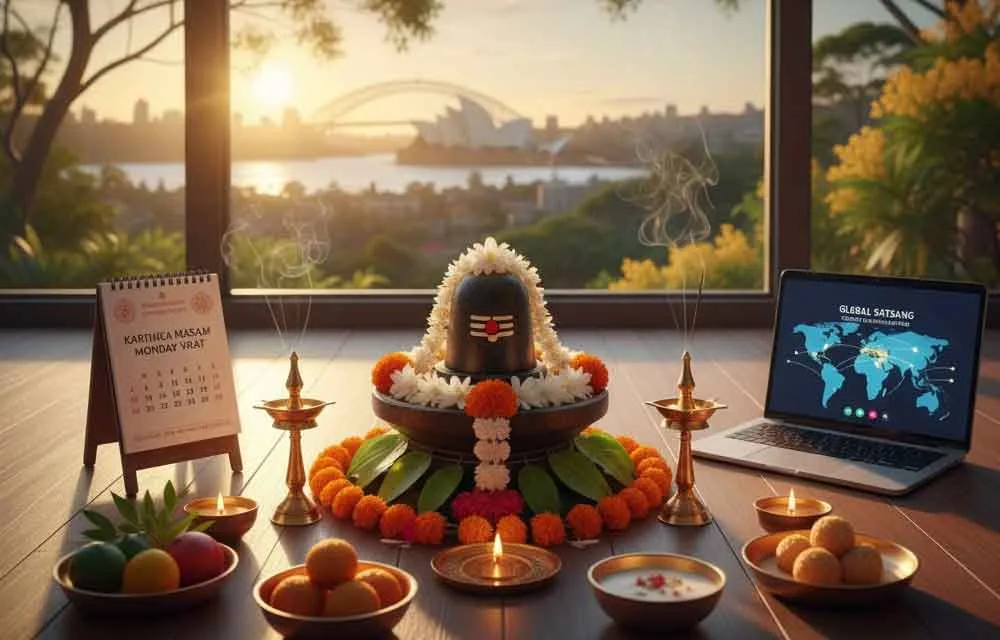
NRI Hindus across the USA, UK, Canada, UAE, Australia, and Singapore can observe the Somavar Vrat at home, even without access to a Shiva temple. The principles remain unchanged; the practical setup adapts:
- Set up a home puja altar with a Shiva Linga (available on Amazon, Indian temple stores worldwide) or a printed image
- Source Bilva leaves from Indian grocery stores (Patel Brothers in USA, Karama in Dubai, Southall in UK, Brampton in Canada) — dried Bilva also acceptable
- Stream HinduTone's Monday Shiva playlist during morning puja — the bhajans recreate the temple atmosphere you miss
- Adjust the timing to your local Brahma Muhurta (4-6 AM local time)
- For Solah Somavar (16-week long form), plan around your work schedule — many NRIs do the morning puja before work and a short evening puja after returning
- Connect with local Hindu community groups — many cities have Somavar Vrat circles where NRI devotees meet weekly
Common Mistakes to Avoid
- Treating the Vrat as merely a fast — without devotion, fasting alone gives only physical benefit, not spiritual
- Skipping the Vrat Katha — the story is central; reading or reciting it is what completes the Vrat
- Breaking the fast before the prescribed time without genuine medical necessity
- Eating non-vegetarian or consuming alcohol on the Vrat day, even at evening break-fast
- Arguing with family members on the Vrat day — internal harmony is essential to the practice
- Skipping the Udyapan ceremony on the 16th Monday — leaving the Solah Somavar incomplete
- Comparing your Vrat experience with others or boasting — the Vrat is a private devotion to Shiva
Combining Somavar Vrat with Other Shiva Practices
The Somavar Vrat is most powerful when combined with daily Shiva practices throughout the week:
- Daily Shiva mantra chanting — "Om Namah Shivaya" 108 times each morning
- Weekly Bilvashtakam recitation while offering Bilva leaves
- Lingashtakam during Monday morning Abhishekam
- Maha Mrityunjaya Mantra during times of health concern
- Shiv Tandava Stotram during major Shiva festivals (Maha Shivratri, Pradosham)
- Visiting Jyotirlingas — even one in a lifetime is considered a great blessing
Frequently Asked Questions
Q1. Can I observe Somavar Vrat without prior initiation or guru?
Yes. The Somavar Vrat is a self-initiated practice. The sincere intention to honor Lord Shiva is the only initiation required. The Shiva Purana itself encourages every devotee to take up the Vrat freely.
Q2. What food can I eat during Somavar Vrat?
Traditional phalahar diet includes: fruits (banana, apple, papaya), milk and milk products (yogurt, paneer), nuts (almonds, cashews, walnuts), sabudana (tapioca pearls), kuttu (buckwheat) atta dishes, samak (barnyard millet), peanuts, and rock salt (sendha namak) instead of regular salt. Avoid grains (rice, wheat), regular salt, onion, garlic, and processed foods.
Q3. Is it okay to drink water during the Vrat?
Yes. Most Somavar Vrats allow water freely. Only the nirjala (waterless) variant restricts water — and that is generally observed only on the 16th Monday or by experienced devotees. For health and modern life, drinking water is recommended throughout.
Q4. Can pregnant or breastfeeding women observe Somavar Vrat?
A modified observance is appropriate. Pregnant or breastfeeding women should not fast strictly. They can: do the morning puja, offer Bilva and water to the Linga, recite the Lingashtakam and Vrat Katha, and observe a satvik diet without skipping meals. The spiritual benefit remains.
Q5. Should I observe the Vrat if I am ill or weak?
Health comes first. Lord Shiva is compassionate and does not require harm to the body. If unable to fast, you can observe a symbolic Vrat: morning puja, reading the Katha, and simple satvik food.
Q6. Can I observe Somavar Vrat for someone else's benefit?
Absolutely. Many parents observe the Vrat for their children's welfare; wives for their husband's long life; husbands for their wife's health; and friends or family for those they care about. The Vrat is shareable in its merit.
Q7. What if I miss a Monday during the 16 Somavar Vrat?
If you miss due to genuine necessity (illness, emergency), simply continue the next Monday — do not start over. If you miss due to negligence, you should restart from Monday 1. Sincerity matters more than rigid count.
Q8. Is the Udyapan (concluding ceremony) absolutely necessary?
Yes, for the Solah Somavar (16-week) Vrat. The Udyapan involves feeding 11-16 Brahmins or needy people, donating clothes/food/dakshina, and a final elaborate Shiva puja. Without Udyapan, the Vrat is considered incomplete and the full fruit is not received.
Q9. Where can I read more about Lord Shiva and Monday devotions?
Visit HinduTone for related guides: How to Chant Lingashtakam on Monday, Bilvashtakam Lyrics & Monday Puja Guide, Best Shiva Songs and Bhajans for NRIs, and Maha Shivratri Complete Puja Guide. These together form a complete Monday Shiva devotional library.
Begin Your Somavar Vrat Today
The Somavar Vrat is one of the most accessible and rewarding spiritual practices in Sanatana Dharma. It demands nothing extraordinary — only a sincere heart, one day of devotional discipline per week, and the willingness to dedicate your Monday to Lord Shiva. In return, it offers what no worldly accomplishment can match: the love of Mahadeva, the protection of His grace, and the slow but certain unfolding of spiritual transformation.
Begin this coming Monday. Wake early, light the diya, offer Bilva leaves, recite "Om Namah Shivaya," read the Vrat Katha, and observe even a partial fast with devotion. Lord Shiva — the most easily pleased of all gods, the Bholenath — sees not the elaborateness of your ritual but the sincerity of your love.
🔱 Har Har Mahadev — Om Namah Shivaya 🔱
Related Reading on HinduTone
- How to Chant Lingashtakam on Monday – Complete Guide
- Bilvashtakam Lyrics, Meaning, and Monday Puja Guide
- Best Shiva Songs and Bhajans for Monday Morning – NRI Guide for USA, UK, Canada & UAE
- Om Namah Shivaya: 108 Times Chanting Benefits & Method
- Maha Mrityunjaya Mantra: How to Chant and Its Benefits
- Shiva Panchakshara Stotram: Lyrics, Meaning & Benefits
- Maha Shivratri Complete Puja Guide with Mantras
You might also like
Bilvashtakam Lyrics, Meaning, and Monday Puja Guide – Complete Shiva Devotional
Maha Shivratri 2026: Complete Puja Guide with Mantras, Four Prahara Vigil & Fast Rules
How to Chant Lingashtakam on Monday: A Complete Guide for Every Hindu