Kalabhairava Ashtakam (Deva Raja Sevyamana): Lyrics, Meaning and Benefits
Kalabhairava Ashtakam, the hymn that begins 'Deva Raja Sevyamana', is an eight-verse prayer to Kalabhairava, the guardian of Kashi, traditionally attributed to Adi Shankaracharya. Here is the full text with a plain-English meaning of every verse, the phalashruti, when to chant it on Ashtami and Kalabhairava Jayanti, and the story of Bhairava as commonly told.
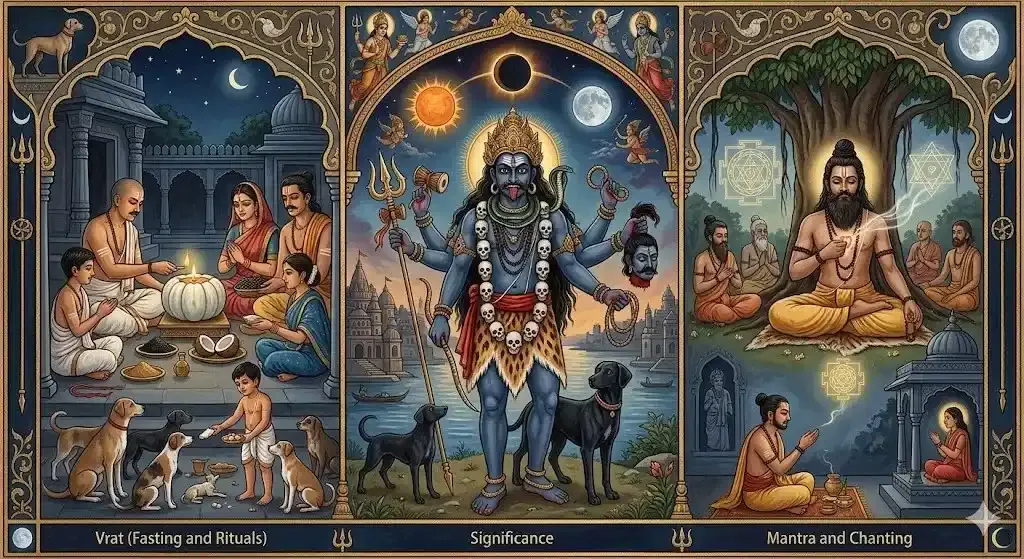
Kalabhairava Ashtakam, the hymn that begins 'Deva Raja Sevyamana', is an eight-verse prayer to Kalabhairava, the guardian of Kashi, traditionally attributed to Adi Shankaracharya. Here is the full text with a plain-English meaning of every verse, the phalashruti, when to chant it on Ashtami and Kalabhairava Jayanti, and the story of Bhairava as commonly told.
Quick answer: Kalabhairava Ashtakam is an eight-verse Sanskrit hymn to Kalabhairava, the fierce and protective form of Lord Shiva who guards the holy city of Kashi (Varanasi). It begins "Deva Raja Sevyamana" and is traditionally attributed to Adi Shankaracharya. Every verse ends "Kashika-puradhinatha-Kalabhairavam bhaje", "I worship Kalabhairava, lord of the city of Kashi". Devotees chant it on Ashtami (the eighth lunar day), on Kalabhairava Jayanti, on Sundays and Tuesdays, and in the evening. It takes about five minutes.
This guide has been restored at its original hindutone.com address. Below you will find the full text in Devanagari and IAST transliteration, a plain-English meaning after every verse, guidance on how and when to chant, and the story of Kalabhairava as commonly told.
Kalabhairava Ashtakam: full stotram with meaning
The text follows the edition on sanskritdocuments.org. Each verse appears in Devanagari, then in IAST transliteration, then in simple English. The meanings are faithful but not word-for-word, so that the devotional sense is clear. The refrain at the end of each verse is translated in full each time, because in recitation it is the heart of the hymn.
Verse 1
देवराजसेव्यमानपावनांघ्रिपङ्कजं
व्यालयज्ञसूत्रमिन्दुशेखरं कृपाकरम् ।
नारदादियोगिवृन्दवन्दितं दिगंबरं
काशिकापुराधिनाथकालभैरवं भजे ॥ १॥
devarājasevyamānapāvanāṃghripaṅkajaṃ
vyālayajñasūtraminduśekharaṃ kṛpākaram |
nāradādiyogivṛndavanditaṃ digaṃbaraṃ
kāśikāpurādhināthakālabhairavaṃ bhaje || 1||
Meaning: His holy lotus feet are served by Indra, the king of the gods. He wears a serpent as his sacred thread and the moon upon his head, and he is the treasure-house of compassion. Narada and hosts of yogis praise him, and he is clad only in the directions of space. I worship Kalabhairava, the supreme lord of the city of Kashi.
Verse 2
भानुकोटिभास्वरं भवाब्धितारकं परं
नीलकण्ठमीप्सितार्थदायकं त्रिलोचनम् ।
कालकालमंबुजाक्षमक्षशूलमक्षरं
काशिकापुराधिनाथकालभैरवं भजे ॥ २॥
bhānukoṭibhāsvaraṃ bhavābdhitārakaṃ paraṃ
nīlakaṇṭhamīpsitārthadāyakaṃ trilocanam |
kālakālamaṃbujākṣamakṣaśūlamakṣaraṃ
kāśikāpurādhināthakālabhairavaṃ bhaje || 2||
Meaning: He shines with the brilliance of millions of suns and is the supreme one who carries us across the ocean of worldly life. Blue-throated and three-eyed, he grants the things his devotees long for. He is death even to Death, lotus-eyed, holding the rosary and the trident, the imperishable one. I worship Kalabhairava, the supreme lord of the city of Kashi.
Verse 3
शूलटंकपाशदण्डपाणिमादिकारणं
श्यामकायमादिदेवमक्षरं निरामयम् ।
भीमविक्रमं प्रभुं विचित्रताण्डवप्रियं
काशिकापुराधिनाथकालभैरवं भजे ॥ ३॥
śūlaṭaṃkapāśadaṇḍapāṇimādikāraṇaṃ
śyāmakāyamādidevamakṣaraṃ nirāmayam |
bhīmavikramaṃ prabhuṃ vicitratāṇḍavapriyaṃ
kāśikāpurādhināthakālabhairavaṃ bhaje || 3||
Meaning: In his hands he holds the trident, the axe, the noose and the staff; he is the first cause of all. Dark in body, the first of the gods, imperishable and free from every affliction, he is the Lord of fearsome valour who delights in the wondrous Tandava dance. I worship Kalabhairava, the supreme lord of the city of Kashi.
Verse 4
भुक्तिमुक्तिदायकं प्रशस्तचारुविग्रहं
भक्तवत्सलं स्थितं समस्तलोकविग्रहम् ।
विनिक्वणन्मनोज्ञहेमकिङ्किणीलसत्कटिं
काशिकापुराधिनाथकालभैरवं भजे ॥ ४॥
bhuktimuktidāyakaṃ praśastacāruvigrahaṃ
bhaktavatsalaṃ sthitaṃ samastalokavigraham |
vinikvaṇanmanojñahemakiṅkiṇīlasatkaṭiṃ
kāśikāpurādhināthakālabhairavaṃ bhaje || 4||
Meaning: He grants both the good things of this life and liberation, and his form is splendid and beautiful. He is tender towards his devotees and ever steady, and the whole universe is his body. Around his waist shine golden bells that tinkle sweetly. I worship Kalabhairava, the supreme lord of the city of Kashi.
Verse 5
धर्मसेतुपालकं त्वधर्ममार्गनाशकं
कर्मपाशमोचकं सुशर्मदायकं विभुम् ।
स्वर्णवर्णशेषपाशशोभितांगमण्डलं
काशिकापुराधिनाथकालभैरवं भजे ॥ ५॥
dharmasetupālakaṃ tvadharmamārganāśakaṃ
karmapāśamocakaṃ suśarmadāyakaṃ vibhum |
svarṇavarṇaśeṣapāśaśobhitāṃgamaṇḍalaṃ
kāśikāpurādhināthakālabhairavaṃ bhaje || 5||
Meaning: He guards the bridge of dharma and destroys the paths of adharma. He frees us from the bonds of karma, grants true happiness, and pervades everything. His body shines, encircled by golden-hued serpents. I worship Kalabhairava, the supreme lord of the city of Kashi.
Verse 6
रत्नपादुकाप्रभाभिरामपादयुग्मकं
नित्यमद्वितीयमिष्टदैवतं निरंजनम् ।
मृत्युदर्पनाशनं करालदंष्ट्रमोक्षदं
काशिकापुराधिनाथकालभैरवं भजे ॥ ६॥
ratnapādukāprabhābhirāmapādayugmakaṃ
nityamadvitīyamiṣṭadaivataṃ niraṃjanam |
mṛtyudarpanāśanaṃ karāladaṃṣṭramokṣadaṃ
kāśikāpurādhināthakālabhairavaṃ bhaje || 6||
Meaning: His two feet glow with the radiance of jewelled sandals. He is eternal, without a second, the beloved chosen deity, and stainless. He destroys the pride of death, and he, with his fearsome fangs, grants liberation. I worship Kalabhairava, the supreme lord of the city of Kashi.
Verse 7
अट्टहासभिन्नपद्मजाण्डकोशसंततिं
दृष्टिपातनष्टपापजालमुग्रशासनम् ।
अष्टसिद्धिदायकं कपालमालिकाधरं
काशिकापुराधिनाथकालभैरवं भजे ॥ ७॥
aṭṭahāsabhinnapadmajāṇḍakośasaṃtatiṃ
dṛṣṭipātanaṣṭapāpajālamugraśāsanam |
aṣṭasiddhidāyakaṃ kapālamālikādharaṃ
kāśikāpurādhināthakālabhairavaṃ bhaje || 7||
Meaning: His mighty laughter shatters the shells of the cosmic eggs born of Brahma. His very glance destroys the net of sins, and his rule is stern. He grants the eight siddhis and wears a garland of skulls. I worship Kalabhairava, the supreme lord of the city of Kashi.
Verse 8
भूतसंघनायकं विशालकीर्तिदायकं
काशिवासलोकपुण्यपापशोधकं विभुम् ।
नीतिमार्गकोविदं पुरातनं जगत्पतिं
काशिकापुराधिनाथकालभैरवं भजे ॥ ८॥
bhūtasaṃghanāyakaṃ viśālakīrtidāyakaṃ
kāśivāsalokapuṇyapāpaśodhakaṃ vibhum |
nītimārgakovidaṃ purātanaṃ jagatpatiṃ
kāśikāpurādhināthakālabhairavaṃ bhaje || 8||
Meaning: He is the leader of the hosts of beings and spirits and the giver of great fame. All-pervading, he purifies the merits and sins of those who live in Kashi. He is wise in the path of righteousness, the ancient one, the lord of the universe. I worship Kalabhairava, the supreme lord of the city of Kashi.
Phalashruti and closing
॥ फलश्रुतिः ॥
कालभैरवाष्टकं पठंति ये मनोहरं
ज्ञानमुक्तिसाधनं विचित्रपुण्यवर्धनम् ।
शोकमोहदैन्यलोभकोपतापनाशनं
प्रयान्ति कालभैरवांघ्रिसन्निधिं नरा ध्रुवम् ॥
॥ इति श्रीमत्परमहंसपरिव्राजकाचर्यस्य
श्रीगोविन्दभगवत्पूज्यपादशिष्यस्य
श्रीमच्छङ्करभगवतः कृतौ
श्री कालभैरवाष्टकं सम्पूर्णम् ॥
|| phalaśrutiḥ ||
kālabhairavāṣṭakaṃ paṭhaṃti ye manoharaṃ
jñānamuktisādhanaṃ vicitrapuṇyavardhanam |
śokamohadainyalobhakopatāpanāśanaṃ
prayānti kālabhairavāṃghrisannidhiṃ narā dhruvam ||
|| iti śrīmatparamahaṃsaparivrājakācaryasya
śrīgovindabhagavatpūjyapādaśiṣyasya
śrīmacchaṅkarabhagavataḥ kṛtau
śrī kālabhairavāṣṭakaṃ sampūrṇam ||
Meaning: Those who recite this lovely Kalabhairava Ashtakam, which is a means to knowledge and liberation, which increases many kinds of merit, and which destroys grief, delusion, poverty, greed, anger and distress, surely reach the presence of Kalabhairava's feet. Thus ends the Sri Kalabhairava Ashtakam, a work of Sri Shankara Bhagavan, the wandering monk of the highest order, disciple of the revered Sri Govinda Bhagavatpada.
The phalashruti is the traditional statement of the hymn's merit. It speaks of inner change (freedom from grief, greed and anger) and of nearness to the Lord, and it is best read in that devotional spirit.
The form of Kalabhairava in the hymn
| Image in the hymn | What it signifies |
|---|---|
| Kala-kala (death even to Death) | He is master of time and death; devotees seek him to lose the fear of both |
| Kashika-puradhinatha | Supreme lord of Kashi; traditionally he is the guardian (kotwal) of the city |
| Digambara (clad in the directions) | Free of all possessions and limits |
| Trident, axe, noose and staff | Weapons of a protector who restrains wrongdoing |
| Dharma-setu-palaka | Guardian of the bridge of dharma, the moral order |
| Karma-pasha-mochaka | He who frees us from the bonds of karma |
| Bhakta-vatsala | Tender and loving towards devotees |
| Ashta-siddhi-dayaka | Giver of the eight spiritual powers |
The hymn holds two sides of Bhairava together. He is terrifying, with fangs, skulls and a laugh that shatters universes. Yet in the very same verses he is the treasure-house of compassion, tender towards devotees and the giver of liberation. The fierceness is turned against ego, wrongdoing and fear, not against the devotee.
How and when to chant Kalabhairava Ashtakam
Best days and times
- Ashtami: the eighth day of each lunar fortnight is traditionally sacred to Bhairava, especially the Ashtami of the waning moon (Krishna Paksha), sometimes called Kalashtami.
- Kalabhairava Jayanti: the day of Bhairava's appearance, the most important day of his year. See our Kalabhairava Jayanti 2026 guide for the date, vrat and mantra.
- Sundays and Tuesdays: many devotees chant it on these days, which are associated with Bhairava in several regional traditions.
- Evening or night: Bhairava is often worshipped after sunset. Evening lamp-lighting time is a simple, practical choice for families.
- Karthika month: a month especially dear to Shiva devotees. See Karthika Somavaram 2026.
How many times
Once a day is a good regular practice. On Ashtami or Jayanti some devotees chant it 3, 8, 11 or 108 times. Eight is a natural choice for an Ashtakam recited on Ashtami. If you count on a mala, see our japa mala guide.
A simple way to chant at home
- Wash, sit before a picture of Kalabhairava or of Lord Shiva, and light a lamp. A sesame-oil or mustard-oil lamp is traditional in many families, but any lamp will do.
- Offer a flower and, if you wish, a simple naivedya such as fruit or a sweet.
- Make a short sankalpa in your own words, for example: "Lord Kalabhairava, guardian of Kashi, I chant your Ashtakam with devotion. Please remove fear and wrongdoing from my mind and keep my family on the path of dharma."
- Recite the eight verses and the phalashruti slowly and clearly.
- Sit quietly for a minute. In many traditions devotees also feed a dog afterwards, since the dog is Bhairava's vehicle, as an act of kindness.
Pronunciation tips in plain English
- The hymn has a steady, marching rhythm of alternating long and short syllables. Once you feel the beat, the long compounds become easy.
- Break the refrain into four parts: 'Kaa-shi-kaa-pu-raa-dhi-naa-tha / Kaa-la-bhai-ra-vam / bha-je'.
- A line over a vowel in the IAST text means it is held longer, as in 'Kaala' and 'Kaashi'.
- The 'bh' in Bhairava is a breathy 'b', as in 'club-house' said quickly; it is not 'b' plus a separate 'h'.
- Listen to a clear recording a few times before chanting alone. A slow, careful recitation is better than a fast one.
Significance and traditional benefits
Kalabhairava is the form of Shiva who is master of time (kala). Since time brings change, ageing and death, devotees approach him to be free of the fear these bring. He is also the strict guardian of dharma, who restrains wrongdoing and protects the sincere.
Traditionally, devotees believe that chanting the Kalabhairava Ashtakam with devotion:
- brings courage and steadiness in times of fear and uncertainty;
- helps loosen inner enemies such as greed, anger, delusion and grief, which the phalashruti names directly;
- invites Bhairava's protection over the home and family;
- supports spiritual growth toward knowledge and liberation, which the hymn calls its true fruit.
These are traditional beliefs about the hymn's spiritual value. No hymn guarantees protection from every difficulty or particular outcomes in life. The Ashtakam is best chanted as an offering of devotion and a reminder to live by dharma.
The story of Kalabhairava and Kashi, as commonly told
As the story is commonly told in the Puranas, Brahma, the creator, once had five heads and grew proud, speaking with disrespect about Shiva. From Shiva's anger arose a blazing, fearsome form: Bhairava. With the nail of his finger, Bhairava cut off Brahma's fifth head, humbling his pride.
But cutting off a head of Brahma carried the grave sin of brahmahatya, and the skull stuck to Bhairava's hand. Carrying it as a begging bowl, he wandered through the worlds as a penitent. Only when he entered the holy city of Kashi did the skull finally fall from his hand. The spot is traditionally remembered as Kapala Mochana, 'where the skull was released'.
Shiva then appointed Bhairava as the guardian of Kashi, the kotwal of the city. Traditionally it is said that no one, not even Yama, the god of death, can act in Kashi without Bhairava's permission, which is why the eighth verse calls him the purifier of the merits and sins of those who live in Kashi. Many pilgrims make it a point to visit the Kalabhairava temple in Varanasi along with the Kashi Vishwanath temple, seeking the guardian's blessing. Check the temple's official sources for current timings before you go.
As commonly told, Adi Shankaracharya composed this Ashtakam in Kashi. The city is also home to one of Shiva's twelve Jyotirlingas; see our 12 Jyotirlingas guide for more.
Tips for NRI devotees
- Use the Ashtami rhythm. Check a reliable panchang such as Drik Panchang for Ashtami in your own city, and chant the Ashtakam that evening.
- Start with the refrain. Children and beginners can join in on the refrain while an elder chants the verses.
- Bhairava shrines abroad. Many large Shiva temples outside India have a Bhairava shrine, often near the entrance or in a corner of the temple, in keeping with his role as guardian. Ask your local temple.
- Pair it with other Shankara hymns. Families who chant this often also learn the Nirvana Shatakam.
Frequently asked questions
What is the meaning of Kalabhairava Ashtakam lyrics?
Each of the eight verses describes Kalabhairava, the fierce form of Shiva, and ends with the refrain 'Kashika-puradhinatha-Kalabhairavam bhaje', meaning 'I worship Kalabhairava, the supreme lord of the city of Kashi'. The verses praise him as compassionate, as the destroyer of death's pride, as the guardian of dharma who frees us from the bonds of karma, and as the giver of both worldly good and liberation.
Who wrote Kalabhairava Ashtakam?
Kalabhairava Ashtakam is traditionally attributed to Adi Shankaracharya. The closing colophon of the text names it a work of Sri Shankara Bhagavan, the disciple of Sri Govinda Bhagavatpada.
What are the benefits of chanting Kalabhairava Ashtakam?
The phalashruti says the hymn is a means to knowledge and liberation, increases merit, and removes grief, delusion, poverty, greed, anger and distress, bringing the devotee near to Kalabhairava's feet. Devotees also believe it brings courage and protection from fear. These are traditional beliefs, not guarantees of results.
Which is the best day to chant Kalabhairava Ashtakam?
Ashtami, the eighth day of the lunar fortnight, especially Krishna Paksha Ashtami, is traditionally linked with Kalabhairava. Kalabhairava Jayanti is the most important day of the year for him. Many devotees also chant it on Sundays and Tuesdays, and in the evening or at night.
How many times should Kalabhairava Ashtakam be chanted?
Once a day is a good regular practice. On Ashtami or Kalabhairava Jayanti some devotees chant it 3, 8, 11 or 108 times. Sincerity and regularity matter more than the number.
Can women and children chant Kalabhairava Ashtakam?
Yes. It is a devotional stotra, not a restricted mantra, and devotees of every age and gender chant it. Despite Bhairava's fierce appearance, the hymn presents him as loving towards devotees, so there is no reason for fear.
Editor's note
Editor's note (7 October 2026): This guide has been restored at its original address after the earlier version was lost. The Sanskrit text in Devanagari and IAST follows the edition on sanskritdocuments.org, and minor variants in wording and recitation exist between editions and family traditions; if your family or teacher follows a particular version, follow that version. The English meanings are our own plain translations. Authorship by Adi Shankaracharya is given as traditionally attributed, and the stories are given as commonly told. The hymn is presented as an act of devotion, with no promise of particular results.
Related guides
You might also like
Mahalakshmi Ashtakam (Namaste Stu Mahamaye): Lyrics, Meaning and Benefits
Ram Raksha Stotram: Full Lyrics with Meaning, Benefits and How to Recite
Achyutashtakam (Achyutam Keshavam): Lyrics with Meaning, How to Chant and Significance