Mahalakshmi Ashtakam (Namaste Stu Mahamaye): Lyrics, Meaning and Benefits
Mahalakshmi Ashtakam, the hymn that begins 'Namaste stu Mahamaye', is Indra's prayer to Goddess Mahalakshmi. Here is the full text with a simple English meaning of every verse, the phalashruti, how and when families chant it on Fridays and at Diwali, and the story behind it as commonly told.
Mahalakshmi Ashtakam, the hymn that begins 'Namaste stu Mahamaye', is Indra's prayer to Goddess Mahalakshmi. Here is the full text with a simple English meaning of every verse, the phalashruti, how and when families chant it on Fridays and at Diwali, and the story behind it as commonly told.
Quick answer: Mahalakshmi Ashtakam is an eight-verse Sanskrit hymn to Goddess Mahalakshmi that begins "Namaste stu Mahamaye". It is spoken by Indra, king of the gods, and is traditionally attributed to the Padma Purana. Each verse ends with the refrain "Mahalakshmi namostu te", "O Mahalakshmi, salutations to you". Families chant it on Fridays, at evening lamp-lighting, during Diwali Lakshmi Puja and on Varalakshmi Vratam. It takes about five minutes to recite.
This guide has been restored at its original hindutone.com address. Below you will find the full text in Devanagari and IAST transliteration, a plain-English meaning after every verse, simple guidance on how and when to chant, and the story behind the hymn as it is commonly told.
Mahalakshmi Ashtakam: full stotram with meaning
The text below follows the edition on sanskritdocuments.org. Each verse is given in Devanagari, then in IAST transliteration, then in simple English. The meanings are faithful but not word-for-word, so that the devotional sense comes through clearly.
Opening
इन्द्र उवाच ।
indra uvāca |
Meaning: "Indra said." The hymn is presented as the words of Indra, king of the gods, in praise of the Goddess.
Verse 1
नमस्तेऽस्तु महामाये श्रीपीठे सुरपूजिते ।
शङ्खचक्रगदाहस्ते महालक्ष्मि नमोऽस्तु ते ॥ १॥
namaste'stu mahāmāye śrīpīṭhe surapūjite |
śaṅkhacakragadāhaste mahālakṣmi namo'stu te || 1||
Meaning: Salutations to you, O Mahamaya, the great power of the Lord, who is seated on the sacred Sri Pitha and worshipped by the gods. You hold the conch, the discus and the mace in your hands. O Mahalakshmi, salutations to you.
Verse 2
नमस्ते गरुडारूढे कोलासुरभयङ्करि ।
सर्वपापहरे देवि महालक्ष्मि नमोऽस्तु ते ॥ २॥
namaste garuḍārūḍhe kolāsurabhayaṅkari |
sarvapāpahare devi mahālakṣmi namo'stu te || 2||
Meaning: Salutations to you who ride upon Garuda, who struck terror into the demon Kolasura. O Devi, remover of all sins, O Mahalakshmi, salutations to you.
Verse 3
सर्वज्ञे सर्ववरदे सर्वदुष्टभयङ्करि ।
सर्वदुःखहरे देवि महालक्ष्मि नमोऽस्तु ते ॥ ३॥
sarvajñe sarvavarade sarvaduṣṭabhayaṅkari |
sarvaduḥkhahare devi mahālakṣmi namo'stu te || 3||
Meaning: O all-knowing one, giver of every boon, who strikes fear into all who are wicked. O Devi, remover of all sorrows, O Mahalakshmi, salutations to you.
Verse 4
सिद्धिबुद्धिप्रदे देवि भुक्तिमुक्तिप्रदायिनि ।
मन्त्रमूर्ते सदा देवि महालक्ष्मि नमोऽस्तु ते ॥ ४॥
siddhibuddhiprade devi bhuktimuktipradāyini |
mantramūrte sadā devi mahālakṣmi namo'stu te || 4||
Meaning: O Devi, giver of success and of wisdom, who grants both the good things of this life and final liberation. O Devi, who is ever the very form of mantra, O Mahalakshmi, salutations to you.
Verse 5
आद्यन्तरहिते देवि आद्यशक्तिमहेश्वरि ।
योगजे योगसम्भूते महालक्ष्मि नमोऽस्तु ते ॥ ५॥
ādyantarahite devi ādyaśaktimaheśvari |
yogaje yogasambhūte mahālakṣmi namo'stu te || 5||
Meaning: O Devi, who has no beginning and no end, the primal Shakti, the great Goddess. You are born of yoga and arise from yoga. O Mahalakshmi, salutations to you.
Verse 6
स्थूलसूक्ष्ममहारौद्रे महाशक्ति महोदरे ।
महापापहरे देवि महालक्ष्मि नमोऽस्तु ते ॥ ६॥
sthūlasūkṣmamahāraudre mahāśakti mahodare |
mahāpāpahare devi mahālakṣmi namo'stu te || 6||
Meaning: You are both the visible and the subtle, and you are also fierce beyond measure. You are the great power whose vast being holds the whole universe. O Devi, remover of great sins, O Mahalakshmi, salutations to you.
Verse 7
पद्मासनस्थिते देवि परब्रह्मस्वरूपिणि ।
परमेशि जगन्माता महालक्ष्मि नमोऽस्तु ते ॥ ७॥
padmāsanasthite devi parabrahmasvarūpiṇi |
parameśi jaganmātā mahālakṣmi namo'stu te || 7||
Meaning: O Devi, seated upon the lotus, whose true nature is the Supreme Brahman. O supreme Goddess, Mother of the world, O Mahalakshmi, salutations to you.
Verse 8
श्वेताम्बरधरे देवि नानालङ्कारभूषिते ।
जगत्स्थिते जगन्मातर्महालक्ष्मि नमोऽस्तु ते ॥ ८॥
śvetāmbaradhare devi nānālaṅkārabhūṣite |
jagatsthite jaganmātarmahālakṣmi namo'stu te || 8||
Meaning: O Devi, clad in white garments and adorned with many ornaments. You abide in and sustain the whole world, O Mother of the universe. O Mahalakshmi, salutations to you.
Phalashruti (the fruit of recitation)
फलश्रुति ।
महालक्ष्म्यष्टकस्तोत्रं यः पठेद्भक्तिमान्नरः ।
सर्वसिद्धिमवाप्नोति राज्यं प्राप्नोति सर्वदा ॥
एककाले पठेन्नित्यं महापापविनाशनम् ।
द्विकालं यः पठेन्नित्यं धनधान्यसमन्वितः ॥
त्रिकालं यः पठेन्नित्यं महाशत्रुविनाशनम् ।
महालक्ष्मीर्भवेन्नित्यं प्रसन्न वरदा शुभा ॥
महालक्ष्मि नमोऽस्तु ते ।
॥ इतीन्द्रकृतं महालक्ष्म्यष्टकं सम्पूर्णम् ॥
phalaśruti |
mahālakṣmyaṣṭakastotraṃ yaḥ paṭhedbhaktimānnaraḥ |
sarvasiddhimavāpnoti rājyaṃ prāpnoti sarvadā ||
ekakāle paṭhennityaṃ mahāpāpavināśanam |
dvikālaṃ yaḥ paṭhennityaṃ dhanadhānyasamanvitaḥ ||
trikālaṃ yaḥ paṭhennityaṃ mahāśatruvināśanam |
mahālakṣmīrbhavennityaṃ prasanna varadā śubhā ||
mahālakṣmi namo'stu te |
|| itīndrakṛtaṃ mahālakṣmyaṣṭakaṃ sampūrṇam ||
Meaning: The person of devotion who recites this Mahalakshmi Ashtakam gains every kind of accomplishment and always attains a royal, prosperous state. Recited once a day, every day, it destroys great sins. Whoever recites it twice a day is blessed with wealth and grain. Whoever recites it three times a day sees great enemies destroyed. Mahalakshmi becomes ever pleased, the auspicious giver of boons. O Mahalakshmi, salutations to you. Thus ends the Mahalakshmi Ashtakam composed by Indra.
The phalashruti is the traditional statement of the hymn's merit, in the style of the Puranas. Read it as an expression of faith in the Goddess's grace, not as a promise of particular results.
Key names of the Goddess in this hymn
| Name in the hymn | Simple meaning |
|---|---|
| Mahamaya | The great power of the Lord that shapes and veils the world |
| Surapujita | Worshipped by the gods |
| Garudarudha | She who rides on Garuda, the eagle mount of Vishnu |
| Sarvajna | The all-knowing one |
| Bhukti-mukti-pradayini | Giver of both worldly good and liberation |
| Mantramurti | She whose very form is mantra |
| Adyashakti | The primal power, the first energy of creation |
| Padmasanasthita | She who is seated on the lotus |
| Jaganmata | Mother of the universe |
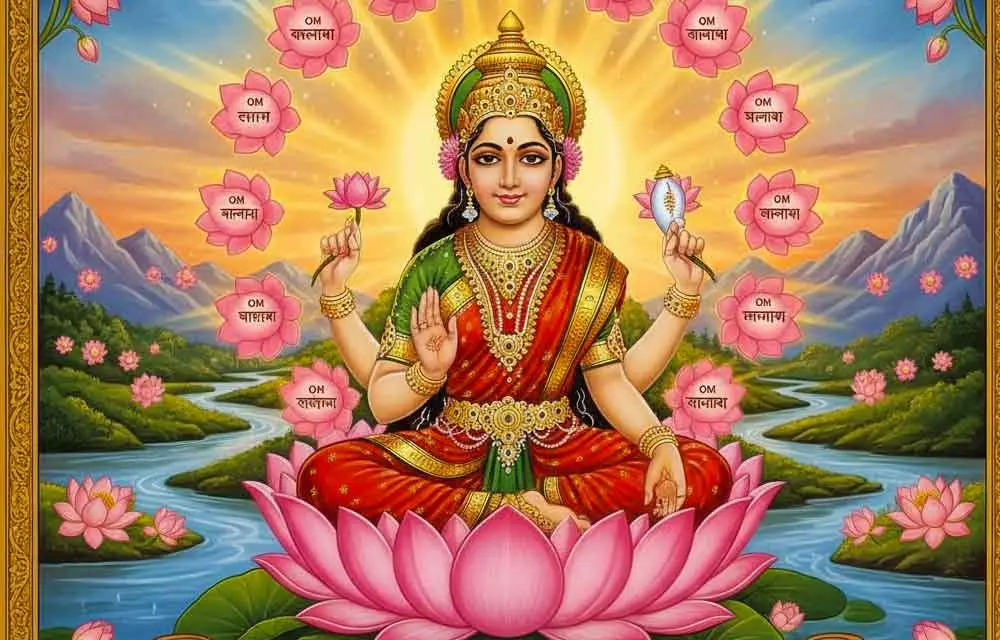
Notice how the hymn moves. It begins with Lakshmi as the consort of Vishnu, holding his conch, discus and mace and riding his eagle Garuda. It then widens to show her as the giver of all boons, the remover of sorrow, and finally as the Supreme Brahman itself and the Mother of the whole world. In a few short verses it teaches that the Goddess of fortune is also the Goddess of liberation.
How and when to chant Mahalakshmi Ashtakam
Best days and times
- Fridays: Friday (Shukravara) is traditionally dedicated to Lakshmi. Many households chant the Ashtakam every Friday evening.
- Evening lamp-lighting: the time of sandhya, when the lamp is lit at dusk, is a natural moment to welcome Lakshmi into the home.
- Diwali Lakshmi Puja: the hymn is often chanted after the main Lakshmi Puja. See our Diwali 2026 guide and the Lakshmi Puja Vidhi for the full puja steps.
- Varalakshmi Vratam and Lakshmi vratas: many South Indian families include it in Varalakshmi Vratam and in the Thursday Lakshmi vratas of Margashirsha. See our Margasira Lakshmi Vratam guide.
- Purnima: the full-moon night, especially Sharad Purnima, when Lakshmi is believed to visit homes that keep awake in devotion.
How many times
Once a day is enough to begin. The phalashruti itself speaks of reciting once, twice or three times a day. On festival days some devotees chant it 11 or 108 times, counting on a mala. If you use a mala, our japa mala guide explains how to hold and count it, and our article on the sacred number 108 explains why that number is special.
A simple way to chant at home
- Bathe or wash your hands and face, and sit facing a picture or murti of Mahalakshmi. Facing east or north is traditional, but any clean, quiet place will do.
- Light a ghee or oil lamp and offer a flower, kumkum, a little rice or a sweet. Lotus or red flowers are traditional, but any fresh flower offered with love is enough.
- Make a simple sankalpa (intention) in your own words, for example: "Mother Mahalakshmi, I chant this hymn with devotion. Please bless our home with peace, goodness and right understanding."
- Recite the opening line, the eight verses and the phalashruti slowly and clearly.
- End with a short aarti or a few minutes of silence, and share the offered sweet as prasad.
Pronunciation tips in plain English
- In the IAST lines, a line over a vowel means it is held longer: the first 'a' in Mahalakshmi is short, the second is long.
- The letters written with a dot or accent as 's' sound like 'sh', so the conch (shankha) and Sri (Shri) are pronounced with 'sh'.
- The refrain is pronounced 'Ma-haa-luck-shmi na-mos-tu te'. Say it in one breath, without rushing.
- Where two words run together in the transliteration, as in 'namaste stu', a light pause between them helps beginners.
- Listen to a clear recording a few times and chant along. A slow, steady recitation is better than a fast one with mistakes.
Significance and traditional benefits
Mahalakshmi is the Goddess of prosperity, but in the Hindu understanding prosperity is much wider than money. It includes health, harmony in the family, good character, generosity, beauty, courage and, finally, spiritual freedom. That is why this hymn calls her the giver of both bhukti (good things in this life) and mukti (liberation).
Traditionally, devotees believe that chanting the Mahalakshmi Ashtakam with devotion:
- invites the grace of the Goddess into the home and brings an atmosphere of peace and auspiciousness;
- helps wash away past wrongdoing and the heaviness of guilt, since several verses praise her as the remover of sins and sorrows;
- supports steady, honest effort in work and household life, which many see as the true doorway of Lakshmi;
- draws the mind from worry about wealth toward gratitude and trust in the Divine Mother.
The phalashruti speaks in the traditional language of the Puranas: freedom from sin, wealth and grain, and victory over enemies. Many teachers explain the 'enemies' as inner ones too, such as greed, fear and anger. No hymn comes with a guarantee of particular results. It is best chanted as an offering of love and gratitude, alongside honest work and kindness to others.
If you are unsure which deity or prayer suits a particular need in life, our guide on which god to pray to for job, marriage, health, money and studies offers gentle, traditional suggestions.
The story behind the hymn, as commonly told
As the story is commonly told, Indra, king of the gods, once received a garland from the sage Durvasa and carelessly placed it on the head of his elephant Airavata, which threw it to the ground. Offended, the sage pronounced a curse, and Lakshmi, the Goddess of fortune, withdrew from the heavens. The gods lost their splendour and strength.
On Vishnu's advice the gods and asuras churned the ocean of milk. Among the treasures that emerged was Lakshmi herself, seated on a lotus, who chose Vishnu as her eternal consort. With her return, the fortune of the gods was restored. Indra, humbled and grateful, sang this hymn of praise. That is why the text opens with the words "Indra said" and closes by calling itself the Ashtakam composed by Indra.
The second verse mentions the demon Kolasura. In the tradition of the Mahalakshmi temple at Kolhapur in Maharashtra, as commonly told, the Goddess defeated a demon of this name there, and the town is said to take its name from him. For this reason the hymn is especially dear to devotees of Kolhapur Mahalakshmi, also lovingly called Ambabai.
The lesson many elders draw from the story is simple: fortune leaves when we become proud and careless, and returns when we become humble and devoted. Indra's hymn is a prayer of someone who has learned that lesson.
Tips for NRI families
- Make Friday evening your anchor. Even in a busy week abroad, five minutes of the Ashtakam with a lamp on Friday creates a family rhythm children remember.
- Teach the refrain first. Young children can join in on "Mahalakshmi namostu te" from the first day while a parent chants the verses.
- One verse a week. Add a verse each week and the whole hymn is learned in about two months.
- Connect it to Diwali. Chanting together during Lakshmi Puja gives the festival a devotional centre, whether you are in the USA, UK, Canada, Australia or the Gulf. See the Diwali 2026 USA Lakshmi Puja muhurat page and the sister pages for other countries.
- Explore related hymns. Families who love this hymn often also chant Adi Shankaracharya's Kanakadhara Stotram, short Lakshmi mantras, or the Lalita Sahasranama on Fridays.
Frequently asked questions
What is the meaning of Mahalakshmi Ashtakam lyrics?
Mahalakshmi Ashtakam is a hymn of salutation. Each of its eight verses praises one group of the Goddess's qualities: she holds the conch, discus and mace, rides Garuda, knows all, grants boons, removes sorrow and sin, gives both worldly good and liberation, is the primal Shakti without beginning or end, and is the Mother of the universe. Every verse ends with the refrain 'Mahalakshmi namostu te', meaning 'O Mahalakshmi, salutations to you'.
Who wrote Mahalakshmi Ashtakam?
The hymn is spoken by Indra, the king of the gods, and is traditionally attributed to the Padma Purana. The closing line of the text itself calls it the Mahalakshmi Ashtakam composed by Indra. No individual human author is named.
What are the benefits of chanting Mahalakshmi Ashtakam?
Devotees believe the hymn invites the grace of Mahalakshmi, brings peace and auspiciousness into the home, and helps remove inner obstacles. The traditional phalashruti speaks of freedom from sin, prosperity and protection from enemies. These are traditional statements of the hymn's spiritual value, not guarantees of particular material results.
What is the best day and time to chant Mahalakshmi Ashtakam?
Friday is the day most families associate with Mahalakshmi, and evening lamp-lighting time is a favourite. Many also chant it during Diwali Lakshmi Puja, Varalakshmi Vratam, Sharad Purnima and the Thursdays of Margashirsha. Any calm time when you can chant with attention is suitable.
How many times should Mahalakshmi Ashtakam be chanted?
Once a day is a good start. The phalashruti mentions chanting once, twice or three times a day, and some devotees chant it 11 or 108 times on special days. Regular, sincere chanting matters more than the count.
Can women and children chant Mahalakshmi Ashtakam?
Yes. Mahalakshmi Ashtakam is a widely loved household stotra, and in many homes it is women and children who lead it. Children can begin with the refrain and the first verse and add more over time.
Editor's note
Editor's note (7 October 2026): This guide has been restored at its original address after the earlier version was lost. The Sanskrit text in Devanagari and IAST follows the edition on sanskritdocuments.org, and minor variants in wording and recitation exist between printed editions and family traditions; if your family or temple follows a particular book, follow that book. The English meanings are our own plain translations. The Padma Purana attribution is given as traditionally attributed, and the stories are given as commonly told. The hymn is presented as an act of devotion, with no promise of particular results.
Related guides
- Lakshmi Puja Vidhi 2026: step-by-step guide
- Diwali / Deepavali 2026: complete 5-day guide
- Lakshmi Puja muhurat 2026, India city-wise
- Kanakadhara Stotram: hymn for prosperity
- Lakshmi mantras and their benefits
- Margasira Masam 2026 and Lakshmivara Vratam
- Which god to pray to for job, marriage, health, money and studies
You might also like
Kalabhairava Ashtakam (Deva Raja Sevyamana): Lyrics, Meaning and Benefits
Ram Raksha Stotram: Full Lyrics with Meaning, Benefits and How to Recite
Achyutashtakam (Achyutam Keshavam): Lyrics with Meaning, How to Chant and Significance