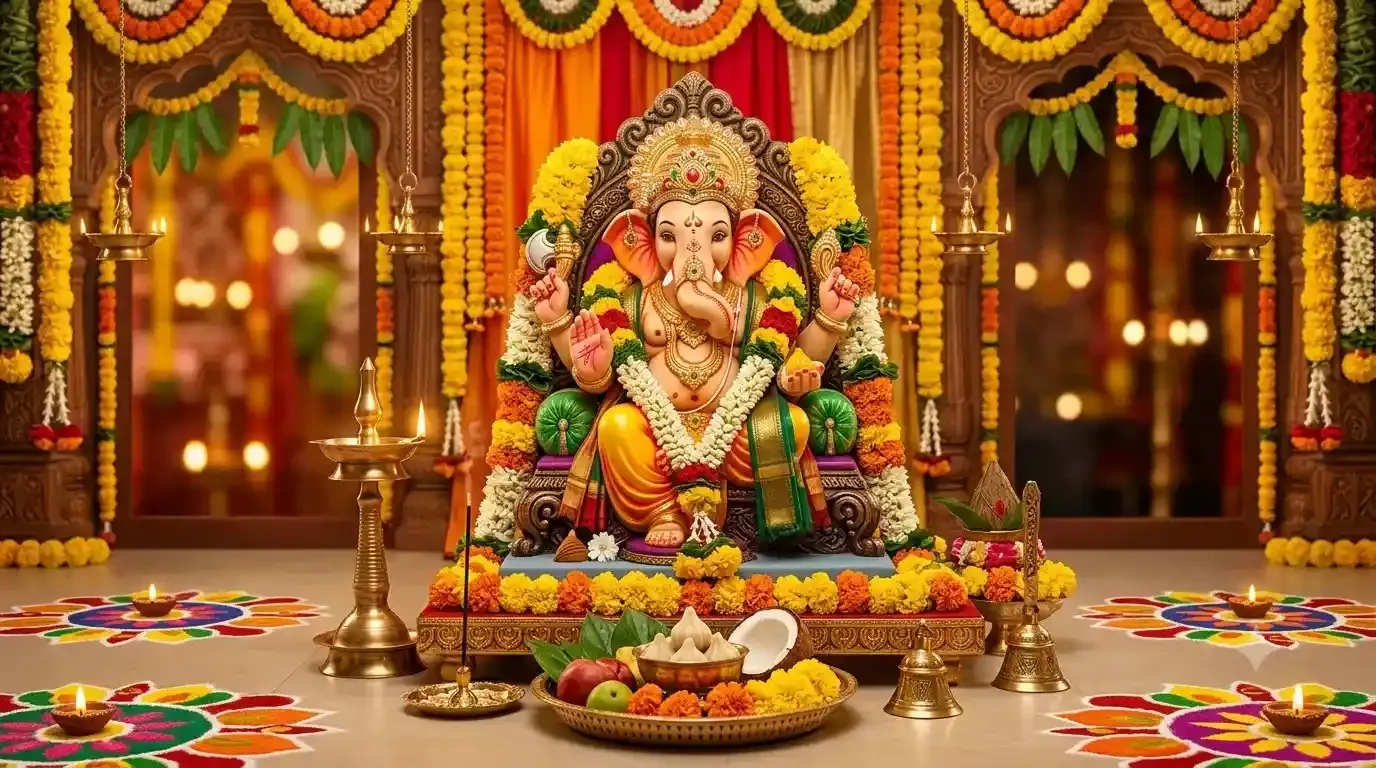
Ganesha Pancharatnam Stotram (Mudakaratta Modakam): Lyrics and Meaning
Ganesha Pancharatnam, the hymn that begins 'Mudakaratta Modakam', is a five-verse prayer to Lord Ganesha traditionally attributed to Adi Shankaracharya. Here is the full text with a plain-English meaning of every verse, the phalashruti, how to chant it in the morning and before new work, and the story behind it.
Ganesha Pancharatnam, the hymn that begins 'Mudakaratta Modakam', is a five-verse prayer to Lord Ganesha traditionally attributed to Adi Shankaracharya. Here is the full text with a plain-English meaning of every verse, the phalashruti, how to chant it in the morning and before new work, and the story behind it.
Quick answer: Ganesha Pancharatnam ("five gems for Ganesha") is a Sanskrit hymn of five verses plus a closing verse of blessing, known by its first words "Mudakaratta Modakam". It is traditionally attributed to Adi Shankaracharya. The hymn itself says it should be recited in the early morning, remembering Ganesha in the heart. Many people also chant it before starting new work, before study, on Wednesdays and during Ganesh Chaturthi. All six verses take about four minutes.
This guide has been restored at its original hindutone.com address. Below you will find the full text in Devanagari and IAST transliteration, a plain-English meaning after every verse, how and when to chant, and the context of the hymn as commonly told.
Ganesha Pancharatnam: full stotram with meaning
The text follows the edition on sanskritdocuments.org. Each verse is shown in Devanagari, then in IAST transliteration, then in simple English. The five main verses are the 'five gems'; the sixth is the phalashruti, which describes the fruit of reciting them. The meanings are faithful but not word-for-word, because Shankara packs many images into each long compound.
Opening
श्रीगणेशाय नमः ॥
śrīgaṇeśāya namaḥ ||
Meaning: Salutations to Sri Ganesha.
Verse 1
मुदाकरात्तमोदकं सदाविमुक्तिसाधकं
कलाधरावतंसकं विलासिलोकरक्षकम् ।
अनायकैकनायकं विनाशितेभदैत्यकं
नताशुभाशुनाशकं नमामि तं विनायकम् ॥ १॥
mudākarāttamodakaṃ sadāvimuktisādhakaṃ
kalādharāvataṃsakaṃ vilāsilokarakṣakam |
anāyakaikanāyakaṃ vināśitebhadaityakaṃ
natāśubhāśunāśakaṃ namāmi taṃ vināyakam || 1||
Meaning: I bow to that Vinayaka who joyfully holds a modaka in his hand, who always helps seekers toward liberation, who wears the crescent moon as an ornament on his head, and who protects the people of the world. He is the one leader of those who have no other leader. He destroyed the elephant-demon, and he quickly removes the misfortunes of all who bow to him.
Verse 2
नतेतरातिभीकरं नवोदितार्कभास्वरं
नमत्सुरारिनिर्जरं नताधिकापदुद्धरम् ।
सुरेश्वरं निधीश्वरं गजेश्वरं गणेश्वरं
महेश्वरं तमाश्रये परात्परं निरन्तरम् ॥ २॥
natetarātibhīkaraṃ navoditārkabhāsvaraṃ
namatsurārinirjaraṃ natādhikāpaduddharam |
sureśvaraṃ nidhīśvaraṃ gajeśvaraṃ gaṇeśvaraṃ
maheśvaraṃ tamāśraye parātparaṃ nirantaram || 2||
Meaning: He is fearsome to those who will not bow, yet shines like the newly risen sun. Gods and demons alike bow before him, and he lifts those who bow to him out of great calamities. He is the lord of the gods, lord of treasures, lord of elephants, lord of the ganas, the great lord. I take refuge in him constantly, the one who is higher than the highest.
Verse 3
समस्तलोकशङ्करं निरस्तदैत्यकुञ्जरं
दरेतरोदरं वरं वरेभवक्त्रमक्षरम् ।
कृपाकरं क्षमाकरं मुदाकरं यशस्करं
मनस्करं नमस्कृतां नमस्करोमि भास्वरम् ॥ ३॥
samastalokaśaṅkaraṃ nirastadaityakuñjaraṃ
daretarodaraṃ varaṃ varebhavaktramakṣaram |
kṛpākaraṃ kṣamākaraṃ mudākaraṃ yaśaskaraṃ
manaskaraṃ namaskṛtāṃ namaskaromi bhāsvaram || 3||
Meaning: He brings good to all the worlds and cast away the elephant-demon. Great of belly, the best of all, with the face of a noble elephant, he is imperishable. He is the source of compassion, of forgiveness, of joy and of good name, and he gives a good mind to those who bow to him. I bow to the radiant one.
Verse 4
अकिञ्चनार्तिमार्जनं चिरन्तनोक्तिभाजनं
पुरारिपूर्वनन्दनं सुरारिगर्वचर्वणम् ।
प्रपञ्चनाशभीषणं धनञ्जयादिभूषणं
कपोलदानवारणं भजे पुराणवारणम् ॥ ४॥
akiñcanārtimārjanaṃ cirantanoktibhājanaṃ
purāripūrvanandanaṃ surārigarvacarvaṇam |
prapañcanāśabhīṣaṇaṃ dhanañjayādibhūṣaṇaṃ
kapoladānavāraṇaṃ bhaje purāṇavāraṇam || 4||
Meaning: He wipes away the suffering of those who have nothing, and he is the one whom the ancient scriptures praise. He is the first son of Shiva, the destroyer of the three cities, and he crushes the pride of the enemies of the gods. Awesome at the dissolution of the world, adorned with serpents such as Dhananjaya, he is like a great elephant whose cheeks flow with ichor. I worship that ancient elephant-faced Lord.
Verse 5
नितान्तकान्तदन्तकान्तिमन्तकान्तकात्मजं
अचिन्त्यरूपमन्तहीनमन्तरायकृन्तनम् ।
हृदन्तरे निरन्तरं वसन्तमेव योगिनां
तमेकदन्तमेव तं विचिन्तयामि सन्ततम् ॥ ५॥
nitāntakāntadantakāntimantakāntakātmajaṃ
acintyarūpamantahīnamantarāyakṛntanam |
hṛdantare nirantaraṃ vasantameva yogināṃ
tamekadantameva taṃ vicintayāmi santatam || 5||
Meaning: I meditate always on that single-tusked one alone: the son of Shiva, who conquered death, and whose tusk shines with surpassing beauty. His form is beyond thought and he has no end. He cuts through every obstacle, and he dwells without ceasing in the hearts of the yogis.
Verse 6 (phalashruti)
महागणेशपञ्चरत्नमादरेण योऽन्वहं
प्रजल्पति प्रभातके हृदि स्मरन् गणेश्वरम् ।
अरोगतामदोषतां सुसाहितीं सुपुत्रतां
समाहितायुरष्टभूतिमभ्युपैति सोऽचिरात् ॥ ६॥
mahāgaṇeśapañcaratnamādareṇa yo'nvahaṃ
prajalpati prabhātake hṛdi smaran gaṇeśvaram |
arogatāmadoṣatāṃ susāhitīṃ suputratāṃ
samāhitāyuraṣṭabhūtimabhyupaiti so'cirāt || 6||
Meaning: Whoever, with reverence, recites these five gems of the great Ganesha every day in the early morning, remembering Ganeshvara in the heart, soon attains health, freedom from faults, good learning, good children, a long and peaceful life and the eight kinds of prosperity.
Closing
इति श्रीशङ्करभगवतः कृतौ श्रीगणेशपञ्चरत्नस्तोत्रं सम्पूर्णम् ॥
iti śrīśaṅkarabhagavataḥ kṛtau śrīgaṇeśapañcaratnastotraṃ sampūrṇam ||
Meaning: Thus ends the Sri Ganesha Pancharatna Stotram, a work of Sri Shankara Bhagavan.
Names and images of Ganesha in the hymn
| Image in the hymn | What it points to |
|---|---|
| Modaka in his hand | The sweet of joy; many teachers explain it as the bliss of spiritual knowledge |
| Crescent moon on his head | Ganesha shares this ornament with his father Shiva |
| Leader of the leaderless | He is the refuge of those who have no other protector |
| The elephant-demon destroyed | His victory over pride and arrogance, as told in the Puranic stories |
| Lord of the ganas | Ganapati, leader of Shiva's attendants |
| Single tusk (Ekadanta) | One of his best-known names; he is often shown holding the broken tusk |
| Remover of obstacles | Vighneshvara, the one who clears the way before any good work |
The hymn moves in a beautiful way. The first verses praise Ganesha's playful, protective outer form: the sweet in his hand, the moon on his head, his elephant face. By the fifth verse the gaze turns inward, to the Ganesha whose form is beyond thought and who lives in the hearts of yogis. In this way, a hymn that children love for its rhythm also carries Shankara's Vedanta teaching.
How and when to chant Ganesha Pancharatnam
Best time
- Early morning: the phalashruti itself says 'prabhatake', in the early morning. Chanting soon after your bath, before the day's work begins, is the classic practice.
- Before new work: Ganesha is worshipped first before any undertaking. See our article on why Ganesha is worshipped first.
- Before study and exams: students often chant it before opening their books, asking for a clear and steady mind.
- Wednesdays and Sankashti Chaturthi: both are traditionally linked with Ganesha. See our guide to Wednesday (Budhvar) worship and the Sankashti Chaturthi moon rules.
- Ganesh Chaturthi: it is a favourite hymn during the festival days. See our Vinayaka Chavithi / Ganesh Chaturthi 2026 guide.
How many times
The traditional practice described in the hymn is once every morning. On Chaturthi or before an important new beginning, some devotees recite it 3, 11 or 21 times. Twenty-one is a number dear to Ganesha, as in the offering of 21 blades of durva grass. If you count on a mala, see our japa mala guide.
A simple morning practice
- After your bath, sit before a picture or murti of Ganesha. Light a lamp or incense if your home allows it.
- Offer a flower, a few blades of durva grass, or a small sweet such as a modak, laddu or even a piece of jaggery.
- Make a short sankalpa in your own words, for example: "Lord Ganesha, I chant your Pancharatnam with devotion. Please clear the obstacles on my path today and guide my work and study."
- Recite the opening salutation, the five verses and the phalashruti.
- Bow, sit quietly for a minute, and begin your day.
Pronunciation tips in plain English
- The hymn has a quick, regular beat of short and long syllables. Clap it softly at first and the rhythm will carry you.
- Each half-line is one long compound word. Break it into the small words inside it: 'muda - kara - atta - modakam' means 'with joy - in the hand - held - the modaka'.
- A line over a vowel in the IAST text means it is held longer; 'Vinayakam' is pronounced 'Vi-naa-ya-kam'.
- The letters shown as 'n' with a dot or tilde are nasal sounds; beginners may say a plain 'n' and refine it later.
- Many people learn it from recordings. Popular Carnatic renderings set it to a lively tune that makes the long compounds easy to remember.
Significance and traditional benefits
Ganesha is Vighneshvara, the lord who removes obstacles, and Buddhi-pradayaka, the giver of wisdom. In nearly every Hindu ritual, he is worshipped first. The Pancharatnam gathers these ideas in a compact, musical form, which is why it has become one of the most widely chanted Ganesha hymns in homes, schools and temples.
Its own phalashruti lists the traditional blessings: health (arogata), freedom from faults (adoshata), good learning and skill with words (susahiti), good children (suputrata), a long, settled life, and the eight forms of prosperity. Devotees believe that chanting it each morning:
- helps begin the day with a calm, focused mind;
- invites Ganesha's blessing before new work, study, travel or a new venture;
- builds patience and humility, since Ganesha is also the one who humbles pride;
- deepens devotion and turns the mind inward, as the fifth verse teaches.
These are traditional beliefs about the hymn's spiritual value. No hymn guarantees exam marks, a job offer or business success. Many families pair the Pancharatnam with honest preparation and effort, and see Ganesha's grace as the support that steadies that effort. For more on prayer and career, see our guides on mantras for software jobs and career growth and which god to pray to for job, studies and more.
The context of the hymn, as commonly told
Adi Shankaracharya is remembered as the teacher who revived Advaita Vedanta and travelled across India, establishing monasteries and writing commentaries on the Upanishads, the Bhagavad Gita and the Brahma Sutras. Alongside this philosophy, a large body of devotional hymns is traditionally attributed to him, including this Pancharatnam. Traditionally, these hymns are seen as a gentle way for ordinary devotees to reach the same truth that the philosophy teaches.
The hymn twice mentions the elephant-demon Ganesha defeated. In one story widely told in South India, the demon Gajamukhasura became proud and troubled the gods. Ganesha fought him, broke off one of his own tusks and used it as a weapon. Humbled, the demon took the form of a mouse and became Ganesha's vehicle. This is one of the traditional explanations of why Ganesha is called Ekadanta, the single-tusked one. Other Puranas tell the story of the broken tusk differently. For more of these tales, see our collection of Ganesha stories and Puranic legends.
The fourth verse calls Ganesha the first son of Shiva, and the fifth calls him the son of the one who conquered death. Both refer to Shiva, who in the Puranas defeated the three cities of the demons and saved the boy Markandeya from Yama. Ganesha is praised as the worthy son of such a father.
Tips for NRI families and students
- Make it a school-morning habit. A four-minute recitation before breakfast fits even a busy weekday in the USA, UK, Canada or Australia.
- Start with verse 1. Children love the bouncing rhythm of 'mudakaratta modakam'. Once it is learned, add one verse a week.
- Explain the pictures. Talk about the modaka, the moon, the single tusk and the mouse, so the words come alive.
- Use it before exams. A short recitation before an exam or interview helps many students settle their nerves.
- Link it to the festival. During Ganesh Chaturthi, families can chant it together after the daily puja. See our Ganesh Chaturthi 2026 Canada page and the other Ganesha guides below.
Frequently asked questions
What is the meaning of Mudakaratta Modakam?
The opening words mean 'he who joyfully holds a modaka (sweet) in his hand'. The first verse goes on to praise Ganesha as the one who helps seekers toward liberation, wears the crescent moon, protects the world, is the leader of those who have no leader, and quickly removes the troubles of those who bow to him. It ends, 'I bow to that Vinayaka'.
Who wrote Ganesha Pancharatnam?
Ganesha Pancharatnam is traditionally attributed to Adi Shankaracharya, the great teacher of Advaita Vedanta. The closing line of the text calls it a work of Sri Shankara Bhagavan.
What are the benefits of chanting Ganesha Pancharatnam?
The phalashruti (verse 6) says that one who recites it every morning, remembering Ganesha in the heart, soon gains health, freedom from faults, good learning, good children, a long and settled life and prosperity. Devotees take this as a traditional statement of the hymn's blessing. It is a prayer of devotion, not a guarantee of results.
What is the best time to chant Ganesha Pancharatnam?
The hymn itself names the early morning (prabhataka) as the time to recite it. Many people also chant it before starting new work, before study or exams, on Wednesdays, on Sankashti Chaturthi and during Ganesh Chaturthi.
How many times should I chant Ganesha Pancharatnam?
Once every morning is the traditional practice described in the phalashruti. On special days some devotees chant it 3, 11 or 21 times. Daily regularity matters more than a large count.
Can children and women chant Ganesha Pancharatnam?
Yes. It is a household stotra chanted by people of every age. Its rhythm is quick and lively, and many children learn it in Sanskrit or music classes. Beginners can start with the first verse alone.
Editor's note
Editor's note (7 October 2026): This guide has been restored at its original address after the earlier version was lost. The Sanskrit text in Devanagari and IAST follows the edition on sanskritdocuments.org, and minor variants in wording and recitation exist between editions and teaching traditions; if your family or teacher follows a particular version, follow that version. The English meanings are our own plain translations of a densely compounded text. Authorship by Adi Shankaracharya is given as traditionally attributed, and the stories are given as commonly told. The hymn is presented as an act of devotion, with no promise of particular results.
Related guides
You might also like
Ram Raksha Stotram: Full Lyrics with Meaning, Benefits and How to Recite
Madhurashtakam (Adharam Madhuram): Lyrics, Meaning and How to Recite
Achyutashtakam (Achyutam Keshavam): Lyrics with Meaning, How to Chant and Significance