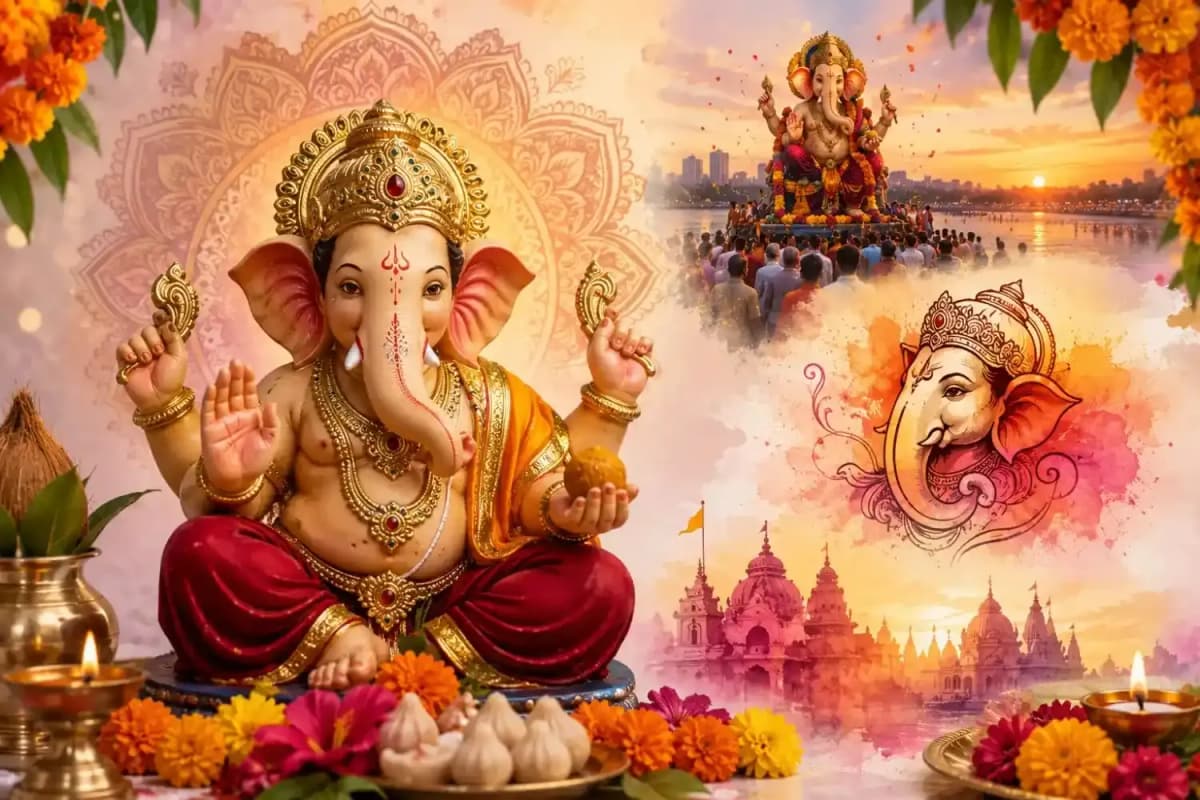
The Stories of Ganesha: Puranic Legends Behind Ganesh Chaturthi
How Ganesha got his elephant head, broke his tusk, won the race with Kartikeya, humbled Kubera, and why tulsi is never offered — the Puranic stories and their sources.

How Ganesha got his elephant head, broke his tusk, won the race with Kartikeya, humbled Kubera, and why tulsi is never offered — the Puranic stories and their sources.
Most people know one Ganesha story — the elephant head. There are hundreds. He wrote the Mahabharata, beat his brother in a race around the world without leaving the room, humbled Kubera the god of wealth with a handful of rice, and stopped Ravana on a road in Karnataka. He has two Puranas to himself. This is a guide to the stories, their sources, and what each is actually about.
For the three kathas read during the Chaturthi vrata itself — the birth, the moon’s curse and the Syamantaka gem — see our Vinayaka Vrata Vidhanam. This page covers everything else.
Where these stories come from
Ganesha is the subject of two Puranas devoted entirely to him — the Ganesha Purana and the Mudgala Purana, core scriptures for the Ganapatyas. His stories also appear in the Shiva, Brahma Vaivarta, Skanda, Padma, Linga and Varaha Puranas, alongside temple sthala-puranas. These sources do not always agree — and that is not a flaw. Where accounts differ below, both are given.
The birth: four different accounts
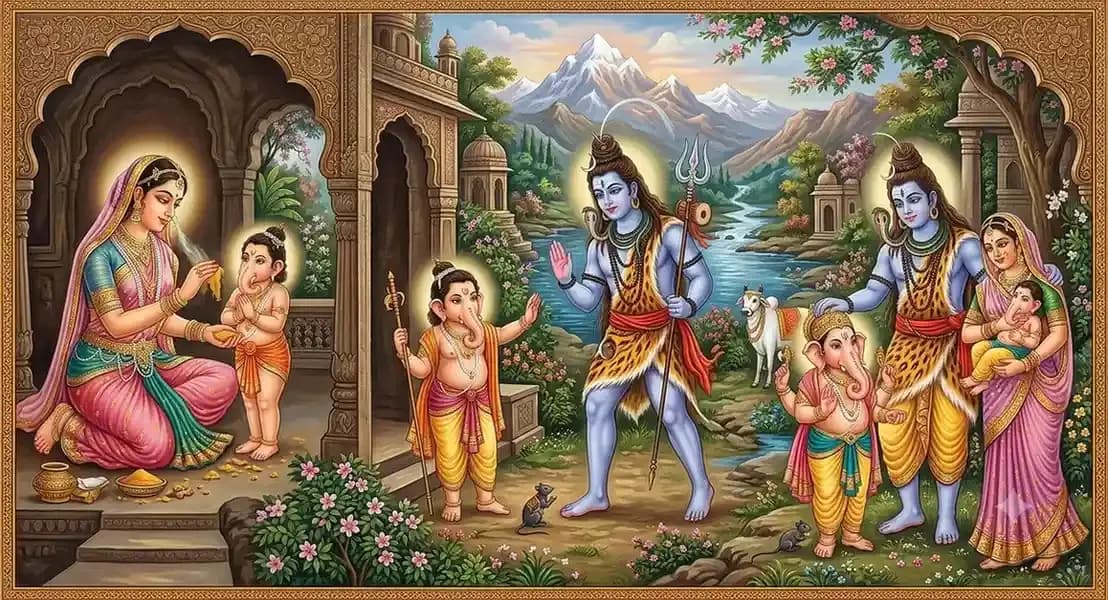
- Parvati made him. The best-known account (Shiva Purana): she formed a boy from her body to guard her door; Shiva was refused, the boy’s head was severed in combat, and Shiva restored him with an elephant’s head.
- Shiva made him. In other accounts the child is created by Shiva, or both, without the severing.
- He appeared. In some tellings Ganesha simply manifests and is found — expressing the idea, central to the Ganesha and Mudgala Puranas, that he is the principle underlying the other deities.
- Shani’s glance. The Brahma Vaivarta Purana: Parvati is granted a son; Shani, pressed to look, does — and Vishnu brings an elephant’s head to replace what his gaze destroyed.
The elephant head is constant. How it came to be there is not — because different communities told it differently, and the tradition kept all of them.
The broken tusk: three accounts
He wrote with it. Vyasa needed a scribe for the Mahabharata who would not break the flow. Ganesha agreed on one condition — Vyasa must not pause; Vyasa set his own — Ganesha must understand each verse before writing it. When the pen failed, Ganesha snapped off his own tusk and wrote with it to the end. This is why he is the patron of writers and students.
Parashurama took it. In the Brahma Vaivarta Purana, Ganesha guarded Shiva’s door and refused Parashurama; when Parashurama threw the axe Shiva had given him, Ganesha recognised his father’s weapon and let it strike rather than deflect it.
He threw it. In a third account he broke it off and hurled it at the moon in anger at Chandra’s mockery — the story told in the vrata katha.
The race around the world
Narada brought a fruit that could not be divided; Shiva and Parvati set a contest — whoever circles the world three times first takes it. Kartikeya mounted his peacock and left. Ganesha walked three times around his parents and sat down: my mother and father are the world; circling them is circling everything. He was given the fruit. It is about parents as a child’s whole universe — and about intelligence, the boy who wins a footrace by refusing to treat it as one. (In South Indian tellings, Kartikeya leaves in anger for the hill at Palani.)
Why Ganesha is worshipped first
Indra created the demon Vighnasura to disrupt a yajna; the demon began destroying every rite everywhere. Ganesha defeated him, and granted mercy on one condition — Vighnasura must never go where Ganesha is worshipped. The demon asked a favour in return: that his own name be spoken before Ganesha’s. So he is Vighna-harta and Vighneshwara — the obstacle in the name before the remover of it. The obstacle is not deleted from the world; it is bound wherever the Lord is honoured. (This belongs to the Vighneshwar temple at Ozar.)
Kubera’s feast
Kubera, wealthiest of beings, invited Shiva to display his riches; Shiva sent Ganesha. Ganesha ate the banquet, the servants’ food, the stores, the kitchen and the furnishings, and asked for more — until Kubera fled to Shiva in terror. Shiva gave Kubera a single handful of roasted rice to offer with humility, and Ganesha ate it and was satisfied. An unlimited display offered to impress could not fill him; a handful offered properly could.
The mouse
The most common account: a gandharva named Krauncha offended a sage and was cursed to become a mouse; grown enormous and destructive, he was subdued by Ganesha and taken as his mount rather than destroyed. Another connects the mouse to the demon Gajamukhasura. Three readings, all traditional: nothing in creation is too small to be of use; the ego ungoverned is a rodent that eats everything, and governed becomes transport; and the way to deal with what attacks you is to put it to work.
Ravana at Gokarna
Ravana obtained the Atmalinga from Shiva, with one condition — it must not be set on the ground before reaching Lanka, or it would remain there immovable. The gods went to Ganesha. As evening and Ravana’s sandhyavandana approached, Ganesha appeared as a small brahmin boy and agreed to hold the linga, warning he would call three times and then set it down. He called three times; Ravana did not return in time. The linga was set down at Gokarna, where it stands as Mahabaleshwara. The greatest power in the three worlds is undone by a small boy keeping precisely to an agreement he announced in advance. He did not cheat — he warned him.
Why tulsi is never offered to Ganesha
In the Brahma Vaivarta Purana, Tulsi came upon Ganesha in tapas and asked him to marry her; he refused, being under a vow of brahmacharya. Offended, she cursed him to be married against his will; he cursed her to be married to an asura and become a plant. And so tulsi — dearest of leaves to Vishnu — is never offered to Ganesha. The one recognised exception is the tulsi leaf included in some paddhatis within the Ekavimshati Patra Puja, and even there some families substitute another leaf. Both practices are observed.
Married, or brahmachari?
In North India and much of the wider tradition, Ganesha is married to Riddhi (prosperity) and Siddhi (attainment), with sons Shubha and Labha. In much of the South he is a brahmachari, worshipped as unmarried. This is not a disagreement to be settled — the two traditions coexist and long have. The Mayureshwar idol at Morgaon is flanked by Riddhi and Siddhi; many South Indian temples have no such figures.
The eight avataras of the Mudgala Purana
The Mudgala Purana describes eight incarnations, each defeating a demon that is a named inner affliction:
- Vakratunda — defeats Matsarasura (envy)
- Ekadanta — Madasura (arrogance/intoxication)
- Mahodara — Mohasura (delusion)
- Gajanana — Lobhasura (greed)
- Lambodara — Krodhasura (anger)
- Vikata — Kamasura (craving)
- Vighnaraja — Mamasura (possessiveness)
- Dhumravarna — Abhimanasura (ego/pride)
The obstacles Ganesha removes are, on this reading, the eight things inside a person that stop anything from being completed. These names appear in the sixteen names and the Ashtottara recited in every Chaturthi puja — most people chant them without knowing each carries a campaign behind it.
The Ashtavinayaka: eight shrines, eight stories
Eight swayambhu shrines in Maharashtra, all within reach of Pune; the pilgrimage begins at Morgaon and returns to Morgaon to be complete:
- Mayureshwar, Morgaon — Ganesha on a peacock slays the demon Sindhu; the idol is flanked by Riddhi and Siddhi.
- Siddhivinayak, Siddhatek — Vishnu propitiates Ganesha here to defeat Madhu and Kaitabha; the only one with the trunk turned right.
- Ballaleshwar, Pali — the boy Ballala, beaten for his devotion, is saved by Ganesha, who takes the devotee’s name before his own (Ganesha Purana, Upasana Khanda).
- Varadavinayak, Mahad — the granter of boons.
- Chintamani, Theur — Ganesha recovers the wish-fulfilling Chintamani gem.
- Girijatmaj, Lenyadri — Ganesha as the son of Girija (Parvati); the shrine is cut into a cave complex.
- Vighneshwar, Ozar — Ganesha subdues Vighnasura, who asks that his name be spoken first.
- Mahaganapati, Ranjangaon — Shiva worships Ganesha here before facing Tripurasura.
Ganesha beyond Hinduism
Among the most widely travelled deities in the world. Jainism has an established tradition of Ganesha worship; Buddhism carries him into the Vajrayana traditions; Japan knows him as Kangiten (Shoten) in the Shingon and Tendai schools; Thailand worships him as Phra Phikanet, patron of arts and commerce; Indonesia carries him in the temple sculpture of Java and Bali. Early Ganesha images are found across Nepal, Tibet, Cambodia, Myanmar, Sri Lanka and beyond. The deity of beginnings travelled with traders, and traders go everywhere.
Explore the Ganesh Chaturthi 2026 Complete Guide
This page is part of Hindutone’s Ganesh Chaturthi 2026 cluster:
- Complete Ganesh Chaturthi 2026 guide (hub)
- Date & city-wise muhurat
- Ganesh Sthapana (setup at home)
- Vinayaka Vrata Vidhanam (full puja)
- Ganesh Visarjan mantra
- Wishes & quotes
Frequently Asked Questions
How did Ganesha get his elephant head?
The Puranas give several accounts. In the best-known (Shiva Purana), Parvati created him and his head was severed in combat with Shiva, who replaced it with an elephant’s. The Brahma Vaivarta Purana instead attributes it to Shani’s glance.
How did Ganesha break his tusk?
Three accounts: he snapped it off as a pen when writing the Mahabharata for Vyasa; he let Parashurama’s axe strike because it was a weapon given by Shiva; or he broke it off and threw it at the moon.
Who won the race between Ganesha and Kartikeya?
Ganesha, by circling his parents three times and declaring they were the world.
Why is tulsi not offered to Ganesha?
Following an exchange of curses between Tulsi and Ganesha in the Brahma Vaivarta Purana. The one exception is the tulsi leaf within the 21-leaf patra puja, and even that varies by family.
What are the eight avataras of Ganesha?
Vakratunda, Ekadanta, Mahodara, Gajanana, Lambodara, Vikata, Vighnaraja and Dhumravarna — from the Mudgala Purana, each defeating a demon representing a vice.
Is Ganesha married?
Depends on the tradition. Much of North India holds him married to Riddhi and Siddhi; much of South India worships him as a brahmachari. Both are long-established.
Related Reading on Hindutone
- Vinayaka Vrata Vidhanam: the complete puja with mantras and the vrata katha
- The moon on Ganesh Chaturthi: why it must not be seen, and the remedy mantra
- Ganesh Sthapana 2026: how to welcome Ganesha into your home
You might also like
Ganesh Chaturthi and NRI Kids: The Questions Nobody Prepares You For
The Moon on Ganesh Chaturthi: Why It Must Not Be Seen, and the Remedy Mantra
Vinayaka Vrata Vidhanam: The Complete Ganesh Chaturthi Puja, Step by Step