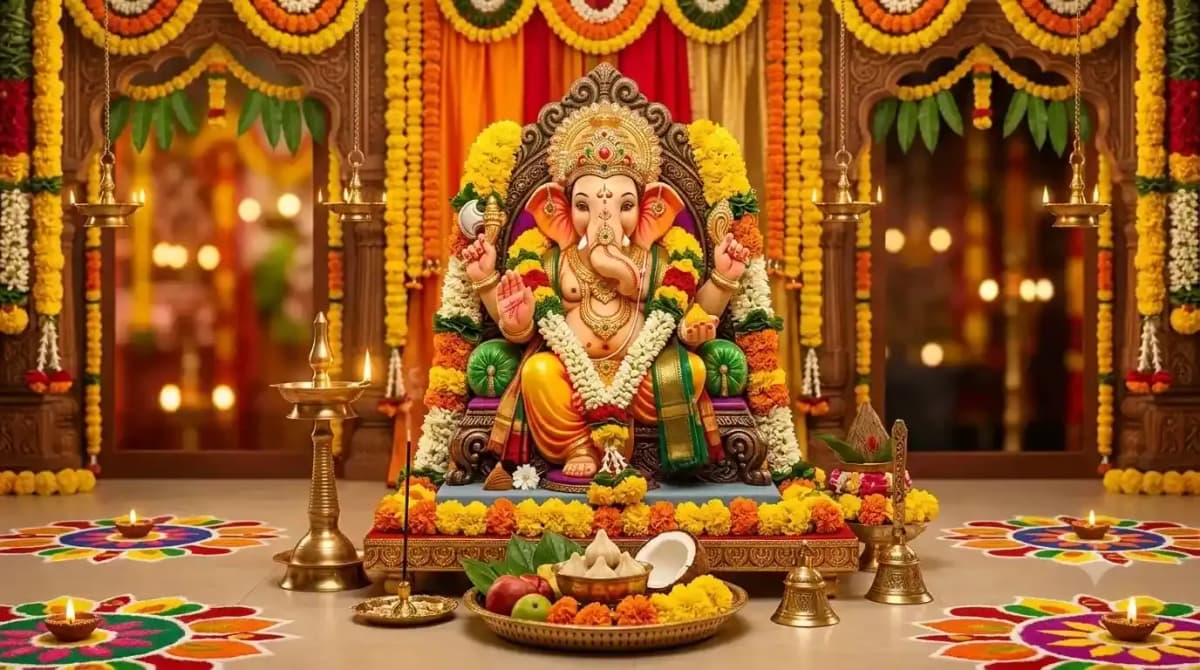
The Moon on Ganesh Chaturthi: Why It Must Not Be Seen, and the Remedy Mantra
Why the moon is not seen on Ganesh Chaturthi, the Chandra and Syamantaka story in full, the 2026 window (local moonrise to moonset), and the remedy verse.

Why the moon is not seen on Ganesh Chaturthi, the Chandra and Syamantaka story in full, the 2026 window (local moonrise to moonset), and the remedy verse.
There are twelve Chaturthis in a year. On only one do people deliberately keep their eyes down after sunset. Seeing the moon on Bhadrapada Shukla Chaturthi is not held to bring general misfortune — it is held to bring one specific thing: mithya dosha, a false accusation. The tradition is confident about this because it names a case: Krishna himself glimpsed the moon on this night and within a day was publicly accused of murder and theft.
...
What the dosha actually is
Mithya dosha (also mithya kalank, mithya apavada) means false blame — not misfortune or loss, but being accused of something you did not do. That precision tells you what the story is about: a warning attached to a single day about a single kind of harm. The remedy is correspondingly specific — you recite a verse that recalls an episode in which a false accusation was publicly disproved.
The 2026 window
- Ganesh Chaturthi: Monday, 14 September 2026.
- Moon to be avoided (New Delhi): roughly 9:01 am–8:09 pm. Published figures vary by a few minutes between panchangs; the difference is immaterial — follow your own.
- The part most pages leave out: that window is simply local moonrise to moonset. It is not a mystical interval, so it is different for every city — the Delhi figure does not apply in Chennai, let alone London or New Jersey. Look up moonrise and moonset for your city on your Chaturthi date.
- Where the real risk is: on Chaturthi the moon is only ~10–12% illuminated, a thin crescent trailing the sun. The genuine risk is the hour or so after sunset, looking west. Before that, ordinary daytime activity carries almost no risk.
Why Chandra was cursed
Having eaten his fill of modaka and ladoos, Ganesha set out on his mouse to bow to his parents. The mouse startled — in most tellings at a snake across the path — and stumbled; Ganesha fell and his belly split, the modaka spilling onto the road. Unembarrassed, he gathered them and tied the passing serpent around his waist to hold himself together — which is why Ganesha wears a snake as a belt. And from the sky, Chandra laughed. Ganesha, who had borne the fall without complaint, broke off his tusk and hurled it at the moon; and Parvati, finding her son mocked, cursed the moon: let his light be extinguished, and let whoever looks upon him carry a stain they did not earn.
The devas pleaded — a world without the moon has no tides, no lunar month, no calendar. Parvati relented partly: the moon’s light would wane and return (which is why it has phases, in this telling), and the curse on those who see him would hold on Bhadrapada Shukla Chaturthi alone. Even then, a remedy — whoever worships Ganesha this day, hears the story with faith, and places the katha akshata on their head is released from the false blame. The remedy was built into the curse from the beginning.
Krishna and the Syamantaka gem
In Dvaraka, Satrajit obtained from Surya the Syamantaka jewel, which yielded gold daily and warded off calamity — blessing one who gave freely, destroying one who hoarded. Krishna advised he give it to King Ugrasena; Satrajit refused, and concluded Krishna wanted it. On Bhadrapada Shukla Chaturthi, Krishna glimpsed the moon’s reflection in milk at the cow-pens and said aloud: I have seen the moon — what false charge is coming?
The next day Satrajit’s brother Prasena wore the gem hunting and was killed by a lion; Jambavan (the same who served Rama an age earlier) killed the lion, took the gem to his cave, and hung it over his infant son’s cradle. Prasena not returning, Satrajit publicly accused Krishna of murder and theft — and Dvaraka believed it. Krishna did not protest; he followed the trail into the forest and the cave, fought Jambavan twenty-seven days, until on the twenty-eighth Jambavan recognised the Rama he had served and surrendered — giving Krishna the gem and his daughter Jambavati. Meanwhile Narada told the grieving household the cause: the Vinayaka vrata had been neglected. Rukmini vowed to observe it, and Krishna returned. Satrajit, ashamed, offered the gem and his daughter Satyabhama; Krishna accepted Satyabhama and returned the gem. A false accusation is not defeated by denial, but by the facts, retrieved at cost.
The mantra to chant if you see the moon
सिंहः प्रसेनमवधीत् सिंहो जाम्बवता हतः। सुकुमारक मा रोदीस्तव ह्येष स्यमन्तकः॥
Siṁhaḥ prasenam avadhīt siṁho jāmbavatā hataḥ | sukumāraka mā rodīs tava hyeṣa syamantakaḥ ||
The lion killed Prasena; the lion was killed by Jambavan. Weep not, little one — this Syamantaka is yours. (Recite three times; some recite eleven or twenty-one.)
The most beautiful detail, almost never pointed out: this verse is not a prayer. It is addressed to no deity and contains no plea. It is what Jambavan sang to his baby son to quiet him, in the cave, while the gem swung above the cradle. The remedy for a false accusation is to recite, calmly and aloud, the plain chain of facts — this happened, then this, and the thing you are crying about is yours and always was.
If you see the moon: what to do
- Do not panic — the remedy is part of the tradition, granted at the same moment as the curse.
- Recite the Syamantaka verse three times.
- Hear or read the katha — the scriptural remedy is specifically to hear it.
- Hold akshata in your right palm while listening, and place it on your head at the end.
- Offer a namaskar to Ganesha and let it go.
The questions nobody answers
A photo, a screen, the moon on TV? The tradition speaks of chandra darshan — direct sight — and was formulated long before screens, giving no ruling. Opinion divides, and both positions are held by observant people. Note that the founding case is a reflection in milk, not a direct sighting — which is the strongest argument for a little care with screens after sunset. Follow your family’s practice, and recite the verse if unsure; it costs nothing.
Bhalachandra: the part that resolves
Among the sixteen names recited in every Ganesh Chaturthi puja is Bhalachandra — the one who bears the moon upon his brow. The deity who threw his tusk at the moon in anger is worshipped, daily, under a name meaning he wears the moon on his forehead. The mockery was answered, the curse moderated, and the offender not merely forgiven but taken up and given a place of honour.
Does this apply to other Chaturthis?
No. On Sankashti Chaturthi (the waning fortnight) the moon must be seen — the fast is broken only after moonrise and moon darshan, the exact opposite of this rule. The prohibition belongs to Bhadrapada Shukla Chaturthi specifically. The two days commemorate different things: Sankashti is about relief from difficulty, and the moon marks the hour; Bhadrapada Shukla Chaturthi is the day the mockery happened.
Explore the Ganesh Chaturthi 2026 Complete Guide
This page is part of Hindutone’s Ganesh Chaturthi 2026 cluster:
- Complete Ganesh Chaturthi 2026 guide (hub)
- Date & city-wise muhurat
- Ganesh Sthapana (setup at home)
- Vinayaka Vrata Vidhanam (full puja)
- Ganesh Visarjan mantra
- Stories of Ganesha
- Wishes & quotes
Frequently Asked Questions
Why should you not see the moon on Ganesh Chaturthi?
Because of a curse Parvati pronounced after Chandra mocked Ganesha. Seeing the moon on Bhadrapada Shukla Chaturthi is held to bring mithya dosha — a false accusation.
What time should the moon be avoided in 2026?
On Monday 14 September 2026, roughly 9:01 am–8:09 pm in New Delhi. The window is simply local moonrise to moonset, so it differs for every city — look up your own.
What is the mantra to chant if you see the moon?
Siṁhaḥ prasenam avadhīt siṁho jāmbavatā hataḥ | sukumāraka mā rodīs tava hyeṣa syamantakaḥ — recited three times.
Does it count if I see the moon in a photo or on TV?
The tradition gives no ruling; opinion divides. In the founding story Krishna saw a reflection in milk, which argues for caution. Follow your family’s practice and recite the verse if unsure.
Does the rule apply to every Chaturthi?
No. On Sankashti Chaturthi the moon must be seen. The prohibition belongs to Bhadrapada Shukla Chaturthi.
Why does Ganesha wear a snake around his waist?
In this story his belly split when he fell from the mouse, and he tied a passing serpent around himself to hold it closed.
Does the remedy still work if I saw the moon hours ago?
Yes. There is no time limit — perform it as soon as you remember. Recite the Syamantaka verse three times and hear or read the katha with a calm mind. The remedy is effective whenever it is done.
Related Reading on Hindutone
- Vinayaka Vrata Vidhanam: the complete puja and the vrata katha
- The stories of Ganesha: Puranic legends behind Ganesh Chaturthi
- Ganesh Sthapana 2026: how to welcome Ganesha into your home
You might also like
Sankashti Chaturthi Moon Rules: Why You Must See the Moon (and Break the Fast)
Ganesh Chaturthi and NRI Kids: The Questions Nobody Prepares You For
The Stories of Ganesha: Puranic Legends Behind Ganesh Chaturthi