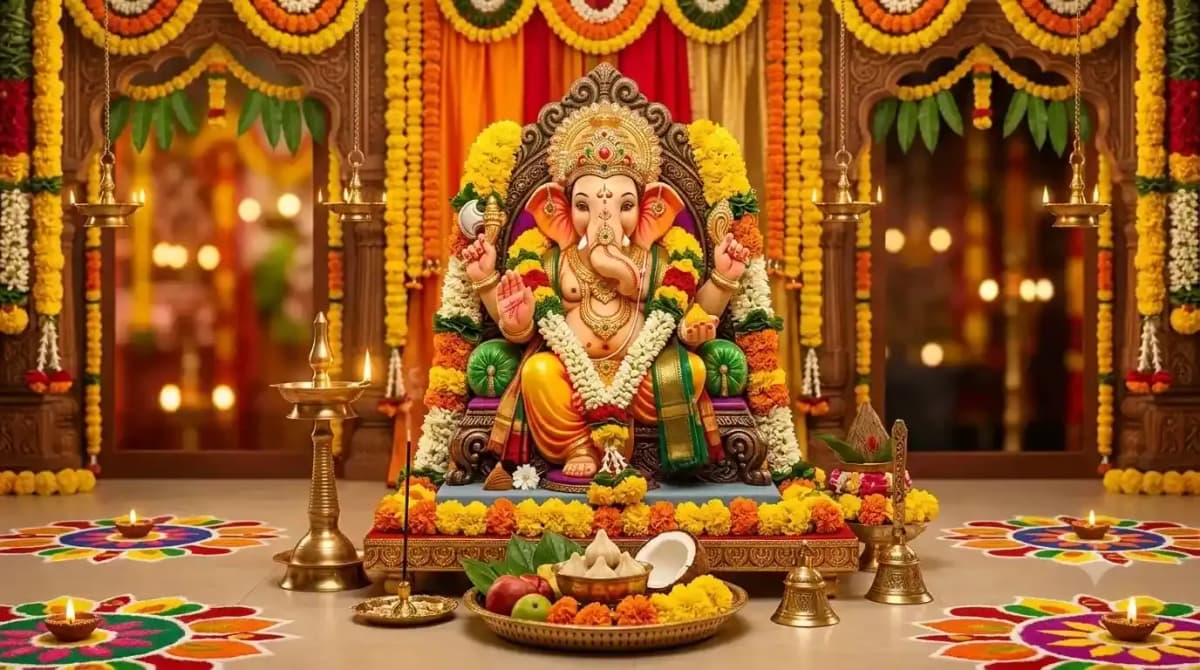
Who Made Ganesh Chaturthi a Public Festival? Tilak, 1893, and the History of Sarvajanik Ganeshotsav
How Ganesh Chaturthi became a public festival — Tilak’s 1893 revival, the Bhau Rangari debate, the three readings historians dispute, and the RSS question answered factually.
How Ganesh Chaturthi became a public festival — Tilak’s 1893 revival, the Bhau Rangari debate, the three readings historians dispute, and the RSS question answered factually.
Ganesha has been worshipped for well over a thousand years. The public festival — the street pandal, the ten-day programme, the immersion procession — is about 130 years old. It was built in Maharashtra in the early 1890s, deliberately, for a specific purpose, and the design worked so well that it is now the shape the festival takes from Hyderabad to New Jersey.
A note on a question that comes up often: the public Ganeshotsav has no founding connection to the Rashtriya Swayamsevak Sangh. The public celebrations were inspired by Lokmanya Bal Gangadhar Tilak in 1893; the RSS was founded in 1925, thirty-two years later. The full answer is below, in its own section.
Before 1893: a festival that had gone indoors
Ganesh Chaturthi is ancient as an observance. The public festival is not, and the reason is political. Under the Peshwas the Ganesh festival enjoyed state patronage; after the establishment of British rule it lost that patronage and contracted into a private family celebration in Maharashtra — much as it remains in most households today: a clay idol on a chowki, the family’s own puja, a quiet immersion. What changed was not the devotion. It was what a crowd was permitted to do.
1892–93: the law that created the pandal
Colonial anti-public-assembly measures of the early 1890s restricted Hindu gatherings. Tilak judged that this effectively blocked public assembly for Hindus — whose religion mandates no daily or weekly congregational worship — and used the religious exemption to turn Ganesh Chaturthi into a lawful means of large public assembly. The mechanism, stated plainly: political gatherings were restricted; religious gatherings were not; so the political gathering was held as a religious one.
In 1893 Tilak praised the Sarvajanik Ganesh Utsav in his newspaper Kesari and committed to turning the annual domestic festival into a large, well-organised public event, installing large public images of Ganesha in pavilions in the Bombay Presidency. The festival came out of homes and into the streets of Pune, and the celebration reached Bombay.
The two claimed first mandals
The 1893 celebrations are traced to the Shree Kasba Ganpati Sarvajanik Ganeshotsav Mandal at Kasba Peth in Pune, and the Shree Sarvajanik Ganeshutsav Sanstha at Keshavji Naik Chawl, Girgaum, Mumbai — the latter often described as the site of the oldest and first pandal. From there it spread across Mumbai and Pune and outward. Both mandals still function, and both are worth visiting if you are in either city during the festival.
Who actually started it: the argument Maharashtra still has
Outside Maharashtra this is settled — Tilak did it. Inside Maharashtra it is not settled at all, and an honest history has to say so.
- The Bhau Rangari case. The idea is traced to Khasgiwale, who saw a public Ganesh festival in Gwalior and brought the concept back to Pune, sharing it with Shrimant Bhausaheb Rangari — a respected royal physician and freedom fighter — and Balasaheb Natu. Bhau Rangari is credited in these accounts with inspiring Tilak to give Ganeshotsav a nationalist purpose.
- The Tilak case. Whoever first had the idea, Tilak is the one who made it a movement. He had the newspaper, the platform and the organising capacity, and he championed it in Kesari, converting a domestic observance into a large organised public event. Concept and scale are different contributions, and the second is what changed history.
A reasonable formulation, and the one this page uses: the sarvajanik Ganeshotsav emerged in Pune in 1892–93 from a circle that included Bhau Rangari and Khasgiwale, and Tilak is the figure who turned it into a mass political-cultural movement across the Bombay Presidency. "Tilak ki Bhau Rangari?" is a live debate in Marathi public life, with local pride on both sides — a page that reports it as settled is reporting it wrongly.
What Tilak actually designed
The innovations are specific, and almost every one is still in use:
- The public pandal with a large communal idol, replacing the household murti as the centre of gravity.
- The ten-day programme as organised public time — lectures, performances, debates.
- Readings of texts, communal feasting, and athletic and martial-arts competitions at public venues.
- Large hoardings bearing the image of the deity.
- The mass immersion procession on the final day.
- Programming — singing, dancing and drama — built around themes of nation and independence.
Read that list as an organiser rather than a devotee: it is a recurring, lawful, ten-day mass gathering with a stage, a captive audience, a fixed calendar slot and a built-in procession. As political infrastructure it is remarkably well built.
Why Ganesha specifically
Tilak had a choice of deities, and the reasoning behind this one is the most interesting part of the story. He recognised Ganesha’s appeal as "the god for everybody"; the scholar Robert Brown describes him as choosing the deity who bridged the gap between Brahmins and non-Brahmins, building grassroots unity across that division against colonial rule. Ganesha suits the purpose in a way few others would: he is worshipped first by every sampradaya — Shaiva, Vaishnava, Shakta, Smarta — requires no temple, priest or elaborate qualification, and is the deity of beginnings, a useful thing to invoke at the start of a national movement.
The RSS question, answered directly
The public Ganeshotsav dates to 1893; the Rashtriya Swayamsevak Sangh was founded in 1925 in Nagpur by Keshav Baliram Hedgewar — thirty-two years later. Hedgewar was a child of about four in 1893.
the organisation is generally described as observing six annual utsavs — Varsha Pratipada, Hindu Samrajya Dinotsav, Guru Purnima, Raksha Bandhan, Vijayadashami and Makar Sankranti. Ganesh Chaturthi is not among them; the Sangh’s principal festival and founding day is Vijayadashami.
is that Hedgewar came of age in a Nagpur nationalist milieu heavily shaped by Tilak, and historians do trace a methodological lineage — the use of cultural and religious forms for political organisation — from Tilak’s generation into the organisations that followed. That is influence on method, not authorship of a festival.
sarvajanik mandals in Maharashtra are significant sites of local organisation, and members of essentially every political formation in the state help run them, as do lakhs of people with no political affiliation at all. Mandal patronage is a feature of Maharashtrian civic life generally, not of any single organisation.
The short version: Tilak, not the RSS, created the public Ganeshotsav; the RSS does not observe it as an official festival; its members take part in mandals as citizens of Maharashtra do.
What historians dispute
The 1893 revival is read three ways by serious people, and a page that gives only one gives a partial education.
- Anti-colonial mobilisation. The standard account: Tilak channelled patriotic spirit and used festive fervour to build unity against the British, using a religious exemption to circumvent an assembly ban. Here the festival is primarily an instrument of the freedom movement.
- The forging of a Hindu political identity. The public celebration is also described as a means to form a Hindu nationalist identity as well as to resist colonial rule — the two purposes inseparable, with consequences in the communally tense Bombay Presidency of the 1890s that historians continue to weigh.
- A response to anti-caste mobilisation. In Phule–Ambedkarite scholarship, the revival is read as a Brahmin-led counter to the growing popularity of Jotirao Phule’s Satyashodhak Samaj and its jalsa programmes, which were organising non-Brahmin communities in the same city at the same moment.
We report all three because all three are argued by people who have done the work, and the evidence admits more than one reading. The strongest argument for the third is timing and geography; the strongest argument against it is that the festival demonstrably did draw participation across caste lines. Both facts are in the record.
From 1893 to now
The mandal became an institution — Lalbaugcha Raja in Mumbai, Dagdusheth Halwai in Pune and Khairatabad in Hyderabad now draw crowds in the millions and operate year-round as trusts. The themes tracked the nation, shifting through the world-war decades and returning to nationalist themes later in the century; pandal tableaux still comment on current affairs, a direct continuation of Tilak’s design. What began in the Bombay Presidency is now central across Telangana, Andhra Pradesh, Karnataka, Goa and Tamil Nadu, and is observed by Hindu communities across the USA, UK, Canada, Australia, the Gulf, Southeast Asia, Mauritius, Fiji and the Caribbean. In 2025 the Maharashtra government moved to declare Ganeshotsav the state festival, with a stated commitment to promoting it across India and globally.
What survives of the original design
- Public pandal with a communal idol → the mandal, from a street corner to Khairatabad.
- Ten-day organised programme → daily aarti, cultural nights, competitions.
- Immersion procession → nimajjanam / visarjan, with crowds in the lakhs.
- Public tableaux on current themes → pandal displays commenting on the news.
- Deliberate cross-caste, cross-community participation → the open pandal anyone may enter.
- A lawful mass gathering on a fixed annual date → unchanged.
The household puja described in our Vinayaka Vrata Vidhanam is the older layer; the pandal outside is the newer one. Most families do both without noticing they are participating in two traditions of very different ages.
Frequently Asked Questions
Who started the public celebration of Ganesh Chaturthi?
The public Ganeshotsav was inspired by Lokmanya Bal Gangadhar Tilak in 1893, though in Maharashtra credit is also given to Shrimant Bhausaheb Rangari and the Pune circle around him.
Why did Tilak start the public Ganesh festival?
Colonial legislation restricted public assembly, but religious gatherings were exempt. Tilak used that exemption to create a lawful mass public gathering.
Which was the first Ganesh mandal?
The 1893 celebrations are traced to Kasba Ganpati in Pune and the Sarvajanik Ganeshutsav Sanstha at Keshavji Naik Chawl, Girgaum, Mumbai (often called the first pandal). Both still operate.
Did the RSS start Ganesh Chaturthi?
No. The public festival dates to 1893; the RSS was founded in 1925. Ganesh Chaturthi is not among the festivals the RSS officially observes.
Why did Tilak choose Ganesha?
He regarded Ganesha as "the god for everybody" and is described as choosing the deity who bridged Brahmins and non-Brahmins to build unity against colonial rule.
Which festival did Tilak introduce in 1893?
The public, organised form of Ganesh Chaturthi — the sarvajanik Ganeshotsav.
Was Ganesh Chaturthi celebrated before 1893?
Yes, for centuries — with state patronage under the Peshwas, contracting to a private family celebration under the British. Tilak revived the public form; he did not invent the festival.
Explore the Ganesh Chaturthi 2026 Complete Guide
This page is part of Hindutone’s Ganesh Chaturthi 2026 cluster:
- Complete Ganesh Chaturthi 2026 guide (hub)
- Date & city-wise muhurat
- Ganesh Sthapana (setup at home)
- Vinayaka Vrata Vidhanam (full puja)
- Ganesh Visarjan mantra
- Stories of Ganesha
- Wishes & quotes
Related Reading on Hindutone
- Vinayaka Chavithi / Ganesh Chaturthi 2026: complete guide (hub)
- The stories of Ganesha: Puranic legends
- Vinayaka Vrata Vidhanam: the complete puja with mantras
You might also like
Ganesh Chaturthi and NRI Kids: The Questions Nobody Prepares You For

The Moon on Ganesh Chaturthi: Why It Must Not Be Seen, and the Remedy Mantra
The Stories of Ganesha: Puranic Legends Behind Ganesh Chaturthi