Madhurashtakam (Adharam Madhuram): Lyrics, Meaning and How to Recite
Madhurashtakam, the hymn that begins 'Adharam madhuram, vadanam madhuram', praises the sweetness of Sri Krishna in eight short verses. Here is the full text in Devanagari and IAST, a simple English meaning of every verse, the background of its author Sri Vallabhacharya, when families recite it, and tips for NRI children learning it.
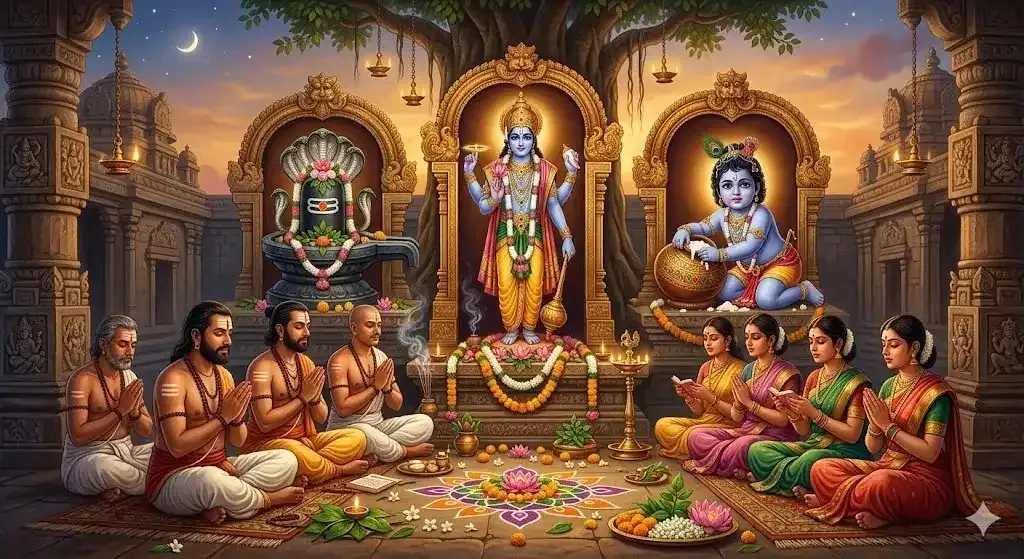
Madhurashtakam, the hymn that begins 'Adharam madhuram, vadanam madhuram', praises the sweetness of Sri Krishna in eight short verses. Here is the full text in Devanagari and IAST, a simple English meaning of every verse, the background of its author Sri Vallabhacharya, when families recite it, and tips for NRI children learning it.
Quick answer: Madhurashtakam is an eight-verse Sanskrit hymn that praises the sweetness of Sri Krishna. It is also known by its first words, "Adharam Madhuram". It is traditionally attributed to Sri Vallabhacharya, the founder of the Pushti Marg. Every verse lists six to eight things about Krishna and calls each one "madhuram" (sweet). Every verse ends with the same line: "madhurādhipater akhilaṃ madhuram", which means "everything about the Lord of sweetness is sweet". Families sing it in the evening, on Janmashtami and on Ekadashi days.
This guide has been restored at its original hindutone.com address. Below you will find the full text in Devanagari and IAST transliteration, a simple meaning of each verse, the background of the hymn, and practical tips for learning it at home in India or abroad.
Madhurashtakam: Adharam Madhuram lyrics (full text)
This is the standard text as it is widely printed and sung. Each verse is given first in Devanagari and then in IAST transliteration. In IAST, ṃ is a nasal sound like 'm', ṛ is pronounced 'ri', ś is 'sh' and a line over a vowel (ā, ī, ū) means it is held longer.
Verse 1
अधरं मधुरं वदनं मधुरं नयनं मधुरं हसितं मधुरम् ।
हृदयं मधुरं गमनं मधुरं मधुराधिपतेरखिलं मधुरम् ॥१॥
adharaṃ madhuraṃ vadanaṃ madhuraṃ nayanaṃ madhuraṃ hasitaṃ madhuram |
hṛdayaṃ madhuraṃ gamanaṃ madhuraṃ madhurādhipater akhilaṃ madhuram ||1||
Verse 2
वचनं मधुरं चरितं मधुरं वसनं मधुरं वलितं मधुरम् ।
चलितं मधुरं भ्रमितं मधुरं मधुराधिपतेरखिलं मधुरम् ॥२॥
vacanaṃ madhuraṃ caritaṃ madhuraṃ vasanaṃ madhuraṃ valitaṃ madhuram |
calitaṃ madhuraṃ bhramitaṃ madhuraṃ madhurādhipater akhilaṃ madhuram ||2||
Verse 3
वेणुर्मधुरो रेणुर्मधुरः पाणिर्मधुरः पादौ मधुरौ ।
नृत्यं मधुरं सख्यं मधुरं मधुराधिपतेरखिलं मधुरम् ॥३॥
veṇur madhuro reṇur madhuraḥ pāṇir madhuraḥ pādau madhurau |
nṛtyaṃ madhuraṃ sakhyaṃ madhuraṃ madhurādhipater akhilaṃ madhuram ||3||
Verse 4
गीतं मधुरं पीतं मधुरं भुक्तं मधुरं सुप्तं मधुरम् ।
रूपं मधुरं तिलकं मधुरं मधुराधिपतेरखिलं मधुरम् ॥४॥
gītaṃ madhuraṃ pītaṃ madhuraṃ bhuktaṃ madhuraṃ suptaṃ madhuram |
rūpaṃ madhuraṃ tilakaṃ madhuraṃ madhurādhipater akhilaṃ madhuram ||4||
Verse 5
करणं मधुरं तरणं मधुरं हरणं मधुरं रमणं मधुरम् ।
वमितं मधुरं शमितं मधुरं मधुराधिपतेरखिलं मधुरम् ॥५॥
karaṇaṃ madhuraṃ taraṇaṃ madhuraṃ haraṇaṃ madhuraṃ ramaṇaṃ madhuram |
vamitaṃ madhuraṃ śamitaṃ madhuraṃ madhurādhipater akhilaṃ madhuram ||5||
Verse 6
गुञ्जा मधुरा माला मधुरा यमुना मधुरा वीची मधुरा ।
सलिलं मधुरं कमलं मधुरं मधुराधिपतेरखिलं मधुरम् ॥६॥
guñjā madhurā mālā madhurā yamunā madhurā vīcī madhurā |
salilaṃ madhuraṃ kamalaṃ madhuraṃ madhurādhipater akhilaṃ madhuram ||6||
Verse 7
गोपी मधुरा लीला मधुरा युक्तं मधुरं मुक्तं मधुरम् ।
दृष्टं मधुरं शिष्टं मधुरं मधुराधिपतेरखिलं मधुरम् ॥७॥
gopī madhurā līlā madhurā yuktaṃ madhuraṃ muktaṃ madhuram |
dṛṣṭaṃ madhuraṃ śiṣṭaṃ madhuraṃ madhurādhipater akhilaṃ madhuram ||7||
Verse 8
गोपा मधुरा गावो मधुरा यष्टिर्मधुरा सृष्टिर्मधुरा ।
दलितं मधुरं फलितं मधुरं मधुराधिपतेरखिलं मधुरम् ॥८॥
gopā madhurā gāvo madhurā yaṣṭir madhurā sṛṣṭir madhurā |
dalitaṃ madhuraṃ phalitaṃ madhuraṃ madhurādhipater akhilaṃ madhuram ||8||
Some printed editions show small spelling differences in a word or two. If your family or temple sings from a particular book, follow that book.
Verse-by-verse meaning in simple English
The hymn uses short, simple words. The meanings below are plain translations. Some words carry more than one sense in Sanskrit, and teachers explain them in different ways.
Verse 1: His lips are sweet. His face is sweet. His eyes are sweet. His smile is sweet. His heart is sweet. His way of walking is sweet. Everything about the Lord of sweetness is sweet.
Verse 2: His words are sweet. His deeds and life story are sweet. His clothes are sweet. The graceful bend of his body is sweet. His movements are sweet. His wandering is sweet. Everything about the Lord of sweetness is sweet.
Verse 3: His flute is sweet. The dust of his feet is sweet. His hands are sweet. His feet are sweet. His dance is sweet. His friendship is sweet. Everything about the Lord of sweetness is sweet.
Verse 4: His singing is sweet. His drinking is sweet. His eating is sweet. His sleeping is sweet. His form is sweet. The tilaka on his forehead is sweet. Everything about the Lord of sweetness is sweet.
Verse 5: His actions are sweet. His way of carrying devotees across is sweet. His stealing (of butter and of hearts) is sweet. His play is sweet. What he gives out is sweet. His calmness is sweet. Everything about the Lord of sweetness is sweet.
Verse 6: His gunja-berry necklace is sweet. His garland is sweet. The Yamuna river is sweet. Its waves are sweet. Its water is sweet. Its lotuses are sweet. Everything about the Lord of sweetness is sweet.
Verse 7: The gopis are sweet. His divine play (lila) is sweet. His meeting is sweet. His release is sweet. His glance is sweet. His good conduct is sweet. Everything about the Lord of sweetness is sweet.
Verse 8: The cowherd boys are sweet. The cows are sweet. His herding staff is sweet. His creation is sweet. His crushing (of evil) is sweet. His bringing things to fruit is sweet. Everything about the Lord of sweetness is sweet.
Key words to know
| Sanskrit word | Meaning |
|---|---|
| madhura (मधुर) | Sweet, charming, delightful |
| adhipati (अधिपति) | Lord, master |
| madhurādhipati | The Lord of sweetness, Sri Krishna |
| akhila (अखिल) | All, everything, whole |
| adhara (अधर) | Lip |
| hasita (हसित) | Smile, laughter |
| veṇu (वेणु) | Flute |
| guñjā (गुञ्जा) | Small red-and-black gunja berries worn as a necklace |
| yaṣṭi (यष्टि) | Stick or staff used by cowherds |
Background: Vallabhacharya and the Pushti Marg
As commonly told, Sri Vallabhacharya was born in 1479 into a Telugu Brahmin family and lived until about 1531. He travelled widely across India, took part in philosophical debates and taught devotion to Krishna. His philosophy is called Shuddhadvaita, or pure non-dualism.
The path he founded is called the Pushti Marg. 'Pushti' means nourishment or grace. In this tradition, the devotee depends on Krishna's grace and serves him with love, much as a family serves a beloved child. Daily seva (loving service) to Krishna in his child form is central to this path.
The best-known Pushti Marg shrine today is the Shrinathji temple at Nathdwara in Rajasthan. Followers are found especially in Gujarat, Rajasthan and Maharashtra, and in Gujarati communities around the world.
Madhurashtakam reflects this mood of loving devotion. It does not ask for anything. It simply looks at Krishna, his flute, his friends, his cows and the Yamuna, and finds every detail sweet. Many devotees see it as an example of how bhakti turns the whole world into a reminder of the Lord.
When to recite Madhurashtakam
- Daily evening: after lighting the lamp at sandhya time. It takes only a few minutes to sing all eight verses.
- Janmashtami: the birthday of Krishna. Many families sing it during the midnight celebration or while decorating the cradle.
- Ekadashi: the eleventh lunar day, sacred to Vishnu and Krishna. See our guide to Papankusha Ekadashi 2026. Check Drik Panchang for Ekadashi dates in your city.
- Karthika month: a month of lamps and devotion for many Hindu families. See our Karthika Masam 2026 guide.
- Bhajan gatherings: Madhurashtakam is a favourite at satsangs, temple bhajan evenings and music classes.
How families sing it at home
Traditions vary from home to home. A simple, widely followed way is:
- Sit in front of a picture or murti of Krishna. Light a lamp or incense if your home allows it.
- Offer a flower, a tulsi leaf or a little butter, sugar or fruit.
- Sing the eight verses slowly. One person can sing a line, and the family can repeat it.
- Many families sing the closing line, 'madhurādhipater akhilaṃ madhuram', together after each verse.
- End with a short aarti or a few minutes of quiet. Then share the offered sweet as prasad.
The hymn is sung to many tunes. Popular recordings range from slow classical renderings to lively bhajan styles. Choose a tune your family enjoys, because a hymn that is sung happily is sung often.
Tips for NRI children learning Madhurashtakam
Families in the USA, UK, Canada, Australia and the Gulf often find this the easiest Sanskrit hymn to start with. These steps help:
- Start with verse 1 only. Sing it every evening for one week. The repeated word 'madhuram' makes it easy to remember.
- Teach the closing line first. Children can join in on 'madhurādhipater akhilaṃ madhuram' from the first day.
- Point and name. While singing verse 1, point to lips, face, eyes and smile. Small children enjoy this game.
- Use pictures. Show pictures of the flute, the cows, the gunja necklace and the Yamuna for verses 3, 6 and 8.
- Add one verse a week. In about two months, most children can sing all eight verses.
- Sing with a recording. Let children sing along with a recording in the car or before bed.
- Explain one word at a time. Use the key words table above. Ask children what they find 'madhuram' in their own day.
If your child is also learning to count japa on a mala, see our japa mala guide and our article on the sacred number 108.
Stotrams and prayers to read next
Frequently asked questions
Who wrote Madhurashtakam?
Madhurashtakam is traditionally attributed to Sri Vallabhacharya. He was a teacher of the Krishna bhakti tradition in the late 15th and early 16th centuries. He founded the Pushti Marg, the path of grace.
What does 'madhurādhipater akhilaṃ madhuram' mean?
It means 'everything about the Lord of sweetness is sweet'. Madhura means sweet, adhipati means lord or master, and akhilam means everything or all. This line closes every one of the eight verses.
How many verses does Madhurashtakam have?
It has eight verses. 'Ashtakam' means a hymn of eight verses. Each verse has two lines, and the word madhura (sweet) appears eight times in each verse.
When is the best time to recite Madhurashtakam?
There is no fixed rule. Many families sing it in the evening after lighting the lamp. It is especially popular on Janmashtami, on Ekadashi days and during Krishna bhajan gatherings. You can also recite it at any quiet time of the day.
Can children and beginners learn Madhurashtakam?
Yes. It is one of the easiest Sanskrit hymns to learn because the word 'madhuram' repeats so often. Many children learn the first verse in a week by singing it with a parent each evening.
Will reciting Madhurashtakam bring specific results?
No hymn comes with a guarantee of particular results. Devotees sing Madhurashtakam to remember Krishna with love and to bring a sweet, calm mood into the home. It is a prayer of devotion, not a formula for outcomes.
Editor's note
Editor's note (6 October 2026): This guide has been restored at its original address after the earlier version was lost. The Sanskrit text is the standard version as widely printed and sung, and we checked each verse against a published edition. Small spelling differences exist between editions. The English meanings are simple translations; some words have more than one accepted sense. Details of Vallabhacharya's life are given as commonly told in the Pushti Marg tradition. The hymn is presented as an act of devotion, with no promise of particular results.
Related guides
You might also like
Bhairav Chalisa: Lyrics in Hindi with Meaning, Bhairav Aarti and How to Recite
Ram Chalisa: Lyrics in Hindi with Meaning, Ram Stuti Aarti and How to Recite
Lakshmi Chalisa Lyrics in Hindi with Meaning, and Om Jai Lakshmi Mata Aarti