Lalita Sahasranama — Complete Guide to the 1000 Names of Devi Lalita Tripura Sundari, Sri Vidya Tradition, Friday Practice & 30-Day NRI Guide for 2026
Lalita Sahasranama complete guide 2026 — 1000 names of Devi Lalita Tripura Sundari, Brahmanda Purana origin, Sri Vidya tradition, Sri Yantra connection, Friday practice, Pournami protocol, 30-day NRI plan.
Lalita Sahasranama complete guide 2026 — 1000 names of Devi Lalita Tripura Sundari, Brahmanda Purana origin, Sri Vidya tradition, Sri Yantra connection, Friday practice, Pournami protocol, 30-day NRI plan.
"Shri Mata, Shri Maha Rajni, Shrimat Simhasaneshwari — Chid-agni-kunda-sambhuta, Deva-karya-samudyata."
"Sacred Mother, supreme Queen, the Empress on the divine throne — born from the fire of consciousness, ready to accomplish the work of the Gods."
— Lalita Sahasranama, opening verses
Updated for 2026. The Lalita Sahasranama — the 1,000 names of Devi Lalita Tripura Sundari — is the supreme Devi recitation in the Hindu canon and the foundational text of the Sri Vidya tradition, the most sophisticated Tantric path within mainstream Hinduism. Found in the Brahmanda Purana, the Sahasranama was taught by Lord Hayagriva (Vishnu's horse-headed avatar of supreme knowledge) to Sage Agastya at the request of Goddess Lalita herself. Each of the 1,000 names captures one facet of the supreme feminine divine — Devi as creator, sustainer, destroyer, and the very ground of consciousness. For NRI Hindu women across USA, UK, Canada, Australia, GCC, Germany — and for entire Hindu families seeking Devi protection, family welfare, women's empowerment, and household prosperity — Friday Lalita Sahasranama is among the most spiritually transformative weekly practices available. This complete guide includes the Sahasranama's structure, 25 selected most-powerful verses with meaning, the Sri Vidya tradition and Sri Yantra connection, the Hayagriva-Agastya origin narrative, the Friday + Pournami protocols, a 30-day NRI practice plan, Karya Siddhi mantras for specific outcomes, country-specific guidance, and the complete pillar mantra framework (Gayatri + Vishnu Sahasranama + Lalita Sahasranama + Maha Mrityunjaya + Hanuman Chalisa).
1. What Is the Lalita Sahasranama?
Lalita Sahasranama literally means "the thousand names of Lalita." It is a Sanskrit stotra (devotional hymn) of approximately 320 verses containing 1,000 distinct names of Goddess Lalita Tripura Sundari — the supreme form of Devi in the Sri Vidya tradition.
Key features:
- 183 verses + opening + closing dohas containing 1,000 names (some count 320 verses with names + framing)
- Recitation duration: 35-45 minutes at devotional pace
- Primary deity: Lalita Tripura Sundari — the supreme Devi, called "the Beautiful Goddess of the Three Cities/Worlds"
- Tradition: Sri Vidya (the supreme Tantric Devi path)
- Yantra: Sri Yantra (the geometric form of Devi)
- Universal acceptance: Recognised across Shakta, Smarta, and most Vaishnava traditions
Each of the 1000 names captures one aspect of the supreme feminine divine — Devi as physical reality, cosmic principle, mental faculty, emotional state, ritual instrument, and ultimate consciousness. Together they map the totality of feminine divinity.
The Sahasranama is the supreme devotional resource for:
- Women's spiritual practice in the Hindu tradition
- Family welfare invoking the Mother principle
- Household prosperity through Devi's benevolence
- Children's protection (Devi as supreme protector)
- Marital harmony invoking the Devi-Shiva union
- Tantric/Sri Vidya practice for serious initiates
2. The Brahmanda Purana Origin — Hayagriva to Agastya
The Lalita Sahasranama appears in the Brahmanda Purana (one of the 18 Mahapuranas). The setting:
The mythological context
Sage Agastya and his wife Lopamudra were performing intense tapasya, seeking to understand the nature of Devi. Agastya approached Lord Vishnu in his Hayagriva form (the horse-headed avatar associated with supreme knowledge, supremely worshipped by scholars and seekers).
Hayagriva, recognising Agastya's worthiness, agreed to reveal the supreme Devi knowledge. He taught Agastya:
- The Lalitopakhyana — the cosmic narrative of Lalita Tripura Sundari, her emergence from the fire of consciousness, her cosmic battle against the demon Bhandasura, her enthronement as supreme Devi
- The Lalita Sahasranama — the 1,000 names that map her totality
- The Khadgamala — the sword-garland mantra invoking the entire Sri Yantra
- The Tantric framework — Sri Vidya practices for accessing Devi
This transmission is preserved in the Lalitopakhyana (story portion) and Lalita Sahasranama (mantra portion) of the Brahmanda Purana.
Why Hayagriva?
Hayagriva is Vishnu's avatar specifically associated with knowledge transmission. While Vishnu himself is the cosmic preserver, Hayagriva is the divine teacher. The choice of Hayagriva to transmit Lalita Sahasranama is significant: this is not casual devotional content but supreme knowledge requiring transmission through a knowledge-bearer.
Why Agastya?
Agastya is among the most revered Vedic sages — credited with traveling south, bringing Vedic learning to South India, drinking the ocean, and many cosmic feats. His worthiness as recipient establishes the Sahasranama's elevated status. The transmission from Hayagriva to Agastya represents the highest level of Vedic-Tantric knowledge being preserved for humanity.
3. Lalita Tripura Sundari — Who Is the Goddess?
Lalita Tripura Sundari is the supreme form of Devi in the Sri Vidya tradition.
The name decoded
- Lalita = "She who plays" — referring to her sportive cosmic play (lila) of creation, sustenance, dissolution
- Tripura = "Three Cities" or "Three Worlds" — referring to (a) the three worlds (Bhuh, Bhuvah, Svaha) she rules; (b) the three lights (sun, moon, fire) she illuminates; (c) the three states of consciousness (waking, dreaming, deep sleep) she pervades
- Sundari = "The Beautiful One" — supreme beauty, but specifically the beauty of consciousness manifesting itself
Her cosmic origin
Per the Lalitopakhyana: when the demon Bhandasura threatened all creation, the gods invoked the supreme feminine principle. From the Chid-agni-kunda (the fire-pit of consciousness), Lalita Tripura Sundari emerged in cosmic majesty, seated on a divine throne carried by Brahma, Vishnu, Shiva, Indra, and other gods. She fought Bhandasura, defeated him, and was enthroned as supreme Devi.
Her iconography
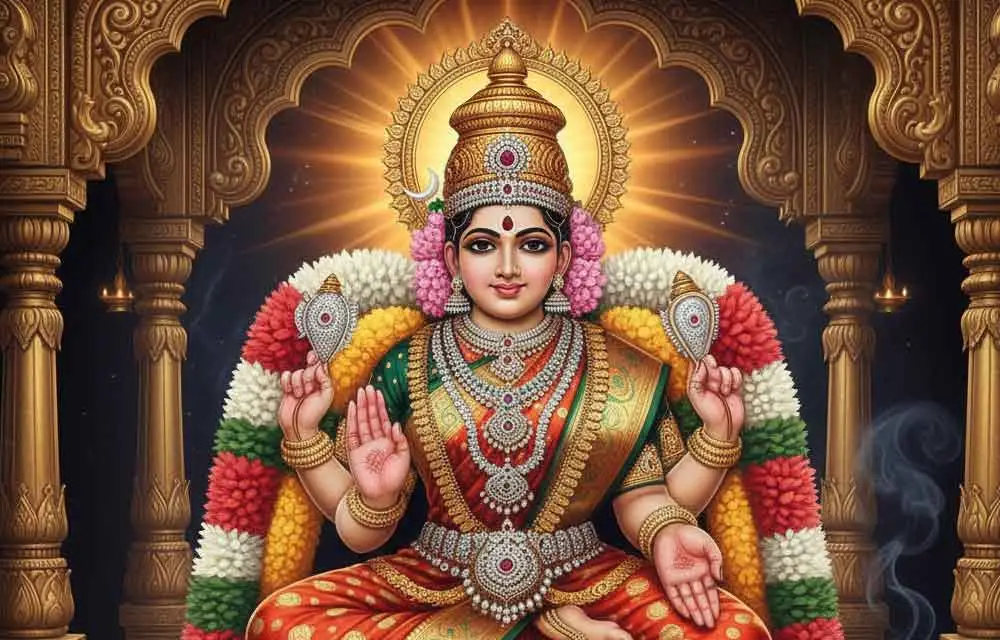
- Three eyes (like Shiva's third eye)
- Four-armed holding sugar-cane bow, five flower arrows, noose, and elephant goad
- Red garments symbolising primal energy
- Throne of five gods (the Pancha Preta Asana — the five "corpses" of Brahma, Vishnu, Shiva, Ishvara, Sadashiva representing all of cosmic creation)
- Crescent moon on her crown
- Garland of skulls / ornaments of cosmic principles
Her cosmic functions
Lalita Tripura Sundari is the integrated cosmic feminine principle:
- The creator (Brahma's wife Saraswati form)
- The preserver (Vishnu's wife Lakshmi form)
- The destroyer (Shiva's wife Parvati/Kali form)
- The supreme reality beyond all three — the Adi Shakti
4. The Sri Vidya Tradition — Hindu Tantra's Foundation
Sri Vidya (literally "the auspicious knowledge") is the most sophisticated and most respected Tantric tradition within mainstream Hinduism. It is the path through which Lalita Tripura Sundari is worshipped.
Key features of Sri Vidya
- Devi-centred: Lalita as the supreme reality
- Mantra-based: Specific bija mantras (Pancha Dasi, Shodashi) form the practice
- Yantra-based: The Sri Yantra is the geometric form for meditation and worship
- Initiation required for advanced practice: But Lalita Sahasranama recitation is open to all
- Includes Vamachara (left-hand path) for advanced practitioners; Dakshinachara (right-hand path) is the standard mainstream approach
Major Sri Vidya acharyas
- Adi Shankaracharya — many of the foundational Sri Vidya texts are attributed to him (Saundarya Lahari, Ananda Lahari, Bhavanopanishad)
- Bhaskararaya (18th century) — wrote the definitive commentary on Lalita Sahasranama (the Saubhagya Bhaskara)
- Modern acharyas: Several Sri Vidya lineages preserved across Karnataka, Tamil Nadu, Andhra Pradesh, and modern diaspora
Sri Vidya for laypeople
Most NRI Hindu practitioners engage Sri Vidya in its devotional dimension:
- Friday Lalita Sahasranama recitation
- Sri Yantra visualisation (no formal initiation required)
- Devotional Devi mantras (without complex Tantric practices)
- Family Devi worship
Serious Sri Vidya practitioners undergo formal initiation (*Sri Vidya Upadesha*) from a qualified acharya. For most NRI Hindu families, the lay devotional path is sufficient and deeply rewarding.
5. The Sri Yantra — The Geometric Form of Devi
The Sri Yantra (also called Sri Chakra) is the geometric representation of Lalita Tripura Sundari. It is the most complex and most sacred geometric form in Hindu Tantra.
Structure
- 9 interlocking triangles (4 upward-pointing representing Shiva, 5 downward representing Shakti)
- Surrounded by 3 concentric circles
- Surrounded by lotus petals (8-petal and 16-petal lotuses)
- Surrounded by a square with four T-shaped gates (the bhupura)
Total geometric elements
The complete Sri Yantra contains 43 triangles + 24 lotus petals + 3 circles + 1 square — a total of 9 levels (called avaranas) which the Sri Vidya practitioner mentally traverses during Khadgamala recitation.
Symbolic meaning
Each triangle represents a specific Devi or deity; together they map the entire cosmic order. The central dot (*bindu*) represents the supreme Lalita herself — the ground from which all manifest reality emerges.
Yantra practice for NRI households
A Sri Yantra image or engraving in the home altar:
- Increases divine feminine presence
- Anchors household prosperity
- Supports women's spiritual practice
- Can be obtained from Indian art shops, Hindu temple stores, or online (Exotic India, Indian Aura, etc.)
Place the Sri Yantra:
- Facing east or north
- At eye level when seated
- Clean weekly
- Light a ghee lamp before it on Fridays
- Recite the Lalita Sahasranama before it for maximum effect
6. Structure — The 1000 Names Organised
The Lalita Sahasranama is organised into:
Opening dhyana (invocation)
Verses establishing the goddess's form, throne, and cosmic context.
The Sahasranama proper — 183 verses, 1000 names
Each verse contains 4-8 names. The names progress through thematic clusters:
Cluster 1 — Cosmic emergence:
Shri Mata, Shri Maha Rajni, Shrimat Simhasaneshwari, Chidagnikundasambhuta — "Sacred Mother, supreme Queen, the Empress, born from the fire of consciousness"
Cluster 2 — Bhandasura defeat narrative:
Names describing her cosmic battle and victory over the demon Bhandasura.
Cluster 3 — Personal form description:
Sumeru-Shringa-Madhya-Sthaa (residing at the centre of Mount Meru), Maha-Lakshmi, Mahesh-Vari (consort of Maheshwara/Shiva), etc.
Cluster 4 — Sri Chakra correspondence:
Names corresponding to the various avaranas and triangles of the Sri Yantra.
Cluster 5 — Cosmic principles:
Names invoking her as Maya, Prakriti, Shakti, Adi Shakti, the cosmic Mother.
Cluster 6 — Specific qualities:
Lalita (the playful), Anaadi (without beginning), Ananta (without end), Sarva-jana-priya (beloved of all beings).
Cluster 7 — Vidya / Knowledge:
Names invoking her as supreme knowledge, the goddess of wisdom, the embodiment of the Vedas.
Cluster 8 — Devotee-relationship:
Bhakta-vatsala, Kripa-pradhana, Sharanya — names describing her grace toward devotees.
Closing dhyana
The closing verses recapitulate the practice, emphasise its merit, and conclude with surrender.
7. 25 Selected Most-Powerful Verses with Meaning
Verse 1 — The Opening (Most Important)
Om Shri Mata, Shri Maha Rajni, Shrimat Simhasaneshwari
Chid-agni-kunda-sambhuta, Deva-karya-samudyata
Meaning: The Sacred Mother, the Supreme Queen, the Empress on the divine throne, who emerged from the fire-pit of consciousness, who is ever-ready to accomplish the work of the gods.
This single opening verse establishes Devi as: (1) Cosmic Mother, (2) Sovereign Empress, (3) Born of pure consciousness, (4) Active divine power that protects and accomplishes.
Verse 4 — Cosmic Beauty
Champaka-ashok-punnaga-saugandhika-lasat-kacha,
Kurivinda-mani-shreni-kanat-koti-eera-mandita
Meaning: Adorned with hair fragrant with champaka, ashoka, punnaga, and saugandhika flowers; bedecked with countless ruby gems forming brilliant ornaments.
Verse 10 — Pancha Tattva (Five Elements)
Pancha-tanmaatra-saayaka, Pancha-bhuteshvari, Pancha-sankhyopacharini, Shashtit-tattva-sa-mahaayini
Meaning: She whose five flower arrows are the five subtle elements; the supreme Lady of the five gross elements; she who is worshipped through the five-fold ritual; she who pervades the sixty cosmic principles.
Verse 17 — Universal Pervasion
Saakaalaalaalalita-sangraha-kaarini, Saraswati,
Saiva, Vaishnavi, Brahmi, Saarvika, Sarvavalpaa
Meaning: She who gathers all forms; she who is Saraswati (knowledge); she who is Shaiva (Shiva's energy); she who is Vaishnavi (Vishnu's energy); she who is Brahmi (Brahma's energy); she who pervades all; she who manifests as all.
Verse 38 — Liberation Foundation
Bhakta-vatsala, Sumati-pradata, Shumati-pradayini,
Sukshma-rupa, Mahaakaala, Mahaa-bhairava-pujita
Meaning: Loving toward devotees; granter of pure intelligence; granter of supreme wisdom; she of subtle form; the great destroyer of time; she worshipped by Mahaabhairava (the supreme Bhairava).
Verse 49 — Sri Yantra Master
Vinanthrika-kshobha-pradayini, Vajrini, Vajra-sirah,
Shiv-aayur-aanavidya, Saraswati, Shri-pratha-vidyaa
Meaning: She who is the giver of cosmic disturbance to evil; she of adamantine essence; she of unshakeable form; she who is supreme knowledge of Shiva; she who is the master of all goddesses; she who is the primary supreme knowledge.
Verse 75 — Maha-Maya
Mahaa-maya-vinodini, Maha-laasya-vinodini,
Maha-pataaka-jaalighni, Mahaa-pataki-naashini
Meaning: She who delights in the cosmic illusion; she who delights in the great cosmic dance; she who destroys the great sins entirely; she who destroys the great sinners.
Verse 99 — Liberation Promise
Sthitaa, Shubhada, Shubhakari, Sammrudhi-data, Saumya-rupa,
Sarva-mantra-svarupa, Sarva-yantra-svarupini
Meaning: She who is the steady one; she who grants auspiciousness; she who creates auspiciousness; she who grants prosperity; she of gentle form; she who is the essence of all mantras; she who is the essence of all yantras.
Verse 175 (closing cluster) — The Bindu
Bindu-rupa, Bindu-vasini, Bindu-puja-priyaayini,
Bindu-sampurna-sahasra-koti-arka-divaa-prakaashini
Meaning: She who is in the form of the bindu (the central dot of Sri Yantra); she who dwells in the bindu; she who delights in bindu worship; she who shines like a thousand million suns concentrated in the bindu.
(The remaining 17 of the 25 most-powerful verses can be studied at home with the Bhaskararaya commentary — see Section 14 for resources.)
8. The Khadgamala — The Devi Sword-Mala Practice
The Khadgamala ("sword-garland") is the Lalita Sahasranama's complementary mantra-practice. It consists of:
- A specific sequence of 100 Devi names
- Each name represents one of the avaranas/triangles of the Sri Yantra
- Recited in a specific order corresponding to traversing the entire Sri Yantra
Why "sword-mala"?
The practice is said to be a "sword" because it cuts through all illusion and karma; "mala" because it forms a garland (continuous sequence) of Devi names corresponding to all 9 avaranas of Sri Yantra.
Khadgamala vs Sahasranama
Both are Devi recitations from the same Sri Vidya tradition:
- Sahasranama: 1,000 names; comprehensive worship; ~35 minutes
- Khadgamala: ~100 names; specifically traversing Sri Yantra; ~10 minutes
- Practitioners often do both — Sahasranama as full weekly worship; Khadgamala as daily quick practice
For NRI practitioners, the Khadgamala is the more accessible daily entry point; the Sahasranama is the weekly deep practice.
9. Friday and Pournami Practice Traditions
Friday — Devi's day
Friday in the Hindu weekly framework is Shukravar (Devi's day, also Lakshmi's day, also Shukra/Venus's day). Lalita Sahasranama recitation on Fridays carries amplified merit.
Friday protocol:
- Bathe and wear red or pink (Devi's colours)
- Set up the home altar with a Sri Yantra (or printed image) + Devi murti
- Light a ghee lamp
- Recite Lalita Sahasranama (35-45 minutes)
- Offer red flowers (rose, hibiscus) and red rice
- Optional: feed unmarried girl-children (Devi embodied)
Pournami (Full Moon) — Supreme Devi day
Each full moon is sacred to Devi. Pournami Lalita Sahasranama is considered exceptionally powerful — practitioners often recite the Sahasranama on every Pournami throughout the year, with particular emphasis on:
- Sharad Pournami (October full moon)
- Vaishakha Pournami (May Buddha Purnima)
- Kartik Pournami (November)
- Magha Pournima (February)
Vaishakha Pournami 2026
Friday, May 22, 2026 — Pournami coinciding with Friday. The supreme NRI Lalita Sahasranama day of the year.
Sankashti Chaturthi sequence
Some practitioners synchronise Friday Lalita Sahasranama with Sankashti Chaturthi (the 4th lunar day Devi day) every two weeks, creating a fortnightly intensive Devi practice rhythm.
10. Navratri Intensive Practice
Navratri (twice yearly — Sharad in October, Chaitra in March-April) is the supreme Devi celebration. Sharad Navratri 2026 runs October 11-19, 2026, with Vijayadashami on October 20.
Navratri Lalita Sahasranama protocol
Many serious practitioners recite the complete Lalita Sahasranama on each of the 9 nights of Navratri, totaling 9 full recitations + 1 Day-9/Maha Navami special:
- Day 1-3: Durga form (Mahakali — destruction of inner negativities)
- Day 4-6: Lakshmi form (preservation of inner wealth)
- Day 7-9: Saraswati form (manifestation of inner wisdom)
The 9-night Lalita Sahasranama practice during Navratri is among the most spiritually transformative annual Hindu practices.
Kanjak Puja (Day 8 / Ashtami)
Many NRI women feed 9 girl-children (representing the 9 Devi forms) on Ashtami. The Lalita Sahasranama is recited before serving the meal. The girl-children are honoured as Devi embodied.
11. The 30-Day NRI Practice Plan
Week 1: Khadgamala Foundation (Days 1-7)
Goal: Begin Devi practice with the shorter Khadgamala. Build the rhythm.
- Set up home altar with Sri Yantra (or printed image)
- Daily 5-minute Khadgamala recitation (use authoritative audio initially)
- Friday: Longer Devi puja with ghee lamp + red flowers
- Listen to authoritative Lalita Sahasranama recording during commute
Week 2: Friday Lalita Sahasranama (Days 8-14)
Goal: Begin full Sahasranama on Fridays.
- Continue daily Khadgamala
- Friday: Recite full Lalita Sahasranama (35-45 minutes)
- Use printed text initially
- Continue listening to audio mid-week
Week 3: Memorisation Begins (Days 15-21)
Goal: Memorise opening verses + key Bindu-related verses.
- Daily Khadgamala + Friday Sahasranama
- Memorise verses 1-3 (opening cluster)
- Read Bhaskararaya's commentary on those verses
- Begin understanding the Sri Yantra correspondence
Week 4: Embodiment (Days 22-30)
Goal: Sustained pattern; observable shifts.
- Friday Sahasranama becomes anticipated weekly anchor
- Khadgamala becomes effortless daily practice
- Brief journal: notice changes in family relationships, women's vitality, household prosperity
Day 30 Review
Most practitioners report shifts within 30 days:
- Increased calm in household
- Improved family relationships (especially in domestic feminine dynamics)
- Enhanced sense of household prosperity
- Subtle increase in women's vitality and presence
- Sense of being protected (Devi as supreme protector)
For sustained practice, the 90-day mark consolidates effects. For lifetime practitioners, Lalita Sahasranama becomes the household's central Devi anchor.
12. Karya Siddhi — Specific-Outcome Mantras
The Lalita Sahasranama tradition includes specific verses for specific outcomes (*Karya Siddhi*):
For unmarried women seeking suitable husband
Specific verses chanted 108 times on consecutive Fridays. Combine with Mangala Gauri puja.
For marital harmony
Recite the entire Sahasranama on Pournami + Karva Chauth + Akshaya Tritiya.
For children's well-being and academic success
Specific verses chanted 108 times with the child's name in the sankalpa.
For removing family obstacles (Vighna)
Recite the Vighna-destroying section (verses 35-45 approximately) 108 times.
For household prosperity
Recite the Lakshmi-related verses (those naming her as Maha Lakshmi, Sripat, etc.) 108 times.
For health protection (women specifically)
Combined with Sumangali-related verses; specifically powerful for menstrual health, fertility, postpartum recovery.
Important caveat
Karya Siddhi practice should be approached with bhava (sentiment) rather than transactional expectation. The Sahasranama works through karmic-energetic mechanisms; results emerge naturally from sustained practice, not from formula-recitation.
13. Country-by-Country NRI Guide
🇺🇸 USA
- Sri Venkateswara Pittsburgh — Devi shrine + Friday community
- BAPS Robbinsville NJ — Devi worship (Lakshmi-Narayan tradition; Lalita inclusive)
- Hindu Heritage Foundation — Devi mantra programmes
- Audio: multiple high-quality recordings; Bombay Sisters, Vidya Bhushana versions
🇬🇧 UK
- Bhaktivedanta Manor — Lakshmi Narayan Devi worship
- Leicester Shree Sanatan Mandir — strong Friday Devi tradition
- Bharatiya Vidya Bhavan London — Sri Vidya programmes
🇨🇦 Canada
- Hindu Sabha Mandir Brampton — Devi shrines + Friday programmes
- BAPS Toronto — Devi worship inclusion
- Major Friday Lalita programmes in Toronto, Surrey BC
🇦🇺 Australia
- Sri Venkateswara Helensburgh NSW — Devi shrine
- Shree Shiva Vishnu Carrum Downs Melbourne — comprehensive Devi worship
- Sydney Murugan Temple — combined Devi practice
🇩🇪 Germany
- Sri Kamadchi Ampal Hamm — Tamil Tantric Devi tradition (extremely strong)
- Frankfurt Sri Ganesh Hindu Tempel — Devi worship inclusion
- BAPS Berlin — Devi inclusive programmes
🇦🇪 GCC
- BAPS Hindu Mandir Abu Dhabi — major Devi worship programmes
- Bur Dubai Krishna Mandir — Devi shrines + Friday observance (Friday is naturally the Gulf weekend)
- Friday Devi practice extremely natural in GCC
🇿🇦 South Africa
- 165-year Tamil tradition includes very strong Devi worship
- Mariamman temples maintain authentic Devi observance
- Phoenix Settlement Durban — Devi community programmes
🇸🇬 Singapore
- Sri Mariamman Temple (Devi's iconic Singapore home)
- Sri Veeramakaliamman Temple (Kali tradition, Devi-encompassing)
- Friday programmes well-attended by NRI women
🇲🇾 Malaysia
- Major South Indian temples include comprehensive Devi worship
- Tamil community maintains 175-year continuous Devi tradition
- Friday Lalita Sahasranama in many households
🇮🇳 India
- Kamakhya Temple Assam — supreme Devi/Sri Vidya centre
- Madurai Meenakshi Temple — South Indian Devi supreme
- Kanchipuram Kamakshi Temple — Sri Vidya tradition
- Tirupati Sri Padmavathi — combined Vishnu-Lakshmi worship
- Daily home practice in millions of Hindu households
14. FAQs
Q: How long does it take to recite the Lalita Sahasranama?
A: 35-45 minutes at devotional pace. Khadgamala (shorter variant) takes 10 minutes.
Q: Can men chant the Lalita Sahasranama?
A: Yes, absolutely. While many women practice the Sahasranama as women's devotional foundation, the practice is fully accessible to all genders. Many male Sri Vidya acharyas (Adi Shankaracharya, Bhaskararaya, etc.) have been foundational to the tradition.
Q: Do I need Sri Vidya initiation to recite the Lalita Sahasranama?
A: No. The Lalita Sahasranama recitation is open to all sincere practitioners without initiation. Advanced Sri Vidya practices (specific mantra-japa, complex puja procedures) may require initiation, but Sahasranama recitation does not.
Q: Can the Lalita Sahasranama be recited during menstruation?
A: Mental recitation acceptable. Some traditional teachings prohibit physical puja during menstruation but the modern dominant view allows mental recitation and is increasingly liberal even about physical recitation. Use judgment.
Q: How does Lalita Sahasranama differ from Vishnu Sahasranama?
A: Both are 1000-name Sahasranamas. Vishnu Sahasranama is older (Mahabharata era), invokes Vishnu, recited primarily on Sunday. Lalita Sahasranama is the Devi parallel, invokes the supreme feminine, recited primarily on Friday and Pournami. They are complementary, not competitive.
Q: What is the connection to the Sri Yantra?
A: Each of the 1000 names corresponds to a specific point/triangle/element in the Sri Yantra. Reciting the Sahasranama is equivalent to mentally traversing and worshipping the entire Sri Yantra.
Q: Can children chant Lalita Sahasranama?
A: Yes — particularly girls age 7+. The Sahasranama is foundational women's spiritual education. Some families specifically introduce daughters to Lalita Sahasranama as their primary Devi practice.
Q: How does Lalita Sahasranama integrate with other practices?
A: Beautifully. Friday Lalita Sahasranama + Sunday Vishnu Sahasranama + Tuesday/Saturday Hanuman Chalisa + Monday Maha Mrityunjaya + daily morning Gayatri = comprehensive weekly framework.
Q: Should I use the Bhaskararaya commentary?
A: For serious study — yes. The Saubhagya Bhaskara by Bhaskararaya (18th century) is the definitive Sanskrit commentary; English translations are available. For casual devotional practice, the standard text with English meaning is sufficient.
Q: What if I'm not Hindu but want to chant?
A: The Lalita Sahasranama is accessible to all sincere seekers. The Devi-feminine principle is universal; the practice carries its effects regardless of religious affiliation.
Q: Is the Lalita Sahasranama in the Bhagavad Gita or Ramayana?
A: No. It's in the Brahmanda Purana (one of the 18 Mahapuranas) — a separate scriptural text. The Mahabharata contains Vishnu Sahasranama; the Brahmanda Purana contains Lalita Sahasranama.
Q: Why is the Khadgamala called "sword-garland"?
A: It is said to cut through illusion (khadga = sword) and form a continuous garland (mala) of Devi names traversing the entire Sri Yantra.
Q: Are there major Lalita temples?
A: Kamakhya Temple Assam is the supreme Sri Vidya / Devi centre. Madurai Meenakshi and Kanchipuram Kamakshi are major southern Devi temples. Vaishno Devi Jammu is the popular northern Devi pilgrimage. Many local goddess temples worldwide.
Frequently Asked Questions
What is the Lalita Sahasranama?
It is the 1,000 names of Devi Lalita Tripura Sundari, found in the Brahmanda Purana — the supreme Devi recitation and the foundational text of the Sri Vidya tradition. Each name meditates on one facet of the supreme Mother.
What are the benefits of reciting the Lalita Sahasranama?
It is traditionally recited for the Goddess's grace, protection, prosperity and spiritual awakening. Devotees contemplate the Mother as creator, sustainer and liberator through her thousand names.
When is the best time to recite it?
Fridays and Pournami (full-moon) days are especially auspicious for Devi worship. Many recite it after a bath, before an image of the Goddess or the Sri Yantra.
Can anyone recite the Lalita Sahasranama?
Yes, with devotion and a pure mind. While formal Sri Vidya initiation deepens the practice, sincere recitation of the names is open to all devotees.
You might also like
Friday Rituals in Hinduism — Shukravar Lakshmi Puja, Devi Worship & Complete NRI Guide for 2026
Soundarya Lahari: Adi Shankaracharya's 100-Verse Hymn to the Divine Mother — Complete Guide
Ganesha Sahasranama: The Thousand Names of Ganesha Explained