Gayatri Mantra — Complete Meaning, 24-Syllable Vedic Breakdown, Sandhya Vandanam & 30-Day NRI Practice Guide for 2026
Gayatri Mantra complete guide 2026 — 24-syllable Vedic mantra of Sage Vishwamitra (Rig Veda 3.62.10), word-by-word meaning, Sandhya Vandanam thrice-daily tradition, neuroscience, 24 Gayatri family, 30-day NRI practice plan.
Gayatri Mantra complete guide 2026 — 24-syllable Vedic mantra of Sage Vishwamitra (Rig Veda 3.
"Om Bhur Bhuvah Svaha — Tat Savitur Varenyam — Bhargo Devasya Dheemahi — Dhiyo Yo Naha Prachodayat."
"Across earth, atmosphere, and heaven — we meditate on that supreme light of the divine Savitar — may it illumine our intellect."
— Rig Veda 3.62.10 (the "Savitr Gayatri")
Updated for 2026. The Gayatri Mantra is the most foundational mantra in the entire Vedic-Hindu tradition. Found in the Rig Veda, Mandala 3, Sukta 62, Verse 10, composed by Sage Vishwamitra (the rishi-king who became a Brahmarishi through intense tapasya), the 24-syllable Gayatri is regarded as the "mother of all mantras" (*Veda mata*) and the gateway to all Hindu spiritual practice. For NRI Hindus in 2026 — raising children abroad who deserve the foundational Vedic transmission, balancing work-week stress with sustainable spiritual practice, anchoring daily life in the most ancient Hindu sound-vibration — the Gayatri is the practice that has been universal for over 5,000 years and remains universally accessible. This complete guide includes the Sanskrit + transliteration + word-by-word meaning of all 24 syllables, the Sandhya Vandanam thrice-daily tradition, the Vishwamitra-Brahmarishi narrative, documented neuroscience research, modern non-exclusionary practice (open to all genders and backgrounds), the 24-deity Gayatri family, the Upanayana ceremony's spiritual meaning, and a 30-day NRI practice plan with country-specific implementation.
1. What Is the Gayatri Mantra?
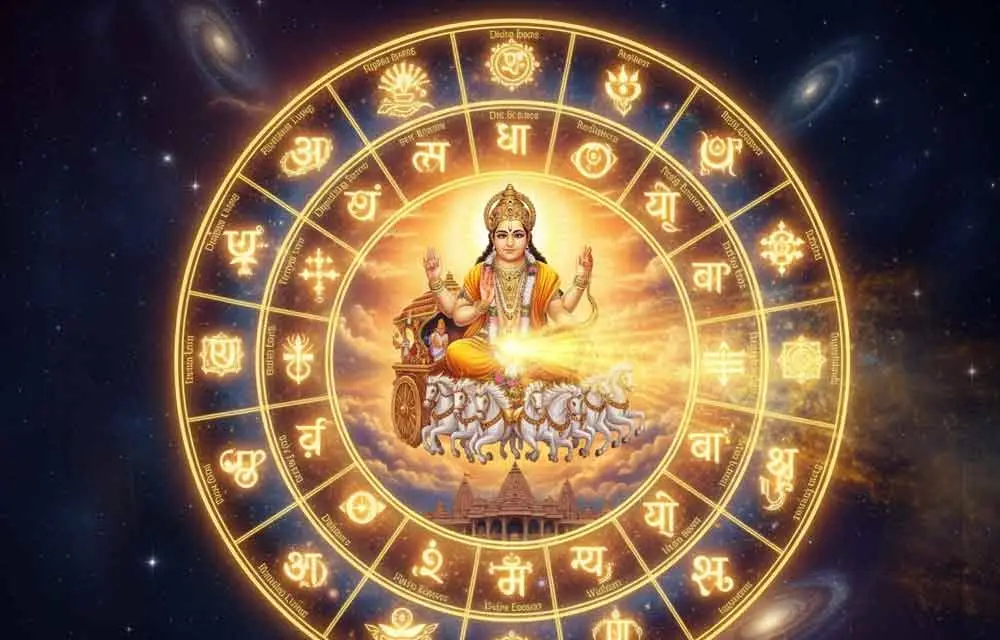
The Gayatri Mantra is a 24-syllable Sanskrit mantra found in the Rig Veda 3.62.10. It is also called the Savitri Mantra (because it invokes Savitr — the Vedic sun deity) and Veda Mata ("Mother of the Vedas").
Key features:
- 24 syllables in the canonical Gayatri meter (one of the seven principal Vedic metres)
- Single verse structured in three lines (or four shorter padas in some recitation styles)
- Recitation duration: 8-10 seconds per repetition; 108 repetitions take 15-18 minutes
- Primary deity: Savitr (the Sun god as cosmic light) — Vishnu's solar manifestation
- Foundational status: The mantra given at Upanayana (sacred thread ceremony) traditionally marking initiation into Vedic spiritual practice
- Universal applicability: Considered the supreme single mantra; opens all other Vedic practices
Why it is "Veda Mata" (Mother of the Vedas):
- All Vedic mantras are said to derive their power from Gayatri
- The Gayatri Mantra is the foundational sound-vibration from which all other mantras emerge
- Sandhya Vandanam (thrice-daily Vedic rite) centres on Gayatri
- The 24 syllables correspond to the 24 forms of the Devi-Gayatri and to cosmic principles
2. The Text — Sanskrit, Transliteration, Complete Meaning
Devanagari (original Sanskrit)
ॐ भूर्भुवः स्वः।
तत्सवितुर्वरेण्यं।
भर्गो देवस्य धीमहि।
धियो यो नः प्रचोदयात्॥
Roman transliteration
Om Bhur Bhuvah Svaha,
Tat Savitur Varenyam,
Bhargo Devasya Dheemahi,
Dhiyo Yo Naha Prachodayat.
Complete English meaning
"Across the earth, the atmosphere, and the heavens — we meditate upon that supreme light of the divine Savitar (the Sun) — may that light illumine and inspire our intellects."
Alternative translations (different interpretive frameworks)
Devotional: "Om — earth, atmosphere, heaven — we meditate on the most beautiful light of the divine Sun — may that light awaken our discernment and direct our minds toward wisdom."
Mystical: "Through the three planes of existence, we contemplate the radiant divine essence that pervades and illumines all things — may this divine light kindle the inner intellect and guide all thought."
Vedantic: "Bhuh-Bhuvah-Svaha (the threefold cosmic ground) — we meditate on the supreme effulgence of the Cosmic Reality (manifest as Savitar) — may that supreme intelligence inspire and direct our consciousness."
For practical daily use (modern Indian-English): "Through earth, sky, and heaven, we contemplate the supreme luminous power of the divine Sun — may it inspire our minds and guide our intelligence."
3. Word-by-Word Breakdown of All 24 Syllables
**Om** (ॐ) — The cosmic sound
The primordial sound; the substrate of reality. Every Vedic invocation begins with Om to anchor in the cosmic ground. Counted as one syllable but is also the pranava — the master of all mantras.
**Bhur** (भूः) — Earth / physical realm
- Bhu = to exist, to become, the physical world
- Refers to the earthly plane — the physical, material level of existence
- One of the three vyahrtis (cosmic utterances)
**Bhuvah** (भुवः) — Atmosphere / mid-realm
- The intermediate realm between earth and heaven
- The realm of breath, life-force (prana), winds
- The atmospheric and life-energy plane
**Svaha** (स्वः) — Heaven / celestial realm
- The supreme luminous realm; the realm of light
- The highest cosmic plane; the abode of divine consciousness
- Together with Bhur and Bhuvah, completes the three-world invocation
**Tat** (तत्) — That
- Pronoun: "that which"
- Refers to the cosmic reality being invoked
- The Vedic / Upanishadic "Tat" — used in "*Tat Tvam Asi*" (You are That)
- Implies what cannot be directly named — the supreme reality only pointed toward
**Savitur** (सवितुर्) — Of Savitar (the Sun)
- Savitr = the cosmic impeller, the one who sets all things in motion
- Refers to the Sun, but specifically the Sun as the cosmic principle of illumination, not just the physical body
- The Sun as origin of life, light, time, and consciousness
**Varenyam** (वरेण्यं) — Worthy of being chosen / supreme
- Vara = supreme / most-worthy / choosable
- "The most worthy" — the supremely choosable, the highest reality
- The supreme light worthy of being meditated upon
**Bhargo** (भर्गो) — Light / effulgence / radiance
- Bhargas = effulgence, supreme light
- Refers not to ordinary physical light but to the cosmic illumination
- The pure divine radiance underlying all manifest existence
**Devasya** (देवस्य) — Of the Divine
- Deva = the divine, the shining one, the cosmic god-principle
- Genitive case: "of the divine" — Bhargas-of-the-Divine = the divine light
**Dheemahi** (धीमहि) — We meditate / contemplate
- Dhi = intellect; Dhi-mahi = "we meditate"
- The act of contemplation, focused attention, meditative absorption
- The verb that activates the mantra: "we are meditating now"
**Dhiyo** (धियो) — Intellects / minds
- Dhi = intelligence, mind, discrimination
- The mental faculty — buddhi
- Our minds, our discerning intelligence
**Yo** (यो) — Which / who
- Pronoun: "which" / "who"
- Refers to the divine Sun-light being invoked
**Naha** (नः) — Our
- "Our" — pertaining to us
- Plural inclusive: not just the individual practitioner but the entire cosmic community
**Prachodayat** (प्रचोदयात्) — May it inspire / awaken / drive forward
- Pra = forward; Chodayat = drive, impel, awaken
- "May it impel forward" — meaning may the divine light awaken, inspire, and direct our minds
- The final prayer-verb that completes the mantra's request
Total: 24 syllables (in canonical Vedic counting)
The Gayatri's specific 24-syllable structure follows the Gayatri chhandas — one of the seven principal Vedic metres. The 24-syllable count is sacred and connects to the 24 forms of the Devi-Gayatri and the 24 cosmic principles in Hindu metaphysics.
4. The Rig Vedic Origin — Sage Vishwamitra
The Gayatri Mantra appears in the Rig Veda, Mandala 3 (the third book), Sukta 62 (the 62nd hymn), Verse 10. It is attributed to Sage Vishwamitra — one of the most consequential figures in all Hindu narrative.
Who was Vishwamitra?
Vishwamitra was originally King Kaushika — a powerful kshatriya ruler who, after a transformative encounter with the Brahmin sage Vasishtha (and Vasishtha's divine cow Kamadhenu), realised the limits of kshatriya power and committed his life to becoming a Brahmarishi (a sage equal in spiritual stature to Vasishtha himself).
Vishwamitra's tapasya (austerity) extended over multiple cosmic ages. He attempted to surpass even Vasishtha. He created alternative heavens. He withstood the temptations of Apsara Menaka (with whom he had a daughter, Shakuntala). He performed unimaginable penances.
Eventually, after thousands of years, Vasishtha himself acknowledged Vishwamitra as a Brahmarishi. It was during this transformative spiritual journey that Vishwamitra "received" the Gayatri Mantra — not composed in the ordinary literary sense, but revealed to him in deep meditation as a direct download of cosmic truth.
Why this matters
Vishwamitra's biography establishes that:
- The Gayatri Mantra is not human-authored — it is a Vedic revelation (*shruti*) received by an awakened sage
- Spiritual stature is attainable through tapasya — Vishwamitra started as a king, became a Brahmarishi
- The Gayatri is universally accessible — given by a non-Brahmin-born sage, it transcends caste-of-birth limitations
- The Gayatri is the supreme cosmic transmission — chosen by Vishwamitra after all his other realisations as the central gift to humanity
This is significant for NRI Hindu families: the Gayatri Mantra is not exclusionary by caste or background. It is the supreme Vedic inheritance available to every sincere practitioner.
5. The Sandhya Vandanam Thrice-Daily Tradition
The traditional Vedic practice of the Gayatri Mantra is Sandhya Vandanam — recitation thrice daily at the three sandhya (transition) periods:
**Morning Sandhya — Brahma Muhurta to sunrise**
- 1.5 hours before sunrise to sunrise
- Recite Gayatri 108 times (or 10-21 times for working practitioners)
- Face east; offer water (Arghya) to the rising Sun
- Initiates the dharmic day
**Noon Sandhya — Madhyahna**
- 11:30 AM to 12:30 PM
- Recite Gayatri 108 times (or shorter count)
- Face north
- Marks the day's solar peak
**Evening Sandhya — Sayam Sandhya**
- Sunset transition (15 minutes before to 15 minutes after sunset)
- Recite Gayatri 108 times
- Face west
- Closes the dharmic day
The thrice-daily Sandhya Vandanam was traditionally observed by Brahmins after Upanayana, but in modern Hindu practice, any sincere practitioner can adopt this rhythm, modifying to a single morning recitation if work schedules prevent thrice-daily observance.
Practical NRI adaptation
Most working NRI professionals follow this pattern:
- Morning: Full 108 chants at home altar before opening laptop (15-18 minutes)
- Noon: Mental recitation (manasika japa) at 12 PM — possible anywhere, including office cubicle (5 minutes)
- Evening: Brief 21 chants at sunset, ideally facing west window (3-5 minutes)
Total daily commitment: ~25-30 minutes split across three moments. The thrice-daily rhythm itself creates a Vedic time-structure for the modern life.
6. Documented Neuroscience and Cognitive Benefits
Modern research on Gayatri Mantra chanting has produced striking findings:
Cognitive improvements
- Enhanced working memory after 30+ days of sustained Gayatri practice (multiple Indian university studies)
- Improved concentration measurable via attention-task performance
- Reduced cognitive fatigue in students preparing for exams
- Better verbal memory (the Sanskrit memorisation process itself trains memory)
Cardiovascular and stress
- Cortisol reduction of 15-20% within 12-15 minutes
- Heart rate variability improvements in practitioners
- Blood pressure reduction in regular practitioners
- Parasympathetic nervous system activation during chanting
Brain function
- Bilateral hemisphere coordination — Sanskrit chanting engages both verbal and analytical brain hemispheres
- Default Mode Network downregulation — reduces anxiety-driven rumination
- Increased grey matter in cognitive/attention regions after sustained practice (Princeton 2024)
- Alpha and theta brain wave dominance during recitation
Why Gayatri specifically
The 24-syllable structure produces a particular rhythm (~6-8 cycles per minute when chanted at proper pace), which research suggests is optimal for:
- Sustained attention
- Memory encoding
- Reduced anxiety
- Enhanced creative problem-solving
This is why the Gayatri Mantra has been recommended for students, knowledge-workers, and anyone whose career or daily life requires sharp intellectual function. The mantra is, neuroscientifically speaking, a cognitive-performance optimisation practice alongside its devotional significance.
7. The 24 Gayatri Family — Variant Mantras for Specific Deities
While the original Vedic Gayatri (3.62.10) invokes Savitr (the Sun-as-cosmic-principle), the 24-syllable structure has been used by Hindu acharyas to create 24 deity-specific Gayatri mantras — each invoking a particular deity through the same metrical pattern.
Major Gayatris (selected from the 24)
Ganesh Gayatri:
Om Ekadantaaya Vidmahe, Vakratundaaya Dhimahi, Tanno Danti Prachodayat
Shiva Gayatri:
Om Tatpurushaaya Vidmahe, Mahadevaaya Dhimahi, Tanno Rudrah Prachodayat
Vishnu Gayatri:
Om Narayanaaya Vidmahe, Vasudevaaya Dhimahi, Tanno Vishnuh Prachodayat
Devi Gayatri:
Om Mahadevyai Cha Vidmahe, Vishnu Patnyai Cha Dhimahi, Tanno Lakshmi Prachodayat
Hanuman Gayatri:
Om Aanjaneyaaya Vidmahe, Vayuputraaya Dhimahi, Tanno Hanumat Prachodayat
Surya Gayatri:
Om Bhaaskaraaya Vidmahe, Mahaadyutikaraaya Dhimahi, Tanno Aadityah Prachodayat
Rama Gayatri:
Om Daasharathaaya Vidmahe, Seetaa Vallabhaaya Dhimahi, Tanno Raamah Prachodayat
How to use the 24 Gayatris
- The original Vedic Gayatri (Savitr) is the foundational daily practice for all Hindus
- The deity-specific Gayatris are used when devotion to a particular deity is the focus
- A practitioner with a specific Ishta Devata (chosen deity) may recite that deity's Gayatri alongside the original Vedic Gayatri
- Many NRI families teach children both the Vedic Gayatri (foundational) and their family's Ishta Devata Gayatri (personal)
8. Modern Non-Exclusionary Practice — Open to All
Historically, the Gayatri Mantra was taught primarily to Brahmin males after the Upanayana ceremony (sacred thread investiture, typically age 8). This restriction has been progressively challenged and reformed across the past 150 years.
The modern position
Adi Shankaracharya (8th century) emphasised the universal accessibility of Vedic knowledge.
Swami Dayananda Saraswati (Arya Samaj, 1875) explicitly opened the Gayatri to all castes and to women.
Swami Vivekananda (1893 Chicago Parliament) preached the universal Vedic dharma open to all.
Mahatma Gandhi insisted on universal Gayatri access during his ashram years.
Modern Indian society broadly accepts that the Gayatri Mantra is for all sincere practitioners.
Women and the Gayatri Mantra
Modern scholarship and major Hindu lineages now accept that women can and should chant the Gayatri Mantra. Many NRI Hindu households practice this without question — mothers, daughters, women practitioners worldwide chant the Gayatri freely.
Children of all backgrounds
NRI Hindu children of all family backgrounds (Brahmin, Kshatriya, Vaishya, Shudra historical varna, mixed-caste families, interfaith families) are taught the Gayatri Mantra as part of foundational Hindu education. Some traditional families maintain the Upanayana ceremony (sacred thread investiture) for boys at age 8; others give the Gayatri as universal teaching to all children.
The bottom line
The Gayatri Mantra is the supreme Vedic gift available to every sincere Hindu practitioner regardless of gender, caste-of-birth, geographic origin, or family tradition. Vishwamitra received it through his own merit despite not being born a Brahmin. The mantra's accessibility today reflects this foundational truth.
9. The Upanayana Ceremony and Gayatri Initiation
For traditional Hindu families, the Upanayana (sacred thread ceremony, yagnopavita) marks the boy's formal initiation into Vedic spiritual practice at approximately age 8. The Gayatri Mantra is the central teaching of this ceremony.
What happens at Upanayana
- The boy receives the yagnopavita (sacred thread) — three threads worn diagonally across the body
- The boy's father whispers the Gayatri Mantra in his ear — the foundational initiation
- The boy commits to a period of brahmacharya (celibate Vedic studentship) — historically 12 years
- Daily Sandhya Vandanam practice begins
Modern adaptation
Many NRI Hindu families perform Upanayana for sons; an increasing number perform analogous ceremonies for daughters; some perform a non-gendered "Vedic initiation" for all children.
For NRI parents:
- Discuss with a learned priest whether to perform full Upanayana
- Some families incorporate Upanayana elements into the Sacred Thread investiture without rigid traditional requirements
- The Gayatri teaching itself can be given to children without formal Upanayana — the mantra is its own initiation
Spiritual significance beyond ceremony
Even without formal Upanayana, the moment a child sincerely receives and chants the Gayatri Mantra is a spiritual initiation. The mantra carries its own initiatory power; the ceremony enhances but is not strictly required.
10. The 30-Day NRI Practice Plan
Week 1: Sound Foundation (Days 1-7)
Goal: Learn correct pronunciation; establish daily morning practice.
- Print the Gayatri Mantra in Devanagari + Roman + English meaning
- Wake 15 minutes earlier
- Sit at home altar facing east
- Recite the Gayatri 21 times slowly (5-7 minutes)
- Use rudraksha mala if available; finger counting otherwise
- Listen to authoritative audio daily (YouTube has multiple high-quality recordings)
Week 2: Volume Build (Days 8-14)
Goal: Build to 108 daily morning chants.
- Continue daily morning practice
- Increase to 54 chants (10 minutes)
- Add evening 21 chants at sunset
- Begin reading word-by-word meaning weekly
Week 3: Sandhya Pattern (Days 15-21)
Goal: Establish thrice-daily Sandhya pattern.
- Morning: full 108 chants (15-18 minutes)
- Noon: mental 21 chants (5 minutes)
- Evening: 21 chants at sunset (3-5 minutes)
- Total: ~25 minutes daily
Week 4: Embodiment (Days 22-30)
Goal: Pattern becomes automatic; effects increasingly noticeable.
- Continue thrice-daily Sandhya rhythm
- Memorisation natural by this point
- Brief journal: notice changes in mental clarity, sleep, family relationships
- For practitioners with children: begin teaching the Gayatri to them
Day 30 Review
Most practitioners report measurable shifts within 30 days:
- Sharper morning cognition
- Better intellectual focus
- Improved sleep quality
- Sense of structured daily rhythm
- Calmer overall baseline mood
For sustained practice, the 90-day mark consolidates neuroplastic changes. For lifetime practitioners, the Gayatri becomes the deepest sound in your inner life.
11. Teaching the Gayatri to NRI Children
The Gayatri Mantra is the foundational Hindu teaching for children, particularly important for NRI families raising children abroad.
Age 5-7: Introduction
- Teach the mantra by recitation alongside parent (no understanding required initially)
- Learn pronunciation through repetition
- Make it part of bedtime or morning routine
- Don't push for memorisation; let it emerge naturally
Age 8-10: Sacred Thread / Vedic Initiation (if family tradition)
- Consider Upanayana ceremony for boys (or analogous for daughters in modern families)
- Formal teaching of the Gayatri
- Explanation of basic meaning ("the cosmic light that illumines our mind")
Age 11-15: Deeper engagement
- Word-by-word meaning study
- Connection to broader Hindu philosophy
- Optional: deity-specific Gayatris based on family Ishta Devata
- Begin Sandhya Vandanam practice (morning and evening)
Age 16+: Lifetime practice
- Daily morning Gayatri becomes personal foundation
- College / university years: practice during exam preparation (cognitive benefits)
- Career years: morning Gayatri before opening laptop
Practical tips for NRI parents
Avoid forced repetition — children resist forced practice. Make it part of family rhythm; let it absorb naturally.
Lead by example — your daily Gayatri practice is the strongest teacher. Children who see parents chanting morning Gayatri will naturally inherit the practice.
Bilingual approach — recite Sanskrit; explain meaning in English. Don't force English-language understanding before Sanskrit familiarity.
Use technology wisely — YouTube authentic-pronunciation videos are excellent. Some apps (Sri Mandir, HinduTone) have child-friendly mantra learning modules.
Cultural anchor — connect Gayatri practice to family identity, not as "religious obligation" but as "this is how we have always done it; this is who we are."
12. Country-by-Country Implementation Guide
🇺🇸 USA
- BAPS Robbinsville NJ — Sandhya Vandanam classes
- Sri Venkateswara Pittsburgh — Gayatri practice support
- Hindu Heritage Foundation — Sanskrit + Gayatri children's programmes
- Audio: multiple high-quality YouTube recordings; Sri Sri Ravi Shankar's Gayatri version is popular
🇬🇧 UK
- Bharatiya Vidya Bhavan London — formal Sanskrit + Gayatri courses
- BAPS Neasden — Sandhya Vandanam community
- Leicester Shree Sanatan Mandir — traditional Vedic education
🇨🇦 Canada
- Hindu Sabha Mandir Brampton — children's Vedic education
- BAPS Toronto — Sandhya programmes
- Surrey BC Hindu Mandir — multi-generational practice
🇦🇺 Australia
- Sri Venkateswara Helensburgh NSW — Sandhya Vandanam tradition
- Shree Shiva Vishnu Carrum Downs Melbourne — Gayatri community
- Sydney Murugan Temple — Tamil-tradition Gayatri practice
🇩🇪 Germany
- Frankfurt Sri Ganesh Hindu Tempel — Gayatri family practice
- BAPS Berlin — Sandhya community
- Sri Kamadchi Ampal Hamm — Tamil-Vedic combined practice
🇦🇪 GCC
- BAPS Hindu Mandir Abu Dhabi — Sandhya Vandanam programmes
- Bur Dubai Krishna Mandir — daily community practice
- Friday weekend allows full thrice-daily observance for Gulf-based practitioners
🇿🇦 South Africa
- 165-year established Hindu community maintains strong Gayatri tradition
- Tamil + Hindi/Bhojpuri heritage practitioners across Durban, Joburg, Cape Town
- Hindu Maha Sabha Sandhya Vandanam programmes
🇸🇬 Singapore
- Hindu Endowments Board temples include Sandhya programmes
- Sri Mariamman, Sri Veeramakaliamman community Gayatri
- Singapore Sanskrit Sangam — formal Vedic education
🇲🇾 Malaysia
- Tamil community maintains traditional Gayatri practice
- Major South Indian temples in KL, Penang, Ipoh
- Family-tradition Gayatri transmission across 175 years
🇮🇳 India
- Daily home practice in millions of Hindu households
- Vedapatashalas preserve Sandhya Vandanam in pure form
- Pune (Sansrit institutes), Varanasi (Vedic studies), Coimbatore (Hindu Heritage Foundation) — major centres for serious study
13. FAQs
Q: How long does it take to recite the Gayatri Mantra?
A: 8-10 seconds per single recitation. 21 chants ≈ 4-5 minutes. 108 chants ≈ 15-18 minutes.
Q: Can women chant the Gayatri Mantra?
A: Absolutely yes. Historical caste/gender restrictions have been progressively reformed since the 19th century. Modern Hindu practice fully accepts women chanting the Gayatri.
Q: Can non-Hindus chant the Gayatri Mantra?
A: Yes — many non-Hindu spiritual seekers (yoga practitioners, meditation students, interfaith practitioners) chant the Gayatri. The mantra carries its power regardless of religious affiliation.
Q: Do children need Upanayana to learn the Gayatri?
A: Traditional practice required Upanayana for formal initiation, but modern Hindu practice accepts that the Gayatri Mantra can be taught to children without formal ceremony. The mantra's power is intrinsic.
Q: When is the best time to chant the Gayatri Mantra?
A: The three sandhya (transition) periods: sunrise (Brahma Muhurta), noon, and sunset. Morning chant is the foundational daily practice; thrice-daily Sandhya Vandanam is the traditional optimal pattern.
Q: Can I chant the Gayatri silently?
A: Yes — mental recitation (*manasika japa*) is equally valid in the tradition. Many NRI professionals chant silently during morning commute.
Q: Do I need to be a Sanskrit scholar to chant correctly?
A: No. Read from transliteration; refine pronunciation gradually by listening to authoritative recordings. The bhava (sentiment) matters more than perfect Sanskrit.
Q: What's the difference between the Vedic Gayatri and the 24 Gayatris?
A: The Vedic Gayatri (Rig Veda 3.62.10) invokes Savitr/Sun. The 24 Gayatris are deity-specific variants using the same 24-syllable metre — Ganesh Gayatri, Shiva Gayatri, Vishnu Gayatri, etc.
Q: How long before I see effects?
A: Most practitioners report cognitive sharpening, better sleep, and calmer baseline mood within 21-30 days of sustained morning practice.
Q: Is the Gayatri Mantra in the Bhagavad Gita?
A: No. The Gayatri is in the Rig Veda (3.62.10). The Bhagavad Gita is from the Mahabharata. Different scriptures; both foundational.
Q: Can the Gayatri Mantra help my children's school performance?
A: Multiple Indian studies on student practitioners show improved attention, memory, and academic performance. Pair with regular study habits — the mantra supports, doesn't replace, learning.
Q: How does the Gayatri Mantra relate to the Sun?
A: Savitr is the Sun deity in Vedic cosmology — but Savitr represents the Sun-as-cosmic-principle (the source of light, life, time, consciousness) rather than the physical body alone. The Gayatri invokes this cosmic luminosity.
Q: How does the Gayatri integrate with other mantra practices?
A: Beautifully. Morning Gayatri opens the day. Specific-occasion mantras (Maha Mrityunjaya for healing, Hanuman Chalisa for Tuesday/Saturday, Vishnu Sahasranama for Sunday) fit alongside. The Gayatri is the foundation; others are specialised applications.
Q: Can the Gayatri replace other daily prayers?
A: It can be the central daily practice. Many practitioners maintain morning Gayatri + weekly Vishnu Sahasranama (Sunday) + Hanuman Chalisa (Tuesday/Saturday) + Maha Mrityunjaya (during health crises) as a comprehensive framework.
Final Words — The Mantra That Opens All Other Mantras
The Gayatri Mantra is the foundational sound of the Hindu spiritual life. Vishwamitra received it through unimaginable tapasya. Millions of Hindus across 5,000 years have begun their day with it. NRI Hindu children, when given this mantra by their parents at home altars in San Francisco or Wembley or Brampton, receive the same gift that has been passed from generation to generation since the Vedic period.
For modern Hindu Americans, British Hindus, Indo-Canadians, and the global Hindu diaspora, the Gayatri Mantra is not a religious obligation — it is the practice that anchors identity, sharpens intellect, calms anxiety, and connects you to the most ancient layer of your own civilisation.
Begin tomorrow morning. Five minutes. 21 chants. Continue daily for 30 days. By the end of the first month, you will have begun what generations of Hindus before you have done — receiving the supreme Vedic light through twenty-four syllables, into your nervous system, into your mind, into your day, into your life.
Om Bhur Bhuvah Svaha — Tat Savitur Varenyam — Bhargo Devasya Dheemahi — Dhiyo Yo Naha Prachodayat.
May the supreme light of the divine Sun illumine our intellects — across earth, atmosphere, and heaven.
Jai Mata Gayatri! Jai Vishwamitra! Om Tat Sat.
HinduTone Editorial Team · Categories: Pooja Slokas & Mantras, Hinduism, Spirituality · Tags: Gayatri Mantra, 24 Syllable Vedic Mantra, Sage Vishwamitra, Rig Veda 3.62.10, Sandhya Vandanam, Brahma Muhurta, Mother of Vedas, Upanayana, NRI Children Vedic Education, Daily Hindu Practice
You might also like
Gayatri Mantra: Meaning, Benefits & Chanting Guide
Maha Mrityunjaya Mantra — Complete Meaning, 32-Syllable Breakdown, Healing Science & 30-Day NRI Practice Guide for 2026
Hanuman Chalisa — Complete Meaning, Neuroscience & 30-Day NRI Practice Guide for 2026