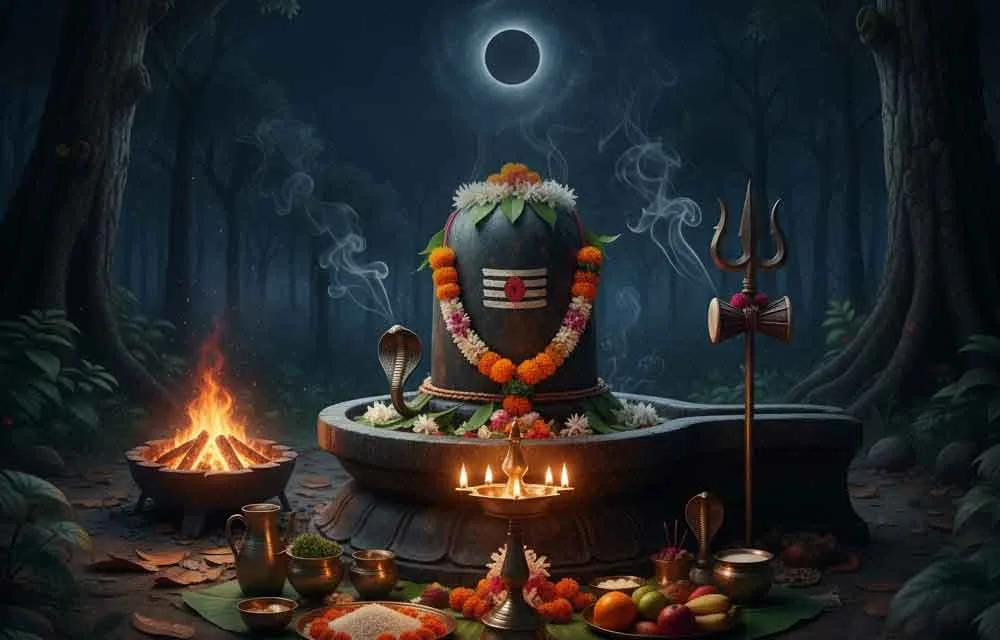
Om Namah Shivaya: The Five-Syllable Mantra That Contains the Universe
"Namaḥ Śivāya — these two words alone are sufficient for liberation.They are the boat that carries the soul across the ocean of existence."— Shivarahasya…
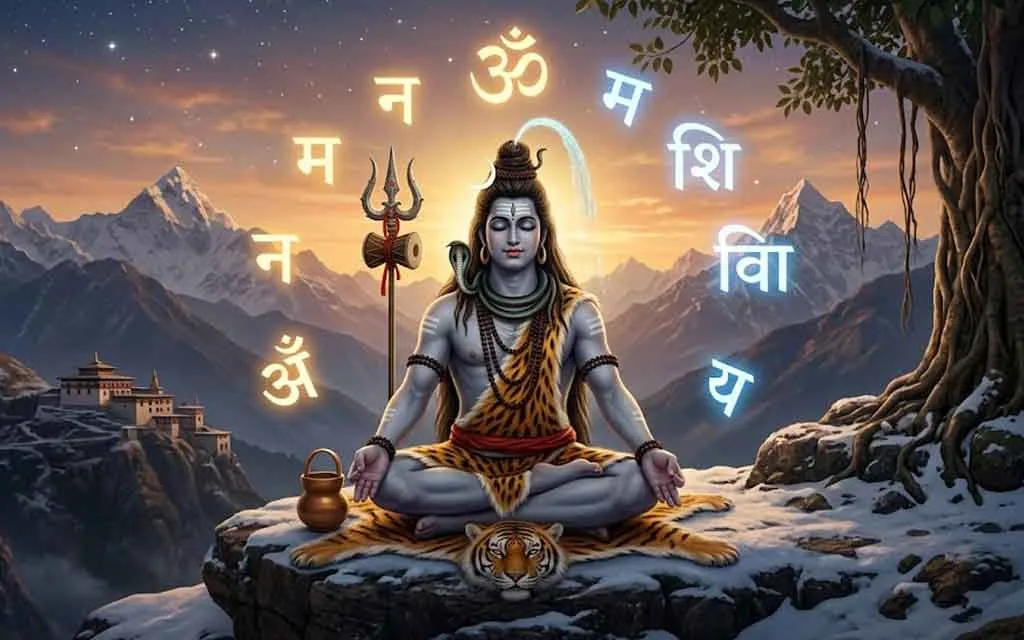
"Namaḥ Śivāya — these two words alone are sufficient for liberation.
"Namaḥ Śivāya — these two words alone are sufficient for liberation.
They are the boat that carries the soul across the ocean of existence."
— Shivarahasya Purana
✦ The Mantra That Was Before the World Began
Before the universe existed — before space curved, before light blazed, before a single atom trembled into being — there was sound. Not the sound of something, but the primordial vibration that is everything. The ancient rishis who sat in the deepest states of samadhi did not compose this sound. They heard it. They listened to the universe singing itself into existence. And what they heard, reverberating through the infinite silence, was this:
ॐ नमः शिवाय Om Namah Shivaya
Five syllables. Na. Ma. Shi. Va. Ya. Five sacred sounds that correspond to the five elements of creation, the five acts of the Divine, the five senses of the human body, and the five cosmic principles that sustain all of existence. In the Shaiva tradition, this mantra is not merely a prayer to Lord Shiva — it is the sound of Shiva Himself, the vibrational signature of the Absolute, the sacred code with which the universe was written.
Om Namah Shivaya is the Maha Mantra of Shaivism — known as the Panchakshara (the Five-Syllable mantra, counting Na-Ma-Shi-Va-Ya, with Om being a prefixed sacred syllable). It appears as the heart of the Shri Rudram, one of the most ancient Vedic hymns in the Krishna Yajurveda, making it more than five thousand years old in recorded form — and, in the understanding of the tradition, beginningless and eternal.
This is its complete story.
✦ Part I: Who Is Shiva? — Understanding the Deity Behind the Mantra
The Paradox of Shiva
To understand Om Namah Shivaya, one must first understand Lord Shiva — and Shiva, more than any other deity in the Hindu pantheon, resists easy understanding. He is the Great Paradox: simultaneously the most terrifying and the most compassionate, the destroyer and the liberator, the ascetic in the cremation ground and the devoted husband at home, the lord of death who alone can grant immortality.
His names reveal His infinite nature:
- Mahadeva — The Great God, greatest of all deities
- Maheshvara — The Supreme Lord of the Universe
- Shankara — The giver of peace and happiness
- Bhairava — The terrible, the fearsome
- Nataraja — The cosmic dancer whose dance sustains the universe
- Pashupati — Lord of all creatures, of every soul bound in ignorance
- Ardhanarishvara — Half-man, half-woman; the unity of Shiva and Shakti
- Dakshinamurthy — The silent teacher, facing south, instructing through stillness
- Sadashiva — The eternally auspicious, the ever-benevolent
Shiva is the Adi Yogi — the first and original yogi — who taught the science of consciousness to the Saptarishis (seven sages) on the banks of the Kantisarovar Lake, giving humanity the gift of yoga and liberation. He is the one who drank the Halahala poison that emerged from the churning of the cosmic ocean, holding it in His throat — His neck turning blue, earning Him the name Neelakantha (Blue-throated One) — to save all of creation from annihilation.
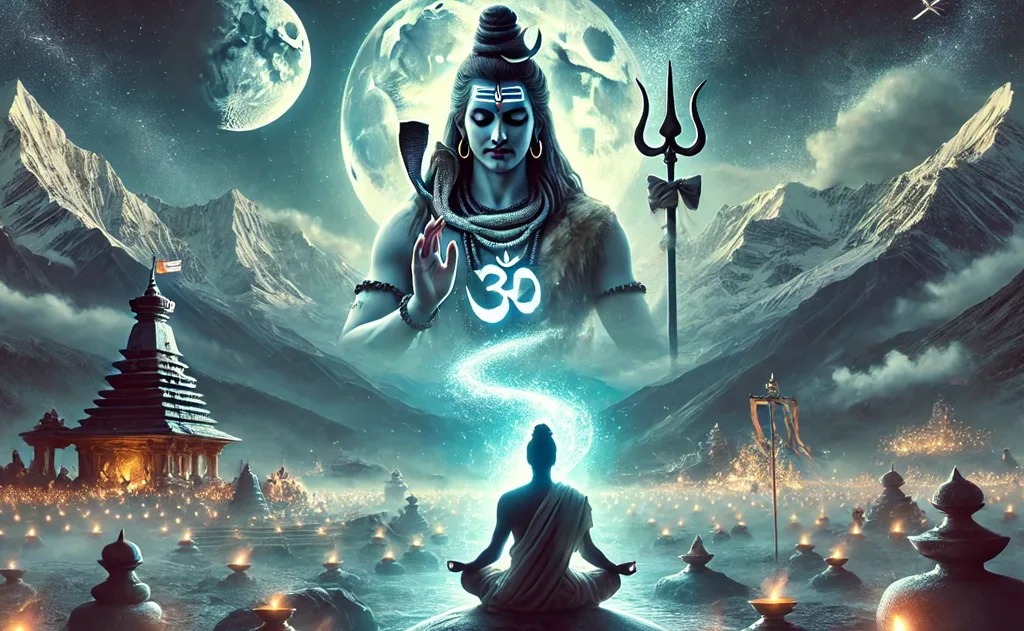
He lives on Mount Kailash, the sacred axis of the world, meditating eternally in a state of absolute stillness from which the dynamism of all creation flows. He is clothed not in silk but in tiger skin and elephant hide, smeared in the sacred ash of cremated worlds (Vibhuti), adorned with serpents that represent mastery over death and time, wearing a garland of Rudraksha beads, the crescent moon gleaming in His matted locks from which the Ganga flows.
He is simultaneously the householder and the renunciant, the lover and the yogi, the fierce and the gentle. This paradox is not contradiction — it is completeness. Shiva contains and transcends all opposites. He is the Absolute itself, wearing a story so we can approach the Unapproachable.
Shiva and Shakti — The Inseparable Union
Shiva cannot be fully understood without His eternal consort Shakti — the Divine Mother in Her forms as Parvati, Durga, Kali, and countless others. Shiva is pure consciousness (Chit), absolute stillness, the transcendent Witness. Shakti is the dynamic power (Prakriti), the creative force, the immanent life in all things.
The universe itself is their love story — Shiva and Shakti in eternal dance, their union the source of all creation, their separation the source of all spiritual longing.
"Shiva without Shakti is a shava (corpse). Shakti without Shiva has no direction."
The mantra Om Namah Shivaya invokes not merely the transcendent Shiva but the complete reality of Shiva-Shakti — consciousness and power, being and becoming, the Absolute and its creative expression. This is why it contains the universe.
✦ Part II: The Origins of the Mantra — From the Depths of the Veda
The Shri Rudram — The Mantra's Ancient Home
Om Namah Shivaya is first found enshrined in the Shri Rudram (also called Shatarudriya or Rudrashtadhyayi), a hymn in the Krishna Yajurveda, specifically in the Taittiriya Samhita (4.5.1). The Shri Rudram is one of the oldest and most sacred hymns in the entire Vedic corpus, chanted by Brahmins at Shiva temples for thousands of years.
The Rudram consists of two parts:
- Namakam (the "Na-Ma" portion) — The invocation, listing the many names and forms of Rudra-Shiva, asking for His grace and protection. The Panchakshara Na-Ma-Shi-Va-Ya appears here as the eighth anuvaka (section).
- Chamakam (the "Cha-Me" portion) — The petition, asking for all blessings, health, prosperity, wisdom, and liberation.
The entire Rudram is chanted eleven times in a ceremony called Ekadasha Rudram, and eleven repetitions of Ekadasha Rudram make a Maha Rudram, said to purify the entire atmosphere of a region and shower blessings upon the entire living world.
The Panchakshara section of the Namakam contains the heart verse:
"Namas te astu bhagavan vishveshvaraya mahadevaya tryambakaya tripurantakaya trikalagni-kalaya kalagnirudraya neelakanthaya mrityunjayaya sarveshvaraya sadashivaya sriman mahadevaya namah"
And within it, luminous as the center of the sun: Namah Shivaya.
Why the Rishi Heard This Mantra
The sage Upamanyu was one of the great devotees of Shiva. As a young student, he was poverty-stricken and could not obtain milk for nourishment. Determined to worship Shiva with single-pointed devotion, he undertook severe austerities and chanted the Panchakshara continuously. Shiva appeared to him and tested him, offering him alternative paths. Upamanyu, unmoved, declared: "I want nothing but Shiva's grace." Shiva blessed him with the knowledge that the mantra Namah Shivaya contains all the Vedas, all liberation, all existence.
This story encodes the tradition's teaching: the mantra was not invented by human intelligence but received in the state of pure devotion by a heart that wanted nothing except the Divine.
✦ Part III: The Architecture of the Mantra — Each Syllable a Universe
This is where the profound genius of Om Namah Shivaya reveals itself. Each of the five syllables is a complete sacred reality — a doorway into one dimension of existence.
[image: 🔱] Na — The Earth Element (Prithvi) | The Grace-Concealing Power
Na is the first syllable. It corresponds to:
Na is the grounding syllable — the earth beneath your feet, the body you inhabit, the material world in all its solidity and beauty. In Shaiva Siddhanta, the five syllables correspond to five kanchukas (sheaths) or five acts of Shiva. Na represents Tirodhana — the act by which Shiva conceals His infinite nature within the finite form. This is not a trick or a cruelty — it is the precondition for the experience of seeking, for the joy of discovery, for the love of the path home.
When you chant Na, you touch the earth element in yourself — the body, the foundation, the temple through which all spiritual experience occurs.
[image: 🔱] Ma — The Water Element (Jala) | The Binding of the Soul
Ma is the second syllable. It corresponds to:
Ma is the flowing syllable — fluid, connecting, sustaining. In the tradition of the Shaiva Agamas, Ma represents the individual soul (Pashu) — the bound soul that is tied by three primal bonds (Pashas): Anava (the primal ego-sense, the feeling of separateness), Karma (the accumulated actions and their fruits), and Maya (the cosmic illusion that makes the One appear as many).
The soul (Pashu, literally "the bound one") is not degraded by these bonds — they are the very conditions of its evolutionary journey toward Shiva. Ma is the recognition: I am the soul. I am in the world. I am bound — and I seek liberation.
When you chant Ma, you acknowledge your journey — that you are a soul in process, that every experience of love and loss, every joy and sorrow, is the soul learning its way back to Shiva.
[image: 🔱] Shi — The Fire Element (Tejas) | Divine Grace Descending
Shi is the third syllable — the central, burning heart of the mantra. It corresponds to:
Shi is the fire syllable — the transformative, illuminating, purifying power of consciousness. This is the syllable of Shiva's grace descending (Shaktipata) — the divine fire that burns away ignorance. Just as fire transforms everything it touches — turning wood into light and heat — the syllable Shi represents the transformative grace of Shiva that turns a bound soul into a liberated one.
Shi is the pivotal syllable — the turning point. The first two (Na-Ma) represent the realm of the soul in the world. The last two (Va-Ya) represent the realm of Shiva's pure consciousness. Shi is the bridge — the grace that descends to meet the soul and lift it upward.
In Shaiva Tantra, this syllable is said to vibrate at the Anahata Chakra (heart center) — confirming that the meeting of the Divine and the human happens always and only in the heart.
[image: 🔱] Va — The Air Element (Vayu) | The Lord's Revealing Grace
Va is the fourth syllable. It corresponds to:
Va is the breath of grace — the liberating exhalation of Shiva's revealing power. In the five cosmic acts of Shiva (Panchakritya), this corresponds to Anugraha — the act of revelation, of bestowing grace, of removing the veil. This is the act by which Shiva reveals His true nature to the mature devotee.
Va flows through everything — like wind, invisible but present in every breath, the medium through which life itself is conducted. To chant Va is to open to the grace that is already flowing toward you — the divine wind that was always trying to carry you home.
[image: 🔱] Ya — The Ether/Space Element (Akasha) | The Soul Itself
Ya is the fifth and most subtle syllable. It corresponds to:
Ya is the syllable of the Self — the Atman, the pure awareness that underlies all experience. Space is not empty — it is the fullest reality, the ground within which all forms arise and dissolve. Ya is the realization: I AM Shiva. Not as an ego claim but as the deepest recognition of the meditator who has traveled through all the outer layers (Na, Ma) through the fire of grace (Shi) and the wind of revelation (Va) to arrive at the pure, spacious awareness that was always already there.
Ya is the answer to the question: Who am I? The answer the entire mantra has been building toward. Shivo'ham — I am Shiva.
✦ Part IV: The Complete Meaning — What "Namah Shivaya" Actually Says
Word by Word
Om — The primordial sound, the vibratory root of the universe, the sound of the Absolute before it becomes word or concept. It is added before the Panchakshara in all formal worship to consecrate and elevate the recitation into the realm of the transcendent.
Namah (Namas) — This sacred word is often translated as "I bow" or "salutations" — but this captures only its surface. Nama is derived from the root nam (to bend, to yield, to surrender). More deeply: Na = na (not) + Ma = mama (mine). So Namah literally means: "Not mine — I renounce the claim of 'mine.'"
This is a declaration of the deepest spiritual surrender: I release the grip of ego, the claim of ownership, the illusion that I am separate and self-sufficient. I return everything — my body, mind, identity, actions, even my spiritual merit — back to You.
Shivaya — Shiva + the dative suffix -ya, meaning "to" or "for." Shiva literally means "the auspicious," "the benevolent," "the eternally good." The dative case means: to Shiva, for Shiva, in the direction of Shiva.
Combined translation:
"I surrender myself — body, mind, and ego — to that which is the eternally auspicious, the all-pervading, the pure consciousness that is the ground of all existence. Everything I am is yours, Shiva. I am not separate from you."
But even this translation is incomplete, because Om Namah Shivaya is ultimately not a prayer to Shiva from a devotee standing outside. It is the recognition of the devotee as identical with Shiva. When the layers of Na (earth) and Ma (water/ego-bonds) are burned by the fire of Shi, revealed by the grace of Va, and recognized in the space of Ya — the devotee does not find another. They find themselves — as Shiva.
✦ Part V: The Mantra in the Great Myths of Shiva
The Churning of the Ocean — Neelakantha's Sacrifice
When the gods and demons churned the cosmic ocean (Samudra Manthan) in search of Amrita (divine nectar), the ocean gave up fourteen great treasures — and also the most terrible of all: Halahala, the poison capable of destroying all of creation. It was so potent that its fumes alone were beginning to annihilate gods and demons alike.
In this crisis, all beings turned to Lord Shiva — the one being whose nature was beyond the duality of creation and destruction, the one who could contain the uncontainable.
Shiva held the poison in His cupped hands, looked at it with complete equanimity — the equanimity of one who has no fear of death because He is the ground that death itself dances upon — and swallowed it.
Parvati, watching in terror, grabbed His throat, pressing the poison into the neck before it could reach His heart. The poison stained His throat a permanent dark blue — and from that moment, Shiva was called Neelakantha: the Blue-Throated One.
This story is the supreme teaching of Om Namah Shivaya:
The universe generates its own poison — hatred, jealousy, the toxins of collective sin, the destructive forces that arise in every cycle of creation. These cannot be destroyed by adding more power to the world. They can only be held, transformed, and neutralized by the one who has gone beyond the duality of pleasure and pain, life and death.
Shiva holds the poison so the world may live. And when we chant Om Namah Shivaya, we invoke this same quality in ourselves — the capacity to hold our own darkness, our own poison, our own difficult realities without being destroyed by them, and without inflicting them on others.
The Story of Markandeya — The Mantra as Conqueror of Death
Markandeya was destined by fate to die at the age of sixteen. The great sage-boy was a devoted worshipper of Shiva. On the night the god of death, Yama, came to claim him, Markandeya was performing puja at a Shivalingam, arms wrapped around it, chanting Om Namah Shivaya with complete absorption.
Yama threw his noose. It fell around the Shivalingam as well as Markandeya. From the lingam erupted Shiva Himself in terrible, blazing fury — roaring at Yama with a wrath that shook the three worlds:
"How dare you cast your noose over one who has surrendered to Me! He who has taken refuge in Namah Shivaya is beyond your reach — for death has no dominion over one who has dissolved into the Deathless."
Yama retreated. Shiva blessed Markandeya with immortality — the sage lives to this day, eternally sixteen, eternally devoted, a living testament to the mantra's power over death.
This is why Shiva is called Mrityunjaya — the Conqueror of Death — and why the Mahamrityunjaya Mantra is paired with Om Namah Shivaya in all rites of healing, protection, and liberation.
The story teaches: Om Namah Shivaya is not merely a prayer for blessings. It is a declaration of identification with the Deathless itself. The soul that truly chants this mantra has moved beyond the reach of time.
The Story of Kannappa — The Devotion Beyond Ritual
Kannappa was a hunter — uneducated in Sanskrit, untrained in ritual procedure, low-born by the caste standards of his time. He had no flowers, no incense, no learned hymns. But he had discovered the Shivalingam in the forest and fallen into a love with Shiva so pure it defied all categories.
Every day he brought Shiva the best of his hunt — meat and river water carried in his mouth (having no vessels), forest flowers carried in his hair (having no plates). By brahminical standards, this was desecration. By Shiva's standards, it was the purest worship He had ever received.
To demonstrate this to the resident priests, Shiva manifested a test: He caused the lingam's stone eye to bleed. The priests ran in horror. Kannappa ran in grief — tried every remedy, and finally, without hesitation, gouged out his own eye and pressed it into the bleeding socket of the lingam. The bleeding stopped. Then the second eye began to bleed.
Kannappa — now blind — placed his foot on the lingam to find the second bleeding eye, raised his knife to his remaining eye. At this moment Shiva appeared in blinding glory and caught his hand:
"Stop. I have seen enough. Kannappa — of all My devotees across all of creation, none has loved Me as you have loved Me."
Kannappa was granted liberation on the spot. He became one of the sixty-three Nayanmars — the Tamil Shaiva saint-poets — and his story is considered the supreme teaching of bhakti (devotion) in the Shaiva tradition.
The teaching of Kannappa within Om Namah Shivaya: Namah — surrender, giving everything — is not measured by what you give but by the completeness of the giving. The hunter who gave his eyes outranked the pundit who gave a thousand perfect rituals. Shiva, the auspicious one, sees the heart, not the form.
Shiva and Sati — The Grief That Made the Sacred Sites
Sati was the daughter of Daksha, the progenitor, and the first earthly form of the Goddess — of Shakti herself. She married Shiva against her father's wishes. Daksha, proud and rigid, could not accept his daughter's love for the ash-smeared, unconventional Lord who sat in cremation grounds with sages and outcasts.
When Daksha organized a great Yagya (fire ceremony) and deliberately excluded Shiva and Sati, Sati — unable to bear the insult to her husband — went anyway. Before the assembled gods, Daksha humiliated her. Unable to endure the dishonour to Shiva, Sati threw herself into the sacrificial fire and died.
When news reached Shiva, He erupted in a grief so enormous it threatened to destroy the cosmos. He retrieved Sati's body and wandered the three worlds in an inconsolable dance of mourning, her body on His shoulder. The universe trembled at Shiva's sorrow.
To bring Shiva back to cosmic balance, Lord Vishnu used His Sudarshana Chakra to dismember Sati's body as Shiva walked. 51 pieces fell to earth across the Indian subcontinent — and each place where a piece of Sati's body fell became a Shakti Peetha, a seat of the Divine Mother, one of the most sacred pilgrimage sites in Hindu geography.
After this, Shiva returned to Kailash and entered a state of deep tapas (austerities). He waited. The entire universe waited. And Shakti was reborn as Parvati, daughter of the Himalayas — and in their second union, creation was restored.
The teaching: Even the Supreme Lord experienced grief — and did not escape it but walked through it. Shiva's sorrow became sacred geography. Every site of loss in our lives, too, can become a seat of the Divine.
Parvati's Tapas — How the Goddess Won Shiva
When Parvati grew to young womanhood and fell in love with Shiva — recognizing Him as her eternal husband — Shiva paid her no attention. He was absorbed in meditation, beyond all desire, the supreme ascetic.
Parvati resolved to win Shiva's attention not through beauty or charm but through tapas — by becoming more of a yogi than Shiva Himself. She left her palace, shed her ornaments, ate nothing but fallen leaves (Parnahari), then nothing at all (Aparna — "she without even leaves," from which she got Her name).
She sat in burning heat, in freezing cold, in driving rain — her body reduced to bone and spirit, her mind fixed on one point: Shiva.
Shiva sent the Saptarishis to dissuade her. She refused. He came Himself in the disguise of a young brahmin and argued against Shiva — calling Him ugly, unconventional, homeless, frightening. Parvati defended Shiva with such fierce love and such penetrating wisdom that Shiva was undone. He revealed Himself, His joy complete.
Their marriage is the reunion of Consciousness and Power — and the mantra Om Namah Shivaya is said to vibrate with the love-energy of this reunion. The devotee who chants it with sincerity enters into this divine love — becoming Parvati calling Shiva home, becoming the soul calling to its Source.
The Cosmic Dance of Nataraja — The Mantra Made Visible
At Chidambaram in Tamil Nadu — the cosmic center of the universe according to Shaiva tradition — Shiva performed His primordial Ananda Tandava, the Dance of Bliss, in the presence of the assembled gods and sages. This dance is the most complete visual representation of Om Namah Shivaya — each element of the Nataraja image encoding a truth.
The great Tamil poet Thirumoolar wrote: "I looked at the dancing Shiva and saw myself. The universe dances in me, and I dance in the universe. What I called 'God' was only the deepest version of myself."
This is the Nataraja's hidden teaching — and the hidden teaching of Om Namah Shivaya.
✦ Part VI: The Five Acts of Shiva — Panchakritya
The mantra is also a complete description of Shiva's five cosmic functions — the five acts (Panchakritya) by which He perpetually manages all of existence:
1. ✦ Srishti — Creation (Na)
Shiva creates. Not from pre-existing matter but from Himself — from the pure potential of His own consciousness. The universe is not made by Shiva; it is made of Shiva. Every atom, every star, every emotion, every thought is a modification of Shiva-consciousness. The syllable Na (earth) grounds this creative outpouring into material form.
2. ✦ Sthiti — Preservation (Ma)
Shiva sustains. In this aspect He works in harmony with Vishnu's preserving function — maintaining the web of creation in being, sustaining the laws of nature, holding the universe together so souls may complete their evolutionary journey. The syllable Ma (water) flows through all of creation, sustaining it as water sustains life.
3. ✦ Samhara — Dissolution (Shi)
Shiva dissolves. This is His most misunderstood function. He is often called the Destroyer, as if this were a negative role. But dissolution is not destruction — it is transformation. The old must be released for the new to arise. Karma must be burned away. The ego must dissolve for the Self to shine. The universe must return to the Source at the end of each cosmic cycle so it can be renewed. The syllable Shi (fire) is the fire of transformation.
4. ✦ Tirodhana — Concealment (Va)
Shiva conceals. By the power of Maya, He veils His own infinite nature within finite forms — so that the soul may have the experience of individuality, of learning, of love through separation and reunion. Without concealment, there is no journey. Without the journey, there is no joy of homecoming. The syllable Va (air) is invisible yet present everywhere — like Shiva's grace, which works even when unfelt.
5. ✦ Anugraha — Grace / Revelation (Ya)
Shiva reveals. This is His ultimate and most beautiful act — the lifting of the veil at the perfect moment of the soul's readiness, the flooding of the devotee's consciousness with divine light, the recognition that there was never any separation, that the soul was always Shiva. The syllable Ya (space) is this infinite, all-pervading, ever-giving grace.
The entire five-act drama of the cosmos — creation, preservation, dissolution, concealment, and revelation — is encoded in Na-Ma-Shi-Va-Ya. The universe is Shiva's autobiography, and the mantra is its title.
✦ Part VII: The Twelve Jyotirlingas — Sacred Geography of the Mantra
Shiva is worshipped in the form of the Jyotirlinga — the pillar of infinite light — at twelve sacred sites across India. Each Jyotirlinga is a self-manifested form (Svayambhu) of Shiva, not installed by human hands. To visit all twelve is considered the greatest pilgrimage of a Shaiva devotee.
Om Namah Shivaya at each Jyotirlinga carries a unique resonance — the mantra vibrates differently in each sacred landscape, attuned to the particular aspect of Shiva present there. Pilgrims traditionally chant the Panchakshara throughout their journey, entering each shrine in a state of continuous mantra-awareness.
✦ Part VIII: The Nayanmars — Saints Who Lived the Mantra
No tradition of Shaivism is complete without the 63 Nayanmars (also Nayanars) — the Tamil Shaiva poet-saints of the 6th to 9th centuries CE, whose devotional hymns (Thevaram and Tiruvachakam) form the sacred canon of Tamil Shaivism and whose lives are living scriptures of what Om Namah Shivaya looks like embodied.
Thirugnana Sambandar — The Child Who Drank Shiva's Wisdom
The infant Sambandar, left alone at a Shiva temple by his father, began to cry. Shiva and Parvati appeared. Parvati offered the child milk from her own divine breast. When his father returned, he found the child's mouth covered with milk, and the child — who had never spoken — burst into a perfect Tamil hymn of Shiva's glory.
He became the greatest of the Nayanmars, composing thousands of hymns, performing miracles, and finally — at a young age — leading a congregation in singing Shiva's praises until Shiva Himself descended and took them all into liberation in a blaze of divine fire.
Appar — The Convert Who Returned
Thirunavukkarasar (Appar) was a Jain monk before his conversion back to Shaivism, which happened through divine healing when he was afflicted with severe stomach disease. Returning to Shiva, he composed the most deeply personal devotional hymns — confessing his sins, his wandering, his return. His most famous verse is a model of complete surrender:
"I do not know how to worship You with flowers and incense. I only know how to say: Shiva, Shiva, Shiva — and my heart breaks open with love."
Manikkavacakar — The Poet Who Dissolved into Shiva
Manikkavacakar ("he whose words are rubies") was a minister of the Pandya king who spent the royal treasury on a Shiva temple instead of buying horses for the king. Condemned to death, he was saved by Shiva's miracle. His hymn collection Tiruvachakam is considered among the most beautiful religious poetry in any language. His final hymn describes liberation — and the story says he walked into the Chidambaram temple, chanting, and simply dissolved into light. His body was never found. He became the mantra.
✦ Part IX: How to Chant Om Namah Shivaya — The Complete Practice Guide
The Mechanics of Mantra
A mantra is not a spell. It is not magic words that produce results if said the right number of times. A mantra is a vibrational vehicle — a sound-form of the divine reality it invokes. The efficacy of the mantra depends on three qualities:
- Shraddha — Faith: not blind faith but the trust that comes from direct experience. Begin with openness; deepening faith follows.
- Bhava — Feeling/Attitude: the emotional sincerity behind the chanting. A mantra chanted with love and longing reaches the Divine; one chanted mechanically does not.
- Nishtha — Steadiness of practice: regularity over time. The mantra carves new grooves (samskaras) in the mind through repetition, transforming the practitioner's very neurological and spiritual constitution.
The Levels of Chanting
The tradition describes four levels at which any mantra can be chanted:
Beginners are advised to begin with Vaikhari (aloud), progress naturally to whispering, and let mental repetition (japa) develop over time. The goal is not to force silence but to let the mantra deepen naturally.
Setting Up Your Practice
The Ideal Time:
- Brahma Muhurta (the hour before sunrise, approximately 4:00–6:00 AM) is the most potent time for mantra practice. The mind is clear, the atmosphere is charged with sattvic energy, and the threshold between individual consciousness and cosmic consciousness is thinner.
- Evening dusk (Sandhya) is the second most powerful time.
- Pradosha (the evening of Trayodashi, 13th lunar day) is specifically dedicated to Shiva and mantra practice.
Physical Preparation:
- Bathe or wash hands and face before practice
- Sit facing East (direction of rising consciousness) or North (direction of wisdom)
- Light a deepam (oil lamp) and incense — the flame represents Shiva's consciousness, the fragrance purifies the space
- Apply Vibhuti (sacred ash) to the forehead — this is the mark of Shiva and activates the Ajna Chakra (third eye)
The Rudraksha Mala: Use a Rudraksha mala of 108 beads for counting repetitions. Rudraksha beads are sacred to Shiva — "Rudraksha" means "eye of Rudra." They are said to absorb and transmit the vibration of Om Namah Shivaya with particular power. Hold the mala in the right hand, move each bead with the thumb, do not cross the Meru (the center bead) — when you reach it, reverse direction.
A Complete Daily Puja with Om Namah Shivaya
Step 1 — Dhyana (Visualization) Close your eyes. Visualize Lord Shiva on Mount Kailash — sitting in deep meditation, the crescent moon in His locks, the Ganga flowing from His hair, a serene smile on His face, clothed in tiger skin and Vibhuti, the Trishul (trident) beside Him, the bull Nandi seated faithfully at His feet. Allow this image to become vivid and alive.
Step 2 — Invocation Chant Om three times, long and full, feeling the vibration in the chest.
Step 3 — Japa Begin chanting Om Namah Shivaya — first aloud (3–5 minutes), then in a whisper (5 minutes), then in mental silence (remaining time). Complete a minimum of one full mala (108 repetitions). The traditional prescription for major results is 108 repetitions daily for 40 consecutive days (a diksha period).
For deeper practice: 1,008 repetitions (ten rounds of the mala). For special occasions or during Maha Shivaratri: Laghu Rudrabhishekam involves 11 rounds of 108 = 1,188 repetitions.
Step 4 — Abhishekam (if you have a Shivalingam at home) Pour water, milk, honey, yogurt, ghee, and rose water over the Lingam while chanting. This Panchamrita Abhishekam (five-nectar bath) is a complete Shiva puja in miniature — the Lingam represents Shiva's infinite, formless presence taking the simplest possible form so the devotee can worship the unimaginable.
Step 5 — Offer Bel Patra (Bilva Leaves) The Bilva (bael) tree is the most sacred plant of Shiva worship. Its triple leaf (trifoliate) represents the Trishul (trident), the three eyes of Shiva, the three Gunas (Sattva, Rajas, Tamas), and the three syllables of AUM. Offering a single Bilva leaf with sincere chanting of Om Namah Shivaya is said to be equal in merit to offering all the flowers of the world.
Step 6 — Aarti Wave the camphor flame in a clockwise circle before Shiva's image or Lingam. The camphor burns without leaving a residue — symbolizing the ego that, in true devotion, burns completely without remainder. Chant the Shiva Aarti: Om Jai Shiv Omkara.
Step 7 — Prasad and Gratitude Offer fruits or sweets. Receive the prasad (blessed food) with both hands. Sit for a few minutes in silence, resting in the space created by the practice. Do not rush immediately back into ordinary activity — let the vibration of the mantra settle into the nervous system.
✦ Part X: The Science of the Mantra — What Modern Understanding Reveals
Sound, Vibration, and Consciousness
Modern neuroscience and physics are gradually arriving at what the Vedic rishis knew through direct experience: reality is fundamentally vibrational. At the quantum level, what appears solid is mostly oscillating energy. At the neurological level, consciousness is associated with specific brainwave frequencies. Sound — particularly structured, repetitive sound — has measurable effects on the brain, the nervous system, and even cellular biology.
Specific findings relevant to Om Namah Shivaya practice:
- Mantra repetition activates the default mode network of the brain (associated with self-reflection and consciousness) while quieting the amygdala (the center of fear and stress response)
- The 'Om' sound (vowel-to-consonant structure) creates resonance in the nasal sinuses and prefrontal cortex, stimulating the vagus nerve and inducing the parasympathetic (rest/digest) response
- The specific vowel sounds Na-Ma-Shi-Va-Ya activate different resonance points along the body corresponding remarkably to the chakra system — the guttural 'Na' in the lower body, the bilabial 'Ma' at the chest, the palatal 'Shi' at the throat, the labio-dental 'Va' at the brow, the palatal 'Ya' at the crown
- Studies on Rudraksha beads have found they have dielectric and electromagnetic properties — the carbon, hydrogen, nitrogen, oxygen, and trace elements in Rudraksha beads create a mild electromagnetic effect that may genuinely influence the body's bioelectric field during prolonged contact
None of this reduces Om Namah Shivaya to a mere biochemical technique. Rather, it suggests that when the ancient sages encoded cosmic truths in sound, they created instruments that work simultaneously on the physical, energetic, psychological, and spiritual dimensions of the human being.
The Mantra and the Brain
Studies on long-term mantra practitioners (particularly those practicing Om-based mantras for over a decade) have shown:
- Increased grey matter density in the prefrontal cortex (associated with compassion, wisdom, and executive function)
- Reduced cortisol levels and improved immune function
- Greater synchrony between left and right brain hemispheres
- Elevated alpha and theta brainwaves during practice — the states associated with deep relaxation, creativity, and insight
The rishis called these changes samskaras — new grooves carved in consciousness through repeated practice. Modern neuroscience calls it neuroplasticity. The language differs. The reality is the same.
✦ Part XI: Om Namah Shivaya Across Traditions and Time
In Tamil Shaivism — Tiruvachakam
The greatest Tamil rendering of the mantra's spirit is Manikkavacakar's Tiruvachakam — especially the opening hymn Shivapuranam, which is essentially a 70-verse meditation on Om Namah Shivaya. It begins:
"Namo Namasivaya — He who is beyond birth and death, who abides in the hearts of all beings as the pure self — to that Shiva, I bow."
The Thevaram hymns of Sambandar, Appar, and Sundaramurthy — sung in Shiva temples of Tamil Nadu to this day — are built entirely around the Panchakshara as their spiritual backbone.
In Kashmir Shaivism — The Non-Dual Understanding
Kashmir Shaivism, the most philosophically sophisticated of all Shaiva schools, interprets Om Namah Shivaya not as a devotional prayer from a lesser being to a greater being, but as the recognition of absolute non-duality. The philosopher Abhinavagupta (10th-11th century CE) — one of the greatest minds in all of world philosophy — wrote in his Tantraloka:
The five syllables represent the five cosmic acts of Shiva-Consciousness recognizing itself. The devotee who truly understands Namah Shivaya does not offer surrender to Shiva — he recognizes that he is Shiva, that the apparent offering and the apparent receiver are one, that consciousness is always already liberated and has never for a moment been bound.
This is Pratyabhijna — the recognition philosophy. Not attainment but recognition. Not liberation from bondage but the discovery that bondage was always only apparent.
In Shaiva Siddhanta — The Devotional Path
Shaiva Siddhanta, the southern Shaiva philosophical school, maintains a more devotional duality: the soul is real, Shiva is real, and the relationship between them — while asymptotically approaching unity — maintains its essential quality of love. In this view, the ultimate state is not the merger of the soul into Shiva but the eternal devotion of the liberated soul in the presence of Shiva — like iron that has become fire-like in a furnace but is still iron.
Both views find their expression in Om Namah Shivaya — which is why the mantra transcends philosophical schools and is chanted by both the advaitin seeking merger and the devotee seeking the bliss of eternal love.
✦ Part XII: Maha Shivaratri — The Night the Mantra Shakes the Cosmos
Maha Shivaratri — the Great Night of Shiva — falls on the 14th dark lunar night of the month of Phalguna (February-March). It is the most sacred night of the Shaiva calendar, when:
- Shiva performed His Ananda Tandava (cosmic dance) for the first time
- Shiva and Parvati were united in divine marriage (in some traditions)
- The Jyotirlinga (pillar of light) appeared and Brahma and Vishnu discovered its infinite nature
- The vibration of Om Namah Shivaya is believed to be most potent
The Night-Long Vigil
The prescribed practice for Maha Shivaratri is a night-long vigil — staying awake through the entire night, chanting Om Namah Shivaya, performing four Abhishekams at the four praharas (3-hour periods) of the night:
At each prahara, the Om Namah Shivaya is chanted in the specific mode associated with that watch: aloud in the first, in a half-voice in the second, in a whisper in the third, and in complete mental silence in the fourth.
The tradition says: one night of Maha Shivaratri vigil with sincere chanting equals the merit of a thousand ordinary days of practice.
✦ Part XIII: The Mantra for Life's Greatest Challenges
For Grief and Loss
Shiva, who held the world's poison in His throat and whose grief at Sati's death created the sacred geography of the subcontinent, is the deity who understands human grief most completely. When we chant Om Namah Shivaya in grief, we do not chant for the grief to go away — we chant to be held in the space of One who has encompassed all grief and was not destroyed by it. The mantra creates the container.
For Fear of Death
The story of Markandeya is the mantra's answer to death. The one who truly surrenders to Shiva — who truly knows that Ya (the Self) is the deathless Shiva — has nothing to fear from death, which is only the dissolution of one form before the arising of another. Chanting Om Namah Shivaya at the bedside of the dying is an act of supreme love — offering the departing soul a vibrational vehicle to carry it through the transition in Shiva's arms.
For Anger and Destructive Energy
Shiva contains the Rudra aspect — the roaring, destroying force that the universe requires. When we experience rage, destructive impulses, the energy of Rudra arising in us, Om Namah Shivaya is the invocation that transforms rather than suppresses. We do not ask Shiva to remove our Rudra energy — we offer it back to its source, and Shiva transforms the raw fire of anger into the purifying fire of tapas.
For Spiritual Dryness
Every long-term spiritual practitioner encounters periods of dryness — when the practice feels mechanical, when the Divine seems absent, when the mantra seems like empty words. This is the moment of Tirodhana (the syllable Na/Va — Shiva's concealing grace). The tradition's counsel: chant more faithfully, not less. The very dryness is part of the practice — the soul being prepared for a deeper opening. The mantra itself, chanted through dryness, carves the channel through which grace will eventually flood.
✦ Epilogue: The Mantra That Returns You to Yourself
There is a story told in the Shaiva tradition:
A student came to a great sage and asked: "I have searched the Vedas, the Upanishads, the Agamas. I have traveled to every teacher. I have performed every ritual. Tell me — what is the highest knowledge?"
The sage was silent for a long time. Then he spoke five syllables:
Na. Ma. Shi. Va. Ya.
"That's all?" the student asked.
"That's everything," the sage said. "Earth, water, fire, air, space. Body, prana, mind, wisdom, bliss. Creation, preservation, dissolution, concealment, revelation. The journey of the soul from ignorance to liberation — all of it is in these five sounds. Understand them fully and you will have understood the universe. Chant them sincerely and you will have become the universe. Stop being the one who chants and you will have become Shiva."
Om Namah Shivaya is not ultimately a mantra you chant. It is a mantra you become.
It begins as Na — you grounded in the earth of your life. It flows through Ma — you acknowledging the soul's journey. It catches fire at Shi — grace descending, the heart cracking open. It breathes at Va — the divine wind blowing away the last veils. And it opens into Ya — the vast, still, luminous space of Shiva-consciousness — which was never absent, never far, never withheld.
Only recognized. At last. As your own deepest Self.
"I searched for God for a thousand years. Finally I stopped searching. And in the silence — I heard Om Namah Shivaya. And I knew: I was never anything other than this. I was never anywhere other than here. I was never anyone other than Shiva."
Om Namah Shivaya. Om Namah Shivaya. Om Namah Shivaya.
Har Har Mahadev!
✦ Sacred Mantras of Shiva for Daily Practice
 The Panchakshara (Five-Syllable Mantra):
Na Ma Shi Va Ya
नमः शिवाय

 With Pranava:
Om Namah Shivaya
ॐ नमः शिवाय

 Mahamrityunjaya Mantra:
Om Tryambakam Yajamahe
Sugandhim Pushtivardhanam
Urvarukamiva Bandhanan
Mrityor Mukshiya Maamritat
ॐ त्र्यम्बकं यजामहे सुगन्धिं पुष्टिवर्धनम्
उर्वारुकमिव बन्धनान् मृत्योर्मुक्षीय माऽमृतात्

 Shiva Panchakshara Stotram (Verse 1):
Nagendra Haraya Trilochanaya
Bhasmanga Ragaya Maheshvaraya
Nityaya Shuddhaya Digambaraya
Tasmai Nakaraya Namah Shivaya

 Daily Invocation:
Om Namah Shivaya Shantaya
Karana Traya Hetave
Nivedayami Chatmanam
Tvam Gatih Parameshhvara
✦ Further Study & Sacred Sources
- Shri Rudram (Taittiriya Samhita, Krishna Yajurveda) — The original Vedic source
- Shiva Purana — Complete mythology and philosophy of Lord Shiva
- Linga Purana — The meaning of the Shivalingam and the Panchakshara
- Tiruvachakam by Manikkavacakar — Tamil Shaiva devotion
- Thevaram by the three Nayanmars — Tamil Shaiva hymns
- Shiva Sutras of Vasugupta — Kashmir Shaivism foundation text
- Tantraloka by Abhinavagupta — Advanced Kashmir Shaiva philosophy
- Tirumantiram by Thirumoolar — Complete Shaiva Siddhanta in Tamil verse
- Shivananda Lahari by Adi Shankaracharya — 100 devotional verses to Shiva
Published with devotion on HinduTone.com — Your sanctuary of Hindu spirituality, devotion, and sacred wisdom.
May Lord Shiva's boundless grace, carried on the wings of the eternal mantra Om Namah Shivaya, touch every heart that reads these words.
Om Namah Shivaya. Har Har Mahadev.
© HinduTone.com | All spiritual content shared for the upliftment of all souls.
Frequently Asked Questions
What is the Om Namah Shivaya?
"Namaḥ Śivāya — these two words alone are sufficient for liberation. They are the boat that carries the soul across the ocean of existence." — Shivarahasya Purana ✦ The Mantra That Was Before the World Began Before the universe existed — before space curved, before light blazed, before a single atom trembled into being — there was sound .
How many times should the Om Namah Shivaya be chanted?
It is traditionally chanted 108 times using a rudraksha or tulsi mala. Even 11 or 21 sincere repetitions daily are considered beneficial — steady, focused practice matters more than the count.
What is the best time to chant the Om Namah Shivaya?
Dawn (Brahma Muhurta) after a bath is considered ideal, though it may be chanted any time with a calm, focused mind. Many devotees keep a fixed daily time to build consistency.
Who can chant the Om Namah Shivaya?
Anyone may chant it with faith and a pure mind, regardless of age, gender or background. Beginners benefit from first hearing the correct pronunciation and understanding its meaning.
What are the benefits of chanting the Om Namah Shivaya?
Devotees chant it to invoke Lord Shiva's grace — for inner peace, protection, focus and spiritual progress.
You might also like
Om Namah Shivaya: The Sacred Five-Syllable Mantra and Its Profound Significance in Hinduism
The Mystical Connection Between Ganga and Lord Shiva in Kashi
The Importance of Om Namah Shivaya Mantra to Hindus