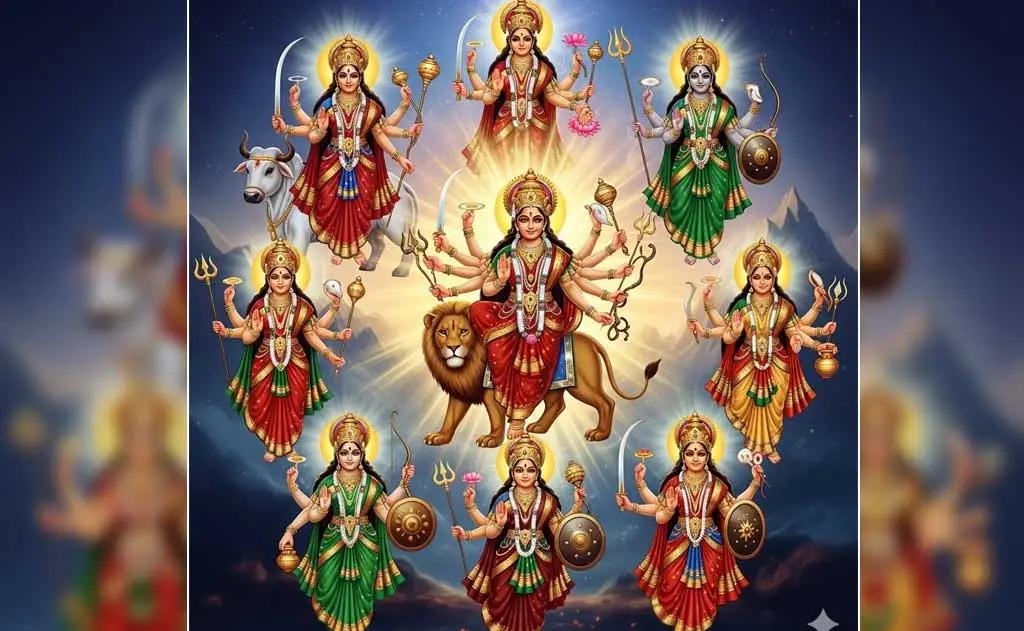
Navratri 2026 Day 7: Maa Kalaratri Mantra, Colour, Bhog and Puja Vidhi (Saturday 17 October)
Navratri Day 7 falls on Saturday 17 October 2026 in India. Meet Maa Kalaratri, the fierce yet gentle-hearted form of Durga: her story as commonly told, her mantras in Devanagari with transliteration and meaning, the grey colour of the day, jaggery bhog, an apartment-friendly puja vidhi, and why Saptami covers two sunrises this year.
Navratri Day 7 falls on Saturday 17 October 2026 in India. Meet Maa Kalaratri, the fierce yet gentle-hearted form of Durga: her story as commonly told, her mantras in Devanagari with transliteration and meaning, the grey colour of the day, jaggery bhog, an apartment-friendly puja vidhi, and why Saptami covers two sunrises this year.
Quick answer: Navratri Day 7 2026 falls on Saturday 17 October 2026 in India, the Saptami of Sharad Navratri, and is dedicated to Maa Kalaratri. The popular colour of the day is grey and the customary bhog is jaggery. Her naam mantra is "Om Devi Kalaratryai Namah". This year the Saptami tithi prevails at sunrise on both 17 and 18 October in India, so some calendars, including Bengal's Durga Puja, keep Maha Saptami on Sunday 18 October.
Kalaratri looks terrifying, yet the tradition remembers her as Shubhankari, the one who brings only good to those who come to her. On this seventh evening, families light a lamp against the dark and ask her to remove fear from their homes and hearts.
Navratri Day 7 2026 at a glance
| Detail | Day 7 |
|---|---|
| Date (India) | Saturday 17 October 2026 |
| Tithi note | Saptami (prevails at sunrise on both 17 and 18 October in India) |
| Goddess | Maa Kalaratri (seventh Navadurga) |
| Colour (popular custom) | Grey |
| Bhog (common) | Jaggery |
| Naam mantra | Om Devi Kalaratryai Namah |
Colours and bhog follow popular custom and lists vary. For all nine days in one place, see the Navratri 2026 colours list.
Why Saptami covers two sunrises in 2026
A Hindu day takes its tithi from the lunar phase at sunrise. In 2026, the Saptami tithi begins before sunrise on Saturday 17 October and is still running at sunrise on Sunday 18 October in India, so it "touches" two sunrises. The Ashtami tithi then begins later on 18 October and Navami follows on 19 October.
This is why calendars differ a little. Families who count the nine nights one by one worship Kalaratri on Day 7, 17 October, and Mahagauri on Day 8, 18 October. Families who follow the tithi closely may keep Saptami rites on 18 October, and Bengal's Durga Puja calendar for Kolkata (Drik Panchang) lists Maha Saptami with the Kolabou (Nabapatrika) puja on Sunday 18 October. Neither is wrong. Follow the calendar your family priest or temple uses, and let the devotion be the same.
Maha Saptami in Durga Puja
In Bengal, Assam, Odisha and Bengali communities everywhere, Saptami is the first of the great days of Durga Puja. At dawn, a banana plant with eight other sacred plants, the Nabapatrika or Kola Bou, is bathed and dressed in a sari and placed beside the Goddess, and the main pujas of the pandal begin. If your family celebrates Durga Puja, read our Durga Puja 2026 dates guide, from Mahalaya to Sindoor Khela, and the story of Durga Puja in West Bengal.
Who is Maa Kalaratri? Form and iconography
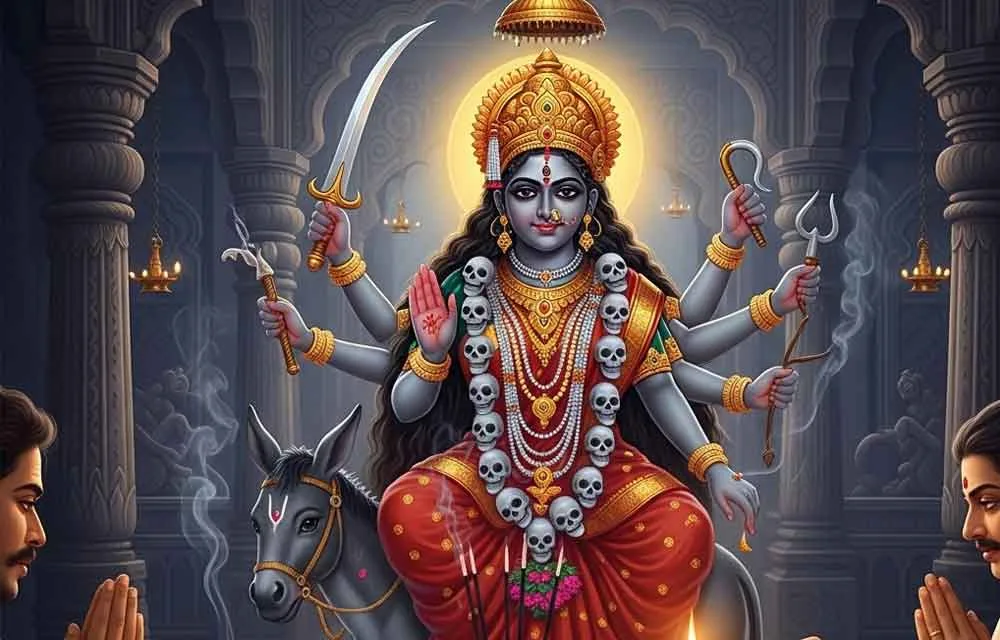
Kalaratri is usually shown with a complexion as dark as a moonless night, loose flowing hair and three eyes that shine like the moon. She rides a donkey. In her four hands she is commonly shown holding a curved sword and an iron hook or thunderbolt, while her other two hands show the abhaya mudra ("do not fear") and the varada mudra (blessing). Her necklace is often described as flashing like lightning, and flames are said to come with her breath.
For devotees, the darkness is the night of time into which all fear dissolves, and the hands of protection and blessing show that this fierce form is still the loving Mother.
The story of Maa Kalaratri, as commonly told
As commonly told, when the demons Shumbha and Nishumbha and their general Raktabija troubled the worlds, the Goddess took on her darkest and most fearsome form to face them. Raktabija had a boon that every drop of his blood falling to the ground would give rise to another demon like him. In the version most families tell, Kalaratri, closely identified with Kali, caught each drop before it could touch the earth, and so Raktabija was finally defeated.
Puranas and regional traditions tell this story in different ways; what unites them is the faith that no darkness is greater than the Mother.
Spiritual significance of Day 7
As traditionally described in many yoga-oriented Navratri teachings, the seven days climb through the chakras, and Kalaratri is often associated with the crown region (Sahasrara), though teachers map these differently. Her quality is fearlessness: the courage to face what frightens us, to let go of what holds us back and to trust in grace. Many devotees use the day to quietly name one fear or habit they wish to lay at her feet.
Maa Kalaratri mantras for Navratri Day 7
The texts below are given exactly as they are traditionally recited, with a plain-English meaning. Chant slowly and clearly; if Sanskrit is new to you, the naam mantra alone, said with love, is a complete offering. For the meaning behind every day's mantra, see our Navratri day-wise mantras and their significance.
Naam mantra of Maa Kalaratri
ॐ देवी कालरात्र्यै नमः॥
Om Devi Kalaratryai Namah
Meaning: Om, salutations to Devi Kalaratri.
How to chant: after lighting the lamp, chant 108 times on a rudraksha or tulsi mala, or simply 11 or 21 times if time is short.
Dhyana shloka (meditation verse)
एकवेणी जपाकर्णपूरा नग्ना खरास्थिता। लम्बोष्ठी कर्णिकाकर्णी तैलाभ्यक्तशरीरिणी॥ वामपादोल्लसल्लोहलताकण्टकभूषणा। वर्धनमूर्धध्वजा कृष्णा कालरात्रिर्भयङ्करी॥
Ekaveni japakarnapura nagna kharasthita, lambosthi karnikakarni tailabhyakta-sharirini. Vamapadollasal-loha-latakantaka-bhushana, vardhana-murdha-dhvaja krishna kalaratrir-bhayankari.
Meaning: I meditate on Kalaratri, the dark and awe-inspiring one: with a single braid of hair, hibiscus (japa) flowers at her ears, unclad, riding a donkey, with long lips and large ears, her body glistening with oil; her left foot adorned with a shining ornament of iron, a banner rising above her head.
How to chant: recite once or three times before the japa while holding her image in your mind. It is a meditation on her form, so read it slowly.
Stuti: Ya Devi Sarvabhuteshu Maa Kalaratri
या देवी सर्वभूतेषु माँ कालरात्रि रूपेण संस्थिता। नमस्तस्यै नमस्तस्यै नमस्तस्यै नमो नमः॥
Ya Devi sarvabhuteshu Maa Kalaratri rupena samsthita, namastasyai namastasyai namastasyai namo namah.
Meaning: To the Goddess who abides in all beings in the form of Mother Kalaratri: salutations to her, salutations to her, salutations to her, salutations again and again.
How to chant: 3, 11 or 21 times, with folded hands, before the aarti.
Navarna mantra
ॐ ऐं ह्रीं क्लीं चामुण्डायै विच्चे॥
Om Aim Hreem Kleem Chamundayai Vichche
Meaning: the nine-syllable mantra of the Devi from the Chandi (Durga Saptashati) tradition, offering salutations to Chamunda. The seed syllables Aim, Hreem and Kleem are traditionally linked with Mahasaraswati, Mahalakshmi and Mahakali.
How to chant: many families chant it 108 times during all nine days; some traditions prefer that it be learned from a guru, so follow your family custom.
Om Dum Durgayai Namah
ॐ दुं दुर्गायै नमः॥
Om Dum Durgayai Namah
Meaning: Om, with Durga's seed syllable Dum, salutations to Goddess Durga.
How to chant: a short, easy mantra for children and beginners; 108 times on a mala, or quietly through the day.
Sarva Mangala Mangalye
सर्वमङ्गलमाङ्गल्ये शिवे सर्वार्थसाधिके। शरण्ये त्र्यम्बके गौरि नारायणि नमोऽस्तु ते॥
Sarva-mangala-mangalye shive sarvartha-sadhike, sharanye tryambake gauri narayani namostu te.
Meaning: O auspiciousness of all that is auspicious, O gracious one who fulfils every good aim, O refuge of all, three-eyed Gauri, O Narayani, salutations to you. (From the Narayani Stuti of the Devi Mahatmya.)
How to chant: recite at the end of puja, three times, as a closing prayer.
Ya Devi Sarvabhuteshu Shakti-rupena
या देवी सर्वभूतेषु शक्तिरूपेण संस्थिता। नमस्तस्यै नमस्तस्यै नमस्तस्यै नमो नमः॥
Ya Devi sarvabhuteshu shakti-rupena samsthita, namastasyai namastasyai namastasyai namo namah.
Meaning: To the Goddess who abides in all beings as power (Shakti): salutations to her again and again. (From the Aparajita Stuti of the Devi Mahatmya.)
How to chant: a fitting verse for Kalaratri, the Mother as pure strength; recite 3 or 11 times.
Simple home puja vidhi for Day 7 (apartment-friendly)
- Prepare: bathe, wear clean clothes (grey if you like, by custom) and wipe the puja space. If you set up a kalash on Day 1, refresh its water and check the jowar or barley sprouts.
- Light the lamp: a ghee or oil diya in front of the Goddess's picture. Keep it on a metal plate, away from curtains and smoke alarms, and never leave it alone.
- Sankalpa: sit quietly, take a little water in your right palm, say your name and that you are worshipping Maa Kalaratri on the seventh day of Navratri, then let the water fall into a small bowl.
- Invocation: recite the dhyana shloka once, then offer kumkum, turmeric and akshata (unbroken rice) to the picture or kalash.
- Flowers: by popular custom, red flowers such as hibiscus, which her own dhyana shloka mentions, or fragrant night-blooming jasmine. Any fresh flower offered with love is welcome.
- Japa: chant the naam mantra 108 times, then the stuti and one or two of the Devi mantras above.
- Bhog: offer jaggery, plain or in a simple sweet, with a glass of water. Share it afterwards as prasad, and if you can, give some in charity.
- Aarti: sing the Durga or Ambe aarti your family knows, waving the lamp in slow circles, and close with Sarva Mangala Mangalye.
- Close: ask forgiveness for any mistakes in the puja, bow down and sit quietly for a minute.
The whole puja can take 20 to 30 minutes. For a full nine-day apartment set-up, see the Navratri 2026 apartment-friendly puja vidhi, and for more on this form, our evergreen Maa Kaalratri puja rituals guide.
Fasting on Day 7: what to do and avoid
- Many devotees keep a phalahar fast: fruit, milk, curd, nuts, sabudana, kuttu (buckwheat), singhara (water chestnut) flour and potatoes, cooked with rock salt (sendha namak).
- Commonly avoided: grains such as wheat and rice, onion, garlic, meat, eggs and alcohol. Customs differ between regions and families.
- Drink enough water, especially if you are working a full day.
- Pregnant women, older people, children and anyone with diabetes or on regular medication should choose a light fast or speak to a doctor first. The Mother asks for devotion, not hardship.
For ideas, see our day-wise Navratri vrat recipes and Navratri prasadam recipes.
A short prayer for Day 7
You may say this in your own words after the japa:
"Maa Kalaratri, you who shine in the darkest night, I bow to you. Take away the fear I carry, and the darkness I cannot see in myself. Make me brave enough to do what is right, and gentle enough to forgive. Stay in this home and in every heart here. Jai Maa Kalaratri."
Navratri Day 7 abroad: tips for NRI families
Day 7 falls on a Saturday, so families abroad can do a longer puja, visit a temple or community Durga Puja and include the children. If you work weekends, an evening puja after sunset suits Kalaratri well.
A note on dates abroad: in the USA, Canada and the UK, Drik Panchang lists Durga Ashtami on Sunday 18 October and Maha Navami on Monday 19 October, one day apart, whereas in India both fall on Monday 19 October. Your local temple's calendar is the best guide. For more on celebrating away from India, read our Navratri 2026 NRI guide.
Previous and next day
Frequently asked questions
Which goddess is worshipped on Navratri Day 7 2026?
Maa Kalaratri, the seventh of the Navadurga forms, is worshipped on Day 7, Saturday 17 October 2026 in India. She is the fierce form of Durga who, as commonly told, destroys darkness and fear, and devotees also call her Shubhankari, the one who does good.
What is the colour of Navratri Day 7 2026?
By the popular weekday custom, the colour for Saturday 17 October 2026 is grey. Colour lists vary between regions and websites, so treat it as a joyful custom rather than a rule.
What is the mantra for Maa Kalaratri?
The simplest is the naam mantra "Om Devi Kalaratryai Namah" (ॐ देवी कालरात्र्यै नमः॥), chanted 108 times on a mala after lighting the lamp. Many devotees also recite her dhyana shloka and the stuti "Ya Devi sarvabhuteshu Maa Kalaratri rupena samsthita".
What bhog is offered to Maa Kalaratri?
Jaggery (gur) is the most common offering on Day 7, either plain or in a simple sweet. Bhog lists vary by tradition, and after the puja the prasad is shared with family or given in charity.
Is Saptami on 17 or 18 October 2026?
In India the Saptami tithi prevails at sunrise on both Saturday 17 and Sunday 18 October 2026. Day-count calendars honour Kalaratri on Day 7, 17 October, and Bengal's Durga Puja calendar for Kolkata lists Maha Saptami on Sunday 18 October. Follow your family or temple calendar.
Can I do Kalaratri puja in the evening after work?
Yes. Kalaratri literally means "the night of time", and many families find an evening lamp and mantra japa especially fitting for her. A clean space, a diya, a flower, a little jaggery and a sincere heart are enough.
Editor's note
Editor's note (6 October 2026): This guide has been restored at its original address. India dates are from Drik Panchang, and the Saptami tithi note is from our panchang calculator for New Delhi. The mantras are traditional texts as commonly recited, given here without additions. Customs, colours and bhog vary between families and regions; please follow your family priest or temple.
Related guides
You might also like
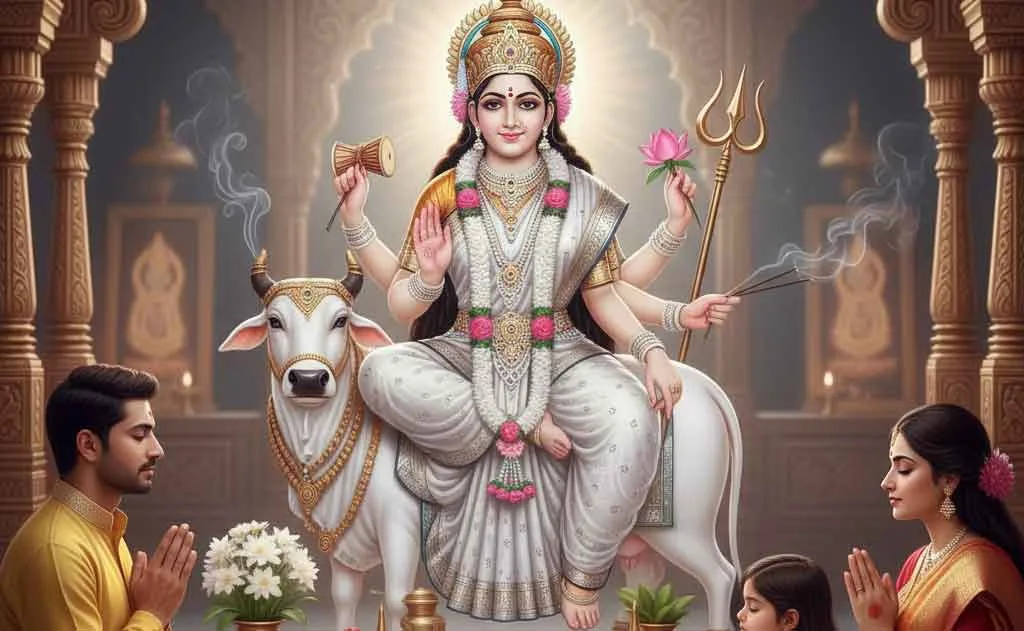
Navratri 2026 Day 8: Maa Mahagauri Mantra, Colour, Bhog and Puja Vidhi (Sunday 18 October)
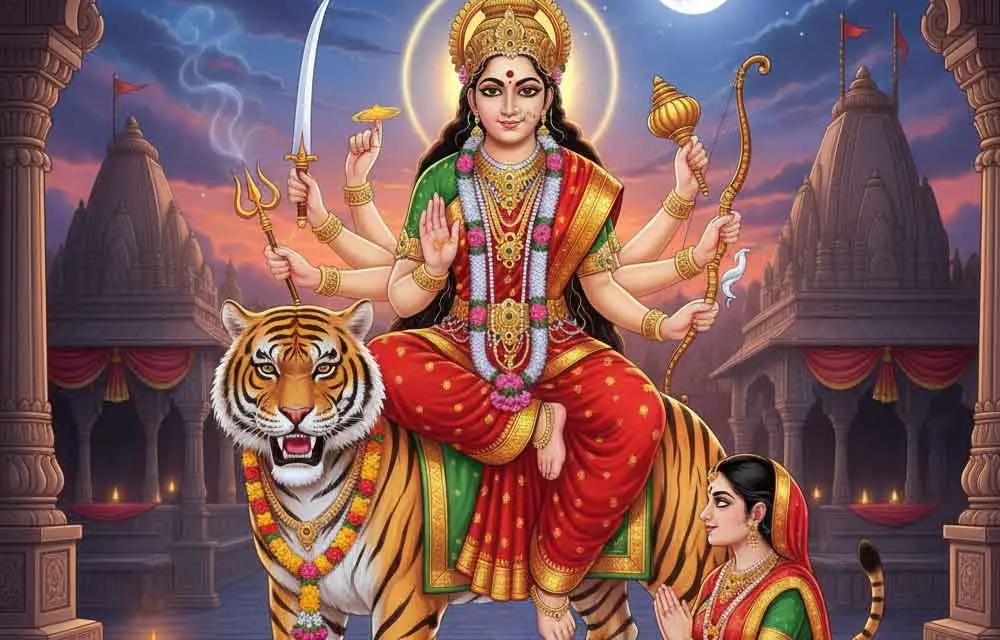
Navratri 2026 Day 3: Maa Chandraghanta Mantra, Colour, Bhog and Puja Vidhi (Tuesday 13 October)
Navratri 2026 Day 2: Maa Brahmacharini Mantra, Colour, Bhog and Puja Vidhi (Monday 12 October)