Krishnashtakam (Vasudeva Sutam Devam): Full Text with Meaning
The Krishnashtakam that begins 'Vasudeva sutam devam' praises Krishna as jagadguru, the teacher of the world, in eight short verses. Here is the full text in Devanagari and IAST from sanskritdocuments.org, our own verse-by-verse meaning, and how to recite it each morning, in Kartik month and on Gita Jayanti (20 December 2026).
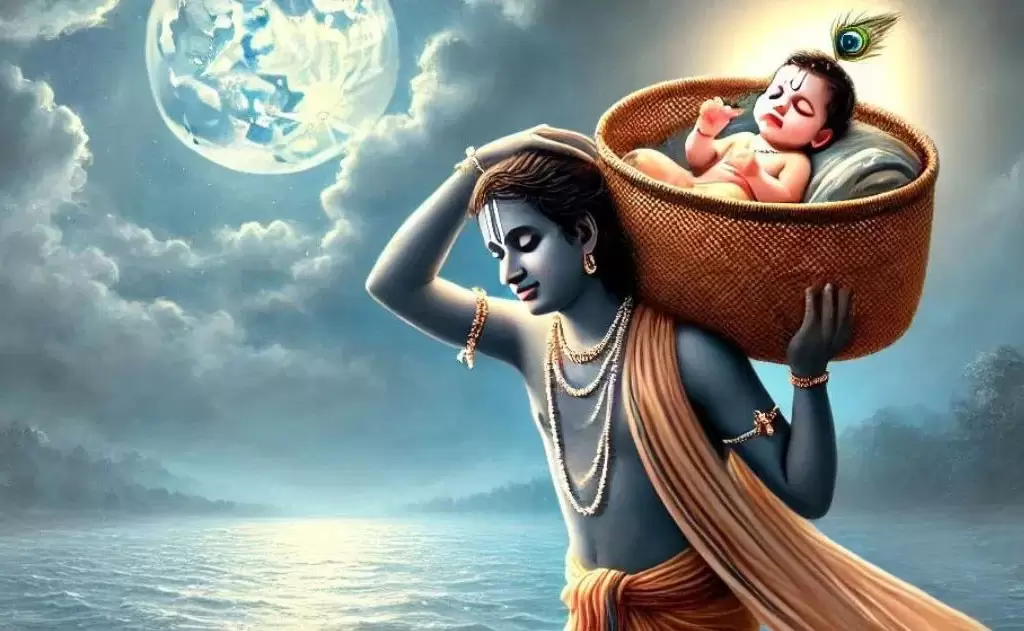
The Krishnashtakam that begins 'Vasudeva sutam devam' praises Krishna as jagadguru, the teacher of the world, in eight short verses. Here is the full text in Devanagari and IAST from sanskritdocuments.
Quick answer: This Krishnashtakam is a short Sanskrit hymn of eight verses to Lord Krishna that begins "vasudeva sutam devam, kamsa chanura mardanam". Every verse ends with the same refrain, "krishnam vande jagadgurum", 'I bow to Krishna, the teacher of the world'. Its first verse is also part of the Gita Dhyanam, so it is recited before reading the Bhagavad Gita and on Gita Jayanti, Sunday 20 December 2026. The closing verse asks for it to be recited on rising each morning.
Last updated: 20 October 2026. The Sanskrit below is the complete text published by sanskritdocuments.org (file krishna8-3.itx), converted to Devanagari and IAST by software from the source, with no word typed by hand. Our own plain-English meaning follows every verse.
Krishnashtakam: full text with meaning
Each verse describes one aspect of Krishna's form or story and ends with the refrain. Each appears in Devanagari and then in IAST transliteration, followed by its meaning.
The eight verses
Verse 1
वसुदेवसुतं देवं कंसचाणूरमर्दनम् ।
देवकीपरमानन्दं कृष्णं वन्दे जगद्गुरुम् ॥ १॥
vasudevasutaṃ devaṃ kaṃsacāṇūramardanam |
devakīparamānandaṃ kṛṣṇaṃ vande jagadgurum || 1||
Meaning: The son of Vasudeva, the divine one, the destroyer of Kamsa and Chanura, the supreme joy of Devaki: I bow to Krishna, the teacher of the world.
Verse 2
अतसीपुष्पसङ्काशम् हारनूपुरशोभितम् ।
रत्नकङ्कणकेयूरं कृष्णं वन्दे जगद्गुरुम् ॥ २॥
atasīpuṣpasaṅkāśam hāranūpuraśobhitam |
ratnakaṅkaṇakeyūraṃ kṛṣṇaṃ vande jagadgurum || 2||
Meaning: Dark and lovely like the atasi (flax) flower, adorned with necklaces and anklets, with jewelled bracelets and armlets: I bow to Krishna, the teacher of the world.
Verse 3
कुटिलालकसंयुक्तं पूर्णचन्द्रनिभाननम् ।
विलसत्कुण्डलधरं कृष्णं वन्दे जगद्गुरुम् ॥ ३॥
kuṭilālakasaṃyuktaṃ pūrṇacandranibhānanam |
vilasatkuṇḍaladharaṃ kṛṣṇaṃ vande jagadgurum || 3||
Meaning: With curling locks of hair, his face like the full moon, wearing shining earrings: I bow to Krishna, the teacher of the world.
Verse 4
मन्दारगन्धसंयुक्तं चारुहासं चतुर्भुजम् ।
बर्हिपिच्छावचूडाङ्गं कृष्णं वन्दे जगद्गुरुम् ॥ ४॥
mandāragandhasaṃyuktaṃ cāruhāsaṃ caturbhujam |
barhipicchāvacūḍāṅgaṃ kṛṣṇaṃ vande jagadgurum || 4||
Meaning: Fragrant with mandara flowers, with a charming smile and four arms, his crown adorned with a peacock feather: I bow to Krishna, the teacher of the world.
Verse 5
उत्फुल्लपद्मपत्राक्षं नीलजीमूतसन्निभम् ।
यादवानां शिरोरत्नं कृष्णं वन्दे जगद्गुरुम् ॥ ५॥
utphullapadmapatrākṣaṃ nīlajīmūtasannibham |
yādavānāṃ śiroratnaṃ kṛṣṇaṃ vande jagadgurum || 5||
Meaning: His eyes like the petals of a fully opened lotus, dark like a blue rain cloud, the crest jewel of the Yadavas: I bow to Krishna, the teacher of the world.
Verse 6
रुक्मिणीकेळिसंयुक्तं पीताम्बरसुशोभितम् ।
अवाप्ततुलसीगन्धं कृष्णं वन्दे जगद्गुरुम् ॥ ६॥
rukmiṇīkeḻisaṃyuktaṃ pītāmbarasuśobhitam |
avāptatulasīgandhaṃ kṛṣṇaṃ vande jagadgurum || 6||
Meaning: Rejoicing in play with Rukmini, resplendent in yellow silk, fragrant with tulasi: I bow to Krishna, the teacher of the world.
Verse 7
गोपिकानां कुचद्वन्द्व कुङ्कुमाङ्कितवक्षसम् ।
श्री निकेतं महेष्वासं कृष्णं वन्दे जगद्गुरुम् ॥ ७॥
gopikānāṃ kucadvandva kuṅkumāṅkitavakṣasam |
śrī niketaṃ maheṣvāsaṃ kṛṣṇaṃ vande jagadgurum || 7||
Meaning: His chest marked with the kumkum of the gopis' embrace, the home of Shri (Lakshmi), the great archer: I bow to Krishna, the teacher of the world.
Verse 8
श्रीवत्साङ्कं महोरस्कं वनमालाविराजितम् ।
शङ्खचक्रधरं देवं कृष्णं वन्दे जगद्गुरुम् ॥ ८॥
śrīvatsāṅkaṃ mahoraskaṃ vanamālāvirājitam |
śaṅkhacakradharaṃ devaṃ kṛṣṇaṃ vande jagadgurum || 8||
Meaning: Bearing the Shrivatsa mark on his broad chest, shining with a garland of forest flowers, holding the conch and the discus, the divine one: I bow to Krishna, the teacher of the world.
Closing verse and colophon
कृष्णाष्टकमिदं पुण्यं प्रातरुत्थाय यः पठेत् ।
कोटिजन्मकृतं पापं स्मरणेन विनश्यति ॥
॥ इति कृष्णाष्टकम् ॥
kṛṣṇāṣṭakamidaṃ puṇyaṃ prātarutthāya yaḥ paṭhet |
koṭijanmakṛtaṃ pāpaṃ smaraṇena vinaśyati ||
|| iti kṛṣṇāṣṭakam ||
Meaning: Whoever recites this holy Krishnashtakam on rising in the morning: the sins of ten million births are destroyed just by remembering it. Thus ends the Krishnashtakam.
What the eight verses describe
| Verse | Picture of Krishna |
|---|---|
| 1 | His birth and mission: son of Vasudeva and Devaki, slayer of Kamsa and the wrestler Chanura |
| 2 | His dark beauty and ornaments |
| 3 | His curls, moon-like face and earrings |
| 4 | Four-armed, smiling, with the peacock feather |
| 5 | Lotus eyes, cloud-dark body, jewel of the Yadavas |
| 6 | With Rukmini, in yellow silk, fragrant with tulasi |
| 7 | Beloved of the gopis, home of Lakshmi, the great archer |
| 8 | As Vishnu: Shrivatsa mark, forest garland, conch and discus |
The hymn moves from Krishna's birth in Mathura (verse 1) through the cowherd boy of Vrindavan (verses 3, 4 and 7) and the king of Dwaraka with Rukmini (verse 6) to his form as Vishnu (verse 8). Verse 1 recalls the slaying of Kamsa; see Kansa Vadh 2026 and our Lord Krishna hub for the stories.
Why Krishna is called jagadguru
The refrain calls Krishna the teacher of the whole world. The tradition gives this title above all because of the Bhagavad Gita, the dialogue in which Krishna teaches Arjuna on the battlefield of Kurukshetra. That is also why verse 1 of this hymn is recited as a Gita Dhyana verse before Gita study. For a taste of that teaching, read our selection of verses from the Bhagavad Gita and the Bhagavad Gita guide to all 18 chapters.
When to recite it
- Every morning: the closing verse asks for it 'on rising in the morning'.
- Kartik month: from Tuesday 27 October to Tuesday 24 November 2026 in the North Indian calendar, alongside the Damodarashtakam; see Damodar month 2026.
- Gita Jayanti: Sunday 20 December 2026 (Mokshada Ekadashi), before reading the Gita; see Gita Jayanti 2026 and Gita Jayanti 2026 in the USA.
- Janmashtami and Ekadashis: as part of Krishna worship at home; see Krishna Janmashtami.
How to recite it at home
- Sit before a picture of Krishna, light a lamp and, if you have them, offer a tulasi leaf (verse 6 speaks of his love of tulasi) and a flower.
- Recite each verse slowly. Let the family join in the refrain 'krishnam vande jagadgurum' at the end of each verse; even small children can say it.
- End with the closing verse and a moment of silence.
- On Gita Jayanti or before Gita study, recite verse 1 and then read one chapter or a few verses of the Gita.
Pronunciation help
- In the IAST, a line over a vowel (ā, ī, ū) means it is held twice as long; ṇ and ṭ are made with the tongue curled back.
- The refrain is read 'krish-nam van-de ja-gad-gu-rum'.
- In verse 6 the source spells the word for 'play' (keli) with the retroflex 'la' used in many South Indian prints; it is read like a soft 'l'.
Traditional beliefs about the hymn
The closing verse states the hymn's merit: remembered on rising, it destroys the sins of countless births. Devotees traditionally believe that beginning the day with these eight verses:
- fills the mind with Krishna's form before the work of the day begins;
- prepares the heart for study of the Gita, Krishna's own teaching;
- brings the family together in a short, joyful prayer.
These are traditional beliefs about the hymn's spiritual value, not promises of particular results.
Tips for NRI families
- A two-minute morning prayer. Recite it at breakfast or in the car; the refrain makes it easy to share.
- Explain the pictures. Each verse is a picture: the peacock feather, the yellow silk, the lotus eyes. Ask children to draw one verse a week.
- More Krishna hymns. Try Madhurashtakam, Achyutashtakam, Govindashtakam and Shankara's Bhaja Govindam.
- Visiting a temple. At Krishna temples such as Guruvayur, devotees often recite verse 1 on entering.
Frequently asked questions
Who wrote the Krishnashtakam 'Vasudeva sutam devam'?
Our source, sanskritdocuments.org, gives the author as unknown. Several different hymns are called Krishnashtakam; this one is recognised by its refrain 'krishnam vande jagadgurum'. Some popular books attribute it to Adi Shankaracharya, but the source does not, so we do not.
What does 'krishnam vande jagadgurum' mean?
'I bow to Krishna, the teacher of the world.' Jagad means world and guru means teacher. Krishna is called the world's teacher above all because he taught the Bhagavad Gita to Arjuna.
Is the first verse part of the Gita Dhyanam?
Yes. 'Vasudeva sutam devam, kamsa chanura mardanam, devaki paramanandam, krishnam vande jagadgurum' is also one of the meditation verses (Gita Dhyana) recited before reading the Bhagavad Gita, which is why many people know it by heart.
When should it be recited?
The closing verse says 'pratar utthaya', on rising in the morning. It is also loved on Janmashtami, during Kartik month (from 27 October 2026), on Ekadashis and on Gita Jayanti, Sunday 20 December 2026.
How long does it take?
About two to three minutes for the eight verses and the closing verse. It is short enough to recite every morning.
What does the closing verse promise?
It says that by remembering this holy hymn on rising, the sins of countless births are destroyed. This is the hymn's traditional praise, a matter of faith rather than a guaranteed result.
Editor's note (20 October 2026)
This page was published on 20 October 2026. The Sanskrit is the full text of Krishnashtakam 3 on sanskritdocuments.org (file krishna8-3.itx, encoded and proofread by Bhargavi Atchutuni), which gives the author as unknown; we have not added an attribution. It was converted from ITRANS to Devanagari and IAST by software; no word has been changed. The source prints '(pinchhava)' after verse 4 as an alternative spelling of the word for the peacock feather; we print its main reading and have left the bracketed note out. The closing verse is unnumbered in the source. Kartik and Gita Jayanti dates are from Drik Panchang (New Delhi) as used across HinduTone's festival pages.
Related guides
You might also like
Sankatanashana Ganesha Stotram (Pranamya Shirasa Devam): Full Text with Meaning
Devi Kavacham (Durga Saptashati): Full Text with Meaning
Argala Stotram (Durga Saptashati): Full Text with Meaning