Bhagavad Gita — Complete Guide for NRIs (18 Chapters + 3 Yogas)
The Bhagavad Gita explained chapter-by-chapter — 18 chapters, 700 verses, 3 yogas (karma/bhakti/jnana). Practical Gita for modern NRI professionals, translations to choose, Gita Jayanti 2026 (Dec 20), Krishna's teachings on duty, devotion, knowledge and liberation.
The Bhagavad Gita explained chapter-by-chapter — 18 chapters, 700 verses, 3 yogas (karma/bhakti/jnana). Practical Gita for modern NRI professionals, translations to choose, Gita Jayanti 2026 (Dec 20), Krishna's teachings on duty, devotion, knowledge and liberation.
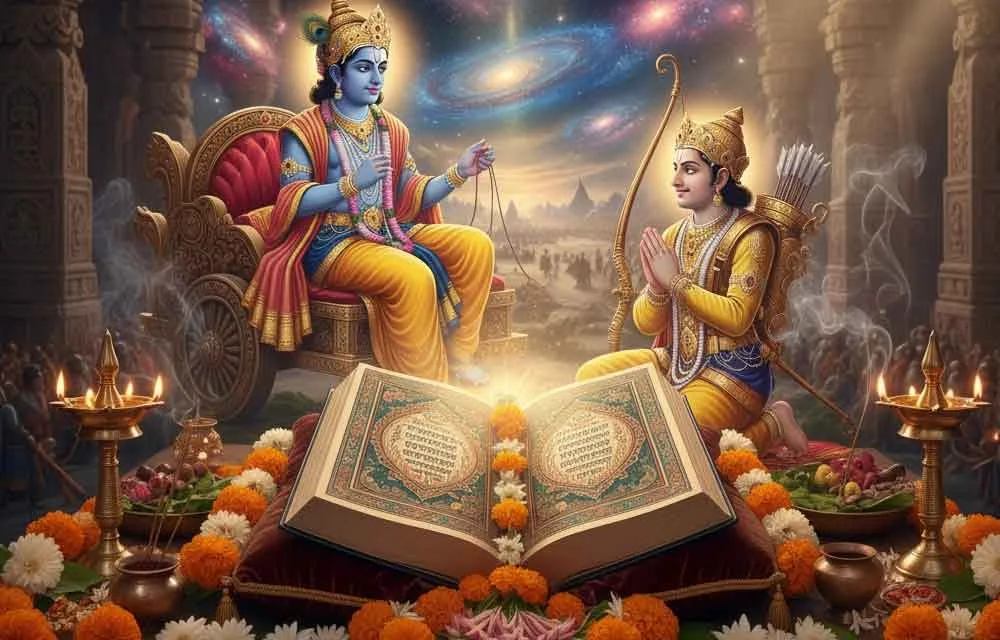
The Bhagavad Gita is a 700-verse dialogue between Lord Krishna and Arjuna, set on the battlefield of Kurukshetra and embedded as chapters 23-40 of the Bhishma Parva of the Mahabharata. Composed approximately in the 2nd-1st century BCE, it has become the most translated, most cited and most globally studied Hindu scripture. For NRIs balancing modern professional life with dharmic practice, the Gita offers the most directly applicable wisdom of any Hindu text.
Quick answer: What is the Bhagavad Gita?
The Bhagavad Gita ("Song of the Lord") is an 18-chapter, 700-verse philosophical dialogue between Krishna and Arjuna at the start of the Mahabharata war. Krishna teaches Arjuna how to act righteously under duty, the three paths to liberation (karma/bhakti/jnana yoga), the nature of the Self, and the structure of reality. It is the central practical scripture of Hinduism — recited daily by millions, translated into 80+ languages, and credited as a major influence on figures from Thoreau to Oppenheimer to MLK.
The 18 chapters at a glance
The Gita is structured in three sections of 6 chapters each:
- Chapters 1-6 — Karma Yoga: action without attachment, the yoga of self-discipline
- Chapters 7-12 — Bhakti Yoga: devotion, the path of love and surrender
- Chapters 13-18 — Jnana Yoga: knowledge, the philosophical structure of reality
Major chapter themes:
- Chapter 1 — Arjuna Vishada Yoga: Arjuna's despair on seeing his relatives across the battlefield
- Chapter 2 — Sankhya Yoga: the immortality of the Atman, sthitaprajna (the steady-minded sage)
- Chapter 3 — Karma Yoga: action as worship; "do your duty, not your due"
- Chapter 4 — Jnana-Karma-Sannyasa Yoga: knowledge as the destroyer of karma
- Chapter 5 — Karma-Sannyasa Yoga: renunciation in action vs renunciation of action
- Chapter 6 — Dhyana Yoga: meditation, the eight-limbed yoga prefiguring Patanjali
- Chapter 7 — Jnana-Vijnana Yoga: the manifest and unmanifest nature of Brahman
- Chapter 8 — Aksara Brahma Yoga: the imperishable Brahman, the moment-of-death teaching
- Chapter 9 — Raja-Vidya-Raja-Guhya Yoga: the royal wisdom, "sarva-dharman parityajya"
- Chapter 10 — Vibhuti Yoga: Krishna's divine manifestations ("among trees I am the ashvattha…")
- Chapter 11 — Vishvarupa Darshana Yoga: the cosmic form revelation, "I am become death"
- Chapter 12 — Bhakti Yoga: the qualities of a true devotee — patience, compassion, equanimity
- Chapter 13 — Ksetra-Ksetrajna Yoga: the field (body/mind) vs the knower of the field (Atman)
- Chapter 14 — Gunatraya-Vibhaga Yoga: the three gunas — sattva, rajas, tamas
- Chapter 15 — Purushottama Yoga: the upside-down banyan tree, the supreme Person
- Chapter 16 — Daivasura-Sampad-Vibhaga Yoga: divine vs demonic qualities
- Chapter 17 — Shraddhatraya-Vibhaga Yoga: the three types of faith, food, sacrifice, austerity
- Chapter 18 — Moksha-Sannyasa Yoga: the conclusion, "sarva-dharman parityajya mam ekam saranam vraja"
The three yogas — which path is yours?
The Gita's genius is that it does not prescribe one path; it lays out three complementary routes to the same goal (moksha, liberation), and Krishna explicitly tells Arjuna to combine them according to temperament:
- Karma Yoga — for the doer, the achiever, the professional. "Yoga is skill in action" (2.50). Modern NRI applies this most directly: work hard but renounce attachment to specific outcomes.
- Bhakti Yoga — for the heart-centred, the devotee. "Whatever you do, do it as offering to Me" (9.27). The easiest path in Krishna's own words; the path of grace.
- Jnana Yoga — for the philosophical, the contemplative. "Knowledge is supreme purifier" (4.38). The path of self-inquiry and Vedanta.
A modern Indian/NRI professional life maps naturally to karma yoga in work + bhakti yoga in family/devotional practice + jnana yoga as the underlying view. Different chapters address different orientations.
Gita Jayanti — when the Gita was given
Gita Jayanti is celebrated on Mokshada Ekadashi — the Shukla Paksha Ekadashi of Margashirsha month. In 2026 this falls on December 20 (Sunday) in India and most of the world. It marks the day Krishna revealed the Gita to Arjuna in the year corresponding to 3137 BCE per traditional reckoning (or ~5,000 years ago). Devotees fast, recite all 18 chapters in one sitting (Gita Saptaham across 7 days is also common), and offer Tulsi to Krishna.
Practical Gita for the modern NRI
- Daily practice: Read 1 verse + the commentary each day; covers the full Gita in ~2 years. Apps like ISKCON's Bhagavad-gita As It Is, Eknath Easwaran's pocket edition, and the Gita Press Gorakhpur Sanskrit-English-Hindi tri-format are all excellent
- Memorization: Chapter 12 (verse 13-19) and Chapter 18 (verse 66) are the most universally quoted; memorizing these gives you the "core download" of the Gita
- For work challenges: Chapter 3 (Karma Yoga) and Chapter 16 (divine vs demonic) — practical professional ethics
- For grief or loss: Chapter 2 (immortality of soul), the foundational consolation in Hindu tradition
- For devotional life: Chapter 9 (rajavidya) and Chapter 12 (bhakti) — the heart of practice
- For philosophical depth: Chapters 13-15 — Vedanta in concentrated form
- Audio: M.S. Subbulakshmi's Gita recitation, Pujya Swami Dayananda Saraswati lectures (Arsha Vidya Gurukulam), Pravin Agarwal's chapter-by-chapter recitation are all freely available
Translations + commentaries — which to choose?
- Eknath Easwaran (Nilgiri Press) — accessible, prose, best first translation; recommended for new NRI readers
- Bhagavad-gita As It Is (A.C. Bhaktivedanta Swami / ISKCON) — Vaishnava perspective with extensive purports; most-distributed edition worldwide
- Gita Press Gorakhpur tri-format (Sanskrit + Hindi + English) — the Indian household standard
- Sri Aurobindo, Essays on the Gita — for philosophical depth; pairs Gita with Sri Aurobindo's integral yoga
- Swami Chinmayananda 8-volume commentary — Vedanta-oriented, comprehensive line-by-line
- Swami Dayananda Saraswati (Arsha Vidya) — strict Vedantic Sankara-Shastra interpretation; the scholar's edition
- Christopher Isherwood + Swami Prabhavananda (Vedanta Press) — beautiful English; the most-quoted translation in the West
- Stephen Mitchell (poetic English) — secular-friendly, controversial for Vedantins; good for non-Hindu friends
Also read: 15 Bhagavad Gita verses with meaning.
Frequently Asked Questions
How long does it take to read the Bhagavad Gita?
A complete cover-to-cover read of just the verses (without commentary) takes ~3-4 hours. With chapter introductions and brief commentary, plan 8-12 hours total. The traditional Saptaham (7-day complete recitation) does 2-3 chapters per day. For a daily-verse practice, 1 verse + commentary takes 5-10 minutes and covers the full Gita in 18-24 months at one verse per day.
In which chapter does Krishna reveal His Universal Form?
Chapter 11 — Vishvarupa Darshana Yoga. After Arjuna asks to see Krishna's divine form, Krishna grants him "divine vision" (divya chakshu) and reveals the Universal Form (vishvarupa) — all beings, all worlds, past, present and future contained within Him. The chapter contains the famous verse "Time I am, the destroyer of worlds" — quoted by J. Robert Oppenheimer after the Trinity nuclear test.
Is the Bhagavad Gita only for Hindus?
No. The Gita is treated as universal wisdom literature in academic philosophy, comparative religion, and even military leadership programs. Practitioners include Hindus globally, many Western seekers, Theosophists, Self-Realization Fellowship followers, and figures from Thoreau, Emerson and Yogananda to Gandhi, MLK and modern NRI professionals. The teaching itself is presented as universally applicable — Krishna addresses dharma as such, not "Hindu dharma" specifically.
What is the famous verse 18.66 of the Bhagavad Gita?
"Sarva-dharman parityajya mam ekam sharanam vraja / aham tvam sarva-papebhyo mokshayishyami ma shucha" — "Abandon all dharmas and take refuge in Me alone. I will free you from all sins; do not grieve." This is the Gita's final teaching (charama shloka) and the foundational verse of saranagati (surrender) in Vaishnava theology. Sri Ramanuja and Sri Madhva both treat this as the supreme conclusion of the entire scripture.
When is Gita Jayanti 2026?
Gita Jayanti 2026 falls on Sunday, 20 December 2026 — Mokshada Ekadashi of Margashirsha Shukla Paksha (on the US West Coast, Smarta calendars mark it on Saturday 19 December). Devotees fast, recite all 18 chapters in one sitting (or across 7 days as Gita Saptaham), and offer Tulsi to Lord Krishna. Many temples organise public Gita parayan readings starting at dawn.
Related Reading on HinduTone
- Bhagavad Gita — main hub
- Bhagavad Gita Chapter 2 — Sankhya Yoga (complete commentary, 72 verses)
- Bhagavad Gita Chapter 12 — Bhakti Yoga (devotee qualities)
- Bhagavad Gita Chapter 15 — Purushottama Yoga (the supreme Person)
- Bhagavad Gita Chapter 18 — Moksha-Sannyasa Yoga (the final conclusion)
- Gita Jayanti 2026 — Prasad recipes & Tulsi sweets
- Krishna Avatar — Bhagavad Gita & Mahabharata context
- Bhagavad Gita lessons for Hindu Americans 2026 (work, AI, immigration)
- Mokshada Ekadashi & Gita Jayanti 2025
- Hindu Festival Calendar 2026 (full year)
- Gayatri Mantra Meaning — Complete Guide
Sources & Tradition
Primary text: Bhagavad Gita as preserved in the Mahabharata Bhishma Parva (chapters 23-40). Reference editions: Gita Press Gorakhpur tri-format; Bhagavad-gita As It Is (BBT); Eknath Easwaran (Nilgiri Press); Sri Aurobindo's Essays on the Gita; Swami Dayananda Saraswati's Bhagavad Gita Home Study Course (Arsha Vidya). Chapter classification follows the traditional Smarta-Vaishnava consensus. Date claims (3137 BCE composition) reflect traditional Hindu reckoning, not academic scholarship.
- Bhagavad Gita — Wikipedia
- Bhagavad-Gita As It Is (free, ISKCON BBT)
- Sringeri Sharada Peetham — Acharya tradition
Editorial Review
Reviewed by HinduTone Dharma Desk — 1 June 2026. Chapter contents verified against the Gita Press Gorakhpur edition (Sanskrit-English-Hindi tri-format). Practical-application sections written for the modern NRI professional context, drawing on Swami Dayananda Saraswati's Home Study lectures and ISKCON's NRI outreach materials. For traditional initiation into Gita study under a guru, contact Arsha Vidya Gurukulam, Chinmaya Mission, Ramakrishna Math, or your family acharya.
All Bhagavad-gita Articles on HinduTone
Complete index of in-depth articles in the bhagavad-gita cluster on HinduTone — bookmarked guides, puja vidhi posts, mantras, festival calendars and cultural deep-dives. Use these as the canonical entry points into each sub-topic:
You might also like
Sanatan Dharma for Young NRIs: A Complete, Honest Guide for Hindus Growing Up in USA, UK, Canada, Australia & UAE

Bhagavad Gita Chapter 12 — Bhakti Yoga Complete Commentary: All 20 Verses, Devotee Qualities, 30-Day NRI Practice Guide for 2026
10 Bhagavad Gita Lessons Every Hindu American Needs in 2026 — Career, AI, Immigration & Inner Peace