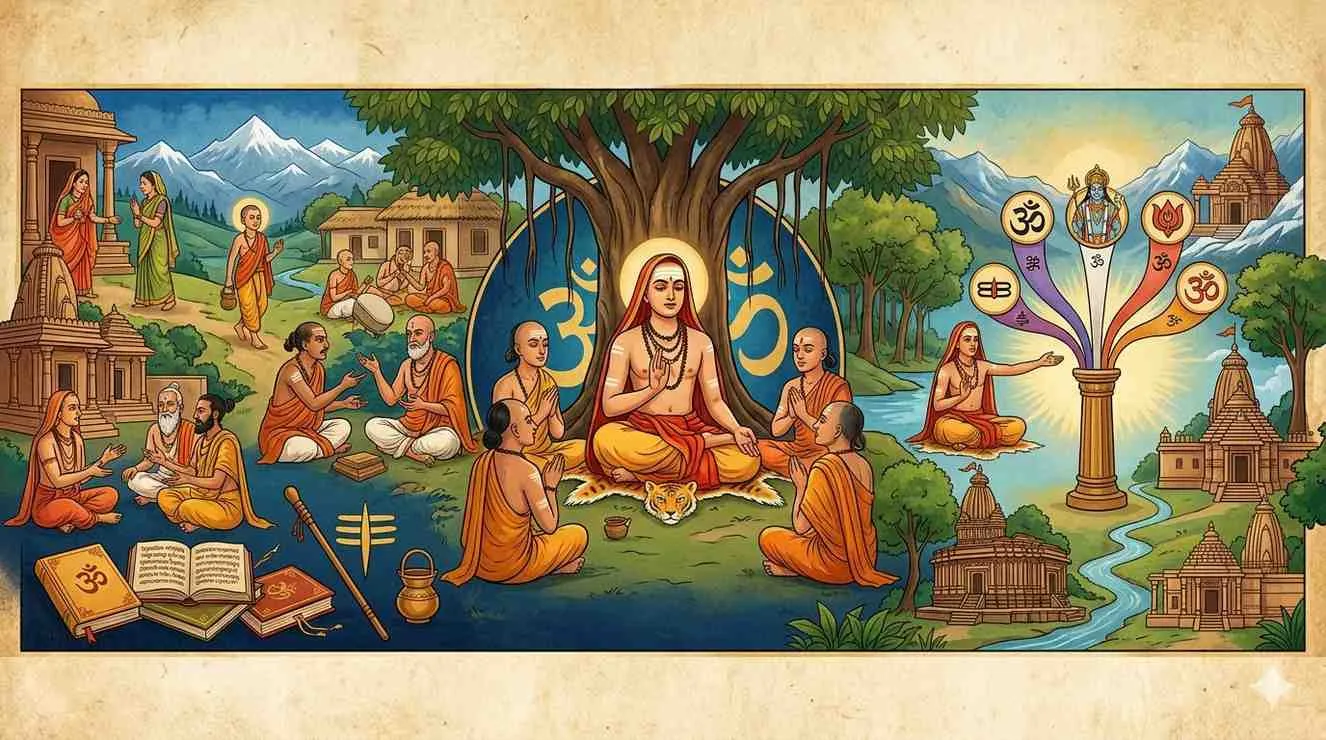
Bhagavad Gita Chapter 2 — Sankhya Yoga Complete Commentary: All 72 Verses, Immortality of Soul, Sthitaprajna, 30-Day NRI Practice Guide for 2026
Bhagavad Gita Chapter 2 (Sankhya Yoga) complete commentary 2026 — all 72 verses with Sanskrit + meaning, immortality of the soul, sthitaprajna teaching, Karmanye Vadhikaraste (2.47), and 30-day NRI practice plan. The Gita in Miniature.

Bhagavad Gita Chapter 2 (Sankhya Yoga) complete commentary 2026 — all 72 verses with Sanskrit + meaning, immortality of the soul, sthitaprajna teaching, Karmanye Vadhikaraste (2.
"Karmanye vadhikaraste, ma phaleshu kadachana;
Ma karma-phala-hetur bhur, ma te sango stv akarmani."
"You have the right to perform your actions, but never to the fruits of those actions. Let not the fruits of action be your motive, nor let your attachment be to inaction."
— Bhagavad Gita 2.47 — among the most-quoted verses in Hindu civilization
Bhagavad Gita Chapter 2 — Sankhya Yoga (the Yoga of Knowledge / the Yoga of Discrimination) — is the foundational chapter of the entire Bhagavad Gita and the second-longest with 72 verses. Updated for 2026. Hindu tradition has called this chapter "the Gita in Miniature" for over a millennium — every major theme of the remaining 16 chapters appears here first, in compressed and definitive form. Chapter 2 contains four of Hindu civilization's most-quoted teachings: (1) the immortality of the atma (the soul that is never born, never dies — verses 11-30), (2) Karmanye vadhikaraste (verse 47 — your right is to action, never to its fruits), (3) the sthitaprajna verses (54-72) describing the steady-minded sage, and (4) Krishna's first complete exposition of karma yoga as the discipline of acting without attachment. For NRI Hindus across USA, UK, Canada, Australia, GCC, and beyond — for those facing grief, doubt, career anxiety, layoff fears, decision paralysis, or the deep question "What kind of mind do I want to have?" — Chapter 2 is the Hindu civilization's most concentrated wisdom in 72 verses. This guide includes the Sanskrit + transliteration + English meaning of all 72 verses, the sthitaprajna's eighteen qualities, the immortality teaching with Adi Shankaracharya's commentary, modern interpretations, and a 30-day NRI practice plan.
Why Chapter 2 is called "the Gita in Miniature"
Of the 18 chapters of the Bhagavad Gita, Chapter 2 has a unique status: every major theme of the entire Gita appears here first.
- The immortality of the soul (verses 11-30) — expanded later in Chapter 13 (kshetra-kshetrajna), Chapter 15 (jivatma)
- Karma yoga (verses 47-53) — expanded in Chapter 3 (karma yoga proper)
- The path of knowledge / sankhya (verses 39-46) — expanded in Chapter 4 (jnana yoga)
- The control of the senses and mind (verses 58-66) — expanded in Chapter 6 (dhyana yoga)
- Sthitaprajna ideal (verses 54-72) — expanded in Chapter 12 (the ideal devotee)
- Sva-dharma teaching (verses 31-38) — expanded in Chapter 18 (sva-karma as worship)
Tradition's verdict: "If you only have time to read one chapter of the Bhagavad Gita, read Chapter 2." Adi Shankaracharya in his Gita Bhashya treats Chapter 2 as the entire Gita's structural foundation. Mahatma Gandhi memorized all 72 verses and recited from them during moments of major decision throughout his life. Lokmanya Tilak's Gita Rahasya devotes more pages to Chapter 2 than any other chapter.
For NRI Hindus: if Chapter 12 is your daily bhakti practice and Chapter 18 is your synthesis chapter, Chapter 2 is the doctrinal foundation underneath both. The soul that practices bhakti is immortal (Chapter 2). The action that becomes worship is yoga (Chapter 2). The mind that becomes steady is sthitaprajna (Chapter 2). Without Chapter 2, the rest of the Gita is incomprehensible.
<a id="context"></a>
The context: Arjuna's complete collapse
Chapter 1 has ended with Arjuna's complete psychological collapse. He has dropped his bow (Gandiva), his mind is reeling, his body is trembling, his eyes are filled with tears. He says he cannot fight, he would rather be killed than kill his elders and cousins, he sees no way forward.
This is the moment many NRI Hindus know intimately — career failure, marital crisis, sudden bereavement, ethical paralysis, immigration rejection, layoff. Chapter 2 opens with the most relatable Hindu scene in all of scripture: a competent, accomplished, brave human being is finished. Done. Cannot continue.
Krishna's first response is unexpected. He does not console. He does not validate. He rebukes — verse 2:
Kutas tva kashmalam idam vishame samupasthitam;
Anarya-jushtam asvargyam akirti-karam Arjuna.
"From where has this faint-heartedness come upon you at this critical moment? It is unworthy, ignoble, and inglorious, O Arjuna."
For three verses Krishna rebukes Arjuna's collapse. Then in verse 7 Arjuna pivots — "karpanya-doshopahata-svabhavah, pricchami tvam dharma-sammudha-cetah; yach chreyah syan nishcitam bruhi tan me, shishyas te ham, shadhi mam tvam prapannam" — "My nature is overpowered by the taint of pity, my mind is confused about dharma. Please tell me decisively what is good for me. I am your disciple. Teach me; I take refuge in You."
This is the moment the Bhagavad Gita becomes scripture. Until verse 7, it is a dialogue. At verse 7, Arjuna becomes a disciple (*shishya*). Krishna becomes a teacher (*acharya*). From here, Krishna's full teaching begins.
For NRI Hindus this matters: Hindu wisdom does not begin with consolation. It begins with rebuke ("this is unworthy of you") — and then waits for the seeker to ask. Until you ask, no teaching comes. When you collapse, the first move is not to seek validation. It is to ask. Krishna will then teach.
<a id="structure"></a>
The chapter's structure: six thematic sections in 72 verses
- 1. Arjuna's collapse and surrender · 1-10 · Krishna's rebuke; Arjuna becomes a disciple
- 2. The immortality of the atma · 11-30 · The soul is never born, never dies
- 3. Sva-dharma — fight your dharma · 31-38 · The kshatriya argument
- 4. Sankhya/buddhi yoga introduction · 39-46 · Knowledge-based path
- 5. Karma yoga — Karmanye Vadhikaraste · 47-53 · Action without attachment to fruits
- 6. The sthitaprajna verses · 54-72 · Eighteen qualities of the steady-minded sage
This structure is masterful. Krishna takes Arjuna from collapse → to philosophical foundation → to ethical justification → to two practical paths (knowledge and action) → to the ideal state of consciousness. By verse 72, Arjuna has been given the entire spiritual architecture of the Bhagavad Gita.
<a id="all-verses"></a>
The complete verse-by-verse summary (all 72 verses)
Section 1: Arjuna's collapse and surrender (verses 1-10)
Verses 1-3: Sanjaya describes Arjuna's tearful, despondent state. Krishna's first words rebuke Arjuna's faint-heartedness: it is unworthy, ignoble, will not lead to heaven, brings no glory. "Yield not to this unmanliness. It does not befit you. Cast off this petty weakness of heart; arise, O scorcher of foes."
Verses 4-6: Arjuna responds: How can I fight against Bhishma and Drona, whom I should worship with arrows? Better to live as a beggar in this world than slay these great souls. I do not know which is better — that we conquer them or they conquer us. The Dhartarashtras stand before us; killing them, we would not wish to live.
Verse 7 — THE MOMENT THE GITA BECOMES SCRIPTURE:
Karpanya-doshopahata-svabhavah, pricchami tvam dharma-sammudha-chetah;
Yach chreyah syan nishcitam bruhi tan me, shishyas te ham shadhi mam tvam prapannam.
"My very nature is overcome by the taint of weakness; my mind is confused about my dharma. I ask You decisively — what is for my good? I am Your disciple. Teach me; I take refuge in You."
Verses 8-10: Arjuna says no triumph on earth or in heaven can dispel his grief. Speaking thus to Krishna, he says, "I will not fight" — and falls silent. Krishna, smiling, begins his response.
Section 2: The immortality of the atma (verses 11-30)
Verse 11:
Sri-bhagavan uvaca:
Ashochyan anvashochas tvam, prajna-vadamsh cha bhashase;
Gatasun agatasumsh cha, nanushochanti panditah.
"You grieve for those who should not be grieved for. Yet you speak words of wisdom. The wise grieve neither for the living nor for the dead."
Verse 12: "Never was there a time when I did not exist, nor you, nor these kings. Nor shall any of us cease to exist in the future."
Verse 13: "As the embodied soul passes from childhood to youth to old age in this body, so it passes to another body. The wise are not deluded by this."
Verse 14: "Cold and heat, pleasure and pain — these contacts of the senses, O son of Kunti, come and go and are impermanent. Endure them, O Bharata."
Verses 15-16: The wise man whom these do not disturb — who remains equal in pain and pleasure — is fit for immortality. The unreal has no existence; the real never ceases to be. The seers see the truth of both.
Verse 17: "Know that to be indestructible by which all this is pervaded. None can effect the destruction of that imperishable substance."
Verse 18: "Only the bodies of the eternal, indestructible, immeasurable embodied Self are said to perish. Therefore fight, O Bharata."
Verses 19-20: "He who thinks the soul slays, and he who thinks the soul is slain — neither knows. It neither slays nor is slain. The soul is never born and never dies. It is unborn, eternal, ancient, and is not slain when the body is slain."
Verses 21-22: "How can one who knows the soul as indestructible, eternal, unborn, and immutable kill anyone? As a man casts off worn-out garments and puts on new ones, so the soul casts off worn-out bodies and enters into new ones."
Verse 23 — among the most-quoted verses:
Nainam chhindanti shastrani, nainam dahati pavakah;
Na chainam kledayanty apo, na shoshayati marutah.
"Weapons do not cut this soul. Fire does not burn it. Water does not wet it. Wind does not dry it."
Verses 24-25: "This soul is uncleavable, incombustible, unwettable, undryable. Eternal, all-pervading, unchanging, immovable, ancient. Imperceptible, inconceivable, immutable — knowing the soul as such, you should not grieve."
Verses 26-28: Even if you think the soul is constantly born and constantly dies, you should not grieve — for death is certain for the born, and birth for the dead. Therefore, over the inevitable, you should not grieve. Beings are unmanifest at the beginning, manifest in the middle, and unmanifest again at the end. What occasion is there for grief?
Verses 29-30: Some look upon the soul as a marvel; others speak of it as a marvel; some hear of it as a marvel — yet none truly knows it. The soul that dwells in the bodies of all beings is eternally indestructible. Therefore, O Bharata, you should not grieve for any being.
Section 3: Sva-dharma — fight your dharma (verses 31-38)
Verses 31-32: Looking at your own duty (sva-dharma) as a kshatriya, you should not waver. For a kshatriya, there is no greater good than a righteous battle. Happy are the kshatriyas to whom such an opportunity comes unsought — an open door to heaven.
Verses 33-37: If you do not fight this righteous war, you incur sin by abandoning sva-dharma. Beyond that, you will earn lasting infamy. The great warriors will think you fled from fear. Your enemies will speak unspeakable words. For an honorable person, dishonor is worse than death. Slain, you will attain heaven; victorious, you will enjoy the earth.
Verse 38 — a key sva-dharma verse:
Sukha-duhkhe same kritva, labhalabhau jayajayau;
Tato yuddhaya yujyasva, naivam papam avapsyasi.
"Treating pleasure and pain, gain and loss, victory and defeat as equal — then engage in battle. Thus you shall incur no sin."
Section 4: Sankhya/buddhi yoga introduction (verses 39-46)
Verse 39: "Thus far I have spoken from the Sankhya viewpoint. Now hear it from the Yoga viewpoint. Endowed with this wisdom, you shall cast off the bondage of karma."
Verse 40 — the foundational karma yoga verse:
Nehabhikrama-nasho sti, pratyavayo na vidyate;
Svalpam apy asya dharmasya, trayate mahato bhayat.
"In this (path), no effort is ever lost; no obstacle (or backsliding) exists. Even a little of this dharma protects from great fear."
Verse 41: "In this (path), the resolute intellect is single-pointed (vyavasayatmika buddhih). The intellects of the irresolute are many-branched and endless."
Verses 42-44: Those who delight in the words of the Vedas (literal interpretation), claim there is nothing else, are full of desires, have heaven as their goal, prescribe varied rites for pleasure and power — for these, single-pointed resolution in samadhi is not formed. Krishna critiques mechanical Vedic ritualism.
Verse 45 — among the most-quoted:
Trai-gunya-vishaya veda, nistrai-gunyo bhava Arjuna;
Nirdvandvo nitya-sattva-stho, niryoga-kshema atmavan.
"The Vedas deal with the three gunas; rise above them, O Arjuna! Be free from the dualities, ever-established in pure being, free from acquisition and protection — possessed of the Self."
Verse 46: "To one who knows Brahman, all the Vedas have as much use as a small well in a place flooded with water."
Section 5: Karma yoga — Karmanye Vadhikaraste (verses 47-53)
Verse 47 — THE FOUNDATIONAL KARMA YOGA VERSE:
Karmanye vadhikaraste, ma phaleshu kadachana;
Ma karma-phala-hetur bhur, ma te sango stv akarmani.
"You have the right to perform action, but never to its fruits. Let not the fruits of action be your motive — nor let your attachment be to inaction."
This verse is the most-quoted single verse from the Bhagavad Gita. More on it below.
Verse 48: "Established in yoga, perform your duty, O Dhananjaya — abandoning attachment, treating success and failure as equal. Samatvam yoga ucyate — equanimity is called yoga."
Verses 49-51: Action with attachment is far inferior to action with equanimity. Take refuge in buddhi (the discriminating intellect). Pitiful are those who act for results. The one endowed with this equanimous wisdom casts off both good and bad karmic results in this very life. Thus engage in yoga — yogah karmasu kaushalam (yoga is skill in action).
Verses 52-53: When your intellect crosses the thicket of delusion, you will become indifferent to what has been heard and to what is yet to be heard. When your intellect — confused by what is heard — stands unmoved and steadfast in samadhi, then you will attain yoga.
Section 6: The sthitaprajna verses (54-72)
Verse 54 — Arjuna's question that triggers the rest of the chapter:
Arjuna uvaca:
Sthitaprajnasya ka bhasha, samadhi-sthasya keshava;
Sthita-dhih kim prabhasheta, kim asita vrajeta kim.
"O Keshava, what is the description of the man of steady wisdom (sthitaprajna), established in samadhi? How does the steady-minded sage speak? How does he sit? How does he walk?"
Verses 55-72 — the eighteen sthitaprajna verses:
Verse 55: When one abandons all desires that have entered the mind, satisfied in the Self by the Self alone — then he is called sthitaprajna.
Verse 56: He whose mind is undisturbed in sorrow, free from longing in pleasure, free from attachment, fear, and anger — he is called muni of steady wisdom.
Verse 57: He who is unattached on all sides, who neither welcomes the pleasant nor recoils from the unpleasant — his wisdom is firmly established.
Verses 58-59: When the senses are withdrawn from sense-objects (like a tortoise withdraws its limbs), then his wisdom is established. The sense-objects withdraw from the abstinent man, but his taste for them remains. Even this taste vanishes when he sees the Supreme.
Verses 60-61: O Kaunteya, the turbulent senses forcibly carry away even the mind of the wise man striving for perfection. Restraining the senses, one should sit in yoga, devoted to Me. His wisdom is established whose senses are under control.
Verses 62-63 — the famous downward spiral verses:
"Thinking about the objects of the senses, one becomes attached to them. From attachment arises desire. From desire arises anger. From anger arises delusion. From delusion arises confused memory. From confused memory comes the destruction of intellect. From the destruction of intellect — one is utterly lost."
Verses 64-65: But the self-controlled, moving among sense-objects with senses free from attraction and aversion — attains tranquility (prasada). In tranquility, all sorrows are destroyed. The intellect of the tranquil-minded soon becomes firm.
Verse 66: There is no buddhi (discriminating intellect) for the un-yoked. There is no meditation for the un-yoked. There is no peace for the un-meditative. For the peace-less, where is happiness?
Verses 67-68: When the mind follows the wandering senses, it carries away the wisdom — as wind carries away a boat on water. Therefore, O mighty-armed, his wisdom is established whose senses are restrained on all sides from sense-objects.
Verse 69 — among the most-quoted philosophical verses:
Ya nisha sarva-bhutanam, tasyam jagarti samyami;
Yasyam jagrati bhutani, sa nisha pashyato muneh.
"What is night for all beings, in that the self-controlled is awake. What is waking for the people of the world, that is night for the sage who sees."
Verses 70-72: As waters flowing into an ocean become quiet though waters constantly enter — so the man into whom all desires enter and yet who remains undisturbed attains peace. Not the one who craves does. He who abandons all desires, free from longing, free from ego, free from mineness — attains peace.
Verse 72 — the final verse of the chapter:
Esha brahmi sthitih partha, nainam prapya vimuhyati;
Sthitvasyam anta-kale pi, brahma-nirvanam ricchati.
"This is the brahmic state, O Partha. Having attained it, one is no longer deluded. Established in this state even at the moment of death, one attains brahma-nirvana — liberation in Brahman."
<a id="immortality"></a>
The immortality of the atma (verses 11-30)
Verses 11-30 contain Hindu civilization's most precise teaching on the immortality of the soul. The key claims:
1. The soul (atma) is never born, never dies (verse 20): Not just "lives after the body" — but never had a beginning at all. The atma is not created at birth. It is eternal, beginningless.
2. The soul is unchanging through bodies (verse 13): The same atma that was the child is now the youth, will be the old person, and later will be in another body. The atma is the continuity through change.
3. The soul is indestructible by any means (verse 23): Weapons cannot cut it. Fire cannot burn it. Water cannot wet it. Wind cannot dry it. No natural or human force can destroy the atma.
4. The soul is all-pervading, immovable, ancient (verses 24-25): Beyond physical categories — does not move because it is everywhere; does not change because it is eternal.
5. Death is the soul changing garments (verse 22): As you change clothes when they wear out, the atma changes bodies. Death is not destruction — it is wardrobe change.
6. Grief over death is misplaced (verse 27): Death is certain for the born; birth certain for the dead. Mourning the inevitable shows lack of wisdom.
Adi Shankaracharya's commentary treats verses 11-30 as the definitive Hindu metaphysics. The atma is eternally pure, eternally awake, eternally free (nitya-shuddha-buddha-mukta-svabhava). The body is a temporary vehicle. The grief that paralyzes Arjuna comes from confusing the body with the atma.
For NRI Hindus this matters in 2026:
- Grief and bereavement: If you have lost a loved one — verses 11-30 are the deepest Hindu consolation. The atma you loved has not perished. Only the body has been laid down. The same atma continues.
- Fear of death (your own or others'): Verses 11-30 are the Hindu antidote to existential anxiety. Read them aloud once a day for 40 days during grief, fear, or anxiety. The verses do not deny pain. They reframe pain.
- Children and family: Teach verse 23 to children early. It becomes the foundational confidence of Hindu psyche — the deeper Self cannot be harmed by any external force.
<a id="karmanye"></a>
Karmanye Vadhikaraste (verse 47) — the foundational karma yoga verse
Karmanye vadhikaraste, ma phaleshu kadachana;
Ma karma-phala-hetur bhur, ma te sango stv akarmani.
Word by word:
- Karmani — to action
- Eva — only
- Adhikarah — right, authority
- Te — your
- Ma — never
- Phaleshu — to the fruits
- Kadacana — at any time
- Ma karma-phala-hetuh bhuh — let the fruits of action not be your motive
- Ma te sangah astu akarmani — let your attachment not be to inaction
The four-fold teaching:
- You have authority to perform action
- You have NO authority over the fruits of that action
- Do not make the fruits your motive
- Do not be attached to inaction either
Why this verse is the single most-quoted from the Gita:
The verse names a paradox that lies at the heart of human anxiety. Most people either: (a) work hard and become attached to results (which leads to disappointment, anxiety, grief), or (b) refuse to engage (which leads to stagnation, regret, depression). Krishna names a third path: engage completely with action, while releasing attachment to its results.
For the modern NRI Hindu:
This verse transforms the daily experience of work:
- The job interview — your effort is yours; the offer is not. Prepare fully; release the outcome.
- The product launch — your work is yours; the market reception is not. Build with excellence; release the reception.
- The startup — your dedication is yours; the unicorn status is not. Found with commitment; release the IPO.
- Parenting decisions — your love and effort are yours; how your children turn out is not. Parent with care; release the outcome.
- Spiritual practice — your sadhana is yours; the experience of grace is not. Practice with devotion; release the experience.
Mahatma Gandhi's translation: "Anasakti Yoga" — the yoga of non-attachment. His entire political life was an extended application of this single verse. Non-violent resistance offered without attachment to political outcome.
Sri Aurobindo's interpretation: Verse 47 is the foundation of "integral yoga" — full engagement with the world combined with full surrender of results to the Divine. The verse resolves the false dichotomy between activism and spirituality.
<a id="sthitaprajna"></a>
The Sthitaprajna verses (54-72) — eighteen qualities of the steady sage
Arjuna's question (verse 54) — "What is the description of a sthitaprajna?" — triggers the most beloved psychological portrait in all Hindu scripture. Verses 55-72 list approximately eighteen specific qualities:
Mental qualities (verses 55-57):
- Abandons all desires that arise in the mind
- Satisfied in the Self by the Self alone
- Undisturbed in sorrow
- Free from longing in pleasure
- Free from attachment
- Free from fear
- Free from anger
- Unattached on all sides
Sense control (verses 58-61):
- Withdraws senses from sense-objects (like a tortoise)
- Even the taste for sense-objects vanishes
- Senses under firm control
Cognitive structure (verses 62-65):
- Sees the downward spiral — attachment → desire → anger → delusion → confused memory → loss of intellect
- Free from attraction and aversion to sense-objects
- Attains tranquility (prasada)
- All sorrows destroyed in tranquility
Yoga and meditation (verses 66-68):
- Has buddhi (discriminating intellect)
- Is yoga-yoked
- Senses restrained on all sides
The two famous final verses:
Verse 69 — "What is night for all, the sage is awake to": The sage sees what the worldly do not see. What ordinary people pursue (sense pleasure, status, possessions) — the sage is asleep to. What the sage pursues (the Self, equanimity, liberation) — ordinary people are asleep to. This verse is one of the deepest expressions of spiritual inversion in any world religion.
Verses 70-72 — Like the ocean receiving rivers:
"As waters flowing into the ocean from many sides — though the ocean is always being filled, it remains unmoved. So the man of steady wisdom receives all desires that approach, but remains undisturbed. He who abandons all desires, free from longing, free from ego, free from mineness — attains peace."
The brahmic state (verse 72): This is the brahmi sthiti — the state of being established in Brahman. Established in it even at death, one attains brahma-nirvana.
For NRI Hindus: The sthitaprajna is not an unreachable monastic ideal. It is a practical psychological diagnostic. Each morning, before the day begins, run through the 18 qualities. Where are you steady? Where are you wavering? The sthitaprajna verses give you a daily mirror for self-knowledge. Hindu civilization's most beautiful self-help diagnostic.
<a id="shankaracharya"></a>
Adi Shankaracharya commentary on Chapter 2
Adi Shankaracharya's Gita Bhashya (8th century CE) treats Chapter 2 as the structural foundation of the entire Gita. His specific contributions:
On verses 11-30 (immortality): Shankara emphasizes that the atma is the witness (sakshin) — eternally conscious, eternally pure, eternally unrelated to the body's experiences. The mind grieves because it identifies with the body. The teaching restores the recognition: I am not the body; I am the eternal atma.
On verse 47 (karmanye vadhikaraste): Shankara reads this as preparation for jnana yoga, not as a final spiritual path. Karma yoga purifies the mind so that knowledge can dawn. The fully realized soul does not need karma yoga — but on the path to realization, action without attachment is essential.
On verses 54-72 (sthitaprajna): Shankara treats this as the description of the jnani (knower of Brahman). The sthitaprajna is not a goal to strive for; it is the natural state of one who has realized the Self. The qualities are not duties but consequences of realization.
Shankara's chapter-level interpretation: Chapter 2 establishes the goal (atma-jnana — knowledge of Self) and the preparatory means (karma yoga — purification through action without attachment). The remaining 16 chapters expand on both threads.
<a id="ramanuja"></a>
Sri Ramanujacharya commentary on Chapter 2
Sri Ramanujacharya (11th century CE) reads Chapter 2 through the Vishishtadvaita lens:
On verses 11-30 (immortality): The atma is eternal and eternally distinct from the Supreme. The atma is a fragment (amsha) of the Supreme — a soul that retains its individuality while being part of the divine whole.
On verse 47: The action is offered to the Supreme. The fruits go to the Supreme. The doer is the soul; the enabler is the Supreme. Action without attachment is action as worship of Narayana.
On verses 54-72: The sthitaprajna is the devotee whose mind is fixed on the Lord. Steady wisdom is not impersonal Self-knowledge but personal devotion that does not waver under any circumstance.
Ramanuja's chapter-level interpretation: Chapter 2 establishes the soul's eternal distinct-yet-related status, action as worship, and devotion as the steady state. The Gita's path is bhakti, framed by jnana and karma yoga.
The two readings are complementary: Shankara's impersonal jnani and Ramanuja's personal bhakta are not contradictions — they are different temperamental approaches to the same goal. Hindu tradition has lived with both for 1,300 years.
<a id="modern"></a>
Modern interpretations — Chinmayananda, Easwaran, Prabhupada, Aurobindo, Gandhi
Swami Chinmayananda (The Holy Geeta):
Chinmayananda calls Chapter 2 "the Bhagavad Gita in microcosm." His commentary on the sthitaprajna verses (54-72) is among the most lucid in modern Hindu literature. He treats Chapter 2 as the practical psychology curriculum every Hindu must absorb in the first decade of spiritual life.
Eknath Easwaran (The Bhagavad Gita):
Easwaran's translation of Chapter 2 is perhaps the clearest English rendering available. He highlights the sthitaprajna verses as Hindu civilization's foundational ethical psychology. His Passage Meditation method uses these verses as primary contemplative texts.
A.C. Bhaktivedanta Swami Prabhupada (Bhagavad-Gita As It Is):
Prabhupada's verse-by-verse commentary on Chapter 2 is foundational ISKCON teaching. He emphasizes that the immortality verses establish the conscious soul (jivatma) as eternally distinct from the Supreme (Paramatma) — the bedrock of Gaudiya Vaishnava bhakti.
Sri Aurobindo (Essays on the Gita):
Aurobindo treats Chapter 2 as the establishment of integral yoga's three pillars: jnana (knowledge), karma (action), bhakti (devotion). All three are foreshadowed here and developed in later chapters. The sthitaprajna ideal is the consummation of integral yoga.
Mahatma Gandhi (Anasakti Yoga):
Gandhi memorized all 72 verses of Chapter 2. He recited verses 47-53 daily and treated the sthitaprajna verses as ethical mirrors for his political life. His autobiography credits Chapter 2 with shaping his non-violent resistance philosophy.
Lokmanya Tilak (Gita Rahasya):
Tilak's monumental commentary devotes more pages to Chapter 2 than to any other chapter. He treats the sthitaprajna verses as the foundation of karma yoga in modern Indian political life — engaged, ethical, non-attached action.
<a id="practice-plan"></a>
The 30-day NRI practice plan
Week 1 — Reading foundation (Days 1-7):
- Print Chapter 2 (72 verses)
- Each morning: read 10 verses in English at devotional pace (10 minutes)
- By Day 7, complete one full reading of the chapter
- Listen to a quality Sanskrit audio (Anuradha Paudwal, M.S. Subbulakshmi, Vidyabhushana) for 10 minutes daily
- Don't worry about memorization yet
Week 2 — Verse 47 memorization (Days 8-14):
- Memorize Karmanye vadhikaraste (verse 47) in Sanskrit
- Recite three times each morning, three times each evening
- Apply it consciously to one work decision each day
- Notice: how does releasing fruits change the experience of action?
Week 3 — Immortality verses (Days 15-21):
- Memorize verses 22 and 23 (the soul changes garments; weapons cannot cut it)
- Reflect 10 minutes daily on the immortality of the atma
- If you have lost a loved one, read verses 11-30 aloud daily
- Discuss the immortality teaching with one family member or friend
Week 4 — Sthitaprajna self-examination (Days 22-30):
- Print verses 55-72 (the 18 qualities)
- Each evening, run through the qualities — where am I steady? Where am I wavering?
- Memorize verses 69 and 72 (the night/awake verse and the brahmic state verse)
- Brief journal — patterns will emerge
By Day 30:
- You can recite verses 22, 23, 47, 69, and 72 from memory in Sanskrit
- You have the sthitaprajna diagnostic as a daily self-knowledge tool
- The immortality teaching has begun to reshape your view of death
- The karma yoga teaching has begun to reshape your experience of work
- Chapter 2 has become your foundational chapter
<a id="applications"></a>
Specific applications by NRI life situation
Grief / loss of loved one:
Verses 11-30 are Hindu civilization's most concentrated consolation. Read aloud once daily during the 13-day mourning period. The atma you loved continues. The body has been laid down. Tradition recommends 40 days of daily Chapter 2 reading after a major bereavement.
Career anxiety / interview / launch / decision:
Verse 47 is the instrument. Before the major action, recite Karmanye vadhikaraste three times. Your effort is yours; the outcome is not. Action without attachment to fruits.
Layoff / job loss / AI displacement fear:
Verse 48 — samatvam yoga ucyate (equanimity is called yoga). Verse 38 — treat pleasure-pain, gain-loss, victory-defeat as equal. The current job and the next job are both bodies for the same career-atma; the atma continues.
H1-B / visa uncertainty:
Verse 40 — svalpam apy asya dharmasya, trayate mahato bhayat (even a little of this dharma protects from great fear). The fear is about a paper status. The atma is not on a visa. Verse 22 — change of body is not death.
Decision paralysis:
Verse 7 — shishyas te ham shadhi mam tvam prapannam (I am Your disciple; teach me; I take refuge in You). The first move in any paralysis is not to seek validation but to surrender and ask. Then the teaching comes.
Confronting elderly family / cultural conflict:
Verse 38 — equanimity first. Sva-dharma second. You can engage difficult family conversations from the sthitaprajna stance — without attachment to whether you "win" the conversation.
Children's college rejection / underperformance:
Verse 47 to your child — they perform; results are not theirs. Read it aloud together. Then verse 70 — like the ocean receiving rivers, remain undisturbed. The college admission is one wave; the atma is the ocean.
Spiritual doubt / dryness:
Verses 39-46 — Krishna's introduction to buddhi yoga. The single-pointed intellect (*vyavasayatmika buddhih*) is the antidote to spiritual confusion. Sit, recite, return to the foundational verses. The doubt is a wave; the foundation is the seabed.
Health crisis (self or family):
Verses 11-30 are the foundational text. The body is in transit; the atma is unaffected. Verse 23 — fire does not burn, water does not wet, wind does not dry the atma. Hospital chairs are bearable when verse 23 lives in the heart.
<a id="country-guide"></a>
Country-by-country implementation
USA (USA Hindu population: ~3.2M):
- BAPS Robbinsville Akshardham — Chapter 2 in foundational Sunday classes
- Sri Venkateswara Pittsburgh — verses 47 and 69 deeply embedded in temple culture
- ISKCON 50+ US temples — Chapter 2 covered in every initiation curriculum
- Hindu Heritage Foundation — Chapter 2 in core youth camps
- Chinmaya Mission USA — multi-week Chapter 2 study courses
UK (UK Hindu population: ~1.0M):
- BAPS Neasden — Chapter 2 as foundational Sunday class
- Bharatiya Vidya Bhavan London — Sanskrit Chapter 2 study
- Leicester — strong Hindu community; Chapter 2 in weekend classes
- British Hindu families — Chapter 2 study circles in homes
Canada (Canadian Hindu population: ~830K):
- Hindu Sabha Brampton — Chapter 2 foundational
- BAPS Toronto — annual Chapter 2 module
- Chinmaya Mission Toronto — The Holy Geeta course foundational
- Indo-Canadian Hindu families — Chapter 2 in weekend classes
Australia (Australian Hindu population: ~440K):
- Sri Venkateswara Helensburgh — Chapter 2 verses recited at temple
- Carrum Downs Melbourne — comprehensive Gita study
- Sydney ISKCON — Chapter 2 monthly study
- Australian NRI families — well-suited for home-based study
UAE / GCC (GCC Hindu expat population: ~3.5M):
- BAPS Abu Dhabi — Chapter 2 in Sunday programs
- Bur Dubai Krishna Mandir — verse 47 widely cited at kirtans
- Bahrain Krishna Mandir — Friday Gita study covers Chapter 2
- Friday Gita study circles widespread among GCC professionals
Germany / Europe (European Hindu population: ~1.5M):
- Frankfurt Sri Ganesh Hindu Tempel — monthly Gita study
- BAPS Berlin — Chapter 2 in Sunday programs
- Munich NRI community — home-based Gita study circles
- European NRI Bhagavad Gita Studies — academic Sanskrit programs
South Africa (South African Hindu population: ~570K):
- Durban / Phoenix — 5th-generation Hindu families with deep Gita tradition
- Joburg ISKCON — Chapter 2 monthly study
- South African Hindu Maha Sabha — Chapter 2 in standard curriculum
Singapore (Singapore Hindu population: ~280K):
- Sri Mariamman Temple — Chapter 2 verses at temple
- ISKCON Singapore — Chapter 2 monthly study
- Tamil Hindu families — preserve Chapter 2 tradition
Malaysia (Malaysian Hindu population: ~1.9M):
- Sri Mahamariamman KL — Chapter 2 at temple kirtan
- ISKCON KL — Chapter 2 monthly study
- Penang Hindu community — preserves Gita study tradition
India:
- Tirumala, Srirangam, Kanchipuram — Sri Vaishnava centers; Chapter 2 foundational
- Vrindavana, Mathura — Gaudiya Vaishnava centers; Chapter 2 in initiation
- Chinmaya Mission centers nationwide — The Holy Geeta course
- Sanskrit colleges — Chapter 2 in core curriculum
<a id="faqs"></a>
Also read: Bhagavad Gita verses with meaning and daily-life reflections.
FAQs
How long does it take to recite Bhagavad Gita Chapter 2?
12-15 minutes for all 72 verses in Sanskrit at devotional pace. Verse 47 alone takes 15-20 seconds.
Why is Chapter 2 called "the Gita in Miniature"?
Because every major theme of the remaining 16 chapters — immortality of soul, karma yoga, jnana yoga, sthitaprajna, sva-dharma — appears here first in compressed and definitive form. If you read only one chapter, read Chapter 2.
What is Karmanye Vadhikaraste?
Bhagavad Gita verse 2.47 — "You have the right to perform action, but never to its fruits. Let not the fruits of action be your motive — nor let your attachment be to inaction." The single most-quoted verse of the Bhagavad Gita.
Should I memorize all 72 verses?
The practical goals are: verse 23 (the soul cannot be cut by weapons), verse 47 (karmanye vadhikaraste), verses 55-56 (sthitaprajna definition), verse 69 (what is night for all), and verse 72 (the brahmic state). Memorizing all 72 is a lifetime project — but tradition recommends it as one of the highest spiritual disciplines.
What is sthitaprajna?
Sthita-prajna = "steady in wisdom" — the steady-minded sage whose intellect is established in the Self. Verses 54-72 give 18 specific qualities. The sthitaprajna is not an unreachable monastic ideal but a practical psychological diagnostic.
What does verse 47 actually mean?
You have authority over your effort, not over its outcome. Engage fully with action while releasing attachment to its results. This is the path between burnout (over-attachment to results) and stagnation (refusal to engage). The middle path.
What is the difference between Sankhya Yoga (Chapter 2) and other yogas?
Sankhya Yoga = the path of knowledge / discrimination. It is one of the two main paths Krishna teaches in Chapter 2 (the other being karma yoga / buddhi yoga). Later chapters expand: Chapter 3 = karma yoga proper, Chapter 4 = jnana yoga, Chapter 12 = bhakti yoga, Chapter 6 = dhyana yoga.
Can children memorize Bhagavad Gita Chapter 2?
Yes — start with verse 47 (one of the most recitable in Sanskrit). Verse 22 (the soul changes garments) is also excellent for children — concrete and memorable. By age 10, most children can recite verses 22, 23, 47 confidently.
How is Chapter 2 different from Chapter 12 and Chapter 18?
Chapter 2 = the foundational chapter (the Gita in miniature). Chapter 12 = bhakti practice. Chapter 18 = the synthesis. Chapter 2 lays the metaphysical and ethical foundation that all other chapters expand.
Why is Mahatma Gandhi associated with Chapter 2?
Gandhi memorized all 72 verses and recited verses 47-53 daily. His political philosophy of "Anasakti Yoga" (non-attached action) was an extended application of verse 47. He treated the sthitaprajna verses as his ethical mirror.
Should I recite Chapter 2 daily?
Daily: verses 22, 23, 47 (3 verses, 90 seconds). Weekly: the entire chapter (12-15 minutes). Annually: complete deep study with a quality commentary. This is the lifetime relationship with Chapter 2.
Can non-Hindus read Bhagavad Gita Chapter 2?
Absolutely. The immortality teaching (verses 11-30) has parallels in Christian/Islamic/Jewish/Buddhist thought. Verse 47's teaching on action without attachment is universal. The sthitaprajna ideal speaks to any contemplative tradition.
<a id="resources"></a>
Frequently Asked Questions
What is Bhagavad Gita Chapter 2?
"Karmanye vadhikaraste, ma phaleshu kadachana; Ma karma-phala-hetur bhur, ma te sango stv akarmani." "You have the right to perform your actions, but never to the fruits of those actions. Let not the fruits of action be your motive, nor let your attachment be to inaction." — Bhagavad Gita 2.47 — among the most-quoted verses in Hindu civilization Bhagavad Git
What are the key points about Bhagavad Gita Chapter 2?
Hindu tradition has called this chapter "the Gita in Miniature" for over a millennium — every major theme of the remaining 16 chapters appears here first, in compressed and definitive form. Chapter 2 contains four of Hindu civilization's most-quoted teachings: (1) the immortality of the atma (the soul that is never born, never dies — vers
Why does Bhagavad Gita Chapter 2 matter in Hinduism?
It reflects core values of Sanatana Dharma and offers practical and spiritual guidance that remains relevant across generations.
How can devotees apply Bhagavad Gita Chapter 2 in daily life?
By reflecting on its teaching, incorporating the related practices or observances into daily routine, and approaching it with sincere devotion and understanding.
You might also like
Bhagavad Gita Chapter 15 — Purushottama Yoga Complete Commentary: All 20 Verses, Ashvattha Tree, Supreme Person Teaching, 30-Day NRI Practice Guide for 2026
Bhagavad Gita Chapter 18 — Moksha Sannyasa Yoga Complete Commentary: All 78 Verses, Sarva Dharman Parityajya, 30-Day NRI Practice Guide for 2026

Bhagavad Gita Chapter 12 — Bhakti Yoga Complete Commentary: All 20 Verses, Devotee Qualities, 30-Day NRI Practice Guide for 2026