Bhagavad Gita Chapter 18 — Moksha Sannyasa Yoga Complete Commentary: All 78 Verses, Sarva Dharman Parityajya, 30-Day NRI Practice Guide for 2026
Bhagavad Gita Chapter 18 (Moksha Sannyasa Yoga) complete commentary 2026 — all 78 verses with Sanskrit + meaning, the Charama Sloka (18.66), tyaga vs sannyasa, three gunas applied to action/knowledge/intellect, Arjuna's final resolution, 30-day NRI plan.
Bhagavad Gita Chapter 18 (Moksha Sannyasa Yoga) complete commentary 2026 — all 78 verses with Sanskrit + meaning, the Charama Sloka (18.
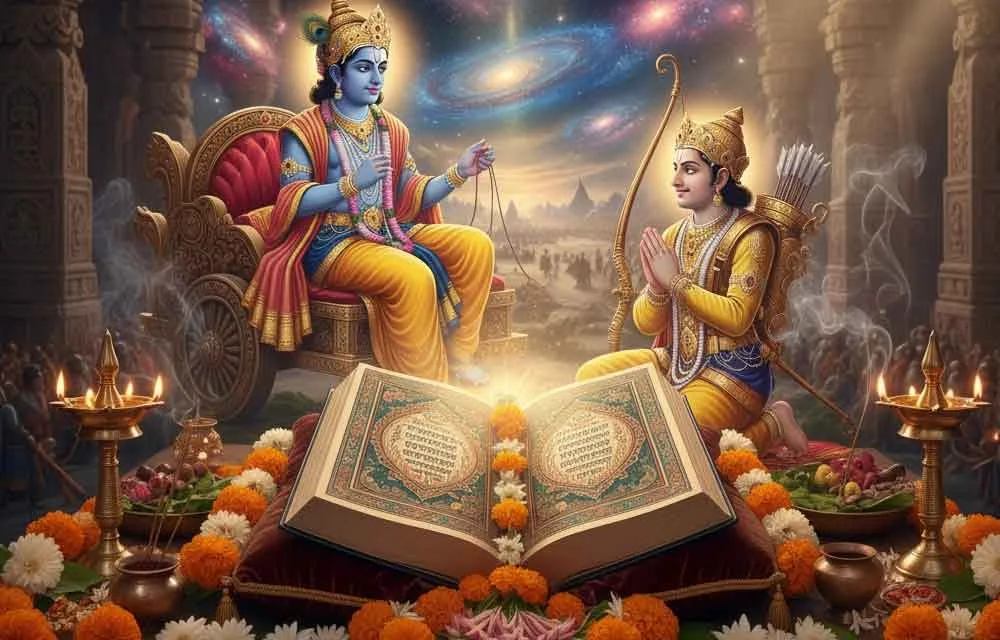
"Sarva-dharman parityajya, mam ekam saranam vraja. Aham tvam sarva-papebhyo moksayisyami; ma shucah."
"Abandoning all dharmas, take refuge in Me alone. I shall liberate you from all sins. Do not grieve."
— Bhagavad Gita 18.66 — the Charama Sloka
Bhagavad Gita Chapter 18 — Moksha Sannyasa Yoga (the Yoga of Liberation through Renunciation) — is the longest, final, and synthesis chapter of the entire Bhagavad Gita. Updated for 2026. Across 78 verses — more than any other chapter — Krishna gathers every thread woven across the previous 17 chapters and binds them into a single integrated teaching. The chapter culminates in verse 18.66 — the Charama Sloka — Hindu civilization's most cited verse on absolute surrender, the verse Sri Ramanujacharya climbed atop the Tirumala temple gate to proclaim publicly despite his teacher's prohibition (because, he said, "if the masses can be saved by hearing this verse, my soul's damnation is a small price"). For NRI Hindus across USA, UK, Canada, Australia, GCC, and beyond — for those navigating career pivots, ethical dilemmas, immigration uncertainty, AI disruption, and the question "What should I do with my life?" — Chapter 18 is the complete Hindu answer. This guide covers all 78 verses (grouped into 11 thematic sections), the Charama Sloka unpacked with the three Vaishnava commentarial traditions, tyaga (renunciation of action) vs sannyasa (renunciation of life), the three gunas systematically applied to knowledge/action/intellect/happiness, Sri Krishna's final command, Arjuna's resolution, and a 30-day NRI practice plan.
Why Chapter 18 is the synthesis of the entire Gita
Of the 18 chapters of the Bhagavad Gita, Chapter 18 is unique on three counts:
- It is the longest — 78 verses, more than any other chapter (Chapter 2 has 72; most others are 25-50). Krishna takes his time because this is the closing argument.
- It is structured as a deliberate synthesis — Krishna explicitly returns to every major theme of the previous 17 chapters and gives his final word on each: karma yoga (action), jnana yoga (knowledge), bhakti yoga (devotion), the three gunas, sva-dharma, faith, the four varnas, the relationship of effort and grace, and the ultimate goal.
- It contains the Charama Sloka (verse 66) — the absolute surrender verse — which Hindu tradition treats as the climactic teaching of the entire Bhagavad Gita and the foundational verse of bhakti philosophy.
The Gita ends three times in Chapter 18. First at verse 63: "This wisdom secret of all secrets has been declared to you by Me. Reflect on it fully, then act as you wish." Krishna respects Arjuna's freedom — first the teaching, then human deliberation. But then Krishna adds verse 64: "Listen again to My supreme word, the most secret of all..." — because the highest truth still remains. And then comes verse 66, the Charama Sloka. Even then, Sanjaya (the narrator) closes with the final verse 78: "Where there is Krishna, the Lord of yoga, and where there is Arjuna, the wielder of the bow — there will be opulence, victory, prosperity, and firm morality." The Gita has a triple ending: the philosophical conclusion (verse 63), the supreme surrender (verse 66), and the cosmic guarantee (verse 78).
For NRI Hindus, this matters: if you read only one Gita chapter end-to-end this year, Chapter 18 contains the entire Gita in compressed form. Every other chapter expands one theme; Chapter 18 reassembles them all.
<a id="context"></a>
The context: Arjuna's final question
The chapter opens with Arjuna's final question — verse 1:
Arjuna uvaca:
Sannyasasya mahabaho, tattvam ichchhami veditum;
Tyagasya cha hrishikesha, prithak keshinishudana.
"O mighty-armed Hrishikesha, slayer of Keshi, I wish to know the truth about sannyasa (renunciation of all action) and tyaga (renunciation of the fruits of action). What is the precise distinction between the two?"
This is not an idle terminological question. By Chapter 18, Arjuna has heard 17 chapters of teaching that has alternated between two seemingly contradictory positions: (a) Krishna has praised action (Chapter 3 — karma yoga, Chapter 4 — wisdom in action, Chapter 6 — yoga discipline), and (b) Krishna has praised renunciation (Chapter 5 — renunciation, Chapter 12 — devotion through detachment, Chapter 14 — transcending the gunas).
Arjuna's question is the practical one: "Should I fight this war (act), or should I walk away (renounce)? What does Krishna actually want me to do?" This is the question on which the entire Bhagavad Gita pivots. Krishna's answer takes 64 more verses.
For NRI Hindus this is the eternal question: Should I take the promotion or stay at the senior IC level? Should I quit the corporate job and follow a calling? Should I tolerate the workplace politics or step away? Should I confront the family member or remain silent? What should I do? Chapter 18 is Krishna's complete framework for answering.
<a id="structure"></a>
The chapter's structure: 11 thematic sections in 78 verses
Krishna's 78-verse response unfolds in eleven precise thematic sections:
- 1. Arjuna's question · 1 · Tyaga vs sannyasa — what is the distinction?
- 2. Krishna's definitions · 2-12 · Precise definitions of tyaga and sannyasa
- 3. The five factors of action · 13-18 · Sankhya analysis of every action
- 4. Three kinds of knowledge · 19-22 · Sattvic, rajasic, tamasic jnana
- 5. Three kinds of action · 23-25 · Sattvic, rajasic, tamasic karma
- 6. Three kinds of doer · 26-28 · Sattvic, rajasic, tamasic karta
- 7. Three kinds of intellect/firmness · 29-35 · Buddhi, dhriti — three gunas
- 8. Three kinds of happiness · 36-39 · Sattvic, rajasic, tamasic sukha
- 9. Sva-dharma and the four varnas · 40-48 · Each person's intrinsic duty
- 10. The path to liberation · 49-55 · Through knowledge, action, devotion
- 11. The supreme teaching: surrender · 56-66 · Culminating in the Charama Sloka
- 12. The Gita's final summary · 67-78 · Closing instructions and Sanjaya's words
This structure is deliberately encyclopedic. Krishna systematically applies the three-guna framework (from Chapter 14) to every dimension of human action — knowledge, action itself, the doer, the intellect, happiness — to give Arjuna and you a complete diagnostic for evaluating any choice.
<a id="all-verses"></a>
The complete verse-by-verse summary (all 78 verses)
Section 1-2: Tyaga vs Sannyasa (verses 1-12)
Verses 1-2: Arjuna asks Krishna to distinguish sannyasa (renunciation of all action) from tyaga (renunciation of fruits of action). Krishna defines: sannyasa = renunciation of all desire-motivated actions; tyaga = renunciation of fruits of action while continuing to act.
Verses 3-6: Some say all action should be abandoned; others say sacrifice (yajna), gift (dana), and austerity (tapas) should never be abandoned. Krishna's verdict: yajna, dana, tapas must be performed — they purify even the wise. But they should be performed without attachment to fruits. This is true tyaga.
Verses 7-9: Three kinds of tyaga: (a) abandoning prescribed duty out of confusion (tamasic), (b) abandoning duty because it is troublesome (rajasic), (c) performing duty as required without attachment (sattvic). Only the third is genuine tyaga.
Verses 10-12: The wise renouncer does not avoid disagreeable work nor cling to pleasant work. For one who has renounced fruits, no karmic residue accumulates — but for those who have not renounced, three kinds of fruits accrue: pleasant, unpleasant, mixed.
Section 3: The five factors of action (verses 13-18)
Verses 13-15: According to Sankhya doctrine, every action involves five factors: (a) the body (adhishthana), (b) the doer (karta), (c) the various sense organs (karanam), (d) the diverse efforts (cheshta), and (e) divine providence (daivam — the fifth, often translated as "fate" or "the divine").
Verses 16-17: Whoever, due to immature understanding, considers himself alone the sole doer of action — does not truly see. One whose ego is free from "I am the doer" and whose intellect is not attached — even if he kills, does not kill and is not bound.
Verse 18: Three things prompt action: knowledge, the object of knowledge, the knower. Three things constitute action: the senses, the work, the doer. Krishna now expands these.
Section 4-8: Three gunas applied to everything (verses 19-39)
Three kinds of knowledge (verses 19-22):
- Sattvic jnana: Sees the one undivided being present in all beings; sees unity in diversity
- Rajasic jnana: Sees different beings as distinct, separate; multiplicity without unity
- Tamasic jnana: Clings to one particular thing as if it were the whole; small-minded, attached to insignificance
Three kinds of action (verses 23-25):
- Sattvic karma: Done as duty, without attachment, without love or hate, without desire for fruits
- Rajasic karma: Done with great effort, motivated by desire and the ego
- Tamasic karma: Done without considering consequences, harm to others, one's own capacity, or proper means
Three kinds of doer (verses 26-28):
- Sattvic karta: Free from attachment and ego, full of resolution and enthusiasm, unaffected by success or failure
- Rajasic karta: Attached, greedy for fruits, impulsive, impure, swayed by joy and sorrow
- Tamasic karta: Disorganized, vulgar, stubborn, deceitful, malicious, lazy, gloomy, procrastinating
Three kinds of intellect (verses 29-32):
- Sattvic buddhi: Knows when to act and when to renounce, knows what should and should not be done, what causes fear, what brings safety, what binds and what liberates
- Rajasic buddhi: Imperfectly distinguishes dharma and adharma, action and non-action
- Tamasic buddhi: Sees adharma as dharma, sees everything in reverse, dwells in darkness
Three kinds of firmness (verses 33-35):
- Sattvic dhriti: Steadiness in controlling mind, breath, senses through unwavering yoga
- Rajasic dhriti: Steadiness in pursuing wealth, desire, dharma — but with attachment to fruits
- Tamasic dhriti: Stubborn dullness — clings to sleep, fear, sorrow, despondency, intoxication
Three kinds of happiness (verses 36-39):
- Sattvic sukha: Like poison at the start, like nectar at the end — born of the clarity of self-knowledge. Practice, discipline, slow growth.
- Rajasic sukha: Like nectar at the start, like poison at the end — born of contact between senses and their objects
- Tamasic sukha: Delusion from start to finish — sleep, laziness, heedlessness
Verse 40: No being on earth, in heaven, or among the devas is free from these three gunas of prakriti. The framework is universal.
Section 9: Sva-dharma and the four varnas (verses 41-48)
Verses 41-44: The four varnas (Brahmin, Kshatriya, Vaishya, Shudra) and their intrinsic qualities and duties — derived from the three gunas operating in nature.
Verse 45: Devoted to one's own duty (*sva-karma-niratah*), one attains perfection. How can the sva-karma-niratah attain perfection? Krishna answers in 46.
Verse 46: "By worship of Him from whom all beings have come, by whom all this is pervaded — performing one's own duty as worship — a person attains perfection." This single verse is the key — sva-dharma performed as worship is the path to liberation.
Verses 47-48: Better one's own dharma (sva-dharma) imperfectly performed than another's dharma well-performed. Performing the duty assigned by nature, no sin accrues. Verse 48: No action is without defect — fire is followed by smoke; one should not abandon one's natural-born duty even if it is defective.
Section 10: The path to liberation (verses 49-55)
Verses 49-50: The one whose intellect is everywhere unattached, who has conquered the self, from whom desire has fled — attains perfection. Listen to how such a one attains Brahman.
Verses 51-54: Endowed with pure intellect, controlling self with firmness, abandoning sound and other objects, leaving aside aversion and attraction — secluded, eating lightly, controlling speech-body-mind, ever absorbed in dhyana yoga, free from egoism, force, pride, lust, anger, possessiveness — calm, becomes fit for union with Brahman.
Verse 55: Becoming Brahman, serene-souled, neither grieves nor desires. Equal toward all beings, he attains supreme devotion (para bhakti) to Me. Through devotion alone, he knows Me truly — what I am, who I am. Then, having known Me in truth, he immediately enters into Me.
Section 11: The supreme teaching — surrender (verses 56-66)
Verses 56-58: Surrendering all actions to Me by My grace, he attains the eternal indestructible state. Mentally renouncing all actions to Me, regarding Me as the supreme, taking refuge in Me — fix your mind on Me always.
Verse 59-60: If, from egoism, you think "I shall not fight" — this resolution will be vain. Your nature will compel you. What you in delusion wish not to do, you shall do helplessly, bound by your karma.
Verse 61: The Lord (Ishvara) dwells in the heart of all beings, O Arjuna, causing them to revolve as if mounted on a machine by His maya.
Verse 62: "Take refuge in Him with your whole being, O Bharata. By His grace you will attain supreme peace, the eternal abode."
Verse 63: "Thus the wisdom secret of all secrets has been declared to you by Me. Reflect on it fully, then do as you wish (*yathechchhasi tatha kuru*)." First philosophical ending — Krishna respects human freedom.
Verses 64-65: "Listen again to my supreme word, the most secret of all. Because you are dear to Me, I shall speak what is for your good. Fix your mind on Me, be devoted to Me, sacrifice to Me, prostrate before Me — you shall come to Me. I promise truly, for you are dear to Me."
Verse 66 — THE CHARAMA SLOKA:
Sarva-dharman parityajya, mam ekam saranam vraja;
Aham tvam sarva-papebhyo moksayisyami; ma shucah.
"Abandoning all dharmas, take refuge in Me alone. I shall liberate you from all sins. Do not grieve."
This is the climactic teaching of the entire Bhagavad Gita. All 700 verses culminate here. More on this verse below.
Section 12: The Gita's final summary (verses 67-78)
Verses 67-69: This teaching is not to be given to one without austerity, to one without devotion, to one who refuses to listen, to one who reviles Me. One who teaches this supreme secret to My devotees, with great devotion to Me — without doubt, will come to Me. No mortal does Me more dear service than he.
Verses 70-71: One who studies this dialogue of dharma — by him, I shall be worshipped through the sacrifice of knowledge. Even one who hears, full of faith and free from malice, becomes liberated.
Verse 72: "O Arjuna — has this been heard by you with single-pointed mind? Has your delusion born of ignorance been destroyed?"
Verses 73-75: Arjuna replies: "Nashto mohah smritir labdha, tvat-prasadan mayachyuta. Sthito smi, gata-sandehah, karishye vachanam tava." "My delusion is destroyed; memory has been regained by Your grace, O Achyuta. I stand firm with my doubts gone. I shall act according to Your word."
This is the moment the Bhagavad Gita resolves. Arjuna, who had collapsed at the start of Chapter 1 unable to act, now stands firm and resolves to fight. Sanjaya (the narrator) marvels at the dialogue he has witnessed.
Verses 76-78: Sanjaya's closing: "Wherever there is Krishna, the Lord of yoga, and wherever there is Arjuna, the wielder of the bow — there will surely be opulence, victory, prosperity, and firm morality. This is my conviction (matir mama)."
The Bhagavad Gita ends with Sanjaya's promise: where Krishna (the divine) and Arjuna (the human being who surrenders) come together — there is everything.
<a id="charama-sloka"></a>
The Charama Sloka (18.66) — the most-cited verse in Hindu civilization
The Charama Sloka (literally "the final verse" — final in the sense of ultimate, climactic) is the foundation of bhakti philosophy across all Vaishnava traditions:
Sarva-dharman parityajya, mam ekam saranam vraja;
Aham tvam sarva-papebhyo moksayisyami; ma shucah.
Word by word:
- Sarva-dharman — all dharmas, every form of duty, every prescribed practice
- Parityajya — completely abandoning, fully renouncing
- Mam — to Me
- Ekam — alone, exclusively
- Saranam — refuge, shelter, surrender
- Vraja — go, take
- Aham — I
- Tvam — you
- Sarva-papebhyah — from all sins, from all karmic residue
- Moksayisyami — I shall liberate
- Ma shucah — do not grieve, do not worry
The verse contains four movements:
- The command: Abandon all dharmas (every other refuge, every external standard)
- The instruction: Take refuge in Me alone (exclusive surrender to the Supreme)
- The promise: I shall liberate you from all sins (the divine guarantee)
- The comfort: Do not grieve (the personal assurance)
The story of Sri Ramanujacharya:
The 11th-century acharya Sri Ramanujacharya received initiation into this verse from his teacher Periya Nambi, who taught: "This verse is not for the masses — its esoteric meaning is for initiated devotees only. If you disclose it publicly, you will go to hell." Sri Ramanuja immediately climbed the gopuram (tower gate) of the Tirumala temple and shouted the verse to the gathered crowd. When his teacher confronted him, Ramanuja replied: "If by my disclosure of this verse, thousands can be saved — what is one soul's fall to hell against thousands attaining liberation?" The teacher embraced him: "You are a true acharya. Disclose freely."
This is why the Charama Sloka is universally taught today. Sri Ramanujacharya's bhakti for souls outweighed his bhakti for personal liberation. The act itself is the highest sva-dharma performed as worship (verse 46).
Sri Ramanujacharya's interpretation (Vishishtadvaita):
Abandoning all dharmas means: do not depend on your own karma yoga, jnana yoga, or even bhakti yoga as instruments. Take refuge in Krishna alone as the sole refuge. The Lord himself liberates — not your effort. This is the doctrine of prapatti (absolute self-surrender).
Sri Madhvacharya's interpretation (Dvaita):
Take refuge in the eternally supreme Vishnu. The dharmas to be abandoned are not the prescribed Vedic duties but the false dharmas — competing claims of liberation paths. Vishnu alone is the supreme refuge.
Adi Shankaracharya's interpretation (Advaita):
The verse points to the highest spiritual realization — abandoning all dualistic categories (including dharma/adharma) and recognizing the non-dual Self. Surrender is metaphysical recognition: there is no other.
A.C. Bhaktivedanta Swami Prabhupada (Gaudiya Vaishnava):
The verse is the conclusion of all Vedic literature. Surrender to Krishna is the highest dharma — sarva-dharma-parityaga (abandoning all dharmas) and Krishna-saranagati (surrender to Krishna) are not contradictions but progressive stages.
Mahatma Gandhi:
Read Chapter 18 every day of his life. Quoted verse 66 as the consummate Hindu teaching. Said: "This verse alone is sufficient for one whose heart is open."
<a id="tyaga-vs-sannyasa"></a>
Tyaga vs Sannyasa: Krishna's precise definitions
The chapter opens with this very question. Krishna's answer (verses 2-9) gives the precise definition:
Sannyasa (renunciation of all action): The deliberate giving up of all desire-motivated actions. Walking away from the kshatriya life into the forest. Renouncing the role of householder. Abandoning prescribed duty entirely.
Tyaga (renunciation of the fruits of action): Continuing to perform prescribed duty — but giving up attachment to its fruits. Acting fully without expectation of reward. Karma yoga in pure form.
Krishna's verdict (verses 7-9): Genuine renunciation is tyaga, not sannyasa. Prescribed duties (yajna, dana, tapas) must continue — they purify even the wise. But they must be performed without attachment to fruits.
The three kinds of tyaga (verses 7-9):
- Tamasic tyaga: Abandoning duty out of confusion or weakness
- Rajasic tyaga: Abandoning duty because it is troublesome or physically demanding
- Sattvic tyaga: Performing duty as required, without attachment, without ego, without desire for fruits — this alone is genuine renunciation
For NRI Hindus: The question "Should I quit my job?" is almost always answered by Chapter 18 as follows: No, do not quit (sannyasa). Instead, continue working but renounce attachment to results (tyaga). This is karma yoga as the practical Hindu path. The exception is sva-dharma incompatibility — when the work is fundamentally against your nature; then change. But mere troublesomeness is rajasic tyaga and produces no spiritual fruit.
<a id="three-gunas"></a>
The three gunas systematically applied (verses 19-39)
Chapter 18's greatest practical contribution is the systematic application of the three-guna framework (sattva, rajas, tamas — established in Chapter 14) to every dimension of action. This is your diagnostic toolkit for evaluating any choice in your life:
For any decision, ask:
- What is the knowledge underlying it? (Sattvic: sees unity. Rajasic: sees diversity. Tamasic: clings to insignificance.)
- What is the action itself? (Sattvic: duty without attachment. Rajasic: ego-driven. Tamasic: heedless of consequence.)
- Who is the doer? (Sattvic: ego-free, resolute. Rajasic: greedy, impulsive. Tamasic: disorganized, lazy.)
- What is the intellect saying? (Sattvic: knows what binds and liberates. Rajasic: confused. Tamasic: reversed — sees adharma as dharma.)
- What is the firmness of resolve? (Sattvic: steady on yoga. Rajasic: attached to fruits. Tamasic: clinging to sleep/fear/inertia.)
- What is the happiness sought? (Sattvic: poison at start, nectar at end. Rajasic: nectar at start, poison at end. Tamasic: delusion throughout.)
For NRI Hindus this is incredibly practical:
- Choosing a job? Run it through the six diagnostics.
- Choosing a school for kids? Run it through the six diagnostics.
- Choosing whether to confront a relative? Run it through the six diagnostics.
- Choosing whether to move countries? Run it through the six diagnostics.
The framework is precise enough to actually use, yet universal enough to apply to any situation. No other religious system offers such a complete diagnostic.
<a id="sva-dharma"></a>
Sva-dharma and the four varnas (verses 41-48)
Krishna's treatment of varna in Chapter 18 is among the most-debated passages in the Bhagavad Gita. Here is the precise teaching:
Verse 41: The duties of Brahmin, Kshatriya, Vaishya, and Shudra are distinguished according to the qualities (gunas) born of their nature (svabhava).
Verses 42-44: The intrinsic qualities and duties of each:
- Brahmin: Tranquility, restraint, austerity, purity, forbearance, uprightness, knowledge, realization, faith
- Kshatriya: Heroism, vigor, firmness, dexterity, not retreating from battle, generosity, lordliness
- Vaishya: Agriculture, cattle-tending, trade
- Shudra: Service (in earlier readings); contemporary interpretation: skilled labor of all kinds
Verse 45: Devoted to one's own duty (sva-karma-niratah), each person attains perfection. All four are paths to perfection. None is superior. None is inferior.
Verse 46 (the master verse): By performing sva-karma as worship of the Supreme — perfection is attained. This is the single most important verse in the chapter on dharma. Work itself, when offered as worship, becomes the liberating path.
Verses 47-48: Better one's own sva-dharma imperfectly performed than another's sva-dharma perfectly performed. No action is without defect — even fire produces smoke. Do not abandon your natural-born duty even if defective.
Important interpretive note on varna:
Sri Ramanujacharya, Sri Madhvacharya, and Sri Aurobindo all read varna as referring to one's intrinsic qualities and inclinations (guna-and-karma based), not birth-based. Krishna himself in Chapter 4.13 says: "The four varnas were created by Me on the basis of qualities and actions." The hereditary caste system that emerged in later Indian society is historically distinct from the Gita's teaching.
For NRI Hindus today:
Sva-dharma in 2026 is not about caste — it is about discovering and performing your authentic intrinsic calling. The senior engineer who is naturally a teacher should teach. The intuitive natural leader trapped in an IC role suffers. The natural caregiver suffocates in finance. Sva-dharma is your soul's natural work. Find it. Perform it as worship. This is the entire teaching of Chapter 18 verses 41-48 reread for modern life.
<a id="ramanujacharya-charama"></a>
Sri Ramanujacharya and the Charama Sloka
Sri Ramanujacharya (1017-1137 CE) — the founder of Vishishtadvaita Vedanta and the great acharya of Srirangam — placed the Charama Sloka at the center of his entire theological system. His tradition treats verse 18.66 as Hindu civilization's most complete teaching on:
1. Prapatti (absolute self-surrender): The doctrine that direct surrender to Narayana is the simplest and most accessible path to liberation, available to all regardless of caste, gender, age, or intellectual capacity. Where karma yoga, jnana yoga, and bhakti yoga require sustained discipline, prapatti requires only sincere surrender.
2. The relationship of effort and grace: The verse establishes that liberation is ultimately God's gift (Aham tvam sarva-papebhyo moksayisyami — "I shall liberate you"), not the soul's achievement. The soul's role is to recognize this and surrender.
3. The doctrine of sole refuge: Mam ekam saranam vraja — "Me alone as refuge." Not Krishna plus other gods. Not Krishna plus karma yoga. Not Krishna plus my own merit. Krishna alone, exclusively.
The Sri Vaishnava initiation tradition:
For 900+ years, when a Sri Vaishnava is initiated by a guru, the central act is the transmission of the Charama Sloka. The initiate is instructed to recite the verse three times — once at initiation, once at the beginning of each day's spiritual practice, and once at death.
The verse is also recited:
- Before any major spiritual undertaking
- During crisis or grief
- At the moment of facing decision
- At the time of death (with the help of family if needed)
For NRI Hindus, this is the most concentrated bhakti tradition available. Memorize this one verse. Recite it three times daily. Within a year, it becomes the deepest layer of your psyche.
<a id="shankaracharya"></a>
Adi Shankaracharya commentary on Chapter 18
Adi Shankaracharya (788-820 CE) in his Gita Bhashya treats Chapter 18 as the synthesis of jnana yoga (knowledge yoga) — the highest path. His specific contributions:
On verse 49 (the path to liberation): Shankara reads this as the final exposition of the jnana yoga path. The buddhi (intellect) becomes everywhere unattached, the self is conquered, desire flees — the soul reaches Brahman.
On verses 50-55: Shankara reads this as the practical disciplines (saadhana) of jnana yoga — pure intellect, controlled self, abandoning sound/touch/objects, controlling speech-body-mind, dhyana yoga, freedom from egoism/force/pride/lust/anger.
On verse 66 (the Charama Sloka): Shankara's reading is the most distinctive. He treats sarva-dharman parityajya not as abandoning all dharmas but as transcending the duality of dharma and adharma at the highest stage of realization. Mam ekam saranam vraja — refuge in the non-dual Self that one finally recognizes as one's own essence. This is jnana yoga's highest point — not surrender to an external Lord, but recognition of one's own divine nature.
The two readings — Vishishtadvaita and Advaita — are not contradictory. Sri Ramanujacharya's reading is dualistic: the soul surrenders to a distinct Lord. Shankara's reading is non-dual: the soul recognizes its own ultimate identity with Brahman. Both are textually grounded. Hindu tradition has lived with both for 1,300 years.
Sri Madhvacharya (Dvaita): Reads verse 66 as eternal surrender to the eternally distinct Vishnu. The soul is forever ontologically distinct from Vishnu but eternally dependent. Surrender is the recognition of ontological dependence.
<a id="modern"></a>
Modern interpretations — Chinmayananda, Easwaran, Prabhupada, Aurobindo, Gandhi
Swami Chinmayananda (The Holy Geeta):
Chinmayananda treats Chapter 18 as the consummate "practical manual" of Hindu spiritual life. His exposition of the three gunas applied to action/knowledge/doer/intellect/happiness is among the most accessible. He calls Chapter 18 "the diagnostic clinic of the Gita."
Eknath Easwaran (The Bhagavad Gita):
Easwaran's translation foregrounds the universality of Chapter 18's teaching on work as worship (verse 46). He frames the chapter as Hindu civilization's most complete answer to the modern question "What should I do with my life?"
A.C. Bhaktivedanta Swami Prabhupada (Bhagavad Gita As It Is):
Prabhupada takes the strong Gaudiya Vaishnava position: the Charama Sloka is the conclusion of all Vedic literature. Sarva-dharma-parityaga + Krishna-saranagati is the highest and most accessible path. Chapter 18 is the verse-by-verse confirmation of Krishna as the Supreme Personality of Godhead.
Sri Aurobindo (Essays on the Gita):
Aurobindo reads Chapter 18 as the consummation of the integral yoga he developed throughout his Essays. The chapter synthesizes karma yoga, jnana yoga, and bhakti yoga into a single integral discipline. Verse 66 is "the Gita's word of the final secret" — total self-giving to the Divine.
Mahatma Gandhi (Anasakti Yoga):
Gandhi recited Chapter 18 verses 56-66 every day of his adult life. He treated verse 66 as the "single verse for those whose hearts are open." His political life — non-violent resistance offered without attachment to outcome — was his lived application of Chapter 18.
Swami Vivekananda:
Vivekananda treated Chapter 18 as the proof that work itself, performed as worship, is the highest spiritual path. Karma yoga — service of humanity as service of God — is rooted in verse 46.
<a id="practice-plan"></a>
The 30-day NRI practice plan
For NRI Hindus across USA, UK, Canada, Australia, GCC, and beyond — here is a complete 30-day practice plan to integrate Chapter 18 into daily life:
Week 1 — Reading foundation (Days 1-7):
- Print or open Chapter 18 (78 verses)
- Each morning: read 10 verses in English at devotional pace (8-10 minutes)
- By Day 7, complete one full reading of the chapter
- Don't worry about Sanskrit memorization yet
- Listen to a quality audio (Anuradha Paudwal, M.S. Subbulakshmi, Vidyabhushana) for 10 minutes daily
Week 2 — Charama Sloka memorization (Days 8-14):
- Memorize verse 18.66 in Sanskrit — the Charama Sloka
- Recite it three times morning, three times evening
- Teach the verse to your spouse and children — one line per day
- Begin recognizing how the verse changes how you face decisions
Week 3 — Three-guna diagnostic (Days 15-21):
- Each evening, reflect on the day's three major decisions
- Apply the six diagnostics (verses 19-39): knowledge, action, doer, intellect, firmness, happiness
- Are you operating sattvically, rajasically, or tamasically?
- Brief journal entries — patterns will emerge
Week 4 — Sva-dharma exploration (Days 22-28):
- Memorize verse 46 (sva-dharma as worship) in Sanskrit
- Reflect: What is my sva-dharma? What is my soul's authentic work?
- Are you performing your work as worship — or merely as obligation?
- What single change would bring you closer to sva-dharma performed as worship?
Days 29-30: The synthesis days:
- Day 29: Re-read the entire Chapter 18
- Day 30: Recite verse 66 (Charama Sloka), then verse 46 (work as worship), then verses 73 (Arjuna's resolution) — these three verses are your daily anchor going forward
- Beyond 30 days: Continue verse 66 three times daily for life
By Day 30:
- You can recite verse 18.66 from memory in Sanskrit
- You can recite verse 18.46 from memory in Sanskrit
- You have the three-guna diagnostic as a daily tool
- You have begun the deep question of sva-dharma in your own life
- Chapter 18 has become your synthesis chapter
<a id="applications"></a>
Specific applications by NRI life situation
Career pivot / mid-life crisis:
The question "What should I do with my life?" is the Chapter 18 question. The diagnostic: apply the six gunas (knowledge, action, doer, intellect, firmness, happiness). Then read verse 46 — sva-dharma performed as worship. The pivot is justified if your current work is not your sva-dharma. The pivot is unjustified if your current work IS your sva-dharma and you are merely tired or seeking novelty.
Should I quit my job?:
Krishna's framework: most "quit my job" impulses are rajasic tyaga (abandoning because troublesome) — and produce no spiritual fruit. The exception is sva-dharma incompatibility — the work is fundamentally against your nature. Diagnostic: would your soul's deepest qualities still develop if you stayed? If yes, continue with tyaga (renunciation of fruits). If no, change.
H1-B/visa uncertainty / immigration anxiety:
Verse 66 — the Charama Sloka — is the supreme refuge in immigration anxiety. The verse moves your locus of safety from USCIS to Krishna. The immigration system has its dharma; you have yours. Take refuge in the Supreme alone. Recite the Charama Sloka three times each morning of an immigration decision week.
Layoff fears / AI uncertainty:
The skill you have is sva-dharma (verse 46) only when performed as worship. The skill itself is not your refuge — Krishna alone is your refuge (verse 66). When AI disruption removes specific skills, sva-dharma adapts — the deeper calling remains. Practice: recite verse 66 daily; the layoff fear loses 80% of its grip within a month.
Workplace ethical dilemmas:
The three-guna diagnostic on action (verses 23-25) is the precise tool. Is this action sattvic (duty without attachment, no harm), rajasic (ego-driven, fruit-seeking), or tamasic (heedless of harm)? Run any ethical dilemma through this filter for clarity.
Parenting decisions:
Chapter 18 teaches that your child has sva-dharma (verse 41). Your job is to recognize and support it — not impose your own dharma on them. The doctor parent may have an artist child. The engineer parent may have a humanities-bound child. Respect sva-dharma. This is the most liberating Hindu parenting framework.
Conflict with elderly parents / cultural pressure:
The framework is verse 47 — sva-dharma imperfectly performed is better than another's perfectly performed. Your parents' dharma is not your dharma. Honor them; do not adopt their dharma as yours. Most NRI family conflict comes from confusion between honor and adoption.
Grief / loss:
Verse 66 — ma shucah — "do not grieve" — is Krishna's direct address to the grieving heart. Read with verse 11.36 ("the world rejoices in your praise"). Hindu grief practice includes verse 18.66 chanted by family during the 13 days of mourning.
Approaching death (self or family member):
The Sri Vaishnava and Gaudiya Vaishnava traditions teach that verse 18.66 chanted at the moment of death liberates the soul. If you are with a dying loved one, chant the Charama Sloka into their ear. This is one of the most sacred services possible.
<a id="country-guide"></a>
Country-by-country implementation
USA (USA Hindu population: ~3.2M):
- BAPS Robbinsville (Akshardham NJ) — annual Gita Mahotsav featuring Chapter 18
- Sri Venkateswara Pittsburgh — Sri Vaishnava lineage; Charama Sloka recited at temple
- Houston BAPS — Chapter 18 covered in monthly Sunday classes
- ISKCON 50+ US temples — Chapter 18 is the foundation of all teaching
- Hindu Heritage Foundation — Chapter 18 in advanced youth camps
UK (UK Hindu population: ~1.0M):
- BAPS Neasden — comprehensive Gita study; Chapter 18 covered annually
- Bharatiya Vidya Bhavan London — Sanskrit Chapter 18 study
- Leicester — Sri Vaishnava community; Charama Sloka deeply embedded
- British Hindu families — Chapter 18 study circles in homes
Canada (Canadian Hindu population: ~830K):
- Hindu Sabha Brampton — annual Gita study covers all 18 chapters
- BAPS Toronto — Chapter 18 in advanced curriculum
- Chinmaya Mission Toronto — The Holy Geeta course covers Chapter 18
- Indo-Canadian Vaishnava families — Charama Sloka in daily practice
Australia (Australian Hindu population: ~440K):
- Sri Venkateswara Helensburgh — Charama Sloka recited daily
- Carrum Downs Melbourne — comprehensive Gita study
- Sydney ISKCON — Chapter 18 monthly study
- Australian NRI families — well-suited for weekend Gita study
UAE / GCC (GCC Hindu expat population: ~3.5M):
- BAPS Abu Dhabi — Sunday programs include Chapter 18
- Bur Dubai Krishna Mandir — Charama Sloka at temple kirtan
- Bahrain Krishna Mandir — Friday Gita study covers Chapter 18
- Friday Gita study circles widespread across GCC professionals
Germany / Europe (European Hindu population: ~1.5M):
- Frankfurt Sri Ganesh Hindu Tempel — monthly Gita study
- BAPS Berlin — Chapter 18 in Sunday programs
- Munich NRI community — home-based Gita study circles
- European NRI Bhagavad Gita Studies — academic Sanskrit programs
South Africa (South African Hindu population: ~570K):
- Durban / Phoenix — 5th-generation Hindu families with deep Gita tradition
- Joburg ISKCON — Chapter 18 in monthly study
- South African Hindu Maha Sabha — Charama Sloka in daily practice
- Strong Sri Vaishnava lineage preserves Chapter 18 emphasis
Singapore (Singapore Hindu population: ~280K):
- Sri Mariamman Temple — Charama Sloka at temple
- ISKCON Singapore — Chapter 18 monthly study
- Tamil Hindu families — preserve Sri Vaishnava tradition
- Singapore Sanskrit Sangam — academic Sanskrit Gita study
Malaysia (Malaysian Hindu population: ~1.9M):
- Sri Mahamariamman KL — Charama Sloka at temple kirtan
- ISKCON KL — Chapter 18 monthly study
- Penang Hindu community — preserves Gita study tradition
- Brickfields KL — Tamil Vaishnava families with deep Chapter 18 practice
India (Hindu home country):
- Tirumala, Srirangam, Kanchipuram — Sri Vaishnava centers where Chapter 18 is foundational
- Vrindavana, Mathura — Gaudiya Vaishnava centers; Chapter 18 is constant teaching
- Chinmaya Mission centers nationwide — The Holy Geeta course
- Sanskrit colleges — Chapter 18 is climactic in Vedanta curriculum
<a id="faqs"></a>
FAQs
How long does it take to recite Bhagavad Gita Chapter 18?
12-15 minutes for all 78 verses in Sanskrit at devotional pace. The Charama Sloka (verse 66) alone takes 15-20 seconds.
Why is Chapter 18 called Moksha Sannyasa Yoga?
Because the chapter teaches the path to liberation (moksha) through proper understanding of renunciation (sannyasa and tyaga). The chapter opens with Arjuna's question about renunciation and closes with the absolute surrender of verse 66 — the supreme renunciation.
What is the Charama Sloka?
Bhagavad Gita verse 18.66 — "Sarva-dharman parityajya, mam ekam saranam vraja; Aham tvam sarva-papebhyo moksayisyami; ma shucah." "Abandoning all dharmas, take refuge in Me alone. I shall liberate you from all sins. Do not grieve." It is the climactic verse of the entire Bhagavad Gita.
Should I memorize all 78 verses?
The practical goals are: verse 66 (Charama Sloka — essential), verse 46 (sva-dharma as worship — important), verses 73-75 (Arjuna's resolution — beautiful), and verse 78 (Sanjaya's closing — auspicious). Memorizing all 78 is a lifetime project.
What is the difference between tyaga and sannyasa?
Sannyasa = renouncing all action (walking away from worldly duty). Tyaga = renouncing the fruits of action while continuing to act. Krishna's verdict: tyaga is the genuine renunciation; sannyasa as walking-away is inferior. Continue acting, but without attachment to results.
What are the three gunas applied to in Chapter 18?
Krishna applies sattva/rajas/tamas systematically to: (1) tyaga itself, (2) knowledge, (3) action, (4) the doer, (5) the intellect, (6) firmness/resolve, and (7) happiness. This is the most complete three-guna diagnostic in all Hindu scripture.
What does verse 46 mean?
"By worship of Him from whom all beings have come, performing one's own duty as worship — a person attains perfection." This single verse teaches that work itself, performed as worship, is the liberating path. The most accessible spiritual teaching for working professionals.
What does sva-dharma mean today?
Sva-dharma = your soul's authentic intrinsic calling, not caste-based duty. It is the work your nature is built for. For NRI Hindus today, sva-dharma is about discovering your authentic vocation — not what your parents or society prescribed.
Why did Sri Ramanujacharya climb the temple tower to shout verse 66?
Because his teacher had forbidden him from disclosing the verse publicly (saying it was esoteric and reserved for initiated devotees only). Ramanuja's reasoning: if thousands can be saved by hearing this verse, his soul's damnation is a small price. His teacher embraced him after this act.
How is Chapter 18 different from Chapters 12 and 15?
Chapter 12 is bhakti practice. Chapter 15 is cosmological foundation. Chapter 18 is the synthesis of all 18 chapters — it gathers every theme and gives Krishna's final word. Chapter 18 is the conclusion.
Can children memorize Bhagavad Gita Chapter 18?
Yes — start with the Charama Sloka (verse 66). Within a week children can memorize it. By age 10, most children can recite it confidently. By age 18, the verse is part of their deepest psychological infrastructure.
Should I recite Chapter 18 daily or weekly?
Daily: verse 66 (Charama Sloka, 15 seconds) and verse 46 (sva-dharma as worship). Weekly: the entire chapter (12-15 minutes). Monthly: Chapter 18 + Chapter 12 + Chapter 15 together as a synthesis reading.
Can non-Hindus read Bhagavad Gita Chapter 18?
Absolutely. Verse 66's teaching on surrender is theologically resonant with Christianity, Sufism, and other devotional traditions. Verse 46's teaching on work as worship has universal application. The three-guna diagnostic is psychologically universal.
<a id="resources"></a>
Frequently Asked Questions
What is Bhagavad Gita Chapter 18?
"Sarva-dharman parityajya, mam ekam saranam vraja. Aham tvam sarva-papebhyo moksayisyami; ma shucah." "Abandoning all dharmas, take refuge in Me alone.
What are the key points about Bhagavad Gita Chapter 18?
I shall liberate you from all sins. Do not grieve." — Bhagavad Gita 18.66 — the Charama Sloka Bhagavad Gita Chapter 18 — Moksha Sannyasa Yoga (the Yoga of Liberation through Renunciation) — is the longest, final, and synthesis chapter of the entire Bhagavad Gita.
Why does Bhagavad Gita Chapter 18 matter in Hinduism?
It reflects core values of Sanatana Dharma and offers practical and spiritual guidance that remains relevant across generations.
How can devotees apply Bhagavad Gita Chapter 18 in daily life?
By reflecting on its teaching, incorporating the related practices or observances into daily routine, and approaching it with sincere devotion and understanding.
You might also like
Bhagavad Gita Chapter 15 — Purushottama Yoga Complete Commentary: All 20 Verses, Ashvattha Tree, Supreme Person Teaching, 30-Day NRI Practice Guide for 2026

Bhagavad Gita Chapter 2 — Sankhya Yoga Complete Commentary: All 72 Verses, Immortality of Soul, Sthitaprajna, 30-Day NRI Practice Guide for 2026

Bhagavad Gita Chapter 12 — Bhakti Yoga Complete Commentary: All 20 Verses, Devotee Qualities, 30-Day NRI Practice Guide for 2026