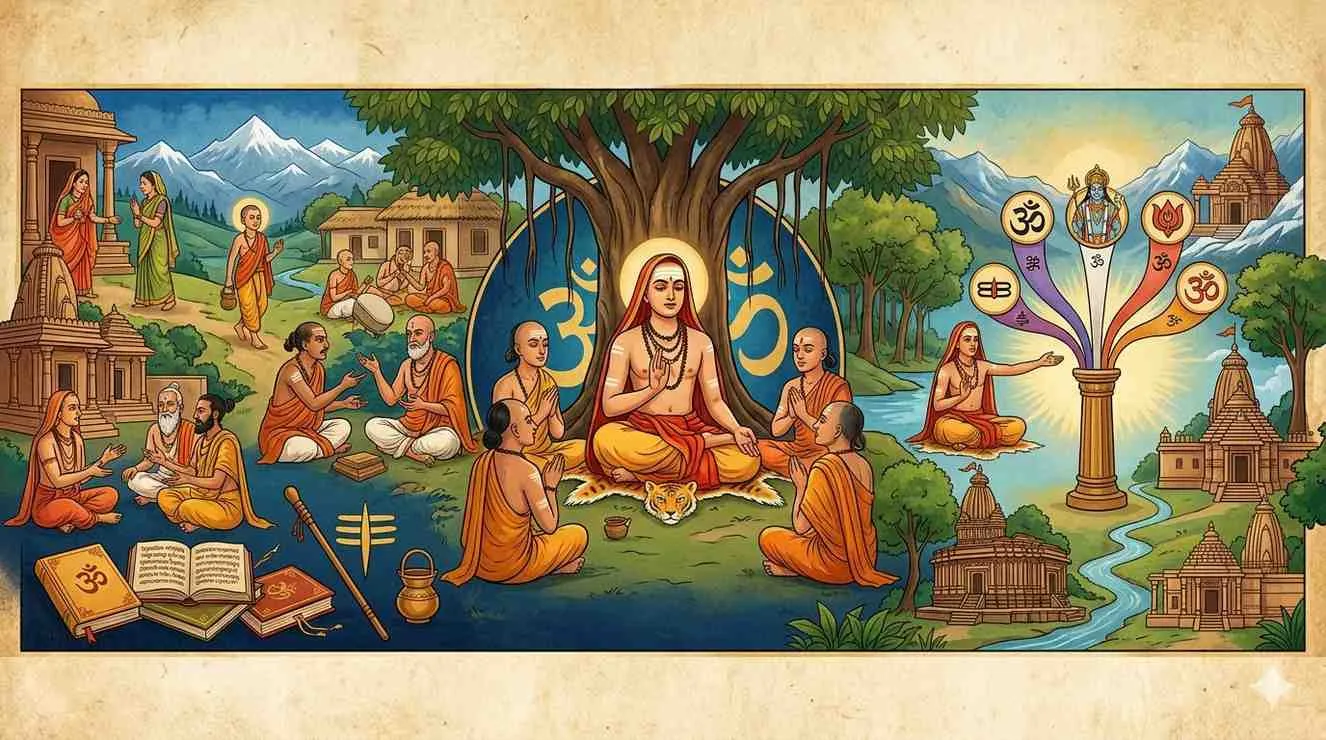
Bhagavad Gita Chapter 15 — Purushottama Yoga Complete Commentary: All 20 Verses, Ashvattha Tree, Supreme Person Teaching, 30-Day NRI Practice Guide for 2026
Bhagavad Gita Chapter 15 (Purushottama Yoga) complete commentary 2026 — all 20 verses with Sanskrit + meaning, the inverted Ashvattha cosmic tree, Krishna as Purushottama, jivatma–paramatma relationship, 30-day NRI plan.
Bhagavad Gita Chapter 15 (Purushottama Yoga) complete commentary 2026 — all 20 verses with Sanskrit + meaning, the inverted Ashvattha cosmic tree, Krishna as Purushottama, jivatma–paramatma relationship, 30-day NRI plan.
"Urdhva-mulam adhah-shakham, ashvattham prahur avyayam. Chandamsi yasya parnani, yas tam veda sa veda-vit."
"They speak of the indestructible Ashvattha tree with roots above and branches below; its leaves are the Vedic hymns; one who knows it is the knower of the Vedas."
— Bhagavad Gita 15.1
Bhagavad Gita Chapter 15 — Purushottama Yoga (the Yoga of the Supreme Person) — is the shortest yet most cosmologically dense chapter of the entire Bhagavad Gita. Updated for 2026. In just 20 verses, Krishna unveils three of the deepest teachings in all of Hindu scripture: (1) the inverted Ashvattha cosmic tree with roots in Brahman and branches in the manifest world, (2) the jivatma-paramatma relationship — how the individual self and the Supreme Self relate — and (3) Krishna's self-declaration as Purushottama — the Supreme Person who transcends both the perishable (kshara) and imperishable (akshara). For NRI Hindus across USA, UK, Canada, Australia, GCC, and beyond — for Sri Vaishnavas chanting this chapter before every meal as Bhagavad Gita's "essence chapter," for daily Gita-reciters, for parents teaching children Hindu cosmology, and for seekers wanting the metaphysical foundation underneath all bhakti — Chapter 15 is the cosmological cornerstone of the entire Gita. This complete guide includes the Sanskrit + transliteration + English meaning of all 20 verses, the Ashvattha tree symbolism unpacked, the kshara-akshara-Purushottama triad explained, Sri Ramanujacharya's and Adi Shankaracharya's commentaries, modern interpretations, and a 30-day NRI practice plan with country-specific guidance.
Why Chapter 15 is the cosmological cornerstone of the Gita
Of the 18 chapters of the Bhagavad Gita, Chapter 15 is among the densest in cosmological revelation. Krishna himself acknowledges this. In verse 20, he closes the chapter with:
"Iti guhyatamam shastram, idam uktam mayanagha. Etad buddhva buddhiman syat, krita-krityash ca bharata."
"Thus, O sinless one, this most secret of all scriptures has been declared by Me. Knowing this, one becomes wise, O Bharata, and his duty is fulfilled."
Three words demand attention: guhyatamam (most secret), shastram (scripture — Krishna calls the chapter itself a complete scripture), and krita-krityah (one whose duty is fulfilled — meaning the chapter's knowledge alone is sufficient for liberation). No other chapter receives this level of self-validation from Krishna. Chapter 15 is the only chapter Krishna explicitly calls a complete shastra.
For 2,500+ years, Hindu tradition has placed Chapter 15 at the metaphysical center:
- Sri Vaishnava lineage chants Chapter 15 verses 13-15 before every meal — making it the most-recited chapter in daily Hindu ritual life
- Adi Shankaracharya's Gita Bhashya treats Chapter 15 as the metaphysical proof for Advaita (non-dual) Vedanta
- Sri Ramanujacharya's Gita Bhashya treats Chapter 15 as the foundation for Vishishtadvaita (qualified non-dualism) — the jivatma-paramatma relationship
- Sri Madhvacharya's Gita Bhashya uses Chapter 15 to establish Dvaita (dualism) — the irreducibility of Purushottama
- All three major Vedanta schools root their cosmology in Chapter 15. No other chapter is foundational to all three.
For NRI Hindus, this matters: if you read only one chapter of the Bhagavad Gita to your children, Chapter 15 gives them the cosmological framework that the entire Hindu civilization is built on.
<a id="context"></a>
The context: between Chapter 14 (Gunas) and Chapter 16 (Daivi/Asuri)
Chapter 15 sits at a critical structural pivot in the Gita:
- Chapter 13 (Kshetra-Kshetrajna Yoga) — the field (body/world) and the knower of the field (consciousness)
- Chapter 14 (Gunatraya Vibhaga Yoga) — the three gunas (sattva, rajas, tamas) and how to transcend them
- Chapter 15 (Purushottama Yoga) — the cosmic tree, the jivatma's journey, and Krishna as Supreme Person
- Chapter 16 (Daivi-Asuri Sampad Vibhaga) — divine vs demoniac natures
- Chapter 17 (Shraddhatraya Vibhaga) — three kinds of faith
- Chapter 18 (Moksha-Sannyasa Yoga) — final synthesis and liberation
Chapters 13-15 form the metaphysical core trilogy of the Gita. After establishing the field/knower (13) and the three modes of nature (14), Krishna in Chapter 15 reveals what holds it all together — the cosmic tree of samsara, the individual soul's wandering, and the Supreme Person who transcends and pervades everything. Chapter 15 is the answer to: "Why does the universe exist, what is my place in it, and who runs it?"
<a id="structure"></a>
The chapter's structure: three sections in 20 verses
Krishna's teaching in Chapter 15 unfolds in three precisely structured sections:
- 1. The Ashvattha cosmic tree · 1-6 · The inverted tree, severance, and the goal
- 2. The jivatma's nature and journey · 7-11 · The individual self and how it relates to the Supreme
- 3. Krishna's revelation as Purushottama · 12-20 · The Supreme Person who transcends both perishable and imperishable
This three-section structure is not accidental. Krishna progresses from cosmology (the universe) → to psychology (the soul) → to theology (the Supreme Person). By verse 20, you have a complete map of existence.
<a id="all-verses"></a>
All 20 verses: Sanskrit + transliteration + English meaning
Section 1: The Ashvattha cosmic tree (verses 1-6)
Verse 1:
Sri-bhagavan uvaca:
Urdhva-mulam adhah-shakham, ashvattham prahur avyayam;
Chandamsi yasya parnani, yas tam veda sa veda-vit.
The Blessed Lord said: They speak of the indestructible Ashvattha tree, with its roots above and branches below; its leaves are the Vedic hymns. One who knows this tree is the knower of the Vedas.
Verse 2:
Adhash chordhvam prasritas tasya shakha, guna-pravriddha vishaya-pravalah;
Adhash cha mulany anusantatani, karmanubandhini manushya-loke.
Its branches extend downward and upward, nourished by the gunas; the sense-objects are its twigs. Its roots also extend downward into the human world, binding through actions.
Verse 3:
Na rupam asyeha tathopalabhyate, nanto na cadir na ca sampratistha;
Ashvattham enam suvirudha-mulam, asanga-shastrena drdhena chittva.
Its form is not perceived here as such — it has no end, no beginning, no foundation. Having severed this firmly-rooted Ashvattha tree with the strong axe of non-attachment...
Verse 4:
Tatah padam tat parimargitavyam, yasmin gata na nivartanti bhuyah;
Tam eva chadyam purusham prapadye, yatah pravrittih prasrita purani.
...one should then seek that goal from which, having gone, none return. Take refuge in that primal Person from whom the ancient creative impulse flowed forth.
Verse 5:
Nirmana-moha jita-sangadosa, adhyatma-nitya vinivritta-kamah;
Dvandvair vimuktah sukha-duhkha-samjnaih, gachhanty amudhah padam avyayam tat.
Free from pride and delusion, victorious over attachment, ever-dwelling in the Self, with desires extinguished, liberated from the dualities of pleasure and pain — the undeluded reach that imperishable goal.
Verse 6:
Na tad bhasayate suryo na shashanko na pavakah;
Yad gatva na nivartante tad dhama paramam mama.
Neither the sun, nor the moon, nor fire illumines that supreme abode of Mine, going to which they do not return.
Section 2: The jivatma's nature and journey (verses 7-11)
Verse 7:
Mamaivamsho jiva-loke jiva-bhutah sanatanah;
Manah-shasthanindriyani prakriti-sthani karshati.
A fragment of My own eternal Self, having become the jiva in the world of the living, draws to itself the mind and the five senses, which abide in prakriti.
Verse 8:
Sariram yad avapnoti yach chapy utkramatisvarah;
Grihitvaitani samyati vayur gandhan ivashayat.
When the master (the jiva) takes a body or leaves one, he carries these (the mind and senses with their impressions) as the wind carries scents from their abodes.
Verse 9:
Shrotram chakshuh sparshanam cha, rasanam ghranam eva cha;
Adhisthaya manash chayam, vishayan upasevate.
Presiding over the ear, eye, touch, taste, and smell — and the mind — the jiva experiences sense-objects.
Verse 10:
Utkramantam sthitam vapi, bhunjanam va guna-anvitam;
Vimudha nanupashyanti pashyanti jnana-chakshushah.
The deluded do not see the jiva departing, residing, experiencing, or interacting with the gunas. Those with the eye of wisdom see.
Verse 11:
Yatanto yoginash chainam, pashyanty atmany avasthitam;
Yatanto py akritatmano, nainam pashyanty achetasah.
Striving yogis behold the Self established within themselves. But the unrefined, even when striving, fail to see — for they lack inner discrimination.
Section 3: Krishna's revelation as Purushottama (verses 12-20)
Verse 12:
Yad aditya-gatam tejo, jagad bhasayate khilam;
Yach chandramasi yach chagnau, tat tejo viddhi mamakam.
The light in the sun that illumines the whole world, the light in the moon, the light in fire — know that light as Mine.
Verse 13:
Gam avishya cha bhutani, dharayamy aham ojasa;
Pushnami chaushadhih sarvah, somo bhutva rasatmakah.
Entering the earth, I sustain all beings by My energy; becoming the soma-bearing moon, I nourish all herbs with their essential juices.
Verse 14:
Aham vaishvanaro bhutva, praninam deham ashritah;
Prananapana-samayuktah, pachamy annam chatur-vidham.
Becoming the fire of digestion (Vaishvanara) in the bodies of living beings, conjoined with the in-and-out breath, I digest the four kinds of food.
Verse 15:
Sarvasya chaham hridi sannivishto, mattah smritir jnanam apohanam cha;
Vedaish cha sarvair aham eva vedyo, vedanta-krid veda-vid eva caham.
I am seated in the hearts of all beings. From Me come memory, knowledge, and their absence. By all the Vedas am I to be known. I alone am the author of Vedanta and the knower of the Vedas.
Verse 16:
Dvav imau purushau loke, ksharash chakshara eva cha;
Ksharah sarvani bhutani, kuta-stho ksharah uchyate.
Two Persons exist in the world: the perishable (kshara) and the imperishable (akshara). The perishable is all beings; the imperishable is the unchanging.
Verse 17:
Uttamah purushas tv anyah, paramatmety udahritah;
Yo loka-trayam avishya, bibharty avyaya ishvarah.
But there is another, the Supreme Person, called the Paramatman — the imperishable Lord who, entering the three worlds, sustains them.
Verse 18:
Yasmat ksharam atito ham, aksharad api chottamah;
Ato smi loke vede cha, prathitah purushottamah.
Because I transcend the perishable and am even higher than the imperishable, I am celebrated in the world and in the Veda as Purushottama — the Supreme Person.
Verse 19:
Yo mam evam asammudho, janati purushottamam;
Sa sarva-vid bhajati mam, sarva-bhavena bharata.
The undeluded one who thus knows Me as Purushottama — he is the knower of all and worships Me with his entire being, O Bharata.
Verse 20:
Iti guhyatamam shastram, idam uktam mayanagha;
Etad buddhva buddhiman syat, krita-krityash cha bharata.
Thus, O sinless one, this most secret of scriptures has been declared by Me. Knowing this, one becomes wise, O Bharata, and his duty is fulfilled.
<a id="ashvattha"></a>
The Ashvattha tree symbolism unpacked
The opening Ashvattha image is among the most dense in Hindu scripture. To understand Chapter 15, you must understand the tree:
The Ashvattha (Sacred Fig) — Ficus religiosa
- The tree under which the Buddha attained enlightenment is the same species
- Hindu tradition treats the Ashvattha as the most sacred tree
- The name Ashvattha derives from a + shvas + tha — "that which will not stand tomorrow" — i.e., the changing world
Inverted: roots above, branches below
- Roots above (urdhva-mulam): Brahman — the unchanging source
- Branches below (adhah-shakham): the manifest world — beings, situations, time
- The world is upside down — most see only the branches; the roots are unseen
Leaves are the Vedic hymns (chandamsi yasya parnani)
- The Vedas describe the manifest world (the leaves)
- Just as leaves protect and nourish the tree, the Vedic ritual order sustains the manifest world
- But leaves are not the root — Vedic ritual is not the goal; it sustains the journey
Branches nourished by gunas; sense-objects are twigs
- The gunas (Chapter 14: sattva, rajas, tamas) feed the tree
- Sense-objects are the smallest extensions of the tree — the twigs we grasp daily
Sever the tree with the axe of non-attachment (asanga-shastra)
- The tree of samsara cannot be killed at its branches — you must cut the root
- The axe is asanga — non-attachment
- Once severed, seek the goal "from which, having gone, none return"
The implication for NRI Hindus:
Your H1-B job, your green card, your kids' school admissions, your career anxieties — these are all twigs and branches. The roots are in Brahman. You cannot solve a job or visa problem by getting more attached to it. You solve it by recognizing it as a branch of a tree whose roots are in the Supreme. This is not detachment-as-indifference; it is detachment-as-perspective.
<a id="purushottama-triad"></a>
The kshara-akshara-Purushottama triad (verses 16-18)
The most precise theology in the entire Bhagavad Gita is in verses 16-18. Krishna names three categories of existence:
- 1. Kshara · The perishable · All changing beings · Bodies, minds, situations, careers
- 2. Akshara · The imperishable · The unchanging substratum · The cosmic self, prakriti, primordial energy
- 3. Purushottama · The Supreme Person · Beyond both — the personal Lord · Krishna, Vishnu, the personal Divine
Why is the third category necessary?
If Brahman is just unchanging consciousness (akshara), it is impersonal — without will, without love, without action. But the universe shows will (creation), love (preservation), and action (destruction-renewal). Therefore, there must be a Supreme Person — Purushottama — who transcends both the changing world (kshara) and the unchanging substratum (akshara), yet is the source of both.
This is why Krishna says (verse 18): "Because I transcend the perishable and am even higher than the imperishable, I am celebrated as Purushottama."
For the three Vedanta schools:
- Advaita (Shankara): Purushottama = the saguna (with-attributes) form of nirguna (without-attributes) Brahman; ultimately one
- Vishishtadvaita (Ramanuja): Purushottama = Narayana with the universe as His body; eternally distinct but inseparable from souls
- Dvaita (Madhva): Purushottama = Vishnu, eternally distinct from souls, ontologically supreme
All three agree: Chapter 15.16-18 is the foundational ontology of Hindu metaphysics.
<a id="sri-vaishnava"></a>
Why Sri Vaishnavas chant Chapter 15 before every meal
In the Sri Vaishnava tradition (the Vishishtadvaita lineage of Ramanuja, centered at Srirangam and Tirupati), Chapter 15 verses 13-15 are recited as Bhojana Mantra before every meal:
The three verses (13-15) describe Krishna as:
- The one who enters the earth and sustains all beings (verse 13)
- The Vaishvanara — the fire of digestion in every living body (verse 14)
- The one seated in every heart, from whom comes memory and knowledge (verse 15)
The logic of the ritual:
The food on your plate is sustained by Krishna (verse 13). The digestion in your body is Krishna himself as Vaishvanara (verse 14). The consciousness that experiences the meal is Krishna seated in your heart (verse 15). The eater, the eaten, and the eating are all Krishna. Hence the meal becomes prasada (sanctified) before it is consumed.
For NRI families: this is the most beautiful and concrete daily Hindu practice you can teach children. Three verses. 90 seconds. Before every meal. Within a year, children memorize them. Within a lifetime, the metaphysical perspective becomes second nature.
The Sri Vaishnava daily order:
- Wake up — Suprabhatam (waking the Lord)
- Sandhya Vandanam (Gayatri Mantra recitation)
- Before lunch — Bhagavad Gita 15.13-15 (Bhojana Mantra)
- Before dinner — Bhagavad Gita 15.13-15 again
- Evening — Vishnu Sahasranama or chosen sloka
- Before sleep — Hare Krishna mantra or chosen mantra
Chapter 15 is the most-recited Gita chapter in actual Hindu ritual life — surpassing even Chapter 12 in frequency due to twice-daily meal recitation.
<a id="acharya-commentary"></a>
Sri Ramanujacharya and Adi Shankaracharya commentaries
Sri Ramanujacharya (1017-1137 CE) — Sri Bhashya & Gita Bhashya:
For Ramanuja, Chapter 15 is the textual foundation for Vishishtadvaita. Verses 7-11 (the jivatma section) establish that the individual soul is a fragment (amsha) of the Supreme but not identical to Him. The relationship is vishesha (qualified) — the universe is the body of Brahman; souls are His parts. Verses 16-18 establish Purushottama as Narayana — the personal Lord with infinite auspicious qualities. The bhakti path of Chapter 12 is grounded in the metaphysics of Chapter 15.
Ramanuja's interpretive method for Chapter 15: read it as a continuous teaching from Chapter 11's cosmic form revelation. Where Chapter 11 showed Krishna as cosmic form, Chapter 15 shows him as cosmological foundation.
Adi Shankaracharya (788-820 CE) — Gita Bhashya:
For Shankara, Chapter 15 is the foundation for Advaita. The Ashvattha tree is the world as appearance (mithya) — the tree itself is real, but its independent existence apart from Brahman is illusory. The jivatma's amsha-status (verse 7) is from the standpoint of vyavaharika (empirical reality); from the standpoint of paramarthika (ultimate reality), there is no fragmentation. Purushottama is the highest saguna (with-attributes) form, but ultimately resolves into nirguna Brahman.
Shankara's contribution: the precision of distinguishing what is conventional truth (the tree, the jiva's wandering) from ultimate truth (Brahman). For the seeker, this distinction is liberating — what binds is only apparent.
Sri Madhvacharya (1238-1317 CE) — Gita Bhashya:
For Madhva, Chapter 15 establishes Dvaita — the eternal distinction between jiva, prakriti (jagat), and Ishvara (Purushottama). The three categories of verse 16-18 are not three modes of one reality; they are three eternally distinct ontological strata. Purushottama is Vishnu, eternally supreme; souls are eternally subordinate; matter is eternally derivative.
Why three different commentaries on the same text?
Hindu tradition does not insist on single interpretation. The Gita itself — and Chapter 15 specifically — is intentionally polysemic. Verse 7's "amsha" can be read as fragment-with-essential-identity (Advaita), fragment-with-qualified-distinction (Vishishtadvaita), or fragment-with-radical-distinction (Dvaita). All three are textually grounded. The reader chooses based on temperament and lineage.
<a id="modern"></a>
Modern interpretations — Chinmayananda, Easwaran, Prabhupada, Aurobindo
Swami Chinmayananda (The Holy Geeta):
Chinmayananda's reading of Chapter 15 focuses on the practical psychology of the Ashvattha tree. The tree is the human mind — roots in the unconscious (above, beyond reach), branches in the conscious (below, daily life), gunas the fuel, sense-objects the leaves. The axe of non-attachment is meditation. Chinmayananda's emphasis: do not philosophize the tree; meditate it.
Eknath Easwaran (translation):
Easwaran's translation foregrounds the universality of Chapter 15. The verses about Krishna as the light of sun/moon/fire (verse 12) and as the fire of digestion (verse 14) are written for universal readers — the metaphysics works for any religious tradition. Easwaran's introduction frames Chapter 15 as Hindu civilization's most accessible metaphysical text.
A.C. Bhaktivedanta Swami Prabhupada (Bhagavad-Gita As It Is):
Prabhupada's reading takes the strong Gaudiya Vaishnava position: Krishna is Purushottama; Purushottama is the personal Lord with form (Krishna in Goloka Vrindavana). Verses 16-18 are not allegory but literal — the eternal distinction between souls and the Supreme Lord is the foundation of bhakti yoga. Prabhupada's exposition of verse 7 (the soul as fragment) is one of the most cited passages in ISKCON literature.
Sri Aurobindo (Essays on the Gita):
Aurobindo's reading of Chapter 15 is the most integral. He treats Purushottama not as a metaphysical category but as the dynamic principle that includes and transcends both kshara and akshara. Aurobindo's Chapter 15 is the foundation for his Supramental philosophy — the descent of the Supreme into manifestation without loss of transcendence. For Aurobindo, verse 18 ("I transcend the perishable and am higher than the imperishable") is the most important verse in the Gita.
Mahatma Gandhi (Anasakti Yoga):
Gandhi's reading is the most ethical. The Ashvattha tree is the social and political world — bound by guna-driven actions. The axe is detachment from results (nishkama karma). Chapter 15 read alongside Chapter 12 gives the complete framework for action in the world without being bound by it.
<a id="practice-plan"></a>
The 30-day NRI practice plan
For NRI Hindus across USA, UK, Canada, Australia, GCC, and beyond — here is a complete 30-day practice plan to integrate Chapter 15 into daily life:
Week 1 — Reading foundation (Days 1-7):
- Print or open Chapter 15 (20 verses) — keep at hand
- Each morning: read all 20 verses in English at devotional pace (5-7 minutes)
- Each evening: read verses 13-15 (Bhojana Mantra section) once — ideally before dinner
- Don't worry about Sanskrit memorization yet — let the meanings sink in
- Listen to a quality audio recitation by Anuradha Paudwal, Vidyabhushana, or M.S. Subbulakshmi for 5 minutes daily
Week 2 — Bhojana Mantra integration (Days 8-14):
- Memorize verses 13, 14, 15 in Sanskrit (the Sri Vaishnava Bhojana Mantra)
- Recite before every meal (lunch + dinner = twice daily minimum)
- Teach children to recite verse 14 alone first (the easiest — about digestion)
- Replace ad-hoc "thank you for food" with this 90-second structured practice
Week 3 — Ashvattha tree contemplation (Days 15-21):
- Each morning, after reading the chapter, spend 5 minutes contemplating verses 1-6
- The tree of your life: what are the branches you're entangled in? (work stress, family pressure, financial anxieties)
- What are the leaves (immediate sense-objects pulling attention)?
- Where are the roots? (Brahman — above, beyond, unseen)
- Practice the axe: one act of asanga (non-attachment) per day — let one thing go
Week 4 — Purushottama meditation (Days 22-30):
- Memorize verses 17-18 (the Purushottama declaration)
- Each morning, after reading, sit for 10 minutes meditating on Krishna as Purushottama
- The triad: kshara (changing things — your situations), akshara (unchanging substratum — consciousness), Purushottama (the Lord who transcends both — your refuge)
- Begin teaching one verse per week to children — verse 7 (you are a fragment of the Supreme) is excellent for self-worth
By Day 30:
- You can recite verses 13-15 from memory in Sanskrit before every meal
- You can recite verses 17-18 from memory daily
- You understand the Ashvattha tree as a contemplative tool
- You have the kshara-akshara-Purushottama framework as a daily perspective
- Chapter 15 has become your cosmological anchor
<a id="applications"></a>
Specific applications by NRI life situation
Tech professional facing layoff/AI uncertainty:
The job is a branch (kshara). The skill you have is closer to the root. The consciousness that learns and adapts is Krishna in your heart (verse 15). Layoff is the wind moving the leaves; the root holds. Practice: every morning before opening email, recite verse 18. Aham purushottamah — the supreme refuge transcends every market cycle.
H1-B/visa uncertainty:
Your status is a leaf — visible, immediate, anxiety-producing. But the root (your dharma, your karma, the cosmic order) is not subject to USCIS. Verse 4: "Take refuge in that primal Person from whom the ancient creative impulse flowed forth." Practice: when anxiety peaks, recite verse 4 three times. The "primal Person" is not in Washington DC.
Parent teaching Hindu values to children:
Chapter 15 is the most teachable Hindu cosmology for ages 7-15. The inverted tree image is visually memorable. The kshara-akshara-Purushottama framework gives children a vocabulary the dominant secular framework cannot match. Practice: print the chapter; one verse per week as Saturday family discussion.
Spouse seeking spiritual conversation (interfaith marriage):
Chapter 15 is the most theologically universal chapter. The "light in sun, moon, fire" (verse 12) and "fire of digestion in all bodies" (verse 14) speak to any monotheistic framework. The Purushottama as transcendent personal Lord (verse 17) has resonance with Abrahamic concepts. Use it as bridge text.
Caring for elderly parent:
Verse 8 — "as the wind carries scents from their abodes" — is one of the most beautiful Hindu teachings on death. The body is a residence; the soul carries impressions to the next residence. For parents approaching the end of life, the Bhagavad Gita Chapter 15 is the most comforting Hindu reading. Read it aloud — once with your parent if possible; or daily on their behalf.
Personal grief (loss of parent, spouse, child):
Verses 7-11 — the jivatma section — is the Gita's most comforting passage on the immortality of the soul. The soul departs; the soul resides elsewhere. The deluded do not see; those with the eye of wisdom see. Practice: read verses 7-11 once daily for 40 days during grief — Hindu tradition's structured mourning period.
Career transition / mid-life pivot:
The Ashvattha tree is the perfect map for mid-life. The branches you have been climbing have an end. The fruits (career achievements) feed but do not satisfy. The roots are elsewhere. Practice: re-read Chapter 15 every Sunday during transition; the framework will guide.
Doctoral students / academics / researchers:
Verse 15 — "From Me come memory, knowledge, and their absence; by all the Vedas am I to be known; I am the author and knower of Vedanta" — is the ultimate epistemological statement. Knowledge itself is Krishna. Practice: recite verse 15 before exam, dissertation defense, or important research.
<a id="country-guide"></a>
Country-by-country implementation
USA (USA Hindu population: ~3.2M, growing):
- BAPS Robbinsville (Akshardham NJ) — weekly Gita classes; Chapter 15 covered annually
- Sri Venkateswara Pittsburgh — Sri Vaishnava lineage; Bhojana Mantra (15.13-15) recited at temple meals
- ISKCON 50+ US temples — Chapter 15 covered in monthly Gita study circles
- Hindu Heritage Foundation — Chapter 15 in summer youth camps
- University Hindu Student Associations — Chapter 15 cosmology resonates with science-and-religion discussions
UK (UK Hindu population: ~1.0M):
- BAPS Neasden (London Mandir) — weekly Sunday class includes Chapter 15 module
- Bharatiya Vidya Bhavan London — Sanskrit Gita study covers Chapter 15
- Leicester — major Sri Vaishnava community; Bhojana Mantra widely practiced
- British Hindu families — Chapter 15 well-suited for Gita study circles in homes
Canada (Canadian Hindu population: ~830K):
- Hindu Sabha Brampton — weekly Gita class; Chapter 15 annually
- BAPS Toronto — Akshardham-style program covers Chapter 15
- Indo-Canadian Vaishnava families — Bhojana Mantra widely practiced
- Chinmaya Mission Toronto — Holy Geeta course covers Chapter 15
Australia (Australian Hindu population: ~440K):
- Sri Venkateswara Helensburgh — Bhojana Mantra at temple meals
- Carrum Downs Melbourne — Sri Mandir programs cover Chapter 15
- Sydney ISKCON — Chapter 15 monthly study
- Australian NRI families — well-suited for weekend Gita study
UAE / GCC (GCC Hindu expat population: ~3.5M):
- BAPS Abu Dhabi (BAPS Hindu Mandir Abu Dhabi) — Sunday programs include Gita study
- Bur Dubai Krishna Mandir — Bhojana Mantra at temple prasad
- Bahrain Krishna Mandir — Gita study among Indian expat community
- Friday Gita study circles widespread among professionals across GCC
Germany / Europe (European Hindu population: ~1.5M):
- Frankfurt Sri Ganesh Hindu Tempel — monthly Gita study
- BAPS Berlin — Chapter 15 in Sunday programs
- Munich NRI community — home-based Gita study circles
- European NRI Bhagavad Gita Studies — academic Sanskrit programs
South Africa (South African Hindu population: ~570K — 5th generation Hindus):
- Durban / Phoenix — 5th-generation Hindu families with deep Gita tradition
- Joburg ISKCON — Chapter 15 in monthly study
- South African Hindu Maha Sabha — Bhojana Mantra widely practiced in traditional families
- Strong Sri Vaishnava lineage preserves Chapter 15 emphasis
Singapore (Singapore Hindu population: ~280K):
- Sri Mariamman Temple — Bhojana Mantra at temple prasad
- ISKCON Singapore — Chapter 15 monthly study
- Tamil Hindu families — preserve Sri Vaishnava Bhojana Mantra tradition
- Singapore Sanskrit Sangam — academic Sanskrit Gita study
Malaysia (Malaysian Hindu population: ~1.9M):
- Sri Mahamariamman KL — Bhojana Mantra at temple prasad
- ISKCON KL — Chapter 15 monthly study
- Penang Hindu community — preserves Gita study tradition
- Brickfields KL — strong Tamil Vaishnava families with Chapter 15 daily practice
India (Hindu home country):
- Tirumala, Srirangam, Kanchipuram — Sri Vaishnava centers where Chapter 15 is daily liturgy
- Vrindavana, Mathura — Gaudiya Vaishnava and ISKCON centers
- Chinmaya Mission centers nationwide — The Holy Geeta course
- Sanskrit colleges — Chapter 15 is central in Vedanta curriculum
<a id="faqs"></a>
FAQs
How long does it take to recite Bhagavad Gita Chapter 15?
6-8 minutes for all 20 verses in Sanskrit at devotional pace. The Bhojana Mantra section (verses 13-15) takes 90 seconds.
Why is Chapter 15 called Purushottama Yoga?
Because Krishna in verse 18 explicitly declares himself Purushottama (the Supreme Person) — the one who transcends both the perishable (kshara) and the imperishable (akshara). The chapter is named after this central self-declaration.
Should I memorize all 20 verses?
The practical goals are: verses 13-15 (Bhojana Mantra — essential), verses 17-18 (Purushottama declaration — important), and verse 7 (jivatma as fragment — beautiful). Memorizing all 20 is a lifetime project.
What is the Ashvattha tree?
The Ashvattha is the sacred fig (Ficus religiosa), the same species under which the Buddha attained enlightenment. In Chapter 15, it is the symbol of the manifest world — with its roots in Brahman (above) and branches in this world (below).
What is the kshara-akshara-Purushottama triad?
Three categories of existence: kshara (the perishable — all changing beings), akshara (the imperishable — the unchanging substratum), Purushottama (the Supreme Person who transcends both). This is foundational Hindu metaphysics.
Why do Sri Vaishnavas chant Chapter 15 before meals?
Verses 13-15 describe Krishna as the sustainer of beings (verse 13), the fire of digestion in every body (verse 14), and the consciousness in every heart (verse 15). Reciting them before meals acknowledges that the food, the body, and the consciousness are all Krishna — making the meal prasada.
Can children memorize Bhagavad Gita Chapter 15?
Yes. Verse 14 alone (about digestion) is excellent for children — it's concrete and biological. Verse 7 (you are a fragment of the Supreme) is foundational for self-worth. Build up gradually.
What is the difference between Chapter 12 and Chapter 15?
Chapter 12 (Bhakti Yoga) is the practice of devotion. Chapter 15 (Purushottama Yoga) is the metaphysical foundation underneath that practice. Read both. Chapter 12 daily; Chapter 15 weekly (or 15.13-15 daily before meals).
How does Chapter 15 connect to other Hindu practices?
Chapter 15 cosmology + Chapter 12 bhakti + Hanuman Chalisa (Tue/Sat) + Vishnu Sahasranama (Sun) + Maha Mrityunjaya (Mon) + Lalita Sahasranama (Fri) + Gayatri (daily sunrise) + Chapter 15.13-15 (every meal) = complete daily Hindu framework.
What did Adi Shankaracharya say about Chapter 15?
Shankara treated Chapter 15 as foundational to Advaita. The Ashvattha tree is the world as appearance; the jivatma is fragment from the vyavaharika (empirical) view but ultimately one with Brahman in paramarthika (ultimate) view; Purushottama is the highest saguna form of nirguna Brahman.
What did Sri Ramanujacharya say about Chapter 15?
Ramanuja treated Chapter 15 as foundational to Vishishtadvaita (qualified non-dualism). The jivatma is eternally a fragment of the Supreme (verse 7) — distinct but inseparable. Purushottama is Narayana with the universe as His body.
What is the Bhojana Mantra?
Verses 13, 14, 15 of Bhagavad Gita Chapter 15, recited by Sri Vaishnavas (and increasingly other Hindus) before every meal — the most widespread Hindu mealtime ritual.
Can non-Hindus read Bhagavad Gita Chapter 15?
Absolutely. Chapter 15 is among the most theologically universal chapters in any world religion. The light in sun/moon/fire (verse 12), the fire of digestion (verse 14), the consciousness in every heart (verse 15) — these speak to any spiritual tradition.
<a id="resources"></a>
Frequently Asked Questions
What is Bhagavad Gita Chapter 15?
"Urdhva-mulam adhah-shakham, ashvattham prahur avyayam. Chandamsi yasya parnani, yas tam veda sa veda-vit." "They speak of the indestructible Ashvattha tree with roots above and branches below; its leaves are the Vedic hymns; one who knows it is the knower of the Vedas." — Bhagavad Gita 15.1 Bhagavad Gita Chapter 15 — Purushottama Yoga (the Yoga of the Supre
What are the key points about Bhagavad Gita Chapter 15?
In just 20 verses, Krishna unveils three of the deepest teachings in all of Hindu scripture: (1) the inverted Ashvattha cosmic tree with roots in Brahman and branches in the manifest world, (2) the jivatma-paramatma relationship — how the individual self and the Supreme Self relate — and (3) Krishna's self-declaration as Purushottama — th
Why does Bhagavad Gita Chapter 15 matter in Hinduism?
It reflects core values of Sanatana Dharma and offers practical and spiritual guidance that remains relevant across generations.
How can devotees apply Bhagavad Gita Chapter 15 in daily life?
By reflecting on its teaching, incorporating the related practices or observances into daily routine, and approaching it with sincere devotion and understanding.
You might also like

Bhagavad Gita Chapter 2 — Sankhya Yoga Complete Commentary: All 72 Verses, Immortality of Soul, Sthitaprajna, 30-Day NRI Practice Guide for 2026
Bhagavad Gita Chapter 18 — Moksha Sannyasa Yoga Complete Commentary: All 78 Verses, Sarva Dharman Parityajya, 30-Day NRI Practice Guide for 2026

Bhagavad Gita Chapter 12 — Bhakti Yoga Complete Commentary: All 20 Verses, Devotee Qualities, 30-Day NRI Practice Guide for 2026