Siddha Kunjika Stotram: Full Text with Meaning, as in the Source
The Siddha Kunjika Stotram is Shiva's short hymn to Parvati, traditionally recited with or in place of the Durga Saptashati. Here is the complete text with its bija mantra, exactly as sanskritdocuments.org gives it, including the source's two variant forms, in Devanagari and IAST, with our own meaning and how to recite it.
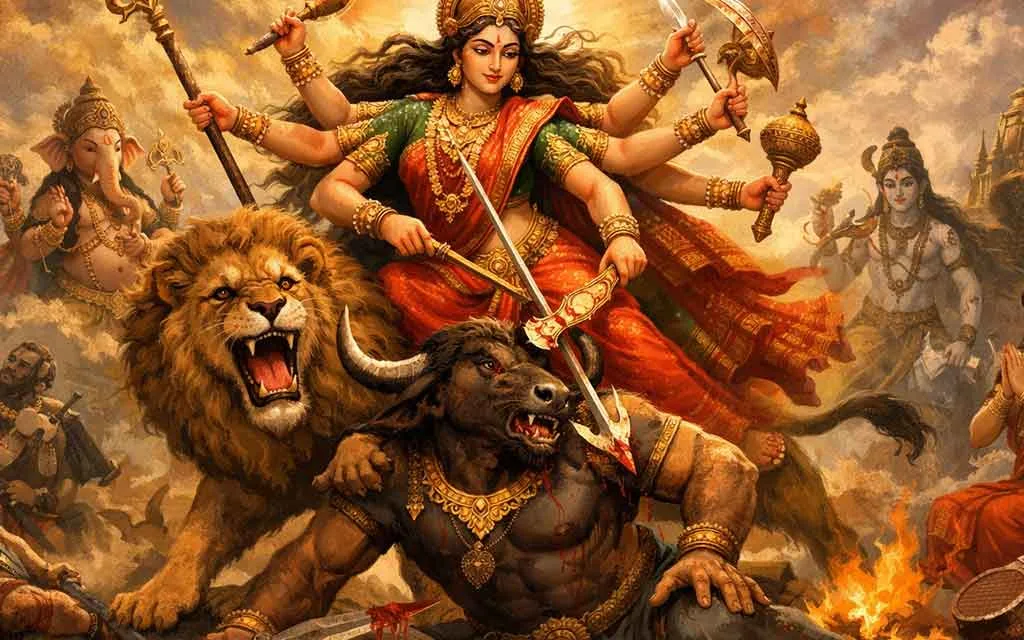
The Siddha Kunjika Stotram is Shiva's short hymn to Parvati, traditionally recited with or in place of the Durga Saptashati. Here is the complete text with its bija mantra, exactly as sanskritdocuments.
Quick answer: The Siddha Kunjika Stotram is a short Tantric hymn of 15 verses with a bija mantra, spoken by Shiva to Parvati and placed by its colophon in the Gauri Tantra of the Rudrayamala. It calls itself the 'key' (kunjika) to the Durga Saptashati: its recitation is traditionally held to give the fruit of the whole Saptashati. It is recited during Navaratri, especially on Durga Ashtami, and on Ashtami days through the year.
Last updated: 20 October 2026. The Sanskrit below, including every seed syllable, is reproduced exactly as published by sanskritdocuments.org (file siddhakunjikaa.itx), converted to Devanagari and IAST by software from the source, with no word typed by hand. The source says its text is 'combined to cover variations', so we also show its two longer variant passages, clearly labelled. Our own plain-English meaning follows every verse.
Siddha Kunjika Stotram: full text with meaning
The text opens with an invocation and the viniyoga. Verses 1 to 4 are Shiva's introduction, verse 5 is the mantra, verses 6 to 13 are the hymn with its seed syllables, and verses 14 and 15 are closing instructions. Each passage appears in Devanagari and then in IAST transliteration, followed by its meaning. Bija syllables are described, not translated.
Invocation and viniyoga
श्री गणेशाय नमः ।
ॐ अस्य श्रीकुञ्जिकास्तोत्रमन्त्रस्य सदाशिव ऋषिः, अनुष्टुप् छन्दः,
श्रीत्रिगुणात्मिका देवता, ॐ ऐं बीजं, ॐ ह्रीं शक्तिः, ॐ क्लीं कीलकम्,
मम सर्वाभीष्टसिद्ध्यर्थे जपे विनियोगः ।
śrī gaṇeśāya namaḥ |
oṃ asya śrīkuñjikāstotramantrasya sadāśiva ṛṣiḥ, anuṣṭup chandaḥ,
śrītriguṇātmikā devatā, oṃ aiṃ bījaṃ, oṃ hrīṃ śaktiḥ, oṃ klīṃ kīlakam,
mama sarvābhīṣṭasiddhyarthe jape viniyogaḥ |
Meaning: Salutations to Shri Ganesha. Om. Of this Kunjika Stotra mantra, Sadashiva is the rishi, anushtup is the metre and Shri Trigunatmika, the Goddess who is the three gunas, is the deity; 'om aim' is the seed, 'om hrim' the power and 'om klim' the pin (kilaka). It is applied in japa for the fulfilment of all that I wish for.
Shiva's introduction (verses 1 to 4)
Verse 1
शिव उवाच ।
शृणु देवि प्रवक्ष्यामि कुञ्जिकास्तोत्रमुत्तमम् ।
येन मन्त्रप्रभावेण चण्डीजापः शुभो भवेत् ॥ १॥
śiva uvāca |
śṛṇu devi pravakṣyāmi kuñjikāstotramuttamam |
yena mantraprabhāveṇa caṇḍījāpaḥ śubho bhavet || 1||
Meaning: Shiva said: Listen, O Devi, I shall tell you the excellent Kunjika Stotra, by whose mantra-power the recitation of the Chandi becomes auspicious.
Verse 2
न कवचं नार्गलास्तोत्रं कीलकं न रहस्यकम् ।
न सूक्तं नापि ध्यानं च न न्यासो न च वार्चनम् ॥ २॥
na kavacaṃ nārgalāstotraṃ kīlakaṃ na rahasyakam |
na sūktaṃ nāpi dhyānaṃ ca na nyāso na ca vārcanam || 2||
Meaning: Neither the Kavacha, nor the Argala Stotra, nor the Kilaka, nor the Rahasya; neither the Sukta, nor the dhyana, nor the nyasa, nor even the ritual worship is needed.
Verse 3
कुञ्जिकापाठमात्रेण दुर्गापाठफलं लभेत् ।
अति गुह्यतरं देवि देवानामपि दुर्लभम् ॥ ३॥
kuñjikāpāṭhamātreṇa durgāpāṭhaphalaṃ labhet |
ati guhyataraṃ devi devānāmapi durlabham || 3||
Meaning: By reciting the Kunjika alone, one gains the fruit of reciting the Durga (Saptashati). It is most secret, O Devi, hard to obtain even for the gods.
Verse 4
गोपनीयं प्रयत्नेन स्वयोनिरिव पार्वति ।
मारणं मोहनं वश्यं स्तम्भनोच्चाटनादिकम् ।
पाठमात्रेण संसिद्ध्येत् कुञ्जिकास्तोत्रमुत्तमम् ॥ ४॥
gopanīyaṃ prayatnena svayoniriva pārvati |
māraṇaṃ mohanaṃ vaśyaṃ stambhanoccāṭanādikam |
pāṭhamātreṇa saṃsiddhyet kuñjikāstotramuttamam || 4||
Meaning: It should be guarded with great care, O Parvati, as one guards what is most private. The verse goes on, in the language of the Tantras, to say that the six rites of power (killing, enchanting, subduing, immobilising, driving away and the rest) are accomplished by its mere recitation. We give this as the text says it; HinduTone does not teach or endorse such rites, and devotees recite the stotra as worship.
The Kunjika mantra (verse 5)
Verse 5: the mantra
अथ मन्त्रः ।
ॐ ऐं ह्रीं क्लीं चामुण्डायै विच्चे ।
ॐ ग्लौं हुं क्लीं जूं सः ज्वालय ज्वालय ज्वल ज्वल प्रज्वल प्रज्वल
ऐं ह्रीं क्लीं चामुण्डायै विच्चे ज्वल हं सं लं क्षं फट् स्वाहा ॥ ५॥
इति मंत्रः ।
atha mantraḥ |
oṃ aiṃ hrīṃ klīṃ cāmuṇḍāyai vicce |
oṃ glauṃ huṃ klīṃ jūṃ saḥ jvālaya jvālaya jvala jvala prajvala prajvala
aiṃ hrīṃ klīṃ cāmuṇḍāyai vicce jvala haṃ saṃ laṃ kṣaṃ phaṭ svāhā || 5||
iti maṃtraḥ |
Meaning: Now the mantra. It opens with the nine-syllable Navarna mantra of the Devi Mahatmya, 'om aim hrim klim chamundayai vicche', continues with further seed syllables and the words 'jvalaya jvalaya, jvala jvala, prajvala prajvala' ('make it blaze; blaze; blaze forth'), repeats the Navarna mantra and ends with seed syllables and 'phat svaha'. Thus the mantra. (Seed syllables are not translated.)
Variant of the mantra, as given by the source
श्रूँ श्रूँ श्रूँ शं फट् ऐं ह्रीं क्लीं ज्वल उज्ज्वल प्रज्वल
ह्रीं ह्रीं क्लीं स्रावय स्रावय शापं नाशय नाशय
श्रीं श्रीं श्रीं जूं सः स्रावय आदय स्वाहा ।
ॐ श्लीं हूँ क्लीं ग्लां जूं सः ज्वल उज्ज्वल मन्त्रं
प्रज्वल हं सं लं क्षं फट् स्वाहा ।
śrūm̐ śrūm̐ śrūm̐ śaṃ phaṭ aiṃ hrīṃ klīṃ jvala ujjvala prajvala
hrīṃ hrīṃ klīṃ srāvaya srāvaya śāpaṃ nāśaya nāśaya
śrīṃ śrīṃ śrīṃ jūṃ saḥ srāvaya ādaya svāhā |
oṃ ślīṃ hūm̐ klīṃ glāṃ jūṃ saḥ jvala ujjvala mantraṃ
prajvala haṃ saṃ laṃ kṣaṃ phaṭ svāhā |
Meaning: The source also gives this alternative form of the mantra. It is made up of seed syllables and the words 'jvala ujjvala prajvala' ('blaze, shine, blaze forth'), 'sravaya' ('make it flow') and 'shapam nashaya' ('destroy the curse'), and ends 'phat svaha'.
Salutations to the Goddess (verses 6 and 7)
Verse 6
नमस्ते रुद्ररूपिण्यै नमस्ते मधुमर्दिनि ।
नमः कैटभहारिण्यै नमस्ते महिषार्दिनि ॥ ६॥
namaste rudrarūpiṇyai namaste madhumardini |
namaḥ kaiṭabhahāriṇyai namaste mahiṣārdini || 6||
Meaning: Salutations to you whose form is Rudra; salutations to you, slayer of Madhu; salutations to you who destroyed Kaitabha; salutations to you, slayer of Mahisha.
Verse 7
नमस्ते शुम्भहन्त्र्यै च निशुम्भासुरघातिनि ।
जाग्रतं हि महादेवि जपं सिद्धं कुरूष्व मे ॥ ७॥
namaste śumbhahantryai ca niśumbhāsuraghātini |
jāgrataṃ hi mahādevi japaṃ siddhaṃ kurūṣva me || 7||
Meaning: Salutations to you, slayer of Shumbha and destroyer of the demon Nishumbha. O Mahadevi, awaken, and make my japa fruitful.
The seed syllables (verses 8 to 13)
Verse 8
ऐङ्कारी सृष्टिरूपायै ह्रीङ्कारी प्रतिपालिका ।
क्लीङ्कारी कामरूपिण्यै बीजरूपे नमोऽस्तु ते ॥ ८॥
aiṅkārī sṛṣṭirūpāyai hrīṅkārī pratipālikā |
klīṅkārī kāmarūpiṇyai bījarūpe namo'stu te || 8||
Meaning: As the syllable aim you are the form of creation; as hrim, the protector; as klim, the form of desire. O you whose form is the seed syllables, salutations to you.
Verse 9
चामुण्डा चण्डघाती च यैकारी वरदायिनी ।
विच्चे चाभयदा नित्यं नमस्ते मन्त्ररूपिणि ॥ ९॥
cāmuṇḍā caṇḍaghātī ca yaikārī varadāyinī |
vicce cābhayadā nityaṃ namaste mantrarūpiṇi || 9||
Meaning: Chamunda, slayer of Chanda; as the syllable yai, giver of boons; as vicche, ever giving fearlessness: salutations to you whose form is the mantra. (This verse unfolds the last words of the Navarna mantra, 'chamundayai vicche'.)
Verse 10
धां धीं धूं धूर्जटेः पत्नी वां वीं वूं वागधीश्वरी ।
क्रां क्रीं क्रूं कुञ्जिका देवि शां शीं शूं मे शुभं कुरु ॥ १०॥
dhāṃ dhīṃ dhūṃ dhūrjaṭeḥ patnī vāṃ vīṃ vūṃ vāgadhīśvarī |
krāṃ krīṃ krūṃ kuñjikā devi śāṃ śīṃ śūṃ me śubhaṃ kuru || 10||
Meaning: Dham dhim dhum: wife of Shiva, the one with matted locks; vam vim vum: queen of speech; kram krim krum: O Goddess Kunjika; sham shim shum: bring me what is good.
Verse 11
हुं हुं हुङ्काररूपिण्यै जं जं जं जम्भनादिनी ।
भ्रां भ्रीं भ्रूं भैरवी भद्रे भवान्यै ते नमो नमः ॥ ११॥
huṃ huṃ huṅkārarūpiṇyai jaṃ jaṃ jaṃ jambhanādinī |
bhrāṃ bhrīṃ bhrūṃ bhairavī bhadre bhavānyai te namo namaḥ || 11||
Meaning: Hum hum: you whose form is the sound 'hum'; jam jam jam: you who roar to crush the demons; bhram bhrim bhrum: O Bhairavi, O gracious one: salutations again and again to you, Bhavani.
Verse 12
अं कं चं टं तं पं यं शं वीं दुं ऐं वीं हं क्षम् ।
धिजाग्रम् धिजाग्रं त्रोटय त्रोटय दीप्तं कुरु कुरु स्वाहा ॥ १२॥
aṃ kaṃ caṃ ṭaṃ taṃ paṃ yaṃ śaṃ vīṃ duṃ aiṃ vīṃ haṃ kṣam |
dhijāgram dhijāgraṃ troṭaya troṭaya dīptaṃ kuru kuru svāhā || 12||
Meaning: A sequence of seed syllables follows, then the words 'trotaya trotaya' ('break, break' the bonds), 'diptam kuru kuru' ('make it shine'), and 'svaha'. (Seed syllables are not translated.)
Variant of verse 12, as given by the source
ॐ अं कं चं टं तं पं सां विदुरां विदुरां विमर्दय विमर्दय
ह्रीं क्षां क्षीं स्रीं जीवय जीवय त्रोटय त्रोटय
जम्भय जंभय दीपय दीपय मोचय मोचय
हूं फट् ज्रां वौषट् ऐं ह्रीं क्लीं रञ्जय रञ्जय
सञ्जय सञ्जय गुञ्जय गुञ्जय बन्धय बन्धय
भ्रां भ्रीं भ्रूं भैरवी भद्रे सङ्कुच सङ्कुच
त्रोटय त्रोटय म्लीं स्वाहा ॥ १२॥
oṃ aṃ kaṃ caṃ ṭaṃ taṃ paṃ sāṃ vidurāṃ vidurāṃ vimardaya vimardaya
hrīṃ kṣāṃ kṣīṃ srīṃ jīvaya jīvaya troṭaya troṭaya
jambhaya jaṃbhaya dīpaya dīpaya mocaya mocaya
hūṃ phaṭ jrāṃ vauṣaṭ aiṃ hrīṃ klīṃ rañjaya rañjaya
sañjaya sañjaya guñjaya guñjaya bandhaya bandhaya
bhrāṃ bhrīṃ bhrūṃ bhairavī bhadre saṅkuca saṅkuca
troṭaya troṭaya mlīṃ svāhā || 12||
Meaning: The source also gives this alternative form of verse 12: seed syllables interwoven with commands such as 'vimardaya' ('crush'), 'jivaya' ('give life'), 'trotaya' ('break'), 'dipaya' ('illumine'), 'mochaya' ('release'), 'bandhaya' ('bind') and 'sankucha' ('draw in'), addressed to Bhairavi, and ending 'svaha'.
Verse 13
पां पीं पूं पार्वती पूर्णा खां खीं खूं खेचरी तथा ।
म्लां म्लीं म्लूं मूलविस्तीर्णा कुञ्जिकास्तोत्र हेतवे ।
सां सीं सूं सप्तशती देव्या मंत्रसिद्धिं कुरूष्व मे ॥ १३॥
कुञ्जिकायै नमो नमः ।
pāṃ pīṃ pūṃ pārvatī pūrṇā khāṃ khīṃ khūṃ khecarī tathā |
mlāṃ mlīṃ mlūṃ mūlavistīrṇā kuñjikāstotra hetave |
sāṃ sīṃ sūṃ saptaśatī devyā maṃtrasiddhiṃ kurūṣva me || 13||
kuñjikāyai namo namaḥ |
Meaning: Pam pim pum: Parvati, the complete one; kham khim khum: Khechari, she who moves in the sky; mlam mlim mlum: she whose root spreads everywhere; sam sim sum: for the sake of this Kunjika Stotra, grant me the fulfilment of the mantra of the Devi's Saptashati. Salutations again and again to Kunjika.
Closing instructions (verses 14 and 15)
Verse 14
इदं तु कुञ्जिकास्तोत्रं मन्त्रजागर्तिहेतवे ।
अभक्ते नैव दातव्यं गोपितं रक्ष पार्वति ॥ १४॥
idaṃ tu kuñjikāstotraṃ mantrajāgartihetave |
abhakte naiva dātavyaṃ gopitaṃ rakṣa pārvati || 14||
Meaning: This Kunjika Stotra is for the awakening of the mantra. It should never be given to one without devotion; keep it guarded, O Parvati.
Verse 15
यस्तु कुञ्जिकया देवि हीनां सप्तशतीं पठेत् ।
न तस्य जायते सिद्धिररण्ये रोदनं यथा ॥ १५॥
yastu kuñjikayā devi hīnāṃ saptaśatīṃ paṭhet |
na tasya jāyate siddhiraraṇye rodanaṃ yathā || 15||
Meaning: One who recites the Saptashati without the Kunjika, O Devi, does not gain its fulfilment: it is like crying out in the forest.
Colophon
। इति श्रीरुद्रयामले गौरीतन्त्रे शिवपार्वतीसंवादे
कुञ्जिकास्तोत्रं सम्पूर्णम् ।
| iti śrīrudrayāmale gaurītantre śivapārvatīsaṃvāde
kuñjikāstotraṃ sampūrṇam |
Meaning: Thus ends the Kunjika Stotra, in the dialogue of Shiva and Parvati, in the Gauri Tantra of the Shri Rudrayamala. (The source gives a variant colophon: 'in the dialogue of Ishvara and Parvati, in the Shri Damara Tantra'.)
Understanding the stotra
The Kunjika is built around the Navarna mantra, the nine-syllable mantra at the heart of the Devi Mahatmya. Verse 5 gives it within a longer mantra; verse 8 explains its three seed syllables, aim, hrim and klim, which are traditionally linked with Mahasarasvati, Mahalakshmi and Mahakali, the three forms of the Goddess honoured in the three parts of the Saptashati; and verse 9 explains the remaining words, 'chamundayai vicche'. Verses 6 and 7 praise the Goddess as the slayer of the demons whose defeat the Saptashati tells: Madhu and Kaitabha, Mahisha, and Shumbha and Nishumbha.
| Verses | Theme |
|---|---|
| Viniyoga | Rishi Sadashiva, deity Trigunatmika; aim, hrim, klim as seed, power and pin |
| 1 to 4 | The Kunjika gives the fruit of the Saptashati without its preliminaries; keep it secret |
| 5 | The mantra, built on the Navarna mantra |
| 6 to 7 | Salutations to the slayer of the demons; 'awaken and make my japa fruitful' |
| 8 to 13 | The Goddess as the seed syllables |
| 14 to 15 | For devoted hearts only; recite it with the Saptashati |
Verse 2 names the usual preliminaries of the Saptashati: the Devi Kavacham, the Argala Stotram and the Kilakam, along with the Rahasyas, the Suktas, the dhyana, the nyasa and the ritual worship. Verse 3 says the Kunjika gives the fruit of the Saptashati by itself, while verse 15 says the Saptashati without the Kunjika bears no fruit; the tradition reads these together as praise of the Kunjika as the key to the Saptashati.
When to recite the Siddha Kunjika Stotram
- Navaratri: Sharad Navaratri 2026 ran from 11 to 19 October; the stotra is recited at every Navaratri, in spring and autumn. See the Navratri 2026 complete guide and the 9-day Devi worship guide.
- Durga Ashtami and Sandhi time: comments printed with the source describe a tradition of reciting it during the Sandhi period, the 48 minutes spanning the end of Ashtami and the start of Navami, when Sandhi Puja is done. See Sandhi Puja, Maha Ashtami 2026 and Durga Ashtami in the USA.
- Masik Durgashtami: the monthly Shukla Ashtami; the next is Tuesday 17 November 2026.
- With the Saptashati, or when time is short: as verses 3 and 15 describe.
How to recite it at home
- Sit before a picture of Durga or Chamunda, or a lamp, with a red flower if you have one.
- Read the invocation and viniyoga, then verses 1 to 4 at a calm pace.
- Recite the mantra of verse 5 slowly and clearly. Seed syllables should be pronounced exactly; if you are unsure, listen to a teacher or a careful recording first, and follow your family's practice.
- Most devotees recite the main text only: verse 5 and verse 12 as printed first. The two labelled variants are given so that the source is shown in full; recite them only if your own tradition uses them.
- Finish with verses 14 and 15, the colophon and a moment of silence. On a long day of worship, continue with the Saptashati or the 108 names of Durga.
Pronunciation help
- In the IAST, ṃ is the nasal hum at the end of syllables such as aim, hrim and klim; m̐ is a nasal with the moon-sign (chandrabindu).
- A line over a vowel (ā, ī, ū) means it is held twice as long; ś and ṣ are both 'sh' sounds; kṣ is 'ksh'.
- Verses 10 to 13 group the seed syllables in threes (short a, long i, long u): read each group evenly before the name that follows it.
Traditional beliefs about the stotra
The stotra speaks of itself in strong terms: that it gives the fruit of the Saptashati, that it 'awakens' the mantra, and, in verse 4, that it accomplishes the rites of power of the Tantras. Devotees traditionally believe that reciting the Kunjika with faith:
- completes and strengthens their reading of the Saptashati;
- lets them honour the Goddess fully on days when they cannot read all thirteen chapters;
- brings them close to Chamunda, the fierce, protecting form of the Mother;
- steadies the mind through the rhythm of the seed syllables.
These are traditional beliefs. HinduTone does not present the stotra's claims of siddhi, protection or power over others as facts, does not teach the Tantric rites it mentions, and does not promise any result. The Kunjika is best recited as an offering of devotion to the Mother.
Tips for NRI families
- Learn the hymn before the mantra. Verses 6 to 9 are simple salutations; learn them first, then the seed-syllable verses.
- Use local dates and times. Ashtami and the Sandhi time abroad follow your local panchang, not India's; see Durga Ashtami in the USA.
- Explain Chamunda gently. Children may find the fierce forms frightening; the Maa Kalaratri guide explains how a fierce form protects.
- More Devi hymns. The Mahishasura Mardini Stotram and the Devi Kavacham are natural companions.
Frequently asked questions
Where does the Siddha Kunjika Stotram come from?
Its closing line places it in the Gauri Tantra of the Rudrayamala, as a dialogue of Shiva and Parvati; the source also gives a variant closing line naming the Damara Tantra. The source gives the author as traditional, and the stotra is spoken by Shiva.
What does 'Kunjika' mean?
Kunjika is usually explained as 'key'. The stotra presents itself as the key to the Durga Saptashati: verse 3 says that its recitation alone gives the fruit of reciting the Saptashati, and verse 14 calls it the hymn 'for the awakening of the mantra'. 'Siddha' means accomplished or perfected.
Can it be recited instead of the full Durga Saptashati?
Verses 2 and 3 say that with the Kunjika one needs neither the Kavacham, the Argala, the Kilakam nor the other preliminaries, and that it gives the fruit of the Saptashati. Many devotees therefore recite it when they cannot read all thirteen chapters. Others recite it together with the Saptashati, as verse 15 suggests. Follow your teacher or family practice.
Do the bija syllables have a meaning?
Bija (seed) syllables such as aim, hrim and klim are not words with a dictionary meaning; they are sounds held to carry the power of the deity. The stotra itself explains some of them: verse 8 links aim with creation, hrim with protection and klim with desire, and verse 9 unpacks the words of the Navarna mantra. We describe the mantras rather than translate them.
Does reciting the Kunjika guarantee siddhi or protection?
No. The stotra speaks in the language of the Tantras about mantra-siddhi and about rites of power, and devotees recite it in faith. HinduTone presents these as the text's own words and traditional beliefs, not as facts or guaranteed results, and does not teach the rites that verse 4 lists.
When is it recited?
Most often during Navaratri, especially at Durga Ashtami and the Sandhi time between Ashtami and Navami, and on Ashtami days through the year; the next Masik Durgashtami is Tuesday 17 November 2026. Many recite it daily.
Why does the text say to keep it secret?
Verses 3, 4 and 14 call it most secret and say it should not be given to one without devotion. Like many Tantric hymns, it asks to be approached with reverence. It is now widely printed and recited, and many teachers advise learning the bija syllables from someone who can pronounce them correctly.
Editor's note (20 October 2026)
This page was published on 20 October 2026. The Sanskrit is the full text of the Kunjika Stotram (Siddha Kunjika Stotram) on sanskritdocuments.org (file siddhakunjikaa.itx, proofread by Ravin Bhalekar), which gives the author as traditional and the source as the Rudrayamala Gauri Tantra or the Damara Tantra. It was converted from ITRANS to Devanagari and IAST by software, and every mantra and seed syllable is reproduced as the source gives it. The source says it is 'combined to cover variations': besides the main text it marks alternative readings ('var'). We show its two long variants (of the mantra after verse 5, and of verse 12) as separate, labelled passages in the source's order. Two one-line variants are not shown in the text: for 'kunjika devi' in verse 10 the source also gives 'kalika devi', and for the second line of verse 11 it gives 'jram jrim jrum bhalanadini'. Its alternative colophon is given in our colophon meaning. One correction: in the variant of verse 12 the source's encoding of the syllable 'hrim' contains a letter that converts to a non-Sanskrit character; we print it as 'hrim', as everywhere else in the text. In verse 4 we have kept the meaning of the source but stated plainly that we do not teach or endorse the rites it lists. The file's English comments by Kumar Sundrarajan Rajendra are summarised, not reproduced, and the meanings here are our own. Dates are from Drik Panchang (New Delhi) as used across HinduTone's Navaratri pages.
Related guides
You might also like
Argala Stotram (Durga Saptashati): Full Text with Meaning
Dattatreya Stotram (Jatadharam Pandurangam), Narada Purana: Full Text with Meaning

Tulasi Stotram (Jagaddhatri Namastubhyam): Full Text with Meaning, for Kartik and Tulsi Vivah