Lakshmi Narasimha Karavalamba Stotram (Adi Shankaracharya): Full Text with Meaning
The Lakshmi Narasimha Karavalamba Stotram, 'mama dehi karavalambam', is Adi Shankaracharya's cry for the Lord's helping hand in the ocean of worldly life. Here is the full text as given by sanskritdocuments.org, 13 main verses and 12 more verses the source gives from other texts, in Devanagari and IAST, with our own verse-by-verse meaning and how to recite it.
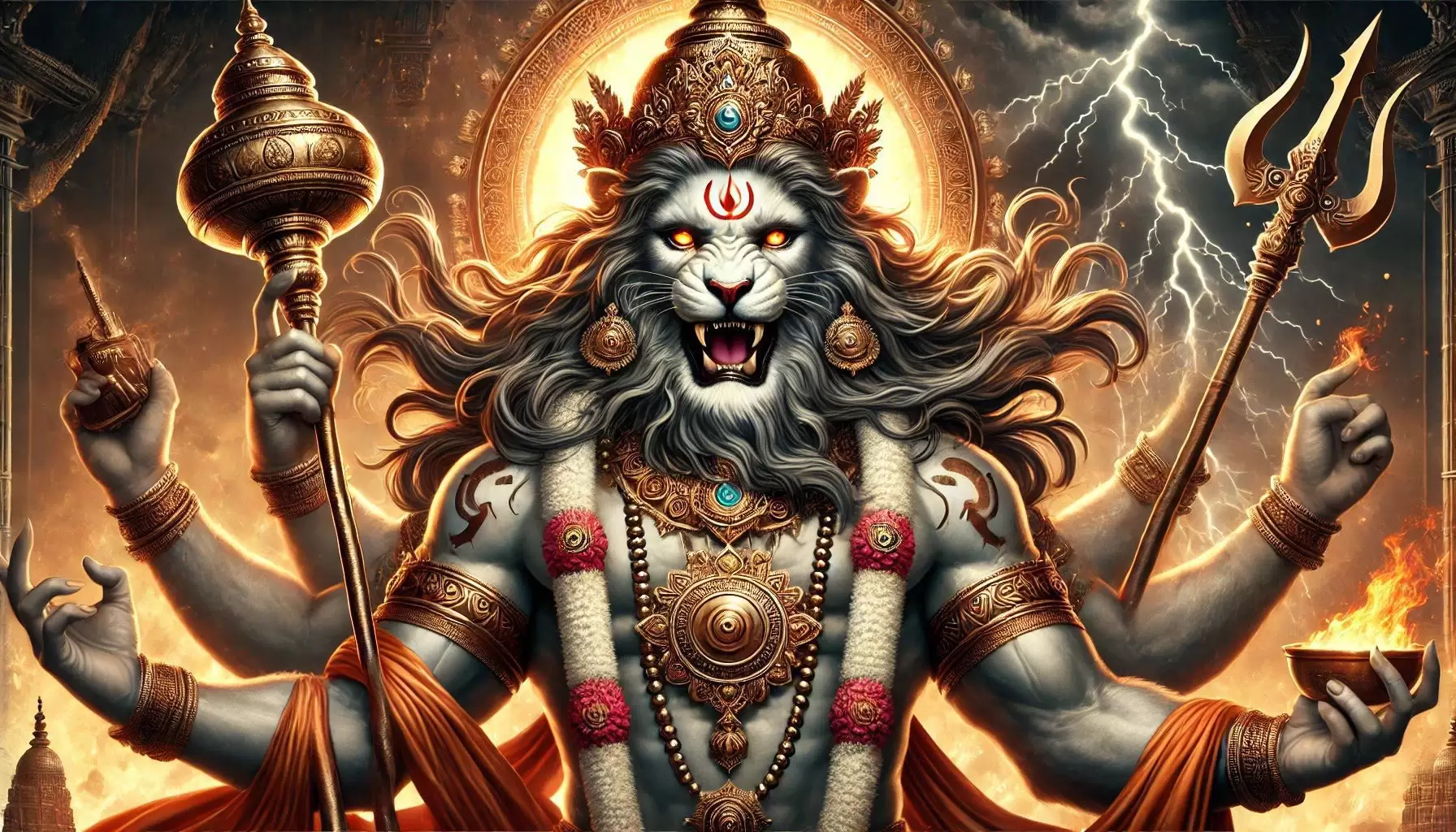
The Lakshmi Narasimha Karavalamba Stotram, 'mama dehi karavalambam', is Adi Shankaracharya's cry for the Lord's helping hand in the ocean of worldly life. Here is the full text as given by sanskritdocuments.
Quick answer: The Lakshmi Narasimha Karavalamba Stotram (also called the Karunarasa Stotram) is a Sanskrit hymn by Adi Shankaracharya to Vishnu as Narasimha with Goddess Lakshmi. Almost every verse ends with the refrain "lakshmi-nrisimha mama dehi karavalambam", "O Lakshmi Narasimha, give me the support of your hand". It pictures worldly life as a forest, a well, an ocean, a tree, a serpent, a fire and a net, and asks the Lord to lift the devotee out of each. It is recited on any day, and especially on Thursdays, Saturdays and Swati nakshatra.
Last updated: 20 October 2026. The Sanskrit below is the text published by sanskritdocuments.org (file lxmnrikar.itx), converted to Devanagari and IAST by software from the source, with no word typed by hand. Our own plain-English meaning follows every verse.
Karavalamba Stotram: full text with meaning
Verses 1 to 13 are the source's main text; verse 13 is Shankara's signature verse. Verses 14 to 25 are the further verses the source prints after noting that 'there are variations of verses and sequence in different texts'; we give them, clearly labelled, in the source's order. Each verse appears in Devanagari and then in IAST transliteration, followed by its meaning.
Main text: the Lord who gives his hand (verses 1 to 13)
Verse 1
श्रीमत्पयोनिधिनिकेतनचक्रपाणे
भोगीन्द्रभोगमणिराजितपुण्यमूर्ते ।
योगीश शाश्वत शरण्य भवाब्धिपोत
लक्ष्मीनृसिंह मम देहि करावलम्बम् ॥ १॥
śrīmatpayonidhiniketanacakrapāṇe
bhogīndrabhogamaṇirājitapuṇyamūrte |
yogīśa śāśvata śaraṇya bhavābdhipota
lakṣmīnṛsiṃha mama dehi karāvalambam || 1||
Meaning: O Lord who holds the discus, whose home is the glorious ocean of milk, whose holy form shines with the jewels on the hoods of the king of serpents; Lord of yogis, eternal one, refuge of all, boat across the ocean of worldly life: O Lakshmi Narasimha, give me the support of your hand.
Verse 2
ब्रह्मेन्द्ररुद्रमरुदर्ककिरीटकोटि
सङ्घट्टिताङ्घ्रिकमलामलकान्तिकान्त ।
लक्ष्मीलसत्कुचसरोरुहराजहंस
लक्ष्मीनृसिंह मम देहि करावलम्बम् ॥ २॥
brahmendrarudramarudarkakirīṭakoṭi
saṅghaṭṭitāṅghrikamalāmalakāntikānta |
lakṣmīlasatkucasaroruharājahaṃsa
lakṣmīnṛsiṃha mama dehi karāvalambam || 2||
Meaning: O Lord whose pure lotus feet shine, touched by the tips of the crowns of Brahma, Indra, Rudra, the Maruts and the Sun bowing before you; royal swan at the lotus of Lakshmi's heart: O Lakshmi Narasimha, give me the support of your hand.
Verse 3
संसारघोरगहने चरतो मुरारे
मारोग्रभीकरमृगप्रचुरार्दितस्य ।
आर्तस्य मत्सरनिदाघसुदुःखितस्य
लक्ष्मीनृसिंह मम देहि करावलम्बम् ॥ ३॥
saṃsāraghoragahane carato murāre
mārograbhīkaramṛgapracurārditasya |
ārtasya matsaranidāghasuduḥkhitasya
lakṣmīnṛsiṃha mama dehi karāvalambam || 3||
Meaning: O Murari, I wander in the dreadful forest of worldly life, tormented by the many fierce and terrifying beasts of desire, suffering and scorched by the summer heat of envy: O Lakshmi Narasimha, give me the support of your hand.
Verse 4
संसारकूपमतिघोरमगाधमूलं
सम्प्राप्य दुःखशतसर्पसमाकुलस्य ।
दीनस्य देव कृपया पदमागतस्य
लक्ष्मीनृसिंह मम देहि करावलम्बम् ॥ ४॥
saṃsārakūpamatighoramagādhamūlaṃ
samprāpya duḥkhaśatasarpasamākulasya |
dīnasya deva kṛpayā padamāgatasya
lakṣmīnṛsiṃha mama dehi karāvalambam || 4||
Meaning: I have fallen into the dreadful, bottomless well of worldly life, crowded with the serpents of a hundred sorrows; helpless, I have come to your feet, O God, by your mercy: O Lakshmi Narasimha, give me the support of your hand.
Verse 5
संसारसागरविशालकरालकाल
नक्रग्रहग्रसितनिग्रहविग्रहस्य ।
व्यग्रस्य रागनिचयोर्मिनिपीडितस्य
लक्ष्मीनृसिंह मम देहि करावलम्बम् ॥ ५॥
saṃsārasāgaraviśālakarālakāla
nakragrahagrasitanigrahavigrahasya |
vyagrasya rāganicayorminipīḍitasya
lakṣmīnṛsiṃha mama dehi karāvalambam || 5||
Meaning: In the vast and fearful ocean of worldly life I am seized by the crocodiles and sea monsters of time, my body caught in their grip; I am anxious and battered by the waves of passion: O Lakshmi Narasimha, give me the support of your hand.
Verse 6
संसारवृक्षमघबीजमनन्तकर्म
शाखायुतं करणपत्रमनङ्गपुष्पम् ।
आरुह्य दुःखफलितं चकितं दयालो
लक्ष्मीनृसिंह मम देहि करावलम्बम् ॥ ६॥
saṃsāravṛkṣamaghabījamanantakarma
śākhāyutaṃ karaṇapatramanaṅgapuṣpam |
āruhya duḥkhaphalitaṃ cakitaṃ dayālo
lakṣmīnṛsiṃha mama dehi karāvalambam || 6||
Meaning: I have climbed the tree of worldly life, whose seed is wrongdoing, whose countless branches are deeds, whose leaves are the senses, whose flowers are desire and whose fruit is sorrow, and I am afraid, O compassionate one: O Lakshmi Narasimha, give me the support of your hand.
Verse 7
संसारसर्पविषदिग्धमहोग्रतीव्र
दंष्ट्राग्रकोटिपरिदष्टविनष्टमूर्तेः ।
नागारिवाहन सुधाब्धिनिवास शौरे
लक्ष्मीनृसिंह मम देहि करावलम्बम् ॥ ७॥
saṃsārasarpaviṣadigdhamahogratīvra
daṃṣṭrāgrakoṭiparidaṣṭavinaṣṭamūrteḥ |
nāgārivāhana sudhābdhinivāsa śaure
lakṣmīnṛsiṃha mama dehi karāvalambam || 7||
Meaning: My body is bitten and broken by the fangs of the serpent of worldly life, fierce and smeared with poison. O rider of Garuda, dweller in the ocean of nectar, Shauri: O Lakshmi Narasimha, give me the support of your hand.
Verse 8
संसारदावदहनाकरभीकरोग्र
ज्वालावलीभिरतिदग्धतनूरुहस्य ।
त्वत्पादपद्मसरसीरुहमागतस्य
लक्ष्मीनृसिंह मम देहि करावलम्बम् ॥ ८॥
saṃsāradāvadahanākarabhīkarogra
jvālāvalībhiratidagdhatanūruhasya |
tvatpādapadmasarasīruhamāgatasya
lakṣmīnṛsiṃha mama dehi karāvalambam || 8||
Meaning: My very body is scorched by the rows of flames of the fierce and terrifying forest fire of worldly life, and I have come to the lotus pool of your feet: O Lakshmi Narasimha, give me the support of your hand.
Verse 9
संसारजालपतितस्य जगन्निवास
सर्वेन्द्रियार्थबडिशाग्रझषोपमस्य ।
प्रोत्कम्पितप्रचुरतालुकमस्तकस्य
लक्ष्मीनृसिंह मम देहि करावलम्बम् ॥ ९॥
saṃsārajālapatitasya jagannivāsa
sarvendriyārthabaḍiśāgrajhaṣopamasya |
protkampitapracuratālukamastakasya
lakṣmīnṛsiṃha mama dehi karāvalambam || 9||
Meaning: O dwelling place of the world, I have fallen into the net of worldly life, like a fish caught on the hook of the objects of the senses, my head and palate trembling violently: O Lakshmi Narasimha, give me the support of your hand.
Verse 10
संसारभीकरकरीन्द्रकराभिघात
निष्पीड्यमानवपुषः सकलार्तिनाश ।
प्राणप्रयाणभवभीतिसमाकुलस्य
लक्ष्मीनृसिंह मम देहि करावलम्बम् ॥ १०॥
saṃsārabhīkarakarīndrakarābhighāta
niṣpīḍyamānavapuṣaḥ sakalārtināśa |
prāṇaprayāṇabhavabhītisamākulasya
lakṣmīnṛsiṃha mama dehi karāvalambam || 10||
Meaning: My body is crushed by the blow of the trunk of the terrifying king of elephants that is worldly life. O remover of all distress, I am overcome by the fear of death and of worldly existence: O Lakshmi Narasimha, give me the support of your hand.
Verse 11
अन्धस्य मे हृतविवेकमहाधनस्य
चोरैर्महाबलिभिरिन्द्रियनामधेयैः ।
मोहान्धकारकुहरे विनिपातितस्य
लक्ष्मीनृसिंह मम देहि करावलम्बम् ॥ ११॥
andhasya me hṛtavivekamahādhanasya
corairmahābalibhirindriyanāmadheyaiḥ |
mohāndhakārakuhare vinipātitasya
lakṣmīnṛsiṃha mama dehi karāvalambam || 11||
Meaning: I am blind, my great wealth of discernment stolen by the powerful thieves called the senses, and thrown down into the dark pit of delusion: O Lakshmi Narasimha, give me the support of your hand.
Verse 12
लक्ष्मीपते कमलनाभ सुरेश विष्णो
वैकुण्ठ कृष्ण मधुसूदन पुष्कराक्ष ।
ब्रह्मण्य केशव जनार्दन वासुदेव
देवेश देहि कृपणस्य करावलम्बम् ॥ १२॥
lakṣmīpate kamalanābha sureśa viṣṇo
vaikuṇṭha kṛṣṇa madhusūdana puṣkarākṣa |
brahmaṇya keśava janārdana vāsudeva
deveśa dehi kṛpaṇasya karāvalambam || 12||
Meaning: O Lord of Lakshmi, lotus-navelled one, lord of the gods, Vishnu, Vaikuntha, Krishna, Madhusudana, lotus-eyed one, friend of the Vedas, Keshava, Janardana, Vasudeva, Lord of gods: give the support of your hand to this helpless one.
Verse 13
यन्माययार्जितवपुःप्रचुरप्रवाह
मग्नार्थमत्र निवहोरुकरावलम्बम् ।
लक्ष्मीनृसिंहचरणाब्जमधुव्रतेन
स्तोत्रं कृतं सुखकरं भुवि शङ्करेण ॥ १३॥
yanmāyayārjitavapuḥpracurapravāha
magnārthamatra nivahorukarāvalambam |
lakṣmīnṛsiṃhacaraṇābjamadhuvratena
stotraṃ kṛtaṃ sukhakaraṃ bhuvi śaṅkareṇa || 13||
Meaning: For those sunk in the mighty flood of a body taken on through his Maya, this hymn, a strong support of the hand, was composed in this world by Shankara, a bee at the lotus feet of Lakshmi Narasimha, to bring happiness.
Additional verses given by the source from other texts (verses 14 to 25)
Verse 14
संसारसागरनिमज्जनमुह्यमानं
दीनं विलोकय विभो करुणानिधे माम् ।
प्रह्लादखेदपरिहारपरावतार
लक्ष्मीनृसिंह मम देहि करावलम्बम् ॥ १४॥
saṃsārasāgaranimajjanamuhyamānaṃ
dīnaṃ vilokaya vibho karuṇānidhe mām |
prahlādakhedaparihāraparāvatāra
lakṣmīnṛsiṃha mama dehi karāvalambam || 14||
Meaning: Look upon me, O all-pervading one, ocean of compassion, sinking and bewildered in the ocean of worldly life, helpless; you who came down to end Prahlada's suffering: O Lakshmi Narasimha, give me the support of your hand.
Verse 15
बद्ध्वा गले यमभटा बहु तर्जयन्तः
कर्षन्ति यत्र भवपाशशतैर्युतं माम् ।
एकाकिनं परवशं चकितं दयालो
लक्ष्मीनृसिंह मम देहि करावलम्बम् ॥ १५॥
baddhvā gale yamabhaṭā bahu tarjayantaḥ
karṣanti yatra bhavapāśaśatairyutaṃ mām |
ekākinaṃ paravaśaṃ cakitaṃ dayālo
lakṣmīnṛsiṃha mama dehi karāvalambam || 15||
Meaning: Where the servants of Yama, tying a rope around my neck and threatening me, drag me away bound with hundreds of the ropes of worldly life, alone, helpless and frightened, O compassionate one: O Lakshmi Narasimha, give me the support of your hand.
Verse 16
एकेन चक्रमपरेण करेण शङ्ख
मन्येन सिन्धुतनयामवलम्ब्य तिष्ठन् ।
वामेतरेण वरदाभयपद्मचिह्नं
लक्ष्मीनृसिंह मम देहि करावलम्बम् ॥ १६॥
ekena cakramapareṇa kareṇa śaṅkha
manyena sindhutanayāmavalambya tiṣṭhan |
vāmetareṇa varadābhayapadmacihnaṃ
lakṣmīnṛsiṃha mama dehi karāvalambam || 16||
Meaning: O Lord who stands holding the discus in one hand and the conch in another, embracing Lakshmi, daughter of the ocean, with another, and with your right hand, marked with the lotus, giving boons and freedom from fear: O Lakshmi Narasimha, give me the support of your hand.
Verse 17
प्रह्लादनारदपराशरपुण्डरीक
व्यासादिभागवतपुङ्गवहृन्निवास ।
भक्तानुरुक्तपरिपालनपारिजात
लक्ष्मीनृसिंह मम देहि करावलम्बम् ॥ १७॥
prahlādanāradaparāśarapuṇḍarīka
vyāsādibhāgavatapuṅgavahṛnnivāsa |
bhaktānuruktaparipālanapārijāta
lakṣmīnṛsiṃha mama dehi karāvalambam || 17||
Meaning: O dweller in the hearts of Prahlada, Narada, Parashara, Pundarika, Vyasa and the other great devotees; wish-fulfilling tree who protects the devotees who love you: O Lakshmi Narasimha, give me the support of your hand.
Verse 18
संसारयूथ गजसंहतिसिंहदंष्ट्रा
भीतस्य दुष्टमैदैत्य भयङ्करेण ।
प्राणप्रयाण भवभीति निवारणेन
लक्ष्मीनृसिंह मम देहि करावलम्बम् ॥ १८॥
saṃsārayūtha gajasaṃhatisiṃhadaṃṣṭrā
bhītasya duṣṭamaidaitya bhayaṅkareṇa |
prāṇaprayāṇa bhavabhīti nivāraṇena
lakṣmīnṛsiṃha mama dehi karāvalambam || 18||
Meaning: To me, who am afraid, with your lion's fangs that scatter the elephant herds of worldly life and terrify the wicked demons, and that remove the fear of death and rebirth: O Lakshmi Narasimha, give me the support of your hand.
Verse 19
लक्ष्मीनृसिंहचरणाब्जमधुव्रतेन
स्तोत्रं कृतं शुभकरं भुवि शङ्करेण ।
ये तत्पठन्ति मनुजा हरिभक्तियुक्ता
स्ते यान्ति तत्पदसरोजमखण्डरूपम् ॥ १९॥
lakṣmīnṛsiṃhacaraṇābjamadhuvratena
stotraṃ kṛtaṃ śubhakaraṃ bhuvi śaṅkareṇa |
ye tatpaṭhanti manujā haribhaktiyuktā
ste yānti tatpadasarojamakhaṇḍarūpam || 19||
Meaning: This auspicious hymn was composed in this world by Shankara, a bee at the lotus feet of Lakshmi Narasimha. Those who recite it, full of devotion to Hari, reach his lotus feet, whole and undivided.
Verse 20
आद्यन्तशून्यमजमव्ययमप्रमेय
मादित्यरुद्रनिगमादिनुतप्रभावम् ।
त्वाम्भोधिजास्य मधुलोलुपमत्तभृङ्गीं
लक्ष्मीनृसिंह मम देहि करावलम्बम् ॥ २०॥
ādyantaśūnyamajamavyayamaprameya
mādityarudranigamādinutaprabhāvam |
tvāmbhodhijāsya madhulolupamattabhṛṅgīṃ
lakṣmīnṛsiṃha mama dehi karāvalambam || 20||
Meaning: You who are without beginning or end, unborn, imperishable and beyond measure, whose power is praised by the Adityas, the Rudras and the Vedas, intoxicated like a bee with the sweetness of the face of Lakshmi, daughter of the ocean: O Lakshmi Narasimha, give me the support of your hand.
Verse 21
वाराहरामनरसिंहरमादिकान्ता
क्रीडाविलोलविधिशूलिसूरप्रवन्द्य! ।
हंसात्मकं परमहंस विहारलीलं
लक्ष्मीनृसिंह मम देहि करावलम्बम् ॥ २१॥
vārāharāmanarasiṃharamādikāntā
krīḍāvilolavidhiśūlisūrapravandya! |
haṃsātmakaṃ paramahaṃsa vihāralīlaṃ
lakṣmīnṛsiṃha mama dehi karāvalambam || 21||
Meaning: O beloved of Lakshmi in your forms as Varaha, Rama and Narasimha, delighting in play, worshipped by Brahma, Shiva and the gods; O Lord who is the swan, whose play is that of the supreme swan: O Lakshmi Narasimha, give me the support of your hand.
Verse 22
स्वामी नृसिंहः सकलं नृसिंहः
माता नृसिंहश्च पिता नृसिंहः ।
भ्राता नृसिंहश्च सखा नृसिंहः
लक्ष्मीनृसिंह मम देहि करावलम्बम् ॥ २२॥
svāmī nṛsiṃhaḥ sakalaṃ nṛsiṃhaḥ
mātā nṛsiṃhaśca pitā nṛsiṃhaḥ |
bhrātā nṛsiṃhaśca sakhā nṛsiṃhaḥ
lakṣmīnṛsiṃha mama dehi karāvalambam || 22||
Meaning: Narasimha is my master, Narasimha is everything; my mother is Narasimha and my father is Narasimha; my brother is Narasimha and my friend is Narasimha: O Lakshmi Narasimha, give me the support of your hand.
Verse 23
प्रह्लादमानससरोजवासभृङ्ग!
गङ्गातरङ्गधवळाङ्ग रमास्थिताङ्क! ।
शृङ्गार सुन्दरकिरीटलसद्वराङ्ग
लक्ष्मीनृसिंह मम देहि करावलम्बम् ॥ २३॥
prahlādamānasasarojavāsabhṛṅga!
gaṅgātaraṅgadhavaḻāṅga ramāsthitāṅka! |
śṛṅgāra sundarakirīṭalasadvarāṅga
lakṣmīnṛsiṃha mama dehi karāvalambam || 23||
Meaning: O bee who dwells in the lotus of Prahlada's heart, whose body is white as the waves of the Ganga, on whose lap Lakshmi is seated, whose head shines with a beautiful crown: O Lakshmi Narasimha, give me the support of your hand.
Verse 24
श्री शङ्करार्य रचितं सततं मनुष्यः
स्तोत्रं पठेदिह तु सर्वगुणप्रपन्नम् ।
सद्योविमुक्तकलुषो मुनिवर्यगण्यो
लक्ष्मीनृसिंह मम देहि करावलम्बम् ॥ २४॥
śrī śaṅkarārya racitaṃ satataṃ manuṣyaḥ
stotraṃ paṭhediha tu sarvaguṇaprapannam |
sadyovimuktakaluṣo munivaryagaṇyo
lakṣmīnṛsiṃha mama dehi karāvalambam || 24||
Meaning: Whoever here recites at all times this hymn composed by the revered Shankara, full of every virtue, is at once freed of all impurity and counted among the best of sages: O Lakshmi Narasimha, give me the support of your hand.
Verse 25
श्रीमन् नृसिंह विभवे गरुडध्वजाय
तापत्रयोपशमनाय भवौषधाय ।
तृष्णादिवृश्चिकजलाग्निभुजङ्गरोग
क्लेशव्ययाम हरये गुरवे नमस्ते ॥ २५॥
śrīman nṛsiṃha vibhave garuḍadhvajāya
tāpatrayopaśamanāya bhavauṣadhāya |
tṛṣṇādivṛścikajalāgnibhujaṅgaroga
kleśavyayāma haraye gurave namaste || 25||
Meaning: Salutations to the glorious Narasimha, whose banner bears Garuda, who calms the three kinds of suffering and is the medicine for worldly existence; to Hari, the guru, who removes the troubles of craving and the like, of scorpions, water, fire, serpents and disease.
Colophon
इति श्रीमत्परमहंसपरिव्राजकाचार्यस्य
श्रीगोविन्दभगवत्पूज्यपादशिष्यस्य
श्रीमच्छङ्करभगवतः कृतौ
लक्ष्मीनृसिंहकरुणारसस्तोत्रं अथवा
लक्ष्मीनृसिंहकरावलम्बस्तोत्रं सम्पूर्णम् ॥
iti śrīmatparamahaṃsaparivrājakācāryasya
śrīgovindabhagavatpūjyapādaśiṣyasya
śrīmacchaṅkarabhagavataḥ kṛtau
lakṣmīnṛsiṃhakaruṇārasastotraṃ athavā
lakṣmīnṛsiṃhakarāvalambastotraṃ sampūrṇam ||
Meaning: Thus ends the Lakshmi Narasimha Karunarasa Stotra, also called the Lakshmi Narasimha Karavalamba Stotra, a work of the revered Shankara, the wandering monk and teacher, disciple of the revered Govinda Bhagavatpada.
The story behind the hymn
Tradition links the hymn to an episode in Adi Shankaracharya's life told in his biographies. As it is commonly told, a fierce ascetic came to Shankara while he was meditating alone and sought to sacrifice him. Shankara's disciple Padmapada, a devotee of Narasimha, sensed the danger, and the Lord in his man-lion form came through him to protect his teacher. In gratitude, Shankara is said to have sung this hymn to Lakshmi Narasimha.
Whatever its origin, the hymn speaks to everyone who has felt overwhelmed. Verses 3 to 11 each take one image of worldly life (a dark forest of wild beasts, a bottomless well of serpents, an ocean of crocodiles, a tree whose fruit is sorrow, a poisonous serpent, a forest fire, a fisherman's net, a charging elephant, and thieves who steal one's judgement), and each ends with the same cry for the Lord's helping hand.
| Verses | Image of worldly life |
|---|---|
| 3 | A dreadful forest full of beasts, scorched by envy |
| 4 | A bottomless well full of serpents |
| 5 | An ocean full of crocodiles and sea monsters |
| 6 | A tree whose fruit is sorrow |
| 7 | The fangs of a poisonous serpent |
| 8 | A forest fire |
| 9 | A net and a hook, with the soul like a caught fish |
| 10 | A charging elephant |
| 11 | Thieves called the senses, who steal discernment |
Verse 22, among the additional verses, is one of the best-loved lines in all devotional Sanskrit: 'Narasimha is my master, my mother, my father, my brother and my friend; Narasimha is everything.'
When to recite the Karavalamba Stotram
- Thursdays: the day of Vishnu and the guru; see the Thursday (Guruvar) rituals guide and why Thursday matters.
- Saturdays: many families pray to Narasimha on Saturdays; see why Saturday matters in Hindu worship.
- Swati nakshatra: Narasimha's birth star, which comes round every month; see Narasimha Swamy janma nakshatram 2026.
- Kartik month: from Tuesday 27 October to Tuesday 24 November 2026, a month dear to Vishnu; see Kartik Snan and Deepdaan 2026.
- Vaikuntha Ekadashi: see Vaikuntha Ekadashi 2026.
- In hard times: the hymn is a prayer for help, and many devotees recite it daily during illness, exams, job loss or family trouble, while also doing what is practical.
How to recite it at home
- Sit before a picture of Lakshmi Narasimha, or of Vishnu, with a lamp lit; offer a flower or a tulasi leaf.
- Make a short sankalpa in your own words, for example: "Lord Narasimha, I hold out my hands to you; please hold them."
- Recite verses 1 to 13 at a steady pace, giving full feeling to the refrain at the end of each verse. Add verses 14 to 25 when you have time.
- Many devotees fold their hands and raise them slightly at the words 'mama dehi karavalambam', as if reaching for the Lord's hand.
- End with verse 22 ('Narasimha is everything') and a moment of silence.
Pronunciation help
- The hymn is in the vasantatilaka metre, fourteen syllables to a line; take a breath at each line break.
- Where a long compound word runs over the line break, as in verses 2, 5 and 10, read the two lines together without a pause.
- In the IAST, a line over a vowel (ā, ī, ū) means it is held twice as long; ś and ṣ are 'sh' sounds; ṛ is a short 'ri' (nṛsiṃha is 'nri-simha').
Traditional beliefs about the hymn
Verses 19 and 24 state the hymn's merit: those who recite it with devotion reach the Lord's feet and are freed of impurity. Verse 25 calls the Lord the medicine for worldly existence, who removes suffering of every kind. Devotees traditionally believe that reciting it:
- brings courage and a sense of protection in fearful situations, as Narasimha protected Prahlada;
- comforts the mind in times of sorrow, loss and confusion;
- deepens surrender, the feeling that the Lord is mother, father, brother and friend (verse 22).
These are traditional beliefs about the hymn's spiritual value. No hymn guarantees particular worldly results; the Karavalamba Stotram is best offered as an act of trust and surrender.
Tips for NRI families
- Learn the refrain first. 'Lakshmi-nrisimha mama dehi karavalambam' is easy to learn; children can join in at the end of every verse.
- Visit a Narasimha shrine. Many Vishnu and Venkateswara temples abroad have a Narasimha or Lakshmi Narasimha shrine; ask about Swati nakshatra pujas. For India, see the top 10 Narasimha temples.
- Learn more mantras. See how to pray to Lakshmi Narasimha Swamy and the Narasimha mantras collection.
- More Shankara hymns. See the Govindashtakam, the Subrahmanya Bhujangam and the Nirvana Shatakam.
Frequently asked questions
Who wrote the Lakshmi Narasimha Karavalamba Stotram?
Adi Shankaracharya. The source names Adi Shankara as the author, verse 13 says the hymn was composed by Shankara, 'a bee at the lotus feet of Lakshmi Narasimha', and the colophon calls it a work of Shankara, disciple of Govinda Bhagavatpada.
What does 'karavalambam' mean?
Kara is hand and avalamba is support. 'Mama dehi karavalambam' means 'give me the support of your hand', the cry of someone drowning who reaches for a helping hand. The hymn is also called the Karunarasa Stotram, 'the hymn of the essence of compassion'.
How many verses does it have?
The source gives 13 verses as its main text, the 13th being the poet's signature verse, and 12 more verses (14 to 25) found in other texts, noting that verses and their order vary between editions. Popular printed versions often have around 17 verses.
When should it be recited?
Any day, and especially on Thursdays and Saturdays, on Swati nakshatra (Narasimha's birth star), on Narasimha Jayanti, in the month of Kartik and whenever one feels overwhelmed and in need of help.
How long does it take to recite?
About five minutes for the 13 main verses and ten to twelve minutes for all 25. Many devotees recite verses 1 to 13 daily.
What are the benefits of reciting the Karavalamba Stotram?
The hymn is a prayer for the Lord's help in the sorrows of life, and verses 19 and 24 say that those who recite it with devotion reach the Lord's feet and are freed of impurity. Devotees traditionally believe it brings courage, protection and peace in hard times. These are matters of faith, not guaranteed results.
Who is Lakshmi Narasimha?
Narasimha is Vishnu's man-lion form, who appeared to protect the child devotee Prahlada. As Lakshmi Narasimha he is worshipped in his peaceful form, with Goddess Lakshmi seated on his lap, as in verse 23 of this hymn.
Editor's note (20 October 2026)
This page was published on 20 October 2026. The Sanskrit is the text given in Lakshmi Narasimha Karunarasa (Karavalamba) Stotram on sanskritdocuments.org (file lxmnrikar.itx, transliterated and proofread by Sunder Hattangadi), which names Adi Shankara as the author. It was converted from ITRANS to Devanagari and IAST by software; no word has been changed. The source marks alternative readings ('var') beside a number of lines and gives a different reading (pathabheda) for the second line of verse 12; we print the main reading and have not shown the alternatives. It prints verses 14 to 25 as additional verses from other texts, citing Appendix 1 of a Shodhganga thesis, A Study of Narasimha Cult in Sanskrit Literature; we keep them labelled and in the source's order. In verse 12 we have rendered 'brahmanya' as 'friend of the Vedas'. The English meanings are our own, the story is given as commonly told, and the hymn is presented as an act of devotion, with no promise of particular results.
Related guides
You might also like
Dattatreya Stotram (Jatadharam Pandurangam), Narada Purana: Full Text with Meaning

Tulasi Stotram (Jagaddhatri Namastubhyam): Full Text with Meaning, for Kartik and Tulsi Vivah
Shiva Mahimna Stotram (Pushpadanta): Full Lyrics with Meaning