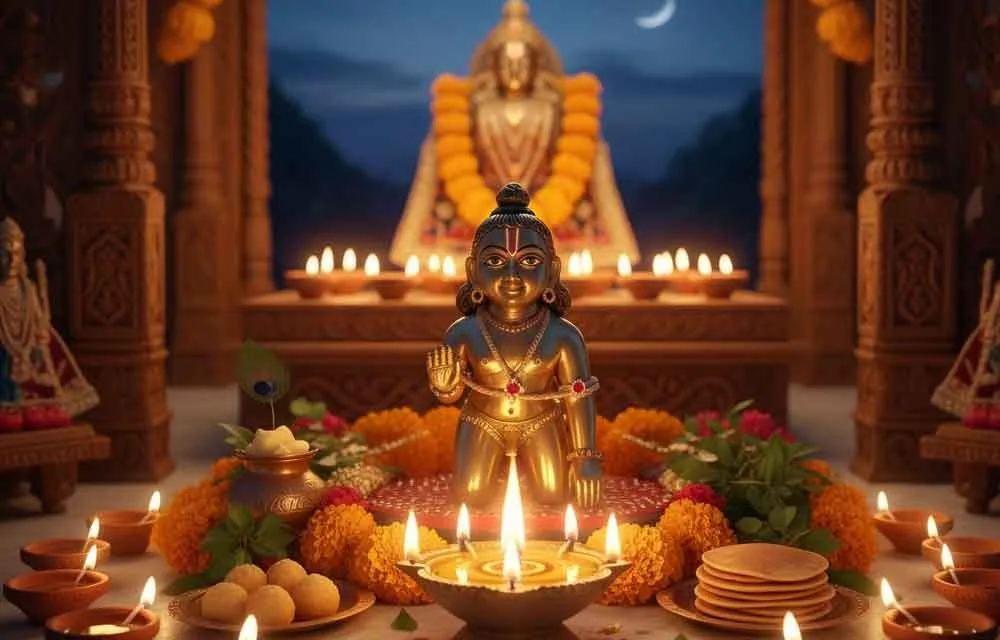
Dattatreya Stotram (Jatadharam Pandurangam), Narada Purana: Full Text with Meaning
The Dattatreya Stotram that opens with the dhyana 'Jatadharam Pandurangam' and repeats 'Dattatreya namo'stu te' is the hymn the Narada Purana attributes to the sage Narada. Here are the dhyana, viniyoga and all 18 verses in Devanagari and IAST from sanskritdocuments.org, our own verse-by-verse meaning, and how to recite it on Thursdays and on Datta Jayanti, Wednesday 23 December 2026.
The Dattatreya Stotram that opens with the dhyana 'Jatadharam Pandurangam' and repeats 'Dattatreya namo'stu te' is the hymn the Narada Purana attributes to the sage Narada. Here are the dhyana, viniyoga and all 18 verses in Devanagari and IAST from sanskritdocuments.
Quick answer: The Dattatreya Stotram of the Narada Purana is a short Sanskrit hymn to Lord Dattatreya, the united form of Brahma, Vishnu and Shiva and the original guru. It opens with the dhyana "jatadharam pandurangam" and almost every verse ends "dattatreya namo'stu te", "O Dattatreya, salutations to you". The text itself names the sage Narada as its composer. It is recited on Thursdays and on Datta Jayanti, Wednesday 23 December 2026.
Last updated: 20 October 2026. The Sanskrit below is the complete text published by sanskritdocuments.org (file datta.itx), converted to Devanagari and IAST by software from the source, with no word typed by hand. Our own plain-English meaning follows every verse.
Dattatreya Stotram: full text with meaning
The hymn begins with a dhyana shloka (a verse for meditation on the deity's form) and a viniyoga (the traditional statement of the hymn's sage, metre and deity). Then come 18 verses: 16 of praise and 2 on the hymn's merit. Each appears in Devanagari and then in IAST transliteration, followed by its meaning.
Dhyana shloka and viniyoga
जटाधरं पाण्डुरङ्गं शूलहस्तं कृपानिधिम् ।
सर्वरोगहरं देवं दत्तात्रेयमहं भजे ॥
अस्य श्रीदत्तात्रेयस्तोत्रमन्त्रस्य भगवान् नारदऋषिः ।
अनुष्टुप् छन्दः । श्रीदत्तपरमात्मा देवता ।
श्रीदत्तप्रीत्यर्थे जपे विनियोगः ॥
jaṭādharaṃ pāṇḍuraṅgaṃ śūlahastaṃ kṛpānidhim |
sarvarogaharaṃ devaṃ dattātreyamahaṃ bhaje ||
asya śrīdattātreyastotramantrasya bhagavān nāradaṛṣiḥ |
anuṣṭup chandaḥ | śrīdattaparamātmā devatā |
śrīdattaprītyarthe jape viniyogaḥ ||
Meaning: Dhyana: I worship the god Dattatreya, who wears matted locks, whose body is pale and radiant, who holds a trident in his hand, who is a treasure of compassion and removes all illness. Viniyoga: of this Shri Dattatreya Stotra mantra, the sage is the revered Narada, the metre is anushtup, and the deity is Shri Datta, the Supreme Self; it is recited for the pleasure of Shri Datta.
The hymn (verses 1 to 16)
Verse 1
जगदुत्पत्तिकर्त्रे च स्थितिसंहार हेतवे ।
भवपाशविमुक्ताय दत्तात्रेय नमोऽस्तुते ॥ १॥
jagadutpattikartre ca sthitisaṃhāra hetave |
bhavapāśavimuktāya dattātreya namo'stute || 1||
Meaning: To the maker of the world's creation and the cause of its preservation and dissolution, who is free from the bonds of worldly life: O Dattatreya, salutations to you.
Verse 2
जराजन्मविनाशाय देहशुद्धिकराय च ।
दिगम्बरदयामूर्ते दत्तात्रेय नमोऽस्तुते ॥ २॥
jarājanmavināśāya dehaśuddhikarāya ca |
digambaradayāmūrte dattātreya namo'stute || 2||
Meaning: To the destroyer of old age and birth, who purifies the body; O form of compassion, clothed only by the directions: O Dattatreya, salutations to you.
Verse 3
कर्पूरकान्तिदेहाय ब्रह्ममूर्तिधराय च ।
वेदशास्त्रपरिज्ञाय दत्तात्रेय नमोऽस्तुते ॥ ३॥
karpūrakāntidehāya brahmamūrtidharāya ca |
vedaśāstraparijñāya dattātreya namo'stute || 3||
Meaning: To him whose body shines like camphor, who bears the form of Brahma, and who knows the Vedas and the scriptures fully: O Dattatreya, salutations to you.
Verse 4
ह्रस्वदीर्घकृशस्थूलनामगोत्रविवर्जित ।
पञ्चभूतैकदीप्ताय दत्तात्रेय नमोऽस्तुते ॥ ४॥
hrasvadīrghakṛśasthūlanāmagotravivarjita |
pañcabhūtaikadīptāya dattātreya namo'stute || 4||
Meaning: You who are beyond short and tall, thin and stout, beyond name and family line; to the one light that shines in the five elements: O Dattatreya, salutations to you.
Verse 5
यज्ञभोक्ते च यज्ञाय यज्ञरूपधराय च ।
यज्ञप्रियाय सिद्धाय दत्तात्रेय नमोऽस्तुते ॥ ५॥
yajñabhokte ca yajñāya yajñarūpadharāya ca |
yajñapriyāya siddhāya dattātreya namo'stute || 5||
Meaning: To the enjoyer of sacrifice and to sacrifice itself, who takes the form of sacrifice, who loves sacrifice, the perfected one: O Dattatreya, salutations to you.
Verse 6
आदौ ब्रह्मा मध्य विष्णुरन्ते देवः सदाशिवः ।
मूर्तित्रयस्वरूपाय दत्तात्रेय नमोऽस्तुते ॥ ६॥
ādau brahmā madhya viṣṇurante devaḥ sadāśivaḥ |
mūrtitrayasvarūpāya dattātreya namo'stute || 6||
Meaning: Brahma at the beginning, Vishnu in the middle and the god Sadashiva at the end: to the one whose nature is these three forms, O Dattatreya, salutations to you.
Verse 7
भोगालयाय भोगाय योगयोग्याय धारिणे ।
जितेन्द्रियजितज्ञाय दत्तात्रेय नमोऽस्तुते ॥ ७॥
bhogālayāya bhogāya yogayogyāya dhāriṇe |
jitendriyajitajñāya dattātreya namo'stute || 7||
Meaning: To the abode of enjoyment and enjoyment itself, fit for yoga, the upholder; who has mastered the senses and knows all: O Dattatreya, salutations to you.
Verse 8
दिगम्बराय दिव्याय दिव्यरूपधराय च ।
सदोदितपरब्रह्म दत्तात्रेय नमोऽस्तुते ॥ ८॥
digambarāya divyāya divyarūpadharāya ca |
sadoditaparabrahma dattātreya namo'stute || 8||
Meaning: To the one clothed by the directions, the divine one who bears a divine form; O supreme Brahman, ever risen: O Dattatreya, salutations to you.
Verse 9
जम्बुद्वीपमहाक्षेत्रमातापुरनिवासिने ।
जयमानसतां देव दत्तात्रेय नमोऽस्तुते ॥ ९॥
jambudvīpamahākṣetramātāpuranivāsine |
jayamānasatāṃ deva dattātreya namo'stute || 9||
Meaning: To him who dwells at Matapura, the great holy place in Jambudvipa; O God who brings victory to the good: O Dattatreya, salutations to you.
Verse 10
भिक्षाटनं गृहे ग्रामे पात्रं हेममयं करे ।
नानास्वादमयी भिक्षा दत्तात्रेय नमोऽस्तुते ॥ १०॥
bhikṣāṭanaṃ gṛhe grāme pātraṃ hemamayaṃ kare |
nānāsvādamayī bhikṣā dattātreya namo'stute || 10||
Meaning: Begging for alms from house to house and village to village, a golden bowl in his hand, the alms full of many flavours: O Dattatreya, salutations to you.
Verse 11
ब्रह्मज्ञानमयी मुद्रा वस्त्रे चाकाशभूतले ।
प्रज्ञानघनबोधाय दत्तात्रेय नमोऽस्तुते ॥ ११॥
brahmajñānamayī mudrā vastre cākāśabhūtale |
prajñānaghanabodhāya dattātreya namo'stute || 11||
Meaning: Whose hand-gesture is full of the knowledge of Brahman, whose garment is the sky and the earth; to the one who awakens pure, dense consciousness: O Dattatreya, salutations to you.
Verse 12
अवधूतसदानन्दपरब्रह्मस्वरूपिणे ।
विदेहदेहरूपाय दत्तात्रेय नमोऽस्तुते ॥ १२॥
avadhūtasadānandaparabrahmasvarūpiṇe |
videhadeharūpāya dattātreya namo'stute || 12||
Meaning: To the avadhuta, ever blissful, whose very nature is supreme Brahman, whose form is beyond the body: O Dattatreya, salutations to you.
Verse 13
सत्यंरूपसदाचारसत्यधर्मपरायण ।
सत्याश्रयपरोक्षाय दत्तात्रेय नमोऽस्तुते ॥ १३॥
satyaṃrūpasadācārasatyadharmaparāyaṇa |
satyāśrayaparokṣāya dattātreya namo'stute || 13||
Meaning: O you whose form is truth, devoted to good conduct, truth and dharma; to the refuge of truth, beyond the reach of the senses: O Dattatreya, salutations to you.
Verse 14
शूलहस्तगदापाणे वनमालासुकन्धर ।
यज्ञसूत्रधरब्रह्मन् दत्तात्रेय नमोऽस्तुते ॥ १४॥
śūlahastagadāpāṇe vanamālāsukandhara |
yajñasūtradharabrahman dattātreya namo'stute || 14||
Meaning: O you who hold the trident and the mace, with a garland of forest flowers on your shoulders, wearing the sacred thread, O Brahman: O Dattatreya, salutations to you.
Verse 15
क्षराक्षरस्वरूपाय परात्परतराय च ।
दत्तमुक्तिपरस्तोत्र दत्तात्रेय नमोऽस्तुते ॥ १५॥
kṣarākṣarasvarūpāya parātparatarāya ca |
dattamuktiparastotra dattātreya namo'stute || 15||
Meaning: To the one whose nature is both the perishable and the imperishable, higher than the highest, whose hymn grants liberation: O Dattatreya, salutations to you.
Verse 16
दत्त विद्याढ्यलक्ष्मीश दत्त स्वात्मस्वरूपिणे ।
गुणनिर्गुणरूपाय दत्तात्रेय नमोऽस्तुते ॥ १६॥
datta vidyāḍhyalakṣmīśa datta svātmasvarūpiṇe |
guṇanirguṇarūpāya dattātreya namo'stute || 16||
Meaning: O Datta, rich in knowledge, Lord of Lakshmi; O Datta, whose nature is one's own Self; to the one whose form is both with and beyond qualities: O Dattatreya, salutations to you.
The merit of the hymn (verses 17 and 18)
Verse 17
शत्रुनाशकरं स्तोत्रं ज्ञानविज्ञानदायकम् ।
सर्वपापं शमं याति दत्तात्रेय नमोऽस्तुते ॥ १७॥
śatrunāśakaraṃ stotraṃ jñānavijñānadāyakam |
sarvapāpaṃ śamaṃ yāti dattātreya namo'stute || 17||
Meaning: This hymn removes enemies and gives knowledge and wisdom; through it all wrongdoing is calmed: O Dattatreya, salutations to you.
Verse 18
इदं स्तोत्रं महद्दिव्यं दत्तप्रत्यक्षकारकम् ।
दत्तात्रेयप्रसादाच्च नारदेन प्रकीर्तितम् ॥ १८॥
idaṃ stotraṃ mahaddivyaṃ dattapratyakṣakārakam |
dattātreyaprasādācca nāradena prakīrtitam || 18||
Meaning: This great and divine hymn, which makes Datta present before the devotee, was proclaimed by Narada through the grace of Dattatreya.
Colophon
॥ इति श्रीनारदपुराणे नारदविरचितं
दत्तात्रेयस्तोत्रं सुसम्पूर्णम् ॥
|| iti śrīnāradapurāṇe nāradaviracitaṃ
dattātreyastotraṃ susampūrṇam ||
Meaning: Thus, in the Shri Narada Purana, the Dattatreya Stotra composed by Narada is complete.
Who is Lord Dattatreya?
Dattatreya (Datta, Gurudeva Datta) is the son of the sage Atri and his wife Anasuya, famed for her devotion. As the story is commonly told, Brahma, Vishnu and Shiva came to test Anasuya and, pleased with her, were born as her son, so that Dattatreya unites all three. Verse 6 of this hymn says it directly: 'Brahma at the beginning, Vishnu in the middle and Sadashiva at the end.' See the Trimurti explained.
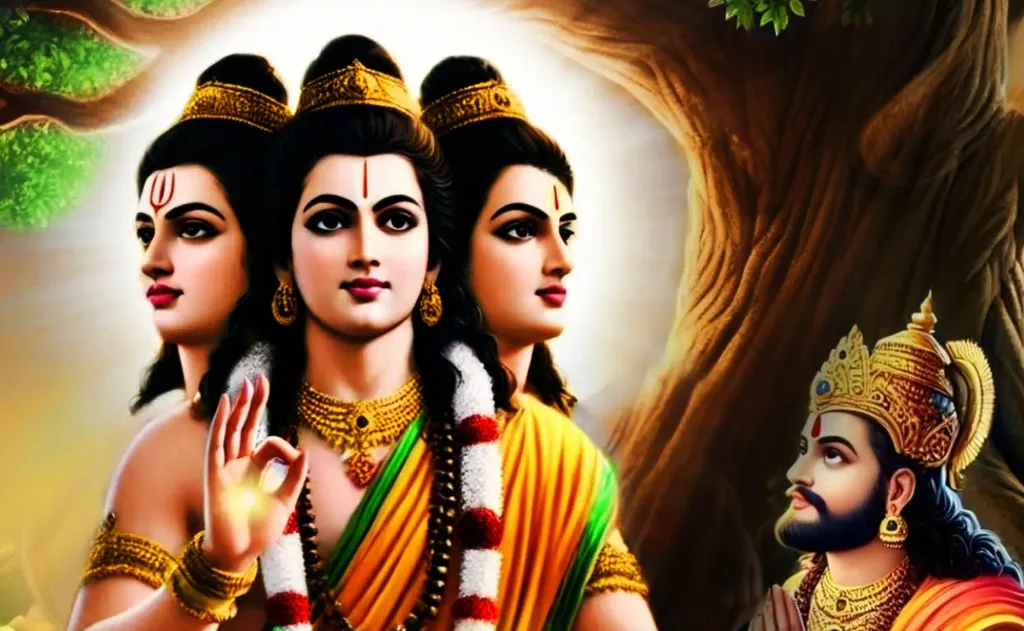
He is honoured as the Adi Guru, the first teacher, and as an avadhuta, one who has gone beyond all outward rules (verse 12). He is usually pictured with three heads and six arms, a cow behind him and four dogs at his feet, often under an audumbara (cluster fig) tree. The Bhagavata Purana tells how the avadhuta learned from twenty-four teachers in nature, including the earth, the ocean, the bee and the child.
| Verses | Theme |
|---|---|
| 1 to 3 | Dattatreya as cause of the world, purifier and knower of the Vedas |
| 4 to 8 | Beyond form and name; the sacrifice; the three gods in one; the sky-clad Brahman |
| 9 to 11 | His dwelling at Matapura; the wandering mendicant; the gesture of knowledge |
| 12 to 16 | The blissful avadhuta, truth, his emblems, beyond and within qualities |
| 17 to 18 | The merit of the hymn; proclaimed by Narada |
Verse 9 mentions Matapura, commonly identified with Mahur in Maharashtra, one of the great Datta kshetras. Others include Ganagapur and Narsobawadi; see the Ganagapur Dattatreya temple and the story of Lord Shani's promise to Datta Maharaj.
When to recite the Dattatreya Stotram
- Datta Jayanti: Wednesday 23 December 2026, Margashirsha Purnima; see Datta Jayanti 2026 and the panchangam for 23 December 2026.
- Datta Jayanti abroad: see the city-by-city dates for the USA, the UK, Canada and Australia.
- Thursdays: Guruvar, the day of the guru, is Dattatreya's traditional weekly day; see the Thursday (Guruvar) rituals guide and why Thursday matters.
- Purnima: the full moon, especially in the month of Margashirsha; see the December 2026 Hindu calendar.
- Daily: it is short enough to recite every morning after one's bath.
How to recite it at home
- On a Thursday, after your bath, sit before a picture of Dattatreya (or of your guru) with a lamp and incense lit.
- Offer a flower, and if you wish a little sweet, such as jaggery or a banana, as naivedya.
- Recite the dhyana verse while picturing the Lord's form, then the viniyoga line, then the 18 verses.
- Many devotees then chant 'Digambara Digambara Shripada Vallabha Digambara' or 'Shri Gurudev Datta' a few times; a japa mala can be used for counting.
- End with a prayer in your own words for guidance, and a moment of silence.
Pronunciation help
- The hymn is in the anushtup metre, eight syllables to a quarter; take a breath at each line break.
- In the refrain, namo'stu te is pronounced 'namo stu te'; the apostrophe marks an a that is dropped after o.
- In the IAST, a line over a vowel (ā, ī, ū) means it is held twice as long; ś and ṣ are 'sh' sounds; ṛ is a short 'ri'.
Traditional beliefs about the hymn
Verses 17 and 18 state the hymn's merit: it removes enemies, gives knowledge and wisdom, calms all wrongdoing and makes Datta present to the devotee. Devotees traditionally believe that reciting it with devotion:
- brings the grace and guidance of the guru, since Dattatreya is the original guru;
- helps the mind turn inward, towards the knowledge of the Self that the hymn praises (verses 11 to 16);
- gives a sense of protection, as the Datta tradition holds for the Lord's devotees.
These are traditional beliefs about the hymn's spiritual value. No hymn guarantees particular worldly results; the Dattatreya Stotram is best offered as an act of devotion to the guru.
Tips for NRI families
- Start with the refrain. Children quickly learn 'dattatreya namo'stu te' and can say it with you at the end of each verse.
- Make Thursday your Datta day. Five minutes on Thursday morning is enough to keep the practice going through the year.
- Plan Datta Jayanti early. In 2026 it falls on a Wednesday, 23 December, in the holiday season; many Datta and Sai temples abroad hold an evening programme.
- Read more. See the Lord Vishnu hub, the Lord Shiva hub and Gita Jayanti 2026, which falls in the same month.
Frequently asked questions
Who composed the Dattatreya Stotram?
The sage Narada, according to the text itself. Its viniyoga names Narada as the rishi, verse 18 says the hymn was proclaimed by Narada through Dattatreya's grace, and the colophon calls it 'the Dattatreya Stotra composed by Narada, in the Narada Purana'. The source notes that its exact place in the Narada Purana is not known.
Is this the same as the Dattatreya Ashtakam?
The source notes that many printed books take the first eight verses of this hymn and call them an ashtakam. There are also other Datta hymns with similar names, such as those of Vasudevananda Saraswati; this page gives only the Narada Purana hymn.
When should the Dattatreya Stotram be recited?
On Thursdays, Dattatreya's traditional weekly day, on Purnima, and above all on Datta Jayanti, which falls on Wednesday 23 December 2026 (Margashirsha Purnima). Many devotees also recite it every day.
How long does it take?
About four to five minutes for the dhyana, viniyoga and 18 verses. The verses are short and the refrain 'Dattatreya namo'stu te' repeats, so the hymn is easy to learn.
What are the benefits of reciting the Dattatreya Stotram?
Verse 17 says the hymn removes enemies, gives knowledge and wisdom, and calms all wrongdoing, and verse 18 calls it a divine hymn that makes Datta present. Devotees traditionally believe it brings the guru's grace and protection. These are matters of faith, not guaranteed results.
Who is Dattatreya?
Dattatreya, the son of the sage Atri and Anasuya, is worshipped as the united form of Brahma, Vishnu and Shiva (verse 6 of this hymn) and as the original guru. He is usually shown with three heads and six arms, with a cow and four dogs, under an audumbara (fig) tree.
Do I need initiation to recite it?
This is a hymn of praise, and families commonly recite it at home with devotion. The viniyoga line is a traditional opening and may be recited as it stands. If your family follows a particular guru tradition, follow its guidance.
Editor's note (20 October 2026)
This page was published on 20 October 2026. The Sanskrit is the text given in Dattatreya Stotram (Narada Purana) on sanskritdocuments.org (file datta.itx; the file names no transliterator), whose colophon reads 'iti shri-Naradapurane Narada-virachitam Dattatreyastotram susampurnam'. It was converted from ITRANS to Devanagari and IAST by software; no word has been changed, except that the source's bracketed alternative reading 'pandurangam' (with a long a) after the first line of the dhyana has been left out and the main reading kept. The source itself notes that the hymn's position in the Narada Purana is not known and that many printed books take the first eight verses as an ashtakam. The English meanings are our own, the story is given as commonly told, and the hymn is presented as an act of devotion, with no promise of particular results. The Datta Jayanti date is from our Datta Jayanti 2026 guide (Drik Panchang, Margashirsha Purnima).
Related guides
You might also like

Tulasi Stotram (Jagaddhatri Namastubhyam): Full Text with Meaning, for Kartik and Tulsi Vivah

Shiva Mahimna Stotram (Pushpadanta): Full Lyrics with Meaning
Lakshmi Narasimha Karavalamba Stotram (Adi Shankaracharya): Full Text with Meaning