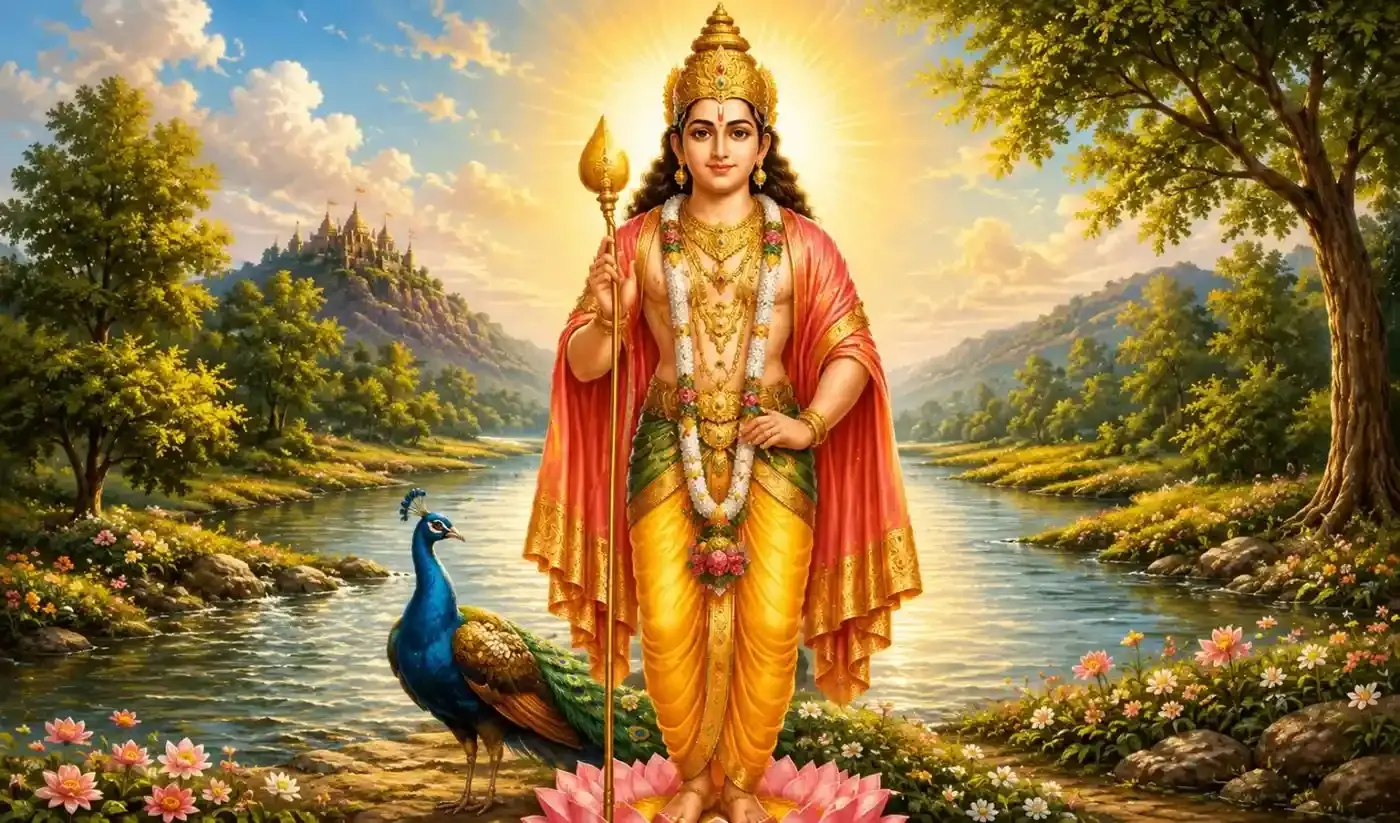
Damodarashtakam: Full Sanskrit Text with Meaning, for Kartik Month
The Damodarashtakam is the hymn to Krishna as Damodara, 'the one bound with a rope at the waist', sung with a lamp every evening of Kartik. Here is the complete text as given by sanskritdocuments.org (Satyavrata's hymn with Narada's framing verses, from the Padma Purana) in Devanagari and IAST, our own verse-by-verse English meaning, the story behind it, and how to sing it at home.
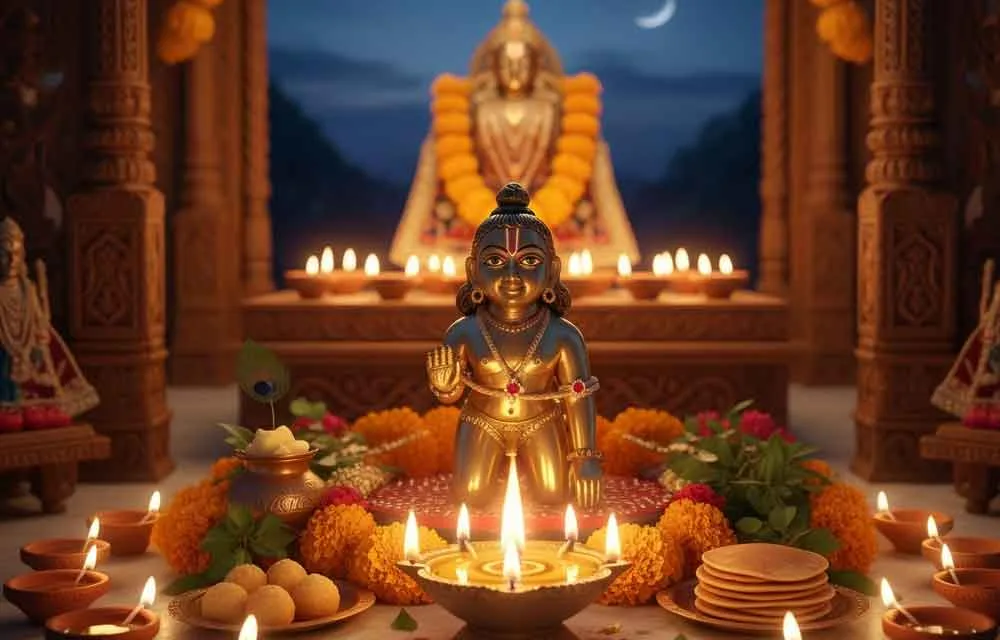
The Damodarashtakam is the hymn to Krishna as Damodara, 'the one bound with a rope at the waist', sung with a lamp every evening of Kartik. Here is the complete text as given by sanskritdocuments.
Quick answer: The Damodarashtakam is the Sanskrit hymn to Krishna as Damodara, the child his mother Yashoda tied to a grinding mortar with a rope around his waist. It is traditionally attributed to the sage Satyavrata and placed in the Padma Purana. It opens "namamishvaram sacchidananda-rupam" and is sung every evening of Kartik month while a small ghee lamp is offered. In 2026 the North Indian Kartik month begins on Tuesday 27 October and ends at Kartik Purnima on Tuesday 24 November.
Last updated: 20 October 2026. The Sanskrit below is the complete text published by sanskritdocuments.org (file satyavratoktadAmodarastotram.itx), converted to Devanagari and IAST by software from the source, with no word typed by hand. Our own plain-English meaning follows every verse.
Damodarashtakam: full text with meaning
The source sets Satyavrata's hymn inside a short narration by the sage Narada. Verses 1 to 4 tell who Satyavrata was, verses 5 to 11 are his hymn (the part sung as the Damodarashtakam), and verse 12 tells how the Lord responded. Each verse appears in Devanagari and then in IAST transliteration, followed by its meaning.
Invocation
श्रीगणेशाय नमः ॥
śrīgaṇeśāya namaḥ ||
Meaning: Salutations to Shri Ganesha.
Narada's narration: who was Satyavrata (verses 1 to 4)
Verse 1
सिन्धुदेशोद्भवो विप्रो नाम्ना सत्यव्रतः सुधीः ।
विरक्त इन्द्रियार्थेभ्यस्त्यक्त्वा पुत्रगृहादिकम् ॥ १॥
sindhudeśodbhavo vipro nāmnā satyavrataḥ sudhīḥ |
virakta indriyārthebhyastyaktvā putragṛhādikam || 1||
Meaning: There was a wise man named Satyavrata, born in the land of Sindhu, who had lost all taste for the things of the senses and had left behind his home, his children and all he owned.
Verse 2
वृन्दावने स्थितः कृष्णमारिराध दिवानिशम् ।
निःस्वः सत्यव्रतो विप्रो निर्जनेऽव्यग्रमानसः ॥ २॥
vṛndāvane sthitaḥ kṛṣṇamārirādha divāniśam |
niḥsvaḥ satyavrato vipro nirjane'vyagramānasaḥ || 2||
Meaning: Living in Vrindavan, owning nothing, alone and with a mind at peace, Satyavrata worshipped Krishna day and night.
Verse 3
कार्तिके पूजयामास प्रीत्या दामोदरं नृप ।
तृतीयेऽह्नि सकृद्भुङ्क्ते पत्रं मूलं फलं तथा ॥ ३॥
kārtike pūjayāmāsa prītyā dāmodaraṃ nṛpa |
tṛtīye'hni sakṛdbhuṅkte patraṃ mūlaṃ phalaṃ tathā || 3||
Meaning: In the month of Kartika, O king, he lovingly worshipped Damodara, eating only once in three days, and then only a leaf, a root or a fruit.
Verse 4
पूजयित्वा हरिं स्तौति प्रीत्या दामोदराभिधम् ॥ ४॥
pūjayitvā hariṃ stauti prītyā dāmodarābhidham || 4||
Meaning: Having worshipped Hari, he lovingly praised him under the name Damodara, in these words.
Satyavrata's hymn to Damodara (verses 5 to 11)
Verse 5 (hymn verse 1)
सत्यव्रत उवाच ।
नमामीश्वरं सच्चिदानन्दरूपं लसत्कुण्डलं गोकुले भ्राजमानम् ।
यशोदाभियोलूखले धावमानं परामृष्टमत्यन्ततो दूतगोप्या ॥ ५॥
satyavrata uvāca |
namāmīśvaraṃ saccidānandarūpaṃ lasatkuṇḍalaṃ gokule bhrājamānam |
yaśodābhiyolūkhale dhāvamānaṃ parāmṛṣṭamatyantato dūtagopyā || 5||
Meaning: Satyavrata said: I bow to the Lord whose form is being, awareness and bliss, whose earrings sway, who shines in Gokula; who runs from the grinding mortar in fear of Yashoda, and who is caught from behind by the cowherd mother running after him.
Verse 6 (hymn verse 2)
रुदन्तं मुहुर्नेत्रयुग्मं मृजन्तं कराम्भोजयुग्मेन सातङ्कनेत्रम् ।
मुहुःश्वासकं पत्रिरेखाङ्ककण्ठं स्थितं नौमि दामोदरं भक्तवन्द्यम् ॥ ६॥
rudantaṃ muhurnetrayugmaṃ mṛjantaṃ karāmbhojayugmena sātaṅkanetram |
muhuḥśvāsakaṃ patrirekhāṅkakaṇṭhaṃ sthitaṃ naumi dāmodaraṃ bhaktavandyam || 6||
Meaning: Crying, again and again rubbing his eyes with his two lotus hands, his eyes full of fear, sobbing again and again, the lines on his throat trembling: I praise Damodara, adored by his devotees, standing there bound.
Verse 7 (hymn verse 3)
वरं देव देहीश मोक्षावधिं वा न चान्यं वृणेऽहं वरेशादपीह ।
इदं ते वपुर्नाथ गोपालबालं सदा मे मनस्याविरास्तां किमन्यैः ॥ ७॥
varaṃ deva dehīśa mokṣāvadhiṃ vā na cānyaṃ vṛṇe'haṃ vareśādapīha |
idaṃ te vapurnātha gopālabālaṃ sadā me manasyāvirāstāṃ kimanyaiḥ || 7||
Meaning: O Lord, giver of boons, I do not ask you for liberation or its highest limit, nor for any other boon, though you are the best of givers. Only let this form of yours, O Lord, the little cowherd child, always appear in my heart. What would I do with anything else?
Verse 8 (hymn verse 4)
इदं ते मुखाम्भोजमत्यन्तनीलैर्वृतं कुन्तलैः स्निग्धवक्त्रैश्च गोप्या ।
मुहुश्चुम्बितं बिम्बरक्ताधरं मे मनस्याविरास्तामलं लक्षलाभैः ॥ ८॥
idaṃ te mukhāmbhojamatyantanīlairvṛtaṃ kuntalaiḥ snigdhavaktraiśca gopyā |
muhuścumbitaṃ bimbaraktādharaṃ me manasyāvirāstāmalaṃ lakṣalābhaiḥ || 8||
Meaning: May this lotus face of yours, framed by soft, very dark curls and kissed again and again by the cowherd mother, with lips red as the bimba fruit, appear in my mind. Of what use to me are a hundred thousand other gains?
Verse 9 (hymn verse 5)
नमो देव दामोदरानन्त विष्णो प्रसीद प्रभो दुःखजालाब्धिमग्नम् ।
कृपादृष्टिवृष्ट्याऽतिदीनं च रक्ष गृहाणेश मामज्ञमेवाक्षिदृश्यम् ॥ ९॥
namo deva dāmodarānanta viṣṇo prasīda prabho duḥkhajālābdhimagnam |
kṛpādṛṣṭivṛṣṭyā'tidīnaṃ ca rakṣa gṛhāṇeśa māmajñamevākṣidṛśyam || 9||
Meaning: Salutations to you, O Lord Damodara, endless Vishnu. Be gracious, O master, to me, sunk in an ocean of sorrows. Protect this helpless one with the rain of your merciful glance, accept me in my ignorance, and let me see you with my own eyes.
Verse 10 (hymn verse 6)
कुबेरात्मजौ वृक्षमूर्ती च यद्वत्वया मोचितौ भक्तिभाजौ कृतौ च ।
तथा प्रेमभक्तिं स्वकां मे प्रयच्छ न मोक्षेऽऽग्रहो मेऽस्ति दामोदरेह ॥ १०॥
kuberātmajau vṛkṣamūrtī ca yadvatvayā mocitau bhaktibhājau kṛtau ca |
tathā premabhaktiṃ svakāṃ me prayaccha na mokṣe''graho me'sti dāmodareha || 10||
Meaning: Just as you, while bound, freed the two sons of Kubera, who stood as trees, and made them your devotees, so give me your own loving devotion. I have no eagerness for liberation here, O Damodara.
Verse 11 (hymn verse 7)
नमस्ते सुदाम्ने स्फुरद्दीप्तधाम्ने तथोरस्थविश्वस्य धाम्ने नमस्ते ।
नमो राधिकायै त्वदीयप्रियायै नमोऽनन्तलीलाय देवाय तुभ्यम् ॥ ११॥
namaste sudāmne sphuraddīptadhāmne tathorasthaviśvasya dhāmne namaste |
namo rādhikāyai tvadīyapriyāyai namo'nantalīlāya devāya tubhyam || 11||
Meaning: Salutations to you, bound by the rope, shining with radiant light; salutations to you, the home of the whole universe that rests within you. Salutations to Radhika, your beloved, and salutations to you, the Lord of endless play.
Narada's closing verse (verse 12)
Verse 12
नारद उवाच ।
सत्यव्रतद्विजस्तोत्रं श्रुत्वा दामोदरो हरिः ।
विद्युल्लीलाचमत्कारो हृदये शनकैरभूत् ॥ १२॥
nārada uvāca |
satyavratadvijastotraṃ śrutvā dāmodaro hariḥ |
vidyullīlācamatkāro hṛdaye śanakairabhūt || 12||
Meaning: Narada said: hearing this hymn of Satyavrata, Hari, as Damodara, slowly appeared in his heart, with a wonder like the play of lightning.
Colophon
इति श्रीसत्यव्रतकृतदामोदरस्तोत्रं सम्पूर्णम् ॥
इति श्रीपद्मपुराणे रुक्माङ्गदमोहिनीसंवादे
iti śrīsatyavratakṛtadāmodarastotraṃ sampūrṇam ||
iti śrīpadmapurāṇe rukmāṅgadamohinīsaṃvāde
Meaning: Thus ends the Damodara Stotra composed by Shri Satyavrata. Thus in the Shri Padma Purana, in the dialogue of Rukmangada and Mohini.
The story behind the hymn: Krishna bound by love
The hymn pictures a scene from the childhood of Krishna in Gokula, told in the Bhagavata Purana. As the story is commonly told, Yashoda was churning butter when baby Krishna, hungry and impatient, broke a pot of curd and ran off to feed the butter to the monkeys. Yashoda came after him with a stick. Seeing her, the little boy ran, frightened, and she caught him from behind (verse 5).
To keep him still, she tried to tie him to a heavy wooden mortar. Every rope she brought fell two fingers short, however many she joined together. Only when Krishna saw how tired and loving his mother was did he allow himself to be tied. That is why he is called Damodara, 'the one with a rope at his waist', and why devotees see in this moment the Lord of the universe choosing to be bound by love.
Still tied to the mortar, Krishna crawled between two tall arjuna trees in the courtyard and pulled them down. From the trees stepped two shining beings, Nalakuvara and Manigriva, the sons of Kubera, who had been cursed to stand as trees. Freed by the child, they praised him and left as his devotees. Verse 10 refers to this: "as you freed the two sons of Kubera and made them devotees, give me loving devotion too."
What the hymn asks for
| Verse | What it says |
|---|---|
| 5 | The scene: the Lord of being, awareness and bliss, running from his mother and caught by her |
| 6 | The child crying and bound, adored by his devotees |
| 7 | No liberation, no other boon: only this child in my heart |
| 8 | His lotus face, kissed by his mother, is worth more than all other gains |
| 9 | A prayer for grace and to see him with one's own eyes |
| 10 | As he freed Kubera's sons, may he give me loving devotion |
| 11 | Salutations to the bound Lord, to Radhika and to his endless play |
The striking idea of the hymn is in verses 7 and 10. Satyavrata does not ask for liberation, wealth or long life. He asks only that the picture of the little cowherd boy, tied with a rope, should stay in his heart. For the Vaishnava traditions that love this hymn, loving devotion (prema bhakti) is the highest goal, and the hymn teaches it through a single image.
When to sing the Damodarashtakam in 2026
- Every evening of Kartik: from Tuesday 27 October to Kartik Purnima, Tuesday 24 November 2026 in the North Indian (purnimanta) reckoning. Some Vaishnava temple calendars begin a day earlier, on 26 October; see our Damodar month 2026 guide and follow your own temple's calendar.
- With Kartik snan and deepdaan: the early-morning bath and the evening lamp are the two pillars of the month; see Kartik Snan and Deepdaan 2026.
- Gopashtami: Tuesday 17 November 2026, the day Krishna is honoured as a cowherd; see Gopashtami 2026.
- Dev Uthani Ekadashi and Tulsi Vivah: Friday 20 and Saturday 21 November 2026; see Dev Uthani (Prabodhini) Ekadashi, Tulsi Vivah 2026 and Ksheerabdi Dwadasi.
- Kartik Purnima: Tuesday 24 November 2026, the last evening of the month; see Kartik Purnima 2026.
- Telugu and Kannada families: the amanta Karthika Masam runs from Tuesday 10 November to Tuesday 8 December 2026; the Karthika Masam 2026 calendar lists every day.
- Thursdays: outside Kartik, many devotees sing it on Thursdays, the day of Vishnu; see the Thursday (Guruvar) rituals guide.
How to sing it at home with a lamp
- In the evening, after lighting the house lamps, place a picture or small image of child Krishna (Damodara or Bala Gopala) on a clean plate or altar.
- Light a small ghee lamp (one or more wicks). In many homes each member of the family takes a turn to offer it.
- Sing or recite verses 5 to 11 slowly. While singing, gently wave the lamp in small circles before the Lord, or simply hold it with folded hands.
- Children can offer a flower or a tulasi leaf at each verse; tulasi is very dear to Krishna, and the Tulasi Stotram can follow.
- End with a moment of silence and the prayer of verse 7: "let this form of yours always appear in my heart".
Pronunciation help
- The hymn is in the bhujangaprayata metre: short-long-long, four times in each half-line, which gives the hymn its gentle, rolling lilt.
- In the IAST, a line over a vowel (ā, ī, ū) means it is held twice as long; ś and ṣ are 'sh' sounds; ṛ is a short 'ri'.
- Listen to a temple recording while following the IAST for a few evenings, then sing on your own.
Traditional beliefs about the hymn
The tradition holds that Kartik is the month most dear to Krishna as Damodara, and that a lamp offered to him in this month, however small, is received with love. Devotees traditionally believe that singing the Damodarashtakam:
- deepens loving devotion, which is the only thing the hymn itself asks for (verses 7 and 10);
- keeps the image of the child Krishna in the heart, as Narada's closing verse describes;
- brings the family together each evening of the month around one simple act of worship.
These are traditional beliefs about the hymn's spiritual value. No hymn guarantees particular worldly results; the Damodarashtakam is best sung simply, as an offering of love.
Tips for NRI families
- Use an electric diya where flames are not allowed. In apartments and dormitories, a battery lamp is fine; the intention matters most.
- Join a temple programme. Many Krishna and Vishnu temples abroad hold Damodar lamp offerings every evening of Kartik and invite families to offer a lamp.
- Make it a 30-evening habit. Pick a fixed time, such as just after dinner; five minutes is enough.
- Read more. See Karthika Masam mantras, the Govindashtakam, the Lord Krishna hub and daily Tulasi pooja in Kartik.
Frequently asked questions
Who wrote the Damodarashtakam?
It is traditionally attributed to the sage Satyavrata. The text we follow, from sanskritdocuments.org, calls it the Damodara Stotra spoken by Satyavrata and places it in the Padma Purana, in the dialogue of King Rukmangada and Mohini; the file also cites the Hari Bhakti Vilasa, chapter 16, as its source.
What does 'Damodara' mean?
Dama means rope and udara means belly or waist. Damodara is Krishna as the child whom his mother Yashoda tied to a grinding mortar with a rope around his waist. The name is a reminder that the Lord of the universe lets himself be bound by love.
Why is the Damodarashtakam sung in Kartik?
The month of Kartik is especially dedicated to Krishna as Damodara. Narada's framing verses in this text say that Satyavrata worshipped Damodara in Vrindavan in Kartik, and in many Vaishnava homes and temples the hymn is sung every evening of the month while a small ghee lamp is offered.
How many verses does the Damodarashtakam have?
The source we follow numbers 12 verses: verses 1 to 4 and 12 are Narada's narration, and verses 5 to 11 are Satyavrata's hymn. The hymn as sung in many temples has eight verses, including one that this source does not contain, and some words differ. We print the source exactly.
How long does it take to sing?
About five to eight minutes for Satyavrata's hymn sung slowly with a lamp offering, and a little longer with the framing verses. Many families sing it once each evening of Kartik.
What are the benefits of singing the Damodarashtakam?
The hymn itself asks for nothing but loving devotion: in verse 7 the devotee declines even liberation and asks only to see the child Krishna in his heart. Devotees traditionally believe that a lamp offered to Damodara in Kartik is very dear to the Lord. These are matters of faith, not guaranteed results.
Can children and beginners sing it?
Yes. Children love the story of Krishna and the rope. Begin with verse 5 (namamishvaram) and verse 7, read the meaning together, and let a child wave the lamp with an adult close by.
Editor's note (20 October 2026)
This page was published on 20 October 2026. The Sanskrit is the text given in Damodarastotram (Damodarashtakam) spoken by Satyavrata on sanskritdocuments.org (file satyavratoktadAmodarastotram.itx, encoded and proofread by Singanallur Ganesan and proofread by PSA Easwaran), which places it in the Padma Purana (dialogue of Rukmangada and Mohini) and gives the Hari Bhakti Vilasa, chapter 16, as its source. It was converted from ITRANS to Devanagari and IAST by software; no word has been changed. Please note two differences from the version sung in many temples: this source has seven verses in Satyavrata's hymn, where the sung version has eight (the extra verse, beginning "itidrik", is not in this file, so we have not added it), and a few readings differ, for example dutagopya in verse 5 and "namaste sudamne" at the start of verse 11. We print the source as it stands. The English meanings are our own, the story is given as commonly told, and the hymn is presented as an act of devotion, with no promise of particular results. Dates are from Drik Panchang (New Delhi) as used across HinduTone's Kartik 2026 pages.
Related guides
You might also like

Tulasi Stotram (Jagaddhatri Namastubhyam): Full Text with Meaning, for Kartik and Tulsi Vivah
Dattatreya Stotram (Jatadharam Pandurangam), Narada Purana: Full Text with Meaning
Lakshmi Narasimha Karavalamba Stotram (Adi Shankaracharya): Full Text with Meaning