
Jagannath (Vishnu) temple · Puri, Odisha, India
The Shree Jagannath Temple in Puri, on the Odisha coast, is one of the most important shrines in Hinduism. Its presiding deity is Jagannath, a form of Vishnu, who is worshipped with his elder brother Balabhadra, his sister Subhadra and the Sudarshana chakra. All four are carved wooden images seated on the jewelled platform called the Ratna Simhasana (Ratnavedi). The present temple dates from the 12th century and is counted as one of the four dhams, along with Badrinath, Dwarka and Rameswaram.
Puri is known around the world for the Rath Yatra. Every summer the deities leave the temple on three huge wooden chariots and are pulled along the Bada Danda (Grand Road) to the Gundicha temple, about 3 km away. The English word 'juggernaut' comes from Jagannatha, which means 'Lord of the World'.
Faith & Tradition
The Puri district administration names Puri as one of the four dhams of India, together with Dwarka, Badrinath and Rameswaram. Many Hindus hope to visit all four in a lifetime. Puri is also called Purushottama Kshetra or Shreekshetra. The Jagannath tradition is central to Odia religious and cultural life.
The temple is known for its food offerings. According to the temple administration, food is cooked in the temple kitchen, offered to Jagannath and then sanctified at the shrine of Goddess Vimala, after which it is called Mahaprasada. Devotees buy and share it at the Ananda Bazaar inside the complex. The Vimala shrine is itself an important centre of Shakti worship, and its sixteen-day Durga Puja is observed every year.
Some of the temple's rituals are unusual. Every year after the bathing festival the deities withdraw from public view for a period known as anasara. In certain years the wooden images are replaced altogether in the Nabakalebara ceremony. Devotees believe the divine essence moves from the old images into the new ones.
Heritage
According to the Shree Jagannath Temple Administration (SJTA), the present temple was built in the 12th century under Anantavarman Chodaganga Deva of the Eastern Ganga dynasty. The SJTA also says that the finishing work took a long time and that Anangabhima Deva III completed the temple and installed the deities in 1230 CE. The Puri district administration likewise credits Chodaganga Deva with the 12th-century construction. Encyclopaedia Britannica describes Puri as the site of the 12th-century temple of Jagannatha.
Temple tradition attributes the original shrine to a legendary king, Indradyumna. This is a matter of faith, not documented history. The SJTA's own account of the medieval period records visits by Vaishnava teachers, including Ramanujacharya. It also says that Ramanuja persuaded the king to set up a separate shrine to Lakshmi within the complex. The SJTA links the poet Jayadeva to Puri as well. His Gita Govinda came to be sung before Jagannath, and verses from it are woven into the khandua silk used in temple rituals.
Puri came under British rule in 1803, according to Britannica. In modern times the temple has been run by the SJTA under the Government of Odisha. The Nabakalebara ceremony, in which the wooden images are renewed, was held in 1996 and again in 2015. The 2015 cycle began with the Banajaga Yatra, the search for the sacred neem logs, on 29 March 2015, according to the Odisha government's Reference Annual.
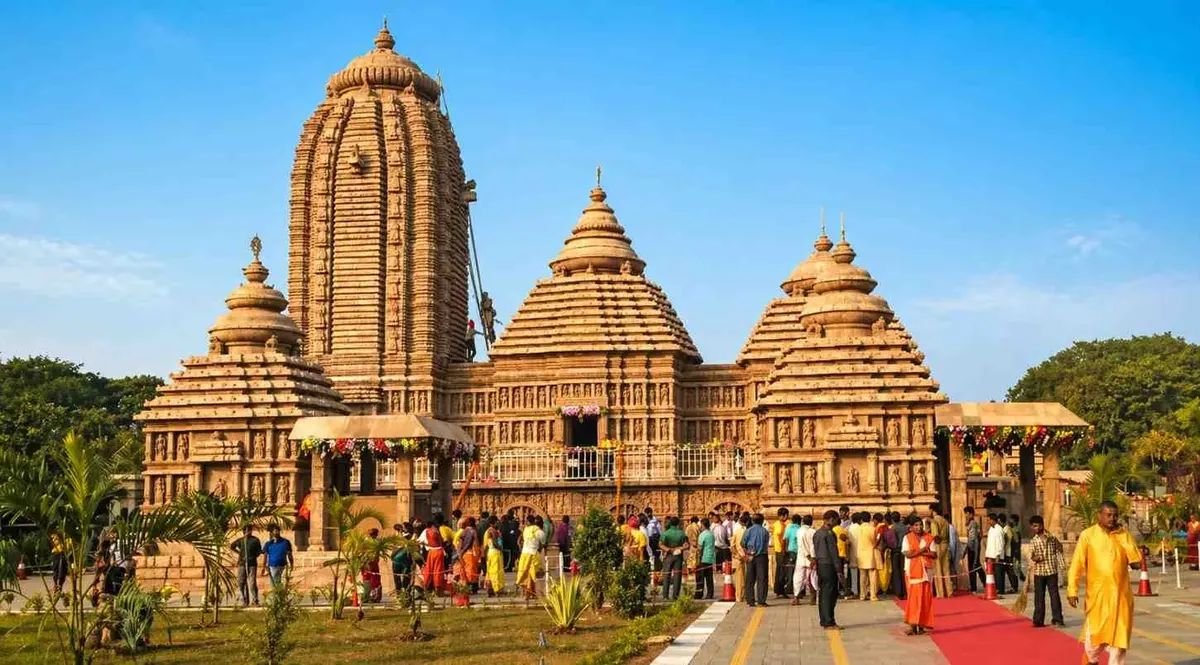
The temple follows the Kalinga style of Odisha. According to the SJTA, the main sanctum (vimana or bada deula) is a pancharatha rekha deula with a curving shikhara. It stands in a row with three halls: the jagamohana (porch, built as a pidha deula with a stepped pyramidal roof), the natamandapa and the bhogamandapa. The Puri district administration gives the height of the main temple as 65 metres, standing on a raised platform.
An older SJTA guide says the complex stands on a raised platform of more than 4,20,000 sq ft. It is enclosed by a wall about seven metres high, with four gates: the Lion Gate (east, the main entrance), the Elephant Gate (north), the Horse Gate (south) and the Tiger or Khanja Gate (west). In front of the Lion Gate stands the Aruna Stambha, a monolithic pillar that the same guide says was brought from the Sun Temple at Konark. Inside the walls are about thirty smaller shrines, including those of Vimala, Lakshmi and Ganesha, the last at the foot of the old Kalpavata banyan.
Plan Your Visit
The SJTA states that only Hindus are allowed inside the temple. Visitors of other faiths can watch the Rath Yatra procession on the Grand Road. A dress code enforced by the SJTA since 1 January 2024 bars shorts, half-pants, ripped jeans, skirts and sleeveless clothing. Footwear, leather items, mobile phones, cameras and other electronic devices are not allowed inside, and the SJTA provides free shoe and mobile deposit stands near the Lion Gate.
Darshan is available for much of the day, but it is paused or restricted during major rituals. After the Snana Yatra the deities are not seen for about two weeks during anasara. These arrangements are as described by the Shree Jagannath Temple Administration (checked October 2026). Confirm current timings and rules with the SJTA before travelling.
Timings and arrangements change with seasons and festivals. Confirm current details with Shree Jagannath Temple Administration (SJTA), Government of Odisha (official website) before travelling. Last reviewed 5 October 2026.
Sacred Calendar
On the second day of the bright fortnight of Ashadha, Jagannath, Balabhadra, Subhadra and Sudarshana are pulled on the chariots Nandighosha, Taladhwaja and Darpadalana to the Gundicha temple. Before the chariots move, the Gajapati king sweeps the chariot floors with a golden broom in the chhera pahanra ritual.
The return journey from the Gundicha temple takes place on the tenth day of the bright fortnight of Ashadha. It is followed by rites such as Suna Besha and the deities' re-entry into the main temple (Niladri Bije).
The wooden deities are brought to the Snana Vedi and bathed with 108 pitchers of water mixed with sandal paste, camphor and other fragrances. Balabhadra and Jagannath are then dressed in the elephant-faced Gajanana Besha.
After the bathing festival the deities stay in seclusion until the new moon of Ashadha. According to tradition they are unwell, and only designated servitors attend them. Public darshan is not available during this time.
The temple administration lists Chandan Yatra, beginning on Akshaya Tritiya, among the twelve traditional festivals (dvadasa yatras) of Jagannath.
The wooden images are replaced with new ones carved from specially chosen neem trees. The SJTA says it falls at intervals of 8, 11, 12 or 19 years, and the most recent cycles were in 1996 and 2015.
Location
The nearest airport is Biju Patnaik International Airport in Bhubaneswar. The Puri district administration puts it about 60 km from the temple. Puri railway station is a terminus with direct trains to many Indian cities, and the district administration gives its distance from the temple as about 3 km. Buses, taxis and auto-rickshaws run from Bhubaneswar and from Puri station.
According to the SJTA, the Lion Gate on the Bada Danda is the only entry point for devotees, and the other three gates are used as exits. Free battery-operated vehicles have been provided from the Jagannatha Ballav parking area to the temple for senior citizens and people with disabilities. Confirm current arrangements with the SJTA before travelling.
Location: Puri, Odisha, India
Nearest airport: Biju Patnaik International Airport, Bhubaneswar (about 60 km, per Puri district administration)
Nearest railway station: Puri railway station (about 3 km, per Puri district administration)
More in Hindu temples in Odisha · Jagannath (Vishnu) temples
Photographs
Questions
The Shree Jagannath Temple Administration and the Puri district administration credit the present temple to Anantavarman Chodaganga Deva of the Eastern Ganga dynasty in the 12th century. The SJTA adds that Anangabhima Deva III completed it and installed the deities in 1230 CE.
No. The temple administration states that only Hindus are allowed inside. Everyone can watch the Rath Yatra on the Grand Road.
Nandighosha carries Jagannath, Taladhwaja carries Balabhadra and Darpadalana carries Subhadra, according to the SJTA.
They are taken there on the second day of the bright fortnight of Ashadha and return on the tenth day for the Bahuda Yatra. The SJTA describes this as a stay of about a week.
After the Snana Yatra on Jyeshtha Purnima, tradition holds that the deities fall ill and rest in seclusion (anasara) until the new moon of Ashadha. Public darshan is not available during this period.
Yes. Since 1 January 2024 the SJTA has barred shorts, half-pants, ripped jeans, skirts and sleeveless clothing. Confirm the current rules with the temple administration before your visit.
It is the ceremony in which the wooden images of the deities are replaced with new ones carved from sacred neem logs. It is usually held in a year with an extra Ashadha month, and the most recent ones were in 1996 and 2015.
The Puri district administration puts Biju Patnaik International Airport in Bhubaneswar about 60 km from the temple. Puri railway station is about 3 km away.
Spotted an error? Write to info@hindutone.com — see our editorial policy.
Pilgrim Circuit
