Welcome to the Sanctum
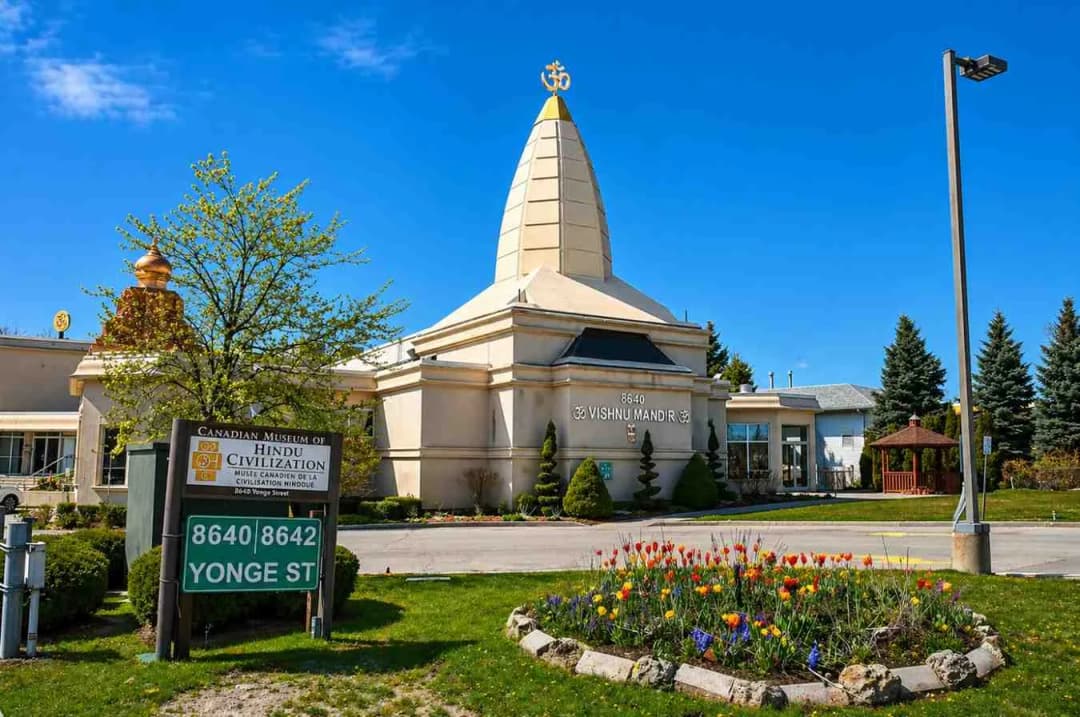
Vishnu Mandir in Richmond Hill, Ontario is one of the most visually distinctive Hindu temples in North America — home to a 50-foot (15-metre) concrete-and-fibreglass Hanuman murti, the tallest outdoor Hanuman statue on the continent, which dominates the Yonge Street skyline and has become a landmark for passing motorists along the Highway 7 corridor. Founded in 1981 by the pioneering Indo-Caribbean physician Dr. Budhendra Doobay, the mandir is one of Canada’s oldest and serves a unique congregation blending Indian, Trinidadian, Guyanese and Surinamese Hindu traditions.
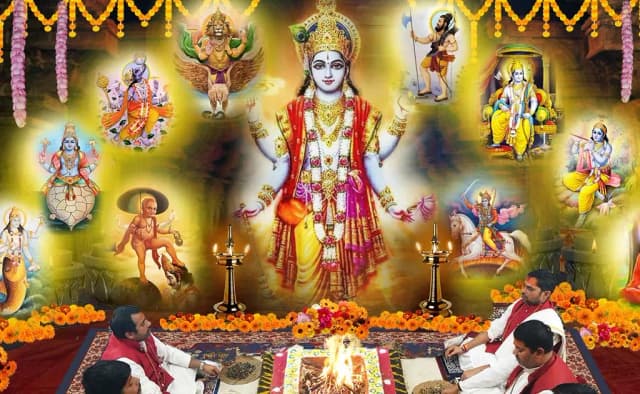
The main mandir is dedicated to Maha Vishnu reclining on Adishesha with Goddess Lakshmi, with sub-shrines to Ram-Sita-Lakshman, Radha-Krishna, Shiva-Parvati-Ganesh, Durga Mata and Ayyappa Swami. Attached to the mandir is the Canadian Museum of Hindu Civilization — the first Hindu museum in North America — featuring a permanent gallery on the history of Hindu migration from India through the Caribbean to Canada, and the struggles and achievements of Indo-Caribbean Hindus building their spiritual home in Toronto.
— ॐ नमो नारायणाय —
Heritage
The story carved into stone, copper, and prayer.
Dr. Budhendra Doobay emigrated to Canada from Guyana in 1972 and quickly noticed the spiritual vacuum felt by the Indo-Caribbean Hindu community, who had maintained faith through three generations of Caribbean indenture and now found themselves in a new country. In 1980 he purchased a small residential property on Yonge Street in Richmond Hill and began conducting weekly Sabha services in his own home; within a year attendance had outgrown the house, and in 1981 a simple wooden mandir was built on the site.
The mandir grew organically through the 1980s and 1990s as the Indo-Caribbean community in the GTA grew from a few hundred families to over 100,000. In 2002 the original wooden mandir was replaced with the current stone-and-concrete temple, consecrated by pandits from India and Guyana. The Canadian Museum of Hindu Civilization opened in 2005 with support from the Government of Ontario.
In 2010 Dr. Doobay commissioned one of the most ambitious Hindu art projects in Canadian history: a 50-foot outdoor Hanuman murti, the tallest outside India at the time. Designed by Indian sculptors and constructed from steel-reinforced concrete with fibreglass outer layer finished in weather-resistant saffron, the murti was unveiled at a public Pran Pratishtha ceremony attended by 10,000 devotees and the Premier of Ontario. The statue is now a mandatory pilgrimage point for Hanuman devotees across North America, particularly on Hanuman Jayanti when up to 20,000 devotees visit.
Vishnu Mandir has expanded further with a Yog Shala, a classical music academy, a Sanskrit school, and a Hindu community food bank distributing over 200,000 meals annually. A major renovation in 2019 added the Atmavidya Hall for youth programming, and in 2023 the mandir celebrated 42 years of continuous service with a commemorative plaque from Parliament Hill.
Sacred Offerings
Offerings performed by ordained priests under the guidance of vedic tradition — for every milestone of life.
Free attendance / sponsor CAD 108
Weekly recitation of the Hanuman Chalisa beneath the 50-foot Hanuman murti — a signature event of Vishnu Mandir.
Book Now →CAD 251
Full Satyanarayan vrat katha performed by temple pandits in the Indo-Caribbean tradition with Hindustani bhajans.
Book Now →CAD 151
Monthly panchamrit abhishek on the reclining Vishnu murti — a rare devotional seva.
Book Now →CAD 351
Fire rituals performed for births, marriages, grihapravesham and memorial occasions.
Book Now →CAD 501
Sponsor the traditional Sunday Sabha prasadam served to all attendees following the worship service.
Book Now →Daily Worship
Open all days of the year
Sacred Calendar
Days that turn the temple into a constellation of light, music, and shared prayer.
The signature festival of Vishnu Mandir — 20,000+ devotees attend for Hanuman Chalisa chanting at the foot of the 50-foot murti, with fire-walking and laddoo procession.
Lakshmi Puja, Annakut and the traditional Indo-Caribbean "Divali Nagar" cultural programme — a Trinidadian variant of Diwali celebration.
The Indo-Caribbean "Phagwa" tradition with Chowtal singing and gulal play — a distinctively Caribbean-Hindu festival experience.
Week-long Ramayan path in Awadhi with Tulsidas-style kirtan, culminating in Sita-Ram Kalyanam.
Lord Krishna’s birth celebrated with Hindustani bhajan mandali and midnight abhishek.
Sacred Moments
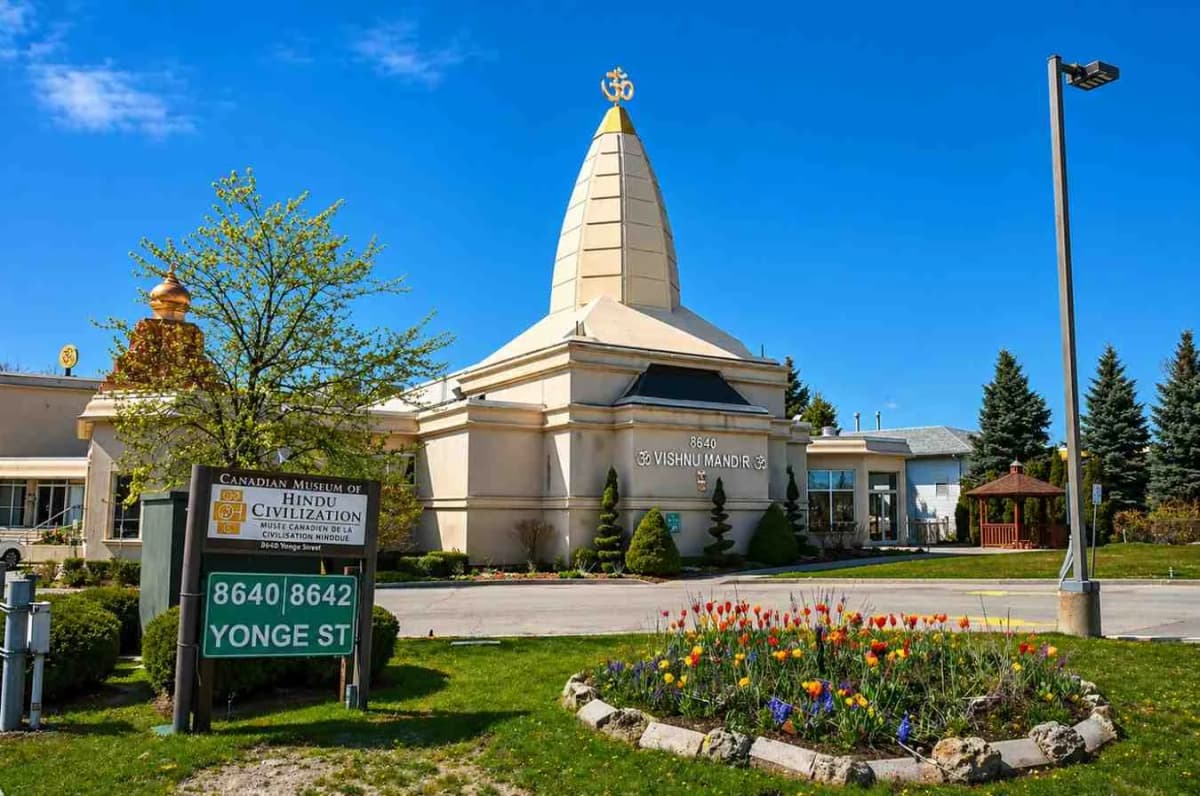
A visual pilgrimage — captured in the soft light of dusk and the gold of dawn.
Devotee Voices
Words from those whose lives were touched within these walls.
The first time I climbed the steps to Vishnu Mandir, I felt the weight of every mistake fall away. By the time I reached the sanctum, I was weeping — and laughing. Lord Vishnu works that way here.
We had been waiting years for our daughter's marriage to settle peacefully. After three visits to Vishnu Mandir and the Richmond Hill family praying together, it happened in three months. We will never miss the annual darshan again.
I was a sceptic when my mother first dragged me here. Now I plan my work travel around the temple's calendar. The Suprabhatam at dawn is something every Indian should hear once in their life.
Plan Your Visit
Address: 8640 Yonge Street, Richmond Hill, Ontario L4C 6Z4, Canada, Richmond Hill, Ontario, Canada L4C 6Z4
Nearest airport: Toronto Pearson International (YYZ) — 28 km
Nearest railway: Langstaff GO Station — 2 km
Nearest bus stand: York Region Transit / Viva bus on Yonge Street
Phone: +1 905-886-1724
Email: info@vishnumandir.com
Official website: vishnumandir.com