
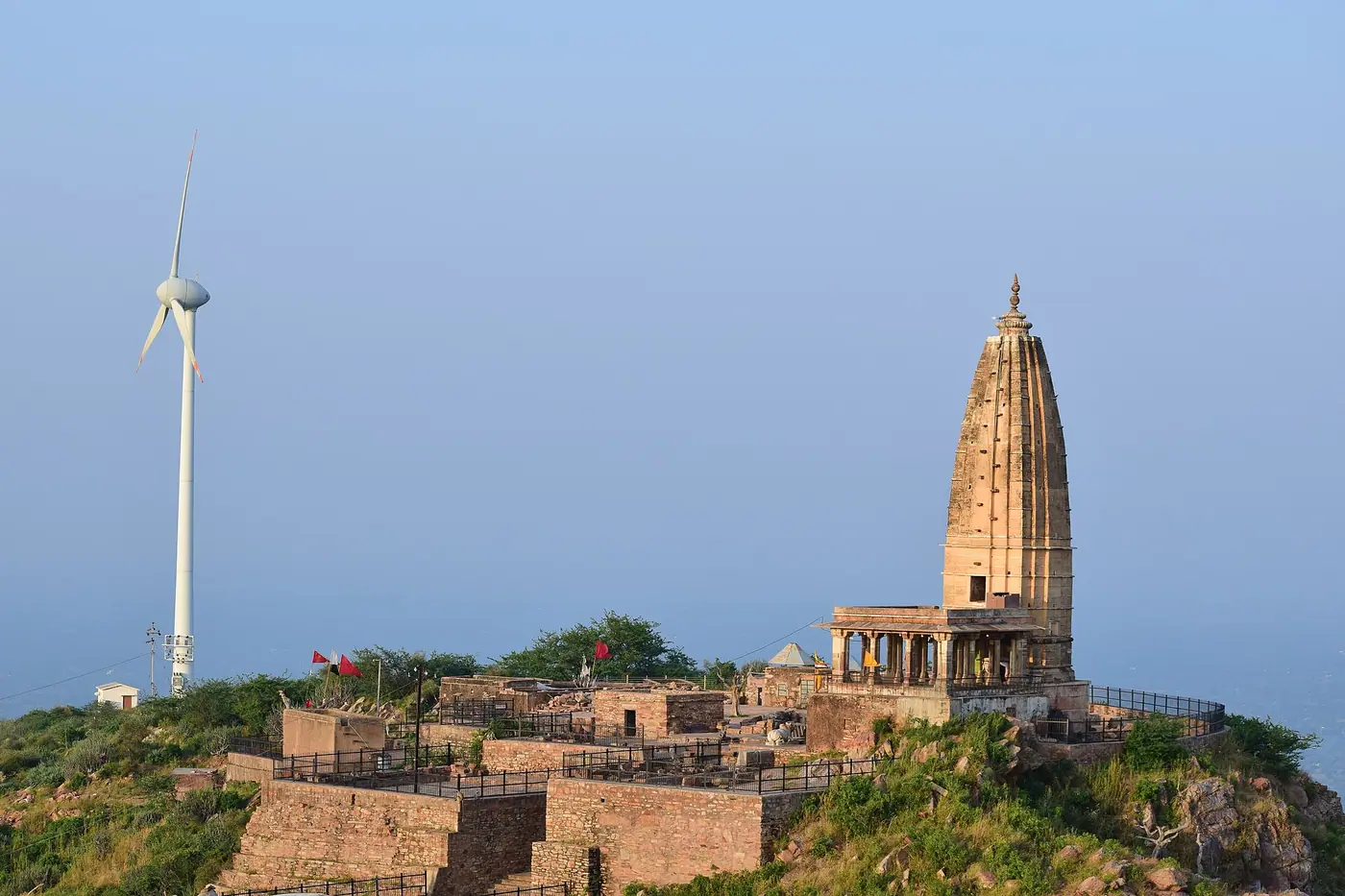
Harsh Nath Temple
Shiva (as Harsha, lord of the mountain) temple · Near Sikar, Sikar, Rajasthan, India
Photo: Mahaveershekhawat77 · CC BY-SA 4.0 · via Wikimedia Commons
Harshnath Temple is a ruined 10th-century Shiva temple on top of Harsha hill (ancient Harshagiri) in Sikar district, Rajasthan, about 14 km from Sikar town. Shiva was worshipped here as Harsha, the lord who lives on the mountain. Despite its ruined state, the temple is one of the most important early medieval monuments in the Shekhawati region.
The Archaeological Survey of India protects the site as a monument of national importance. It is known for the quality of its carving and for a long Sanskrit inscription that records how the temple was built. The Chahamana (Chauhan) rulers of Shakambhari treated Lord Harsha as their family deity and made the hill their main royal religious centre.
Faith & Tradition
Religious Significance of Harsh Nath Temple
The temple's stone inscription praises Shiva as Harsha. It explains the name with a story: Shiva, full of joy (harsha) after destroying the demon cities of Tripura, came to live on this mountain. In the poem the hill becomes Shiva's second home, an earthly version of Kailasa. In her study of the site, the scholar Elizabeth Cecil shows that the Chahamanas honoured Harsha as their kuladeva (lineage deity) and that donations from kings, local people and merchants paid for the temple.
Harshnath is also a key site for the history of the Pashupata Shaiva ascetics. The temple's builder, Allata (also called Bhavarakta), was a Pashupata teacher, and the inscription lists the line of ascetics who lived on the mountain. Today the hill is still visited for worship. Rajasthan Tourism says thousands of devotees come during Navratri and Maha Shivaratri, and part of the old complex is now an active Bhairava shrine.
Heritage
History of Harsh Nath Temple
According to the ASI, the temple was built by the Shaiva ascetic Bhavarakta, alias Allata, during the reign of the Chahamana king Vigraharaja, as recorded in an inscription dated 973 CE. Cecil's reading of the same inscription finds three dates in it. The temple was completed in VS 1013 (956 CE), Allata died in VS 1027 (970 CE), and the last recorded donations date to VS 1030 (973 CE). After Allata's death his pupil Bhavadyota continued work at the site.
The inscription was found among the rubble of the main temple in 1834 and is now kept in the Government Museum, Sikar. Kielhorn published an edition of it in Epigraphia Indica in 1894. Its royal eulogy is one of the main sources for early Chahamana history, and it names Chahamana rulers such as Simharaja as donors. Merchants also gave money, including salt traders from Shakambhari (Sambhar), whose salt lake lay on a trade route that passed Mount Harsha.
The main shrine and the many smaller shrines around it are now ruins. The ASI notified the site as protected in 1951. Many loose sculptures from the hill, including a dancing Shiva, a reclining Vishnu and images of the Mother goddesses (Matrikas), are now in the government museums at Sikar and Ajmer.
Architecture and sacred features
The ASI describes the main temple as facing east. It has a pancharatha sanctum (a sanctum whose walls are broken into five projections) joined to a rangamandapa (hall) with four central pillars and side transepts with seat-back balustrades. In front, on the same axis, stood a separate Nandi pavilion and a distant torana (gateway). The pillars are richly carved. Inside the sanctum, the west wall has a standing image of Parvati, labelled Vikata, performing the penance of the five fires, with female attendants on either side.
Carved panels, lintels and fallen architectural pieces lie around the hilltop. They include a lintel showing Lakulisha, the teacher revered by the Pashupatas, and panels showing worship of the linga.
Plan Your Visit
Darshan and Visitor Information
The ASI lists no entry fee and mentions parking and toilets at the site. Remember that this is a protected monument: do not climb on the ruins or move loose sculptures. Arrangements can change, so confirm current arrangements with the Archaeological Survey of India, Jaipur Circle, before visiting.
Timings and arrangements change with seasons and festivals. Confirm current details with Archaeological Survey of India, Jaipur Circle before travelling. Last reviewed 5 October 2026.
Sacred Calendar
Festivals at Harsh Nath Temple
Maha Shivaratri
Rajasthan Tourism says thousands of devotees climb to Harshnath on Maha Shivaratri to worship Shiva at the hilltop.
Navratri
Rajasthan Tourism also names Navratri as a season of large pilgrim gatherings at Harshnath.
Location
How to Reach Harsh Nath Temple
Harshnath is about 14 km from Sikar town, according to Rajasthan Tourism, and stands on a hill about 900 m high. The ASI lists Jaipur as the nearest airport and Sikar as the nearest railway station and bus point. The last stretch is a climb by road up the hill, so check local road conditions before you go.
Location: Near Sikar, Sikar, Rajasthan, India
Nearest airport: Jaipur
Nearest railway station: Sikar
More in Hindu temples in Rajasthan · Shiva (as Harsha, lord of the mountain) temples · Temples in Sikar Gramin Tehsil · Temples in Sikar District
Questions
Harsh Nath Temple: Frequently Asked Questions
Who built Harshnath Temple?
Its inscription credits the Pashupata Shaiva teacher Allata, also called Bhavarakta, with building the temple. It was built during the reign of the Chahamana (Chauhan) dynasty, and its kings were major donors.
How old is Harshnath Temple?
The inscription records the temple's completion in 956 CE and later donations up to 973 CE. That makes it a 10th-century monument.
Why is the temple called Harshnath?
Shiva was worshipped here as Harsha, the joyful lord of the mountain, and the hill itself was called Harsha or Harshagiri. The inscription links the name to Shiva's joy after destroying Tripura.
Where is the Harshnath inscription kept now?
It was found among the ruins of the main temple and is now in the Government Museum at Sikar.
How far is Harshnath from Sikar?
Rajasthan Tourism gives the distance as about 14 km from Sikar town. The temple stands on a hill about 900 m high.
Is Harshnath Temple protected?
Yes. It is a centrally protected monument under the Archaeological Survey of India, Jaipur Circle, notified in 1951.
Sources and attribution
- © OpenStreetMap contributors — location data © OpenStreetMap contributors (ODbL)
- Wikidata Q5673931 — structured data (CC0)
- Wikipedia — Harshnath Temple — text facts from Wikipedia, licensed CC BY-SA 4.0
- Archaeological Survey of India, Jaipur Circle — Harshnath Temple (monument page)
- Department of Tourism, Government of Rajasthan — Shekhawati – Harsh Nath
- Brill (Elizabeth A. Cecil, 2020, open access) — Mapping the Pāśupata Landscape: Narrative, Place, and the Śaiva Imaginary in Early Medieval North India (ch. 3, 'The Salt Lakes')
Further reading: Harsh Nath Temple on Wikipedia (CC BY-SA 4.0).
Spotted an error? Write to info@hindutone.com — see our editorial policy.
Pilgrim Circuit