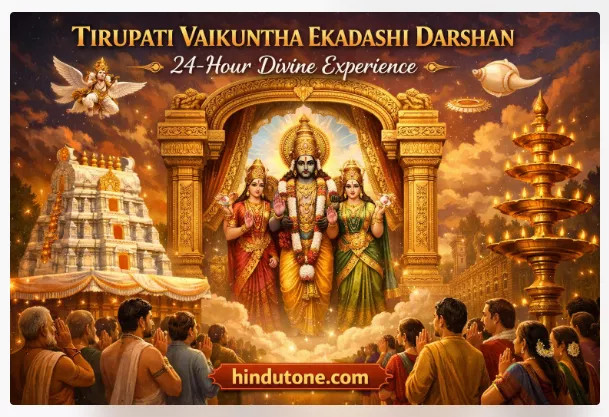
TTD Announces Special Vaikuntha Dwara Darshan Quota for Local Devotees | January 2025 Update
Tirumala Tirupati Devasthanams (TTD) has announced welcome news for local devotees eagerly awaiting the sacred Vaikuntha Dwara Darshanam of Lord Sri…
Tirumala Tirupati Devasthanams (TTD) has announced welcome news for local devotees eagerly awaiting the sacred Vaikuntha Dwara Darshanam of Lord Sri…
Update (October 2026): Vaikuntha Ekadashi 2026 falls on Sunday, 20 December (Saturday, 19 December for Smarta households in the USA and Canada). This article describes an earlier observance — for current dates and guidance, see our Vaikuntha Ekadashi 2026 guide.
Tirumala Tirupati Devasthanams (TTD) has announced welcome news for local devotees eagerly awaiting the sacred Vaikuntha Dwara Darshanam of Lord Sri Venkateswara. A special quota of darshan tokens will be issued exclusively for residents of Tirumala, Tirupati, Renigunta, and Chandragiri.
For darshan on January 6, 7, and 8, TTD will allocate 5,000 tokens per day. Interested local residents can register their details from today until 5:00 PM on the 27th of this month. Registration can be completed through the TTD official website, mobile application, or WhatsApp using the 1+3 registration method.
Out of the total daily quota:
- 4,500 tokens will be allotted to residents of Tirupati, Renigunta, and Chandragiri
- 500 tokens will be reserved for Tirumala residents
The beneficiaries will be selected through the ‘e-dip’ system, and the final list will be announced at 2:00 PM on the 29th of this month. TTD has urged eligible local devotees to take full advantage of this special opportunity.
January–February Festival Schedule at Sri Govindaraja Swamy Temple, Tirupati
In addition, TTD has released the schedule of important festivals to be celebrated at the Sri Govindaraja Swamy Temple during January and February:
- January 3 – Pournami Garuda Seva
- January 14 – Bhogi Theru
- January 16 – Goda Kalyanam
- January 17 – Parveti Utsavam
- January 25 – Ratha Saptami
- January 27 to February 1 – Teppotsavams (to be conducted grandly)
Devotees are encouraged to participate in these auspicious events and seek the divine blessings of Lord Govindaraja Swamy.
What is Vaikuntha Dwara Darshanam and Why Is It Considered Supremely Auspicious?
Vaikuntha Dwara Darshanam refers to darshan of Lord Sri Venkateswara through the Vaikuntha Dwaram — the sacred northern gate of the Ananda Nilayam sanctum sanctorum at Tirumala. This gate, ordinarily kept closed throughout the year, is opened exclusively during the ten-day Vaikuntha Ekadasi festival, known at Tirumala as Mukkoti Dwadasi. Tradition holds that passing through this gateway is spiritually equivalent to entering Vaikuntham, the eternal abode of Lord Vishnu himself.
The theological basis for this belief rests in the Vaishnava Agama tradition and the Srivaishnava sampradaya established by Sri Ramanujacharya. According to the Pancharatra Agamas, the northern gate of a Vishnu temple is associated with moksha-marga, the path of final liberation. Devotees believe that a single darshan through the Vaikuntha Dwaram during Ekadasi or Dwadasi tithi washes away accumulated sins across several lifetimes and grants direct access to the Lord's grace.
Historical and Scriptural Roots of Vaikuntha Ekadasi at Tirumala
Vaikuntha Ekadasi falls on the Shukla Paksha Ekadasi of the Margazhi month (December–January) in the Tamil and Telugu calendar. The Padma Purana dedicates an entire section — the Uttara Khanda — to the glory of Ekadasi vratas, declaring that the Ekadasi of the Dhanur masa (Margazhi) is the most exalted among all twenty-four annual Ekadasis. It is on this day that, according to Vaishnava belief, Lord Vishnu slew the demon Muran after resting in yogic sleep, and therefore the day is also called Murarari Ekadasi.
At Tirumala, the festival has been observed for several centuries and is described in the temple's inscriptional records maintained by TTD's own Agama and Heritage departments. The Alwars — Tamil Vaishnava poet-saints — composed numerous Prabandha verses celebrating Lord Vishnu's Vaikuntham, which are sung in their entirety during these ten days in a recitation called Saatrumurai, underscoring the deep interlinking of this festival with the Nalayira Divya Prabandham corpus.
How Does the e-Dip Token System Work and What Should Local Devotees Know?
TTD's e-dip (electronic draw by lot) system is a computerised random selection process designed to ensure fair and transparent distribution of darshan tokens when demand far exceeds availability. Applicants who register within the stipulated window — in this case, by 5:00 PM on the 27th — are entered into a digital lottery pool. The system then draws names impartially, and the selected list is published at 2:00 PM on the 29th, giving beneficiaries adequate time to prepare for their January 6, 7, or 8 darshan.
Registration follows the 1+3 method, meaning one primary applicant can register up to three additional family members under a single application. Residents must ensure their Aadhaar-linked address or locally verifiable documents confirm their residence in Tirumala, Tirupati, Renigunta, or Chandragiri, as TTD officers will cross-check eligibility. Applicants are advised to use only the official TTD website (tirupatibalaji.ap.gov.in), the official TTD mobile application, or the designated WhatsApp number to avoid fraudulent third-party registration services.
The Significance of Sri Govindaraja Swamy Temple and Its Teppotsavam Festival
The Sri Govindaraja Swamy Temple in the heart of Tirupati city is one of the 108 Divya Desams — the sacred Vishnu shrines celebrated by the Alwar saints in the Nalayira Divya Prabandham. The presiding deity, Lord Govindaraja, is believed to be Balaji's elder brother, and pilgrims often visit this temple before or after ascending to Tirumala. The temple's gopuram and mandapam architecture belong to the Vijayanagara style, and the complex houses shrines for Goddess Pushpasayi (Andal) and other associated deities.
Among the listed festivals, Teppotsavam — scheduled grandly from January 27 to February 1 — is a float festival in which the utsava murtis (processional deities) are ceremonially placed on a decorated float (teppa) and taken around the temple's pushkarini (sacred tank). This ritual, common to major South Indian Vaishnava temples including the Srirangam Ranganathaswamy Temple and the Madurai Meenakshi Amman Temple, symbolises the Lord's grace extending across water, which in Agamic symbolism represents samsara, the ocean of worldly existence. Devotees gathered along the tank banks receive direct darshan of the adorned deity on water, considered highly meritorious.
Goda Kalyanam — Celebrating the Wedding of Andal with Lord Vishnu
The Goda Kalyanam scheduled on January 16 at Sri Govindaraja Swamy Temple commemorates the divine wedding of Andal (Godadevi), the only female Alwar saint, with Lord Ranganatha of Srirangam. Andal, born in Srivilliputtur in Tamil Nadu, is celebrated as an avatara of Bhumi Devi (Earth Goddess) and composed two immortal works: the Thiruppavai (thirty verses) and the Nachiyar Thirumozhi (143 verses). The Thiruppavai is recited every morning during the entire Margazhi month in Vaishnava temples across India.
During Goda Kalyanam, the idol of Andal (worshipped as Pushpasayi in Tirupati) is ceremonially wedded to Lord Govindaraja in a re-enactment of her spiritual union with the Lord. The ritual follows Vaidika and Agamic wedding rites performed by temple archakas, and devotees witnessing this event seek blessings for harmonious marital life and devotion to Lord Vishnu. The celebration holds special resonance during Margazhi, as Andal herself observed the Pavai nonbu (vow) during this month, an act that the Thiruppavai verses describe in vivid detail.
Ratha Saptami at Tirupati — The Solar Festival and Its Vedic Significance
Ratha Saptami, falling on January 25 in this schedule, is the seventh day (Saptami tithi) of the bright fortnight of the month of Magha. It marks the point in the solar calendar when Surya (the Sun God) is said to turn his chariot — the divine ratha drawn by seven horses representing the seven colours of visible light and the seven Chandas (Vedic metres) — northward in full vigour. This day is also known as Surya Jayanti and Arogya Saptami, celebrated for bestowing health and vitality.
At Tirumala, Ratha Saptami is one of the grandest annual festivals: Lord Sri Venkateswara is taken out in a magnificent procession on the Surya Prabha Vahanam (the Sun chariot vehicle), one of the most spectacular among the temple's many sacred vahanas. The Rigveda contains several Surya suktas (hymns to the Sun), and the Saura tradition within Shaiva-Vaishnava synthesis has always regarded the Sun as a visible, daily manifestation of Brahman. Devotees who take ritual bath (called Aruna snanam) before sunrise on Ratha Saptami, while placing Ekka (Calotropis) leaves on their head, are said to gain the spiritual merit of bathing in all sacred tirthas simultaneously, as stated in the Bhavishya Purana.
Frequently Asked Questions
Who was eligible for TTD's special Vaikuntha Dwara Darshan quota?
The quota was reserved for residents of Tirumala, Tirupati, Renigunta and Chandragiri. TTD officers cross-check eligibility using Aadhaar-linked or locally verifiable address documents.
How many local darshan tokens did TTD allot per day?
TTD allotted 5,000 tokens per day for darshan on January 6, 7 and 8. Of these, 4,500 went to residents of Tirupati, Renigunta and Chandragiri, and 500 to Tirumala residents.
How did local devotees register for the Vaikuntha Dwara Darshan tokens?
Registration was open on the TTD official website, the mobile app or WhatsApp until 5:00 PM on the 27th, using the 1+3 method. One primary applicant can add up to three family members.
How were token holders chosen and when was the list announced?
Winners were picked through the e-dip system, a computerised random draw. The final list was announced at 2:00 PM on the 29th of the month.
What is the Vaikuntha Dwaram at Tirumala and why is it special?
It is the northern gate of the Ananda Nilayam sanctum, kept closed through the year and opened only during the ten-day Vaikuntha Ekadasi festival. Tradition holds that passing through it is equal to entering Vaikuntham, Lord Vishnu's abode.
Which festivals were scheduled at Sri Govindaraja Swamy Temple in January?
The schedule listed Pournami Garuda Seva on January 3, Bhogi Theru on January 14, Goda Kalyanam on January 16, Parveti Utsavam on January 17 and Ratha Saptami on January 25. Teppotsavams ran from January 27 to February 1.
You might also like
Tirumala VIP Darshan Summer 2026: TTD Big Update — VIP Break Darshan Suspended, Special Entry Darshan Guide & Summer Heat Tips for Devotees

Tirumala Latest News April 2026: Padmavati Parinayotsavam Live Updates, Darshan Stats & Devotee Donations
Tirumala Tirupati Devasthanams Daily Update -Wednesday, November 12, 2025