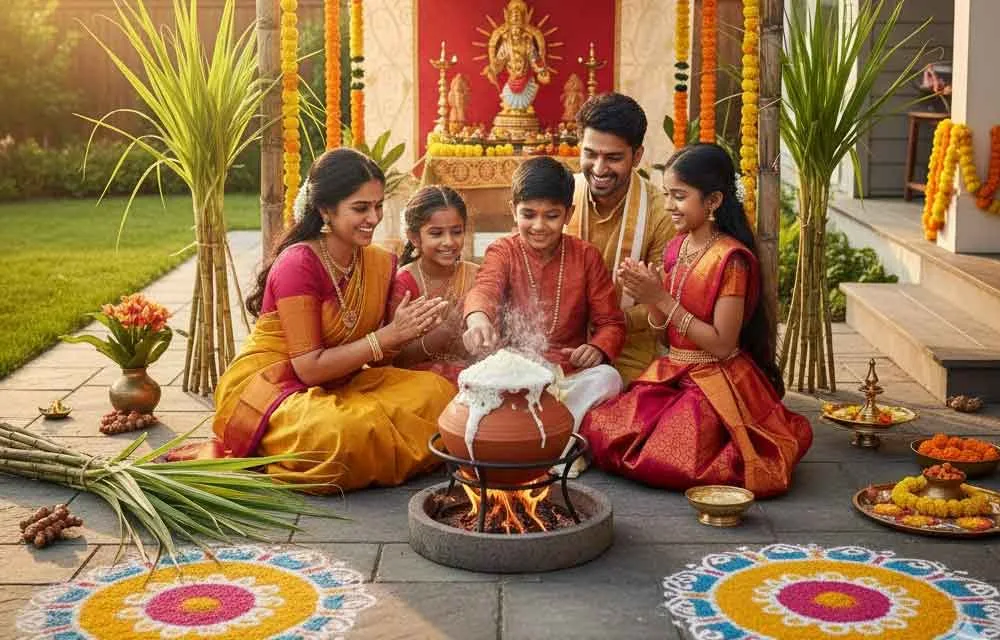
Pongal is the four-day Tamil harvest festival celebrated at Makara Sankranti — when the Sun transitions into Makara rashi and begins its northern journey (Uttarayana). One of the few Hindu festivals that follows the solar rather than lunar calendar, Pongal falls on the same Gregorian date each year (14 January, or 15 in leap years). The festival thanks Surya the Sun-god for the harvest, the cattle that worked the fields, and the family bonds that sustain rural life. Pongal — the dish — is sweet milk-rice boiled in a new clay pot until it overflows, symbolising abundance overflowing the family. Pongal 2026 runs 14–17 January, with the main Surya Pongal day on Wednesday, 14 January. HinduTone's Pongal hub covers the full festival cycle: Day 1 Bhogi Pongal (the bonfire day where old items are burnt to welcome the new); Day 2 Surya Pongal (the main day — Pongal cooked outdoors in new earthen pots facing East, offered to the Sun, with 'Pongalo Pongal!' shouted when the rice overflows); Day 3 Mattu Pongal (the day cattle are bathed, decorated with garlands and turmeric, and worshipped — including the Jallikattu tradition); Day 4 Kanu Pongal (women place rice balls on banana leaves for crows and sisters pray for their brothers' welfare). We cover the broader Sankranti picture: how Punjab celebrates the same astronomical event as Lohri, Andhra as Sankranti (with Bhogi, Sankranti and Kanuma sub-days), and how the Tamil diaspora across Sri Lanka, Singapore, Malaysia, Mauritius and the West celebrates Pongal in their adopted homes. Includes the traditional Pongal recipe (chakkara pongal and venn pongal), the Pongal panai (cooking pot) tradition, and the kolam designs that grace every Tamil household's threshold during the festival.
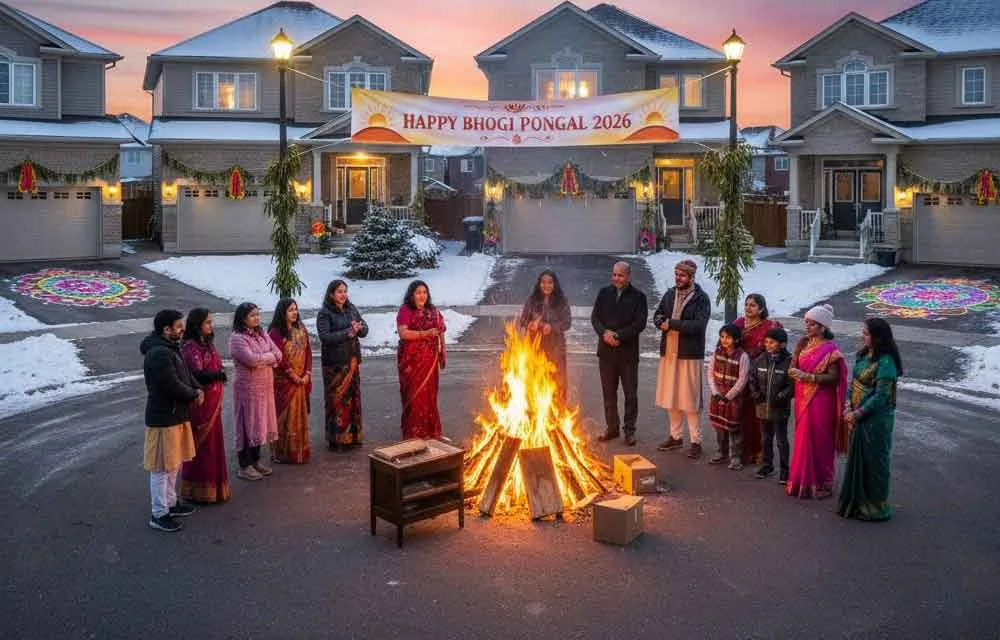
Pongal 2026 runs 14–17 January. Bhogi Pongal: 14 Jan. Surya Pongal (main day): 15 Jan. Mattu Pongal: 16 Jan. Kanu Pongal: 17 Jan. The festival aligns with Makara Sankranti (Sun entering Makara rashi).
Boil milk in a new earthen pot until it overflows — the "Pongalo Pongal!" moment. Add raw rice, jaggery (or sugar), cashews, green cardamom, ghee, and a pinch of saffron. Stir, cook to a thick consistency. Offer first portion to Surya (the Sun-god) outside the home, then to family. Salt-based Venn Pongal uses moong dal, pepper, ginger and cumin instead.
The third day of Pongal honouring cattle — bulls, cows and buffaloes that worked the fields. Animals are bathed, painted with turmeric and saffron, garlanded, and fed special pongal. In rural Tamil Nadu, the traditional Jallikattu bull-taming competition is held — a 2000-year-old practice protected by special legislation since 2017.
Same astronomical event (Sun entering Makara), different regional names: Pongal in Tamil Nadu (4-day festival), Sankranti in Andhra/Karnataka (3-day festival with Bhogi/Sankranti/Kanuma), Lohri in Punjab (1-day bonfire festival), Magh Bihu in Assam, Khichdi in UP/Bihar. All celebrate the Sun's northward turn.
Yes — large Tamil diaspora communities in Singapore, Malaysia, Sri Lanka, Mauritius, the UK, Canada, the USA and Australia celebrate Pongal. Singapore designates it a public holiday for the Tamil community. Most diaspora celebrations focus on Surya Pongal (the main day), often shifted to the nearest weekend.
