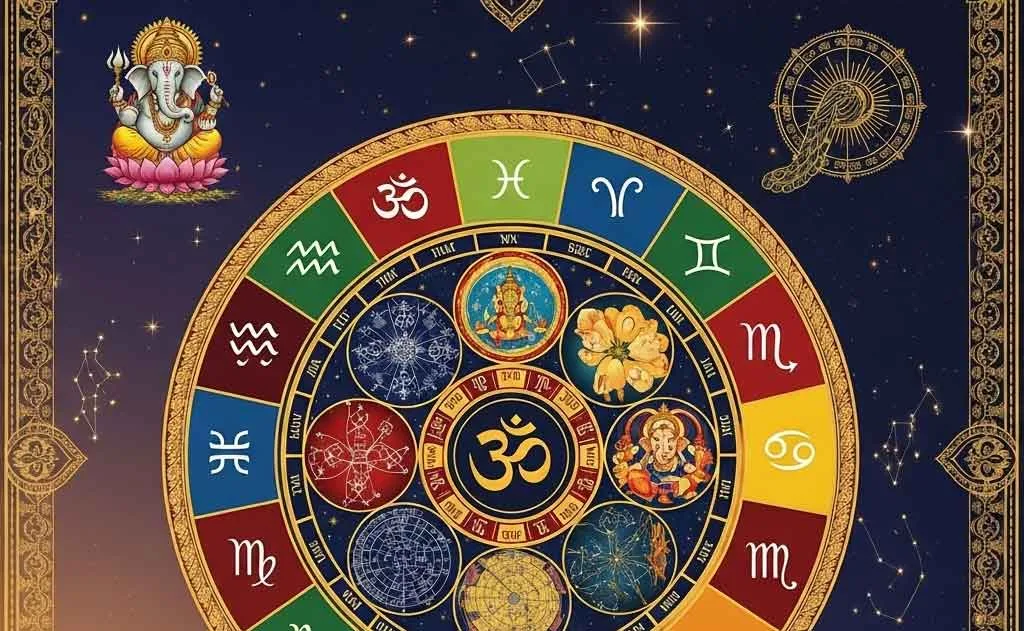
Why Indian Astrology Persists Among NRI Tech Professionals
A counterintuitive pattern worth examining: the more analytically trained an NRI tech professional, the more likely they are to consult a Vedic astrologer at major life decisions. The structural reasons explain why.
A counterintuitive pattern worth examining: the more analytically trained an NRI tech professional, the more likely they are to consult a Vedic astrologer at major life decisions. The structural reasons explain why.
Ask any Vedic astrologer with a meaningful NRI clientele who their actual customers are, and the answer is rarely what an outside observer expects. The clients are disproportionately software engineers, product managers, data scientists, doctors, lawyers and consultants — the analytically trained professional class that the pop-cultural framing of astrology suggests should be most resistant to it. A 2026 review of any major Vedic astrologer's appointment book in San Francisco, Seattle, Bengaluru, Hyderabad, Singapore or London would show this pattern with consistency.
The naive explanation — that these professionals are inconsistent about their analytical commitments — is rarely the right one. Most NRI tech professionals who consult an astrologer are perfectly capable of holding scientific epistemology in their professional work and a different framework in their personal decisions. The honest question is why two frameworks coexist in the same person, and the answer is structural rather than psychological.
The hypothesis: structured decision-making under uncertainty
The most useful frame for understanding the pattern is this: highly trained analytical professionals are the population most acutely aware of how poorly their analytical training equips them for certain categories of personal decision. The frameworks that work well for shipping code, structuring a product roadmap or running a clinical trial do not transfer cleanly to deciding when to marry, whether to move countries, when to start a business, or how to navigate a difficult family situation.
In these domains, the analytically trained professional discovers that their tools — A/B testing, hypothesis frameworks, structured analytic reasoning — produce no signal because there is no comparable data, no opposing hypothesis to test, and the outcome variable is too entangled with subjective values to optimise. The professional is in a decision context that their training has not prepared them for, and they reach for whichever structured framework is available for that kind of decision. In NRI households, the available framework is often Vedic astrology.
What the framework offers
Vedic astrology, used at this level, is offering three things that a tech professional finds useful in personal decision contexts.
First, it offers a structured vocabulary for thinking about a decision. The astrologer's framing — what Dasha is currently active, what transit is approaching, what planetary positions are favourable or unfavourable for which kinds of activity — gives the client a structure to organise their own thinking around. The client is not necessarily believing literally that planetary positions determine outcomes; they are using the framework as a thinking prompt that forces consideration of multiple dimensions of the decision.
Second, it offers timing guidance that the client can act on or not. A recommendation that "the next three months are not a favourable window for major decisions" gives the client either a reason to delay a difficult decision (which often is what they wanted anyway) or a reason to think harder about why they want to act despite the recommendation. Either response is more deliberate than the default, which is often to act on accumulated pressure without structured pause.
Third, it offers a third-party voice that is outside the client's usual feedback loop. Family members have their own positions on the client's decisions; close friends have biases the client knows well. The astrologer is an outside voice that has structural credibility within the cultural tradition without being entangled in the client's daily life. The client gets a fresh perspective from someone who is not invested in the specific outcome.
Why the framework persists across analytical training
The reason this framework persists in analytically trained populations is that the alternative frameworks are weaker than the alternative frameworks are usually understood to be. The tech professional considering whether to leave their current company to join an early-stage startup is not actually in possession of strong analytical tools for that decision. They can model financial outcomes, estimate probabilities, and rationalise either choice, but the underlying inputs are deeply uncertain and the personal stakes are not legible to the model.
A structured non-analytical framework that produces a recommendation — even one the professional may decide to override — is, in this context, additive to the analytical reasoning rather than competitive with it. The professional is not choosing between analysis and astrology; they are using analysis where it works and astrology where analysis has run out of signal.
What separates useful from useless consultations
Not every Vedic astrologer is providing this kind of structured value, and clients who have been at this for years can articulate the distinction. The astrologer who works at this level is doing three specific things: they are reading the client's actual chart carefully rather than running generic advice, they are framing recommendations as inputs to the client's own decision rather than as prophecies the client must obey, and they are willing to disagree with the client's preferred course of action when the chart suggests differently rather than telling the client what they want to hear.
Astrologers who fail these tests — generic advice, deterministic prophecies, sycophantic alignment with the client's existing view — do not retain analytically trained NRI clients across multiple consultations. The market sorts itself; the astrologers with enduring NRI tech-professional clienteles are usually the ones working at the structured-decision-support level rather than the fortune-telling level.
A typical use pattern
The use pattern that recurs is something like this: the NRI tech professional consults an astrologer at three to five points across a decade — usually at major decisions like marriage, a career-change inflection, a relocation, a major investment, a significant family decision. Between consultations, the professional operates in their analytical professional mode. At the consultation, they bring the specific decision and listen to the structured framework, take what feels useful, discard what does not, and proceed with whatever combination of analytical reasoning and traditional-framework input they have synthesised.
This is, in plain terms, structured decision-making under uncertainty with multiple frameworks. The professional is using whichever framework adds signal at whichever point in the decision process. The continuation of astrology in this population is not a regression to pre-modern reasoning; it is a sophisticated multi-framework approach to the kinds of decisions that purely analytical reasoning has trouble with.
Implications for the tradition's future
The persistence of Vedic astrology in NRI tech professional populations has implications for the tradition's long-term shape. The clients who consult astrologers in this mode are different from the traditional rural-Indian client base in their expectations: they want chart-specific readings, they want to engage with the framework intellectually rather than passively, they want to understand the reasoning rather than receive verdicts. The astrologers who serve this clientele have had to upgrade their craft to match — clearer chart readings, more sophisticated framings, more willingness to be challenged on specifics.
This upgrading is, in its way, modernising the tradition. The next generation of Vedic astrologers serving NRI populations is structurally different from the previous one — more educated, more familiar with the client's professional context, more able to translate the tradition's vocabulary into terms that work for an analytically trained interlocutor. The tradition is adapting to its clientele in the same way every durable tradition has had to. The NRI tech professional population, which an outsider might have predicted would let the tradition fade, has instead become one of the populations most actively shaping its current evolution.