
Jai Ganesh Deva Aarti: Lyrics in Hindi and English, Meaning and How to Sing It
The complete Jai Ganesh Deva aarti in Hindi (Devanagari) and English transliteration, with line-by-line meaning, regional variants, and tips on rhythm, tune and how to perform aarti at home or in a diaspora temple.
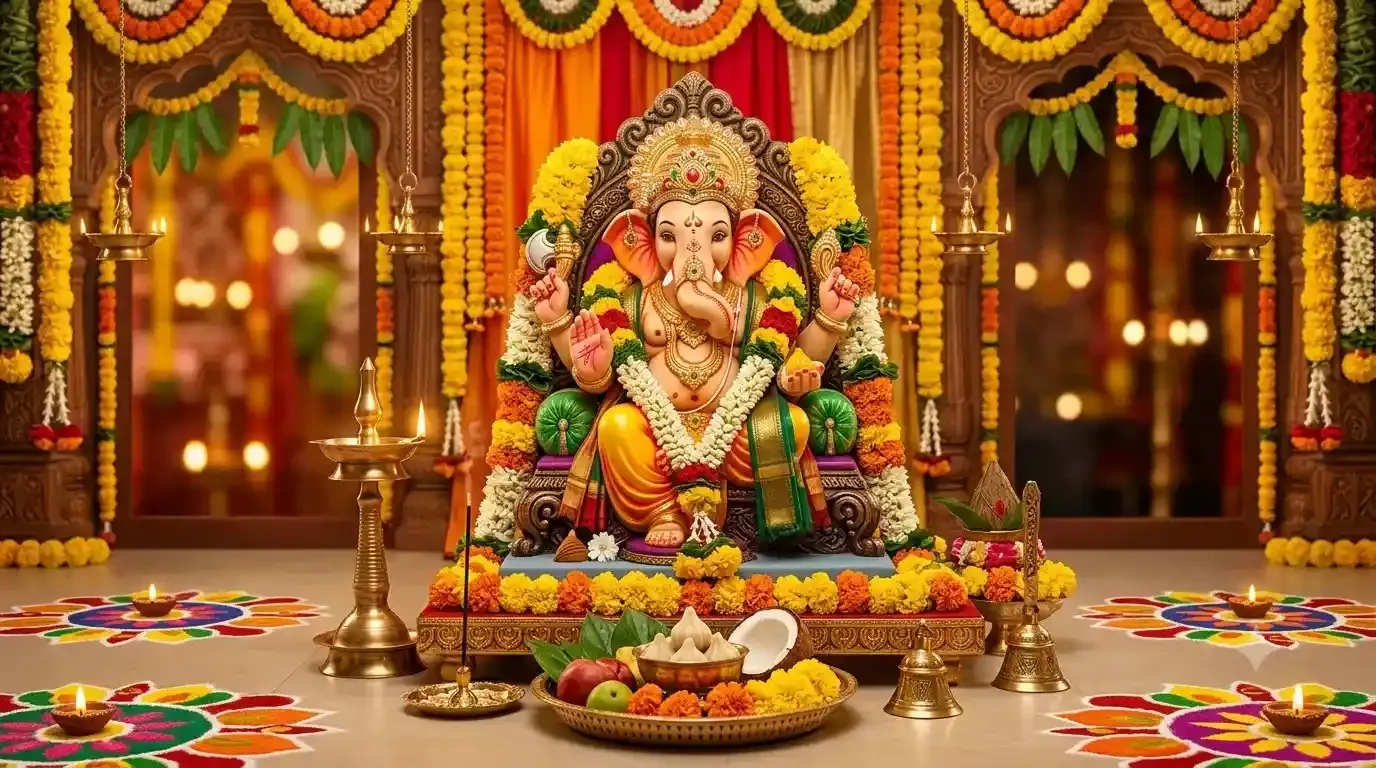
The complete Jai Ganesh Deva aarti in Hindi (Devanagari) and English transliteration, with line-by-line meaning, regional variants, and tips on rhythm, tune and how to perform aarti at home or in a diaspora temple.
Quick answer: Jai Ganesh Deva is the most widely sung Hindi aarti to Lord Ganesha. Its refrain, 'Jai Ganesh, Jai Ganesh, Jai Ganesh Deva, Mata jaki Parvati, Pita Mahadeva', praises Ganesha as the son of Parvati and Shiva. It is sung at the close of Ganesha puja, while the lamp is waved before the deity. Below you will find the full text in Devanagari, a transliteration, a line-by-line English meaning, the common variants and a practical guide to singing it.
This page was originally published on hindutone.com and has been restored at the same address. It is written for families in India and in the diaspora who want to sing the aarti correctly and understand what every line means, so children who grow up abroad can join in with confidence.
The full text in Devanagari
The version below is the one most often printed in North Indian aarti books. The refrain is repeated after each verse.
जय गणेश जय गणेश जय गणेश देवा।
माता जाकी पार्वती पिता महादेवा॥
एक दंत दयावंत चार भुजा धारी।
माथे सिंदूर सोहे मूसे की सवारी॥
पान चढ़े फूल चढ़े और चढ़े मेवा।
लड्डुअन का भोग लगे संत करें सेवा॥
अंधन को आंख देत कोढ़िन को काया।
बांझन को पुत्र देत निर्धन को माया॥
'सूर' श्याम शरण आए सफल कीजे सेवा।
माता जाकी पार्वती पिता महादेवा॥
Many families add this closing couplet:
दीनन की लाज रखो शंभु सुतकारी।
कामना को पूर्ण करो जाऊं बलिहारी॥
Transliteration in English letters
If you cannot read Devanagari, use this roman transliteration. Read 'aa' as the long a in 'father' and 'e' as in 'day'.
- Jai Ganesh, Jai Ganesh, Jai Ganesh Deva, Mata jaki Parvati, Pita Mahadeva.
- Ek dant dayavant, char bhuja dhari, Mathe sindoor sohe, muse ki savari.
- Paan chadhe, phool chadhe, aur chadhe meva, Ladduan ka bhog lage, sant karen seva.
- Andhan ko aankh det, kodhin ko kaya, Baanjhan ko putra det, nirdhan ko maya.
- 'Sur' Shyam sharan aaye, safal kije seva, Mata jaki Parvati, Pita Mahadeva.
- Deenan ki laaj rakho, Shambhu sutkari, Kamna ko poorn karo, jaun balihari.
Line-by-line meaning
| Line | Meaning in English |
|---|---|
| Jai Ganesh, Jai Ganesh, Jai Ganesh Deva | Victory to Ganesha, victory to Lord Ganesha. |
| Mata jaki Parvati, Pita Mahadeva | Whose mother is Parvati and whose father is Mahadeva (Shiva). |
| Ek dant dayavant, char bhuja dhari | The one-tusked, compassionate Lord who bears four arms. |
| Mathe sindoor sohe, muse ki savari | Vermilion shines on his forehead, and he rides a mouse. |
| Paan chadhe, phool chadhe, aur chadhe meva | Betel leaves, flowers and dry fruits are offered to him. |
| Ladduan ka bhog lage, sant karen seva | Laddus are offered as food, and saints serve him. |
| Andhan ko aankh det, kodhin ko kaya | He gives sight to the blind and a healthy body to the afflicted. |
| Baanjhan ko putra det, nirdhan ko maya | He blesses the childless with children and the poor with wealth. |
| 'Sur' Shyam sharan aaye, safal kije seva | The poet ('Sur Shyam') has come to your refuge; make his service fruitful. |
| Deenan ki laaj rakho, Shambhu sutkari | O son of Shambhu (Shiva), protect the honour of the humble. |
| Kamna ko poorn karo, jaun balihari | Fulfil our wishes; I offer myself to you. |
The verses about sight, health, children and wealth are devotional praise of Ganesha's compassion, in the style of bhakti poetry. They express trust in his grace; they are not a promise that singing the aarti replaces medical care or effort.
What the images in the aarti tell us
- Ek dant (one tusk): Ganesha is Ekadanta. Different Puranic stories explain the broken tusk, from a battle with Parashurama to writing down the Mahabharata. Devotionally it is read as sacrifice for a higher purpose.
- Char bhuja (four arms): Classical images show him holding a noose (pasha), a goad (ankusha), a modak or sweet, and one hand raised in blessing.
- Sindoor: Vermilion is a traditional offering to Ganesha, especially in Maharashtra and North India.
- Muse ki savari (the mouse): The mouse, Mushika, is his vehicle. A common teaching is that the Lord of wisdom rides on, and controls, restless desire.
- Laddus and paan: These are the classic offerings in North Indian homes; modaks are more typical in Maharashtra and kudumulu or kozhukattai in the South.
Common variants you may hear
Aartis travel orally, so small differences are normal. You may hear:
- 'Mathe par tilak sohe' instead of 'Mathe sindoor sohe'.
- 'Laddu ka bhog lage' instead of 'Ladduan ka bhog lage'.
- The verses in a different order, with 'Andhan ko aankh det' sung before 'Paan chadhe'.
- The 'Deenan ki laaj rakho' couplet left out, or sung only once at the very end.
- Some temples add a closing 'Bolo Ganapati Bappa Morya' or 'Jai Bolo Ganesh Maharaj ki Jai' after the aarti.
If your family or temple has its own version, keep it. The devotion matters far more than a single word.
How to sing it: tune, rhythm and an audio-learning plan
Jai Ganesh Deva is sung to a simple, steady tune that is easy for groups, which is why it works so well in temples and community halls. We have not embedded a recording here, because there is no single authentic version and quality varies. Instead, use this plan:
- Pick one recording and stick to it. Choose a clear version from your local temple or a well-known devotional label. Switching tunes while learning causes confusion.
- Learn the refrain first. Everyone can join in on 'Jai Ganesh Deva' within a minute; children often learn the rest by repeating the refrain.
- Keep the rhythm with claps or a bell. The aarti moves in an even beat. One person rings the bell while another waves the lamp.
- Read along with the transliteration. Print the transliteration above for children and guests who do not read Hindi.
- Slow down for beginners. In mixed groups abroad, a slightly slower pace lets everyone sing every word.
How to perform the aarti at home
- Finish the main puja first: offerings of flowers, durva grass, sweets and naivedyam.
- Light a ghee lamp or camphor on the aarti plate. Add a little kumkum, rice and a flower to the plate.
- Stand facing the deity. One person waves the lamp clockwise while everyone sings and claps.
- A widely followed pattern is four circles at the feet, two at the navel, one at the face and seven over the whole form, though customs differ.
- After the aarti, the plate is taken around. Each person passes their palms over the flame and touches their eyes and head.
- Distribute prasad. Many families then recite a short prayer asking forgiveness for any mistakes in the puja.
Tips for NRI families
- Smoke alarms: Camphor produces a lot of smoke. In apartments in the USA, UK, Canada or Australia, use a small ghee diya instead and keep it away from detectors and curtains.
- Teach the meaning, not only the sounds: Use the table above to explain each line. Children remember songs they understand.
- Sing it together online: Grandparents in India can lead the aarti on a video call; it is a simple way to keep the family tradition alive across time zones.
- Temple programmes: Most diaspora temples sing Jai Ganesh Deva during Ganesh Chaturthi and Sankashti. Check your temple's official website for programme times.
Families from Maharashtra usually sing 'Sukhkarta Dukhharta' alongside or instead of Jai Ganesh Deva. See our separate guide to Sukhkarta Dukhharta and its meaning, and our wider collection of Ganesh aartis with meaning.
Frequently asked questions
Who wrote the Jai Ganesh Deva aarti?
The closing verse carries the signature 'Sur Shyam', so the aarti is popularly attributed to the poet-saint Surdas. There is no firm historical evidence for this, and many scholars treat the author as unknown. What is certain is that it has been sung across North India for generations.
Is 'Mathe sindoor sohe' or 'Mathe par tilak sohe' correct?
Both are sung. Printed aarti books and temple traditions differ on this line. Ganesha is traditionally offered sindoor (vermilion), which is why 'mathe sindoor sohe' is the more common reading, but neither is wrong.
Can I sing Jai Ganesh Deva on days other than Ganesh Chaturthi?
Yes. It is sung at the end of almost any Ganesha puja, on Wednesdays, on Sankashti Chaturthi, before starting new work and as part of daily evening aarti in many homes and temples.
How many times should the aarti plate be circled?
A widely followed household practice is to circle the lamp four times at the deity's feet, twice at the navel, once at the face and then seven times over the whole form. Family customs vary, so follow what your elders or temple priest do.
Is there an official audio version I should use?
There is no single official recording. Families usually learn the tune from their local temple or from popular devotional recordings. Pick one clear, steady version and sing along with it until you can lead it yourself.
Editor's note
Editor's note (5 October 2026): This guide has been restored at its original address after the earlier version was lost. The text follows the version most widely printed in North Indian aarti books; we have flagged lines where traditions differ. Authorship by Surdas is popular belief, not established fact. If your temple sings a different version, follow your temple.
Related guides
You might also like
Sukhkarta Dukhharta Ganesh Aarti: Lyrics and Meaning, Verse by Verse
Top Tamil Vinayagar Songs for Ganesh Mandapams and Home Puja
Top Bollywood Songs for Ganesh Mandapams and Ganpati Processions