
Dussehra 2026 in Uttar Pradesh: Date, Vijay Muhurat for Lucknow, Varanasi, Ayodhya and Prayagraj, and the Ramlila Tradition
Vijayadashami falls on Tuesday 20 October 2026. Vijay Muhurat for Lucknow (1:45–2:30 PM), Varanasi, Ayodhya and Prayagraj, the Ramlila heritage of Uttar Pradesh from Ramnagar to Lucknow, Navratri at the state's Devi shrines, and tips for families at home and abroad.
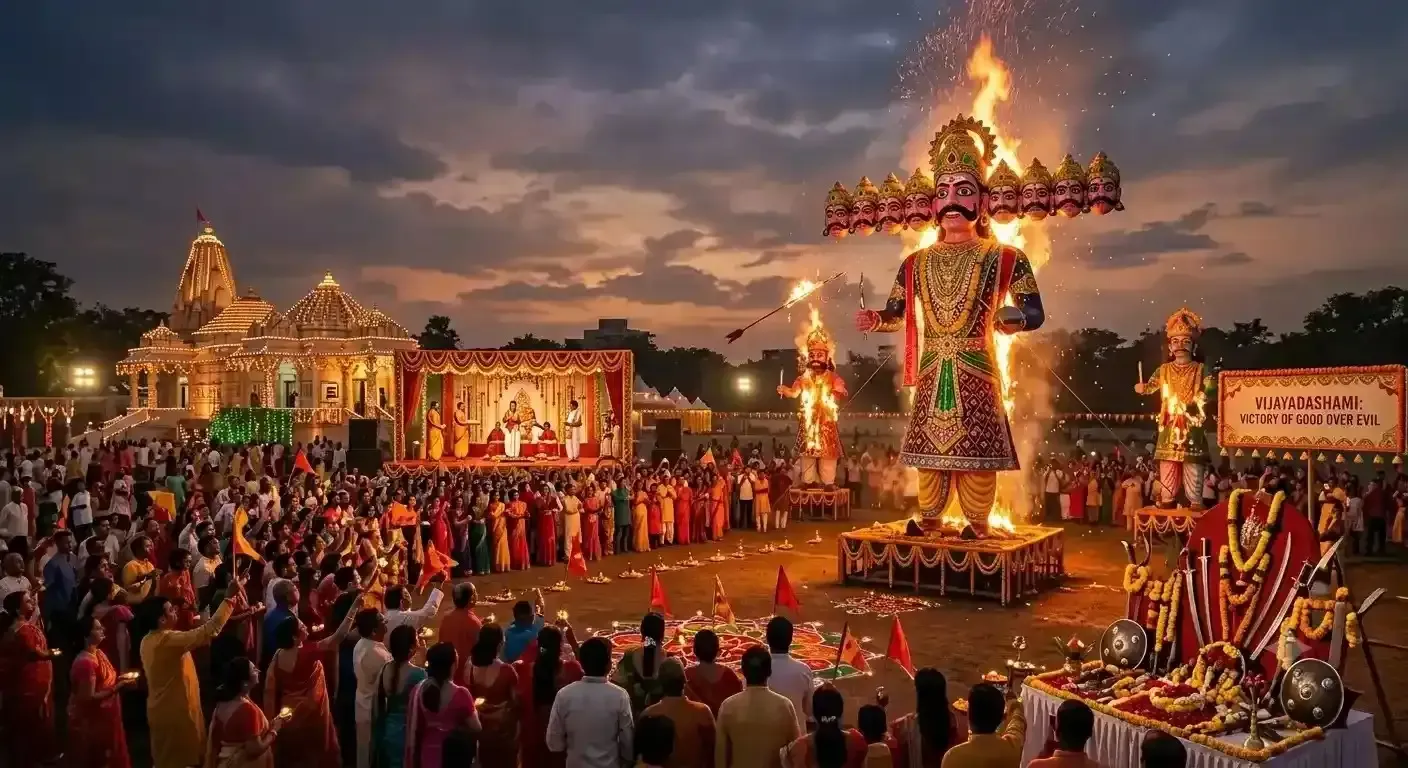
Quick answer: Dussehra (Vijayadashami) 2026 in Uttar Pradesh is on Tuesday 20 October 2026. Vijay Muhurat: Lucknow 1:45–2:30 PM, Varanasi 1:37–2:23 PM, Ayodhya 1:40–2:25 PM and Prayagraj 1:42–2:27 PM (local time, calculated by the Drik Panchang method). Navratri begins on Sunday 11 October, and Durga Ashtami and Maha Navami fall together on Monday 19 October 2026.
District by district: for 2026 events, arrangements and traditions in every district, see our district-wise Dussehra 2026 guide.
Uttar Pradesh is the land of Rama. Ayodhya, his birthplace, lies in the state, and so does Varanasi, where the Ramcharitmanas of Goswami Tulsidas, the Awadhi retelling of the Ramayana that shapes most North Indian Ramlilas, has deep roots. It is no surprise that Dussehra here is above all a festival of Ramlila: night after night of the Ramayana enacted on stages, in open grounds and in the streets, ending with the burning of Ravana on Vijayadashami.
Dussehra 2026 key dates (India)
| Observance | Date (2026) |
|---|---|
| Navratri begins (Ghatasthapana) | Sunday 11 October |
| Durga Ashtami and Maha Navami (Kanya pujan) | Monday 19 October |
| Dussehra / Vijayadashami (Ravan Dahan) | Tuesday 20 October |
| Dashami tithi | 12:50 PM IST 20 Oct to 2:11 PM IST 21 Oct |
| Diwali | Sunday 8 November |
Dates are from Drik Panchang for India. Because Ashtami and Navami share a single day in 2026, Kanya pujan falls on Monday 19 October for most families. The Dashami tithi begins shortly after midday on 20 October and covers the afternoon, which is why Vijayadashami is observed on Tuesday 20 October. Bengali Durga Puja committees in UP cities follow the Bengali panjika, which in 2026 places Bijoya Dashami on Wednesday 21 October in Kolkata; check your local committee's announcements.
Vijay Muhurat 2026 for Uttar Pradesh cities
The Vijay Muhurat is the most auspicious window of Vijayadashami afternoon, traditionally used for Aparajita puja, Shami puja, Shastra puja and for beginning new work, purchases or journeys. Timings for Tuesday 20 October 2026, in local time (IST), calculated by the Drik Panchang method:
| City | Vijay Muhurat (20 Oct 2026) |
|---|---|
| Lucknow | 1:45–2:30 PM |
| Varanasi | 1:37–2:23 PM |
| Ayodhya | 1:40–2:25 PM |
| Prayagraj | 1:42–2:27 PM |
Varanasi lies furthest east of the four, so its window opens first; Lucknow, to the west, opens last. All four windows fall after the Dashami tithi begins at 12:50 PM IST. For other towns, such as Kanpur, Agra, Mathura, Gorakhpur or Meerut, check a panchang set for your own location.
The Ramlila heritage of Uttar Pradesh
Ramnagar Ramlila, near Varanasi
The Ramlila of Ramnagar, on the eastern bank of the Ganga opposite Varanasi, is widely regarded as one of the most traditional Ramlilas in India. It has long been associated with the patronage of the Maharaja of Banaras, and it is widely known as a month-long performance in which the action moves between different locations around the town, so that the audience walks with the story from Ayodhya to the forest to Lanka. The text recited is the Ramcharitmanas.
In 2008 UNESCO inscribed Ramlila, the traditional performance of the Ramayana, on its list of the Intangible Cultural Heritage of Humanity, and Ramnagar is among the Ramlilas most often cited in that context. Details such as the exact start date, the order of episodes and arrangements for spectators follow the Ramlila's own traditional calendar and can differ from the all-India Navratri dates, so check current information before planning a visit.
Lucknow: Aishbagh and neighbourhood Ramlilas
In Lucknow, the Aishbagh Ramlila is widely described as one of the city's oldest, and many other mohallas and residential areas stage their own Ramlilas and burn effigies on Dussehra evening. Lucknow's Bengali community also holds Durga Puja, so the city sees both traditions side by side during the festival. Schedules are set by each committee every year; check local announcements for 2026.
Ayodhya
For many devotees, spending Navratri or Dussehra in Ayodhya, the city of Rama, is a pilgrimage in itself. The Ram Janmabhoomi temple, whose consecration in January 2024 drew devotees from across the world, together with older shrines such as Hanuman Garhi and the ghats of the Sarayu, draw large numbers of pilgrims through the festive season. Ramlila performances are also held in Ayodhya around Dussehra; programmes and any official arrangements are announced each year, so check them close to the date. Crowds can be very heavy, so allow plenty of time and check the temple's official website for current darshan arrangements.
Prayagraj processions
Prayagraj has a long tradition of Dussehra processions, in which decorated tableaux and illuminated displays move through parts of the city over the festive days, organised by local committees. Routes, dates and timings are set locally each year, and traffic arrangements change accordingly, so follow announcements from the local administration and organisers.
Navratri at Uttar Pradesh's Devi shrines
Alongside Ramlila, Navratri in UP is a time of fasting and Devi worship. Many families keep the nine-day vrat and end it with Kanya pujan. The Vindhyavasini temple at Vindhyachal near Mirzapur is one of the best-known Shakti shrines in the state and is especially crowded during Navratri. In Varanasi, the Durga Kund temple is a much-loved Devi shrine, and the city's Bengali community celebrates Durga Puja in its own pandals. Pilgrims to Varanasi often combine these with darshan at Kashi Vishwanath Temple. Temples are very busy in the festival period, so check each temple's official website for current timings.
What to do on Vijayadashami
- Aparajita and Shami puja: worship the goddess of victory and the Shami tree in the afternoon, ideally during the Vijay Muhurat.
- Shastra puja: clean and worship tools, vehicles, account books and laptops.
- Neelkanth darshan: in many UP households it is considered auspicious to sight the Indian roller (neelkanth) bird on Dussehra.
- Ravan Dahan: join the community effigy burning after sunset, which closes the Ramlila season in most towns.
- Seek blessings: touch the feet of elders and share sweets with neighbours.
For the meaning of Dussehra and a full puja procedure, see our Dussehra / Vijayadashami 2026 pillar guide.
Practical tips
- Ramlila grounds and Ravan Dahan sites draw large crowds. Keep children close, agree a meeting point and carry minimal valuables.
- Stand well back from effigies, which are often packed with firecrackers, and follow the instructions of organisers and police.
- Traffic diversions are common in Lucknow, Varanasi, Prayagraj and Ayodhya around major events. Watch for advisories from the local police.
For UP families abroad
- Use a panchang calculated for your own city. Do not convert Lucknow's or Varanasi's Vijay Muhurat into your local time zone.
- Tuesday 20 October 2026 is a working day in most countries. Many mandirs and community groups hold their Ramlila or Ravan Dahan on the nearest weekend, so check their announcements.
Our Navratri 2026 guide for NRI families covers fasting, Kanya pujan and puja steps that work abroad.
Share the Vijayadashami 2026 blessing
For Hindus in Uttar Pradesh, the land of Rama, Vijayadashami is the joyful close of nights of Ramlila. As commonly told, Lord Rama triumphed over Ravana and Maa Durga over Mahishasura, and dharma and light overcame darkness. When the effigy burns and elders bless the young, that victory feels close to home. Wherever you are today, choose a message below and send a heartfelt Dussehra blessing to your family and loved ones.
Shami shloka for Vijayadashami
शमी शमयते पापं शमी शत्रुविनाशिनी। अर्जुनस्य धनुर्धारी रामस्य प्रियदर्शिनी॥
Shami shamayate papam shami shatru-vinashini, arjunasya dhanurdhari ramasya priyadarshini.
Meaning: The Shami tree takes away sin and destroys enemies; it held Arjuna's bow and is dear to Lord Rama. Many families recite this while offering Shami (Jammi) leaves on Vijayadashami.
Rama mantra to chant on Dussehra
रामाय रामभद्राय रामचन्द्राय वेधसे। रघुनाथाय नाथाय सीतायाः पतये नमः॥
Ramaya ramabhadraya ramachandraya vedhase, raghunathaya nathaya sitayah pataye namah.
Meaning: Salutations to Rama, to Ramabhadra, to Ramachandra the creator, to the lord of the Raghu clan, to the husband of Sita.
Vijayadashami 2026 messages to share
Happy Dussehra to our whole family! 🪔 May the victory of good over evil bring peace, togetherness and the light of dharma into every corner of our home. Share on WhatsApp
Pranam Maa and Papa! 🙏 On this Vijayadashami I touch your feet in my heart and pray that Lord Rama blesses you with good health, joy and a long life. Share on WhatsApp
Happy Dussehra, dost! As the Ramlilas of Uttar Pradesh end in Ravan Dahan, may every Ravana of worry in your life burn away today, and may the year ahead bring you courage, laughter and success. ✨ Share on WhatsApp
Wishing you and your family a blessed Vijayadashami. May this festival of victory bring new energy, clear purpose and success to the work we share. Share on WhatsApp
Jai Maa Durga! 🌺 After nine nights of devotion, may the Divine Mother who conquered Mahishasura fill your home with strength, protection and grace. Share on WhatsApp
Jai Shri Ram! 🏹 From the land of Ayodhya and Kashi in Uttar Pradesh, may Lord Rama's path of truth guide your family to lasting peace and happiness. Share on WhatsApp
A short Vijayadashami prayer
Lord Rama, ideal of dharma, and Maa Durga, Mother of strength, on this Vijayadashami I bow before you with folded hands. Please burn away the pride, anger and fear within me, as Ravana's effigy burns tonight. Give me the courage to speak the truth, the wisdom to act rightly and the patience to serve my family well. Keep our home free of negativity and discord, and let your blessings stay with us always. Jai Shri Ram.
Use the share buttons on this page to send these blessings to your family and friends.
Also read: Vindhyachal Navratri 2026.
Also read: Ramnagar Ramlila, Varanasi.
Frequently asked questions
When is Dussehra 2026 in Uttar Pradesh?
Dussehra (Vijayadashami) 2026 in Uttar Pradesh is on Tuesday 20 October. Navratri begins on Sunday 11 October, and Durga Ashtami and Maha Navami fall together on Monday 19 October.
What is the Vijay Muhurat in Lucknow, Varanasi, Ayodhya and Prayagraj?
On Tuesday 20 October the Vijay Muhurat is 1:45–2:30 PM in Lucknow, 1:37–2:23 PM in Varanasi, 1:40–2:25 PM in Ayodhya and 1:42–2:27 PM in Prayagraj (local time, IST). For other towns, check a panchang set for your location.
When is Kanya pujan in 2026?
Because Durga Ashtami and Maha Navami share a single day in 2026, Kanya pujan falls on Monday 19 October for most families in Uttar Pradesh.
What is the Ramnagar Ramlila?
The Ramlila of Ramnagar, on the eastern bank of the Ganga opposite Varanasi, is widely regarded as one of the most traditional Ramlilas in India. It is known as a month-long performance of the Ramcharitmanas in which the audience walks with the story between locations around the town.
Where can I see Ramlila and Ravan Dahan in Lucknow?
The Aishbagh Ramlila is widely described as one of Lucknow's oldest, and many mohallas stage their own Ramlilas and burn effigies on Dussehra evening. Schedules are set by each committee, so check local announcements for 2026.
Is it good to visit Ayodhya for Dussehra?
For many devotees, spending Navratri or Dussehra in Ayodhya, the city of Rama, is a pilgrimage in itself, with the Ram Janmabhoomi temple, Hanuman Garhi and the Sarayu ghats drawing large numbers. Crowds can be very heavy, so allow plenty of time and check official darshan arrangements.
Editor's note
Editor's note (5 October 2026): This page has been restored at its original address after the earlier version was lost. Festival dates are from Drik Panchang for India, and the Vijay Muhurat times for Lucknow, Varanasi, Ayodhya and Prayagraj were calculated by the Drik Panchang method. We describe the Ramnagar and Aishbagh Ramlilas and the Prayagraj processions in general terms only; we have not given founding dates, schedules or venues because these vary by account and are set each year by the organisers. Check official and organiser announcements, and each temple's official website for current timings.
Related guides
Share this with family and friends
Send it on WhatsApp, post it, or copy the link.
More from Navratri
- Today's Sankalpam, 25 October 2026: Sandhyavandanam Sankalpam and Traditional Panchangam (Sunday)
- Every Day Vijayadashami: The Real Invitation of Navaratri and How to Live Its Victory Daily
- How to Wish Happy Vijayadashami 2026 on WhatsApp, Instagram, Facebook and Telegram: A Complete Guide for NRIs in the USA, UK, Australia and New Zealand
- How to Wish Happy Vijaya Dasami on WhatsApp, Telegram, Instagram and Facebook in 2026
- Happy Dussehra 2026: Heartfelt Vijayadashami Wishes to Hindus Around the World
You might also like
Dussehra 2026 in Uttar Pradesh, District by District: Ramlila, Ravan Dahan and Durga Puja
Dussehra 2026 in Andhra Pradesh, District by District: Dasara Navaratri
Dussehra 2026 in Himachal Pradesh, District by District: Kullu Dussehra and Navratri melas