Vindhyachal Dham in Navratri 2026: Maa Vindhyavasini Temple, the Trikona Yatra and Planning from Varanasi or Prayagraj
Vindhyachal, on the Ganga near Mirzapur in Uttar Pradesh, is one of North India's most loved seats of the Goddess. Here is the story of Maa Vindhyavasini as traditionally told, the Trikona yatra to Ashtabhuja and Kali Khoh, what Navratri is usually like at the temple, and how to plan a visit from Varanasi or Prayagraj in 2026.
Vindhyachal, on the Ganga near Mirzapur in Uttar Pradesh, is one of North India's most loved seats of the Goddess. Here is the story of Maa Vindhyavasini as traditionally told, the Trikona yatra to Ashtabhuja and Kali Khoh, what Navratri is usually like at the temple, and how to plan a visit from Varanasi or Prayagraj in 2026.
Quick answer: Vindhyachal Dham, on the Ganga near Mirzapur in Uttar Pradesh, is the seat of Maa Vindhyavasini, the Goddess who, as traditionally told, made her home in the Vindhya hills after escaping Kamsa. Pilgrims complete the Trikona yatra to Vindhyavasini, Ashtabhuja and Kali Khoh. Sharad Navratri 2026 runs from Sunday 11 to Monday 19 October in India (Drik Panchang), and the Navratri mela usually draws very large crowds. Base yourself in Varanasi, Prayagraj or Mirzapur, and check official local announcements for current timings and arrangements.
Vindhyachal at a glance
| Item | Details |
|---|---|
| Main deity | Maa Vindhyavasini (Vindhyavasini Devi) |
| Location | Vindhyachal, on the Ganga, Mirzapur district, Uttar Pradesh |
| Trikona shrines | Vindhyavasini, Ashtabhuja Devi, Kali Khoh |
| Nearest big cities | Varanasi and Prayagraj |
| Navratri 2026 (India) | Sun 11 to Mon 19 October; Ashtami and Navami Mon 19 October |
| Dussehra 2026 | Tue 20 October |
| Timings and arrangements | Check official temple and district announcements |
Maa Vindhyavasini: the Goddess of the Vindhyas
The name Vindhyavasini simply means "she who dwells in the Vindhyas". The Vindhya range meets the Ganga here, and the temple stands in the heart of the town, a short walk from the river ghats where many pilgrims bathe before darshan.
The best-known story, as traditionally told, comes from the Krishna legend. When Krishna was born to Devaki in Kamsa's prison in Mathura, his father Vasudeva carried him across the Yamuna to Gokul and brought back the baby girl just born to Yashoda. When Kamsa seized the girl and tried to dash her against a stone, she slipped from his hands, rose into the sky as the Goddess Yogamaya, told him that the one who would end him had already been born, and vanished. Tradition says she then chose the Vindhya hills as her home, and is worshipped here as Vindhyavasini.
The Devi Mahatmya (Durga Saptashati), the great Navratri text, also contains the Goddess's promise that she will be born in the house of Nanda, from the womb of Yashoda, and dwell on the Vindhya mountain. For devotees, this links Vindhyachal directly to the scripture they recite during the nine nights.
Vindhyachal is widely revered as a Shakti Peetha and as a Siddha Peetha, a place where sincere prayer is believed to bear fruit. A local tradition says the Goddess is present here in her complete form, rather than as one part of Sati's body as at the classical Peethas. Lists and interpretations vary between traditions.
The Trikona yatra: Vindhyavasini, Ashtabhuja and Kali Khoh
A visit to Vindhyachal is traditionally completed with the Trikona (triangle) parikrama, which links three shrines that together form a sacred triangle. As traditionally described, the three goddesses correspond to the three great forms worshipped in the Devi Mahatmya:
- Maa Vindhyavasini (Mahalakshmi): the main temple in the town, near the Ganga. Pilgrims usually begin and end here.
- Ashtabhuja Devi (Mahasaraswati): the eight-armed Goddess, in a temple on the Vindhya hill a short distance from the town, reached by steps and road.
- Kali Khoh (Mahakali): a cave-like shrine of Mahakali set among the hills, the third point of the triangle.
The full circuit can be done by road in part of a day, with walking and steps at the hill shrines. Many pilgrims also visit smaller shrines on the way, such as Sita Kund near the Ashtabhuja hill, which is linked in local tradition with Sita. Local guides and auto-rickshaw drivers know the route well; agree on a plan before you start.
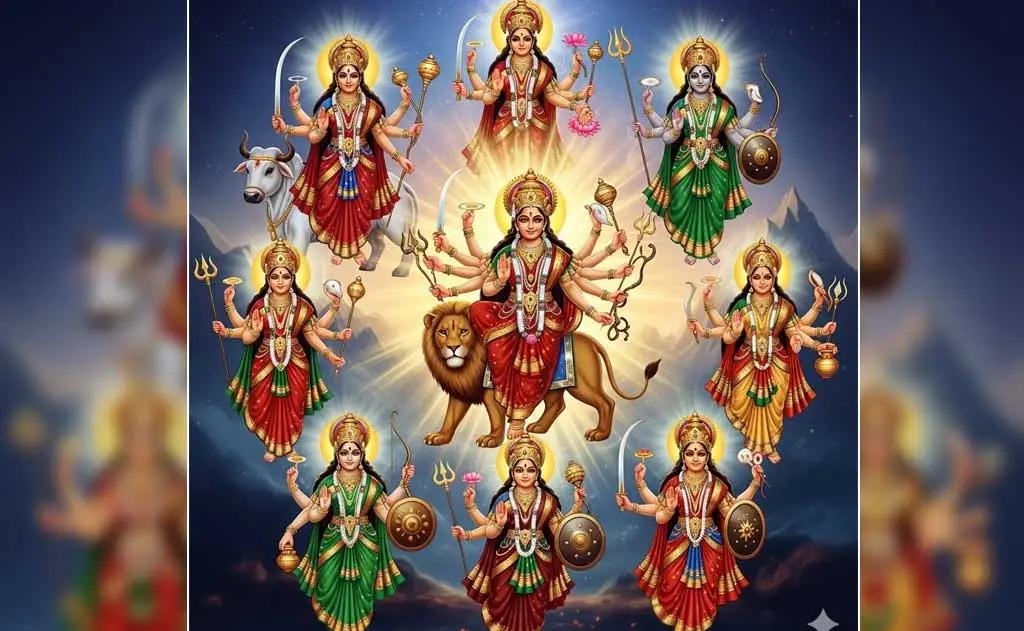
The triangle is a neat way to understand Navratri itself. Many families divide the nine nights into three groups of three, dedicated to Durga or Kali, Lakshmi and Saraswati. At Vindhyachal, devotees walk that idea on the ground. The three-by-three division is a common devotional interpretation rather than a fixed rule.
Navratri at Vindhyachal
Both Navratris, Chaitra in spring and Sharad in autumn, are the peak seasons at Vindhyachal. The temple is usually decorated with flowers and lights, special shringar (adornment) of the Goddess and recitation of the Durga Saptashati are performed, and a Navratri mela fills the lanes with stalls selling chunri, coconuts, flowers and prasad. The district administration usually makes special arrangements for crowd management, queues and security during these weeks. Exact arrangements and darshan timings change, so check official temple and district announcements before you go.
Navratri 2026 in India, with each day's goddess and the popular colour custom:
| Day | Date (India) | Goddess | Popular colour |
|---|---|---|---|
| Day 1 | Sun 11 Oct | Shailaputri | Orange |
| Day 2 | Mon 12 Oct | Brahmacharini | White |
| Day 3 | Tue 13 Oct | Chandraghanta | Red |
| Day 4 | Wed 14 Oct | Kushmanda | Royal blue |
| Day 5 | Thu 15 Oct | Skandamata | Yellow |
| Day 6 | Fri 16 Oct | Katyayani | Green |
| Day 7 | Sat 17 Oct | Kalaratri | Grey |
| Day 8 | Sun 18 Oct | Mahagauri | Purple, pink or peacock green (lists differ) |
| Day 9 | Mon 19 Oct | Siddhidatri (Ashtami and Navami in India) | Purple, pink or peacock green (lists differ) |
Colours are a popular modern custom; see the Navratri 2026 colours list. In India, Durga Ashtami and Maha Navami both fall on Monday 19 October 2026, so that day and the weekend before it are likely to be among the busiest.
Planning a visit from Varanasi or Prayagraj
Vindhyachal is easiest to reach as part of a trip to Varanasi or Prayagraj. Both cities have airports with domestic connections, and both are linked to Mirzapur and Vindhyachal by road and rail. Many pilgrims make it a long day trip from either city, while others stay overnight in Vindhyachal or Mirzapur to have darshan early and complete the Trikona yatra without rushing.
- By rail: Vindhyachal and Mirzapur stations lie on the main rail line between Prayagraj and the east; check which trains stop at each during Navratri.
- By road: taxis and buses run from Varanasi and Prayagraj. Traffic and parking near the temple are usually restricted during the mela, so expect to walk the last stretch.
- Combine with Kashi: many families pair Vindhyachal with darshan at Kashi Vishwanath in Varanasi.
- Stay: book rooms early for Navratri; the town is small and fills quickly.
Practical tips for the day: carry little, keep phones and valuables secure in crowds, wear footwear you can leave and reclaim easily, and keep children close in the queues. October is usually warm in the day and pleasant in the evening, so dress light and carry water.
A simple prayer for darshan
A verse from the Devi Mahatmya, chanted all over India in Navratri, is a fitting prayer at Vindhyachal:
सर्वमङ्गलमाङ्गल्ये शिवे सर्वार्थसाधिके। शरण्ये त्र्यम्बके गौरि नारायणि नमोऽस्तु ते॥
Sarva-mangala-mangalye shive sarvartha-sadhike, sharanye tryambake gauri narayani namostu te.
Meaning: "O auspicious one, source of all that is auspicious, Shiva's consort who fulfils every aim, our refuge, three-eyed Gauri, Narayani, salutations to you." More mantras: Navratri day-wise mantras.
For NRI pilgrims
If you are visiting India for Navratri, Vindhyachal pairs well with a stay in Varanasi, and the days after Navratri bring Dussehra on Tuesday 20 October with Ramlila and Ravan Dahan across Uttar Pradesh; see Dussehra 2026 in Uttar Pradesh. Book flights and trains as early as possible, allow a rest day after a long-haul flight, and check official announcements for any changes. If you cannot travel, offer a chunri and lamp to the Goddess at home or at your local temple; our Navratri 2026 NRI guide explains the nine days for families abroad.
Frequently asked questions
Where is Vindhyachal Dham?
Vindhyachal is a pilgrimage town on the southern bank of the Ganga in Mirzapur district, Uttar Pradesh, close to Mirzapur city. It lies between Varanasi and Prayagraj, and many pilgrims visit it on a trip to either city.
Who is Maa Vindhyavasini?
Vindhyavasini means "she who dwells in the Vindhyas". As traditionally told, she is the divine Yogamaya who was born to Yashoda at the same time Krishna was born to Devaki, slipped from Kamsa's hands when he tried to kill her, warned him of his end, and chose the Vindhya hills as her abode. The Devi Mahatmya also foretells a form of the Goddess dwelling on the Vindhya mountain.
What is the Trikona yatra at Vindhyachal?
The Trikona (triangle) yatra links three shrines: Maa Vindhyavasini in the town, Ashtabhuja Devi on the hill, and Kali Khoh, a cave shrine of Mahakali. As traditionally described, they represent Mahalakshmi, Mahasaraswati and Mahakali, and visiting all three is considered to complete the pilgrimage.
Is Vindhyachal a Shakti Peetha?
Vindhyachal is widely revered as a powerful Shakti Peetha and Siddha Peetha in popular devotion. Local tradition holds that the Goddess dwells here in her complete form rather than as a part of Sati's body, which is why it is described a little differently from the classical Peetha lists. Traditions vary, so it is fair to call it a great seat of the Goddess.
Is Navratri a good time to visit Vindhyachal?
It is the most auspicious time, and both Chaitra and Sharad Navratri usually bring a large mela and very heavy crowds. If you want a quieter darshan, consider the days just before or after Navratri. In 2026, Sharad Navratri is 11 to 19 October in India, with Dussehra on 20 October.
Editor's note (8 October 2026)
This guide was written in October 2026. Dates are from Drik Panchang for India (Navratri 11 to 19 October, Durga Ashtami and Maha Navami 19 October, Dussehra 20 October). The story of Yogamaya and the identification of the Trikona shrines with Mahalakshmi, Mahasaraswati and Mahakali are given as traditionally told; local tellings differ. We do not publish darshan timings, fees or crowd figures; check official temple and district announcements before you travel.
Related guides
You might also like
Kamakhya in Durga Puja and Navratri 2026: The Nilachal Shakti Peetha, Its Durga Puja Tradition and Planning a Visit to Guwahati
Himachal's Shakti Temples in Navratri 2026: Jwala Ji, Chintpurni, Naina Devi, Chamunda and Brajeshwari Devi

Vaishno Devi in Navratri 2026 (11 to 19 October): Pilgrimage Guide to the Trikuta Shrine, Trek, Bhairon Temple and NRI Tips