Kamakhya in Durga Puja and Navratri 2026: The Nilachal Shakti Peetha, Its Durga Puja Tradition and Planning a Visit to Guwahati
Kamakhya on Nilachal hill in Guwahati is one of the most revered Shakti Peethas in India. Here is what makes the shrine unique, how the temple observes Durga Puja in its own Shakta tradition, why the famous Ambubachi Mela is in June rather than Navratri, the wider Assam Durga Puja scene, and how to plan a visit in October 2026.
Kamakhya on Nilachal hill in Guwahati is one of the most revered Shakti Peethas in India. Here is what makes the shrine unique, how the temple observes Durga Puja in its own Shakta tradition, why the famous Ambubachi Mela is in June rather than Navratri, the wider Assam Durga Puja scene, and how to plan a visit in October 2026.
Quick answer: Kamakhya, on Nilachal hill in Guwahati, Assam, is one of the most revered Shakti Peethas in India, where, as traditionally told, the yoni of Sati fell. The temple observes Durga Puja in its own Shakta tradition, traditionally over a longer period than the usual five days. Navratri 2026 is Sunday 11 to Monday 19 October in India, and Dussehra is Tuesday 20 October (Drik Panchang). Note that the famous Ambubachi Mela is in June, not during Navratri. Check the temple's official channels for current timings and festival schedules.
Kamakhya at a glance
| Item | Details |
|---|---|
| Deity | Maa Kamakhya, worshipped without an image, as a yoni-shaped rock in a cave sanctum |
| Location | Nilachal hill, Guwahati, Assam, near the Brahmaputra |
| Status | One of the most revered Shakti Peethas; a great centre of Shakta and Tantric worship |
| Navratri 2026 (India) | Sun 11 to Mon 19 October; Ashtami and Navami Mon 19 October |
| Dussehra 2026 | Tue 20 October |
| Ambubachi Mela | Every year in June (not in Navratri) |
| Timings and schedules | Check the temple's official channels |
The Shakti Peetha on Nilachal hill
As traditionally told, Sati, daughter of Daksha and wife of Shiva, gave up her body at her father's sacrifice after he insulted Shiva. Grief-stricken, Shiva carried her body across the worlds, and Vishnu divided it with his Sudarshana Chakra so that creation could return to balance. Where the parts of her body fell, the Shakti Peethas arose. At Kamakhya, tradition says, the yoni of Sati fell, making this the seat of the Goddess as the source of creation.
A second tradition links the area to Kamadeva, the god of love, who is said to have regained his form here after being burnt by Shiva's third eye, giving the region its ancient name, Kamarupa. Kamakhya is also closely associated with the Dasa Mahavidya (ten wisdom goddesses) of the Tantric tradition, and shrines to several of them stand on the same hill.
Inside the main temple, pilgrims descend into a dark cave sanctum. There is no image: the Goddess is worshipped as a sloping, yoni-shaped cleft in the stone, kept moist by an underground spring and usually covered with red cloth and flowers. The temple's rounded, beehive-like shikhara is often cited as a distinctive example of the region's style, and the present structure is traditionally dated to the sixteenth century, when it was rebuilt under the Koch kings. For a full introduction, see our Kamakhya temple guide.
Durga Puja and Navratri at Kamakhya
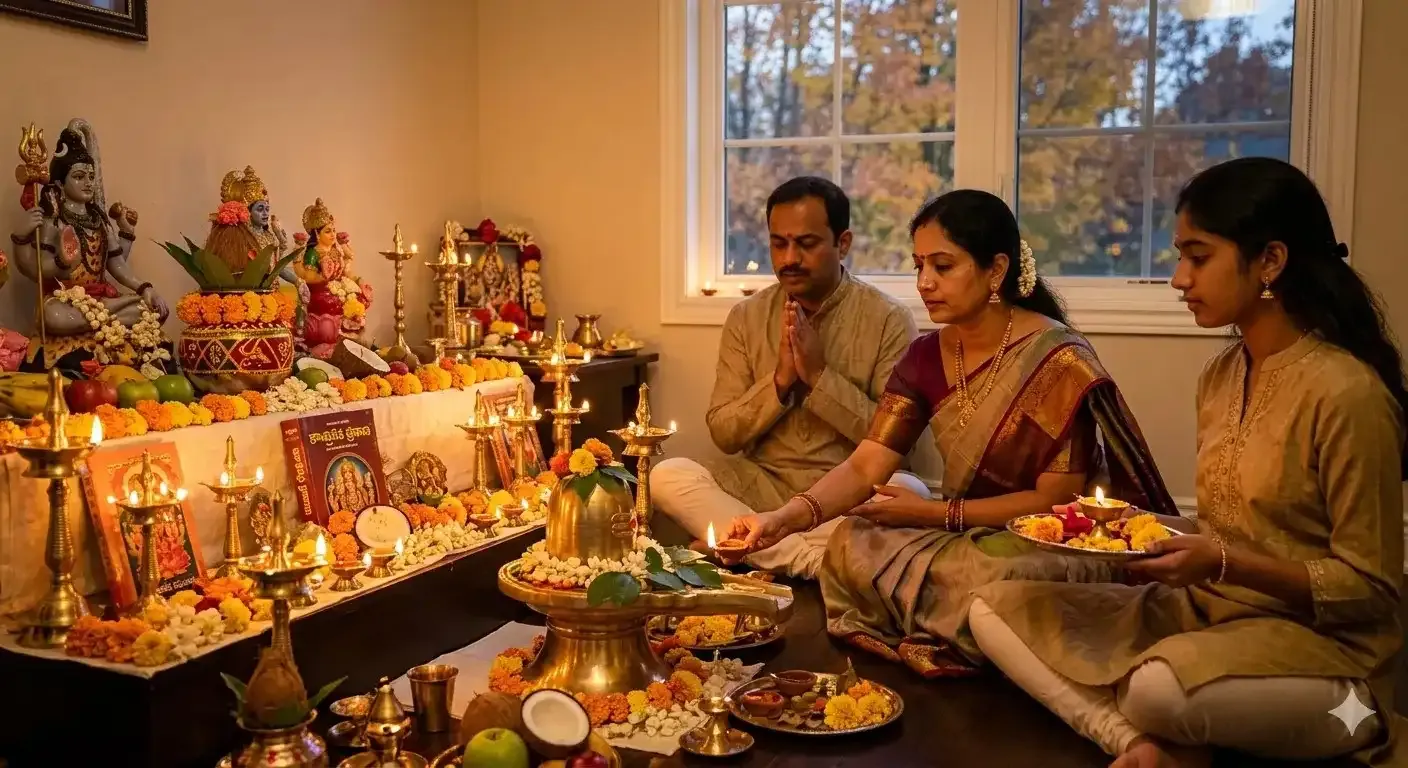
For most of India, Navratri is nine nights and Durga Puja in the east is concentrated on five days, from Shashthi to Dashami. Kamakhya observes the season according to its own ancient Shakta rites. The temple's Durga Puja is traditionally described as an extended period of worship that begins earlier than the community pujas and builds to a climax around Ashtami, Navami and Dashami. We do not give the temple's internal ritual calendar here; the temple announces its own schedule each year.
What pilgrims can usually expect during the season:
- Special pujas and recitation: worship of the Goddess with Chandi path (Devi Mahatmya) and elaborate offerings.
- Kumari Puja: the worship of young girls as living forms of the Goddess is a cherished tradition at Kamakhya and in Durga Puja more widely.
- Ancient Shakta rites: some rituals follow older traditions, including offerings that may be unfamiliar to visitors from other regions. Approach them with respect, and follow the guidance of temple staff.
- Decorations and crowds: the temple and the hill are usually busy, with long queues around the last days of Navratri.
In 2026, Durga Ashtami and Maha Navami both fall on Monday 19 October in India, followed by Vijayadashami on Tuesday 20 October. Expect those days, and the weekend before, to be among the busiest. Check the temple's official channels for darshan arrangements before you go.
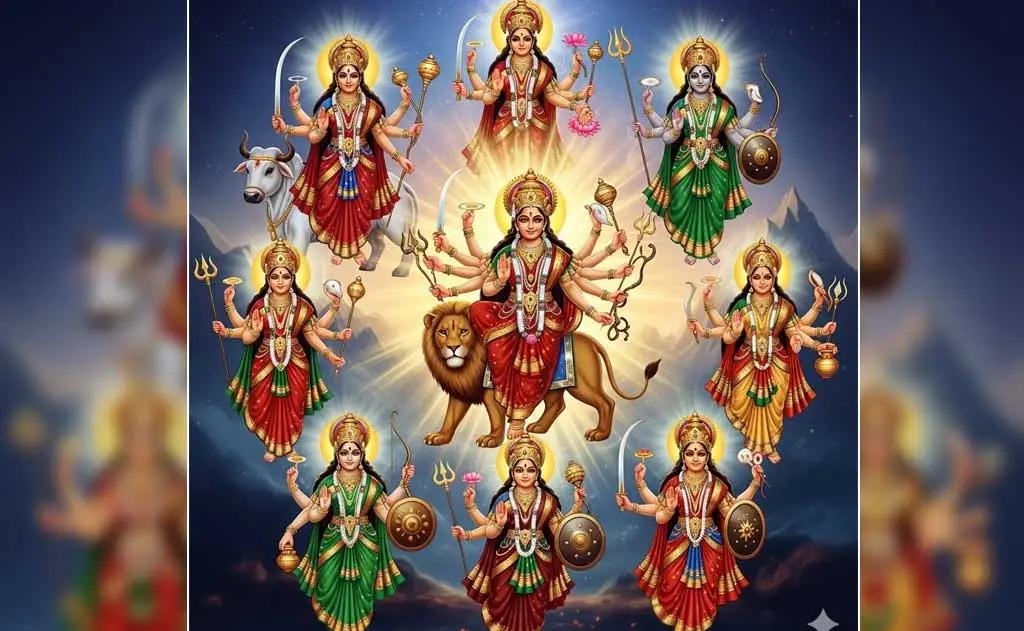
The nine days of Navratri 2026 in India, with each day's goddess and the popular colour custom:
| Day | Date (India) | Goddess | Popular colour |
|---|---|---|---|
| Day 1 | Sun 11 Oct | Shailaputri | Orange |
| Day 2 | Mon 12 Oct | Brahmacharini | White |
| Day 3 | Tue 13 Oct | Chandraghanta | Red |
| Day 4 | Wed 14 Oct | Kushmanda | Royal blue |
| Day 5 | Thu 15 Oct | Skandamata | Yellow |
| Day 6 | Fri 16 Oct | Katyayani | Green |
| Day 7 | Sat 17 Oct | Kalaratri | Grey |
| Day 8 | Sun 18 Oct | Mahagauri | Purple, pink or peacock green (lists differ) |
| Day 9 | Mon 19 Oct | Siddhidatri (Ashtami and Navami in India) | Purple, pink or peacock green (lists differ) |
The colours are a popular modern custom rather than a temple rule; see the Navratri 2026 colours list.
Ambubachi Mela is in June, not Navratri
A common confusion: Kamakhya's best-known festival, the Ambubachi Mela, is not part of Navratri. It is held every year in June, in the monsoon month of Ashadha. As traditionally believed, the Goddess undergoes her annual menstrual cycle at this time, the temple doors remain closed for a few days, and they reopen with great celebration. Ambubachi draws very large numbers of pilgrims, sadhus and Tantric practitioners. If you are planning around Ambubachi, check the temple's announcements for that year; it has nothing to do with the October festival dates.
Durga Puja across Assam
Beyond the temple, Durga Puja is one of the biggest festivals in Assam. Guwahati and other towns fill with community pandals, many organised by Assamese and Bengali neighbourhood committees, with evening crowds visiting pandal after pandal, cultural programmes and immersion processions at the end. Assamese families also mark Kati Bihu, the quiet lamp-lighting Bihu, which falls on Sunday 18 October 2026, in the middle of the Navratri week.
Exact puja days for community pandals follow local almanacs and committees, so confirm them locally. For Vijay Muhurat and city traditions, see Dussehra 2026 in Assam. For the Bengali Durga Puja calendar, see Durga Puja 2026 in Kolkata: Mahalaya to Sindoor Khela.
Planning your visit
- Getting there: Guwahati has an international airport and is well connected by rail, including Kamakhya railway station. The temple is reached by road up Nilachal hill.
- Queues: the temple usually offers a general queue and other darshan arrangements; rules and any charges change, so check the temple's official channels.
- Allow time: Guwahati traffic can be heavy during Durga Puja, and the hill road is busy. Go early and be patient.
- Weather: October in Guwahati is usually warm and humid in the day, with the monsoon tapering off; carry water and light clothes, and a small umbrella.
- Nearby: pilgrims often visit the Bhuvaneshwari shrine higher on Nilachal hill and the Umananda Shiva temple on an island in the Brahmaputra.
A prayer to the Goddess
Whether you are at Kamakhya or praying at home, this verse from the Devi Mahatmya is recited across India during Navratri:
जयन्ती मङ्गला काली भद्रकाली कपालिनी। दुर्गा क्षमा शिवा धात्री स्वाहा स्वधा नमोऽस्तु ते॥
Jayanti mangala kali bhadrakali kapalini, durga kshama shiva dhatri svaha svadha namostu te.
Meaning: "Victorious one, auspicious one, Kali, Bhadrakali, bearer of the skull-garland, Durga, forbearance, Shiva's consort, sustainer of all: to you who are svaha and svadha, salutations." More in Navratri day-wise mantras.
For NRI pilgrims
Durga Puja is a popular time for families from the Northeast living abroad to come home, so book flights to Guwahati early. Give yourself a rest day after a long-haul flight, keep your passport or OCI documents handy, and check your country's travel advice for the region. If you cannot travel, many diaspora Durga Pujas and temples abroad hold special pujas over the same weekend; our Navratri 2026 NRI guide explains how to observe the nine days from anywhere.
Frequently asked questions
Is Ambubachi Mela held during Navratri?
No. Ambubachi Mela, Kamakhya's most famous festival, is held every year in June, during the monsoon month of Ashadha, when the Goddess is traditionally believed to undergo her annual menstrual cycle and the temple closes for a few days. Navratri and Durga Puja come in autumn; in 2026 Navratri runs from 11 to 19 October in India.
Why is Kamakhya a Shakti Peetha?
As traditionally told, when Shiva carried the body of Sati in grief and Vishnu divided it with his Sudarshana Chakra, the yoni (womb) of Sati fell on Nilachal hill. Kamakhya is therefore revered as the seat of the Goddess's creative power and is counted among the most important Shakti Peethas, especially in the Tantric tradition.
How is Durga Puja observed at Kamakhya?
The temple observes Durga Puja in its own Shakta tradition, traditionally as an extended period of worship that begins before the usual five days of community Durga Puja and culminates around Navami and Dashami. Special pujas, recitation and Kumari Puja are associated with the season. The temple announces its own schedule, so check its official channels.
When is Durga Puja in Assam in 2026?
In India, Navratri 2026 runs from Sunday 11 to Monday 19 October (Drik Panchang), with Durga Ashtami and Maha Navami both on Monday 19 October and Dussehra on Tuesday 20 October. Community Durga Pujas in Assam follow local almanacs and puja committees, so confirm exact puja days locally.
Is there an idol at Kamakhya?
No. The Goddess is worshipped in the sanctum, a cave below the temple, as a yoni-shaped cleft in the rock that is kept moist by a natural spring. It is usually covered with cloth and flowers. This is one of the features that makes Kamakhya unique among major temples.
How do I reach Kamakhya?
Kamakhya is on Nilachal hill in the western part of Guwahati, Assam. Guwahati has an international airport and major railway stations, including Kamakhya station, and the temple is reached by road up the hill. During festivals, expect traffic and queues and allow extra time.
Editor's note (8 October 2026)
This guide was written in October 2026. Dates are from Drik Panchang for India (Navratri 11 to 19 October, Durga Ashtami and Maha Navami 19 October, Dussehra 20 October); Kati Bihu is 18 October 2026. The Shakti Peetha legend and the Kamadeva story are given as traditionally told. We describe the temple's Durga Puja only in general terms and do not publish darshan timings, fees or crowd figures; check the temple's official channels before you travel.
Related guides
You might also like
Kamakhya Temple, Guwahati: Complete Guide to the Shakti Peetha on Nilachal Hill
Himachal's Shakti Temples in Navratri 2026: Jwala Ji, Chintpurni, Naina Devi, Chamunda and Brajeshwari Devi
Vindhyachal Dham in Navratri 2026: Maa Vindhyavasini Temple, the Trikona Yatra and Planning from Varanasi or Prayagraj