Karwa Chauth 2026 in the UK: Date (Thursday 29 October) and Moonrise Time City by City
Karwa Chauth 2026 in the UK is on Thursday 29 October, the same day as India. Moonrise is 6:22 PM in London and Birmingham, 6:17 PM in Leicester, 6:15 PM in Manchester, 6:09 PM in Leeds and 6:00 PM in Glasgow (GMT). Here is the city table, why the UK date needs a word of explanation, why apps show a slightly later moonrise, and how to keep sargi, the katha and the puja on a dark autumn evening.
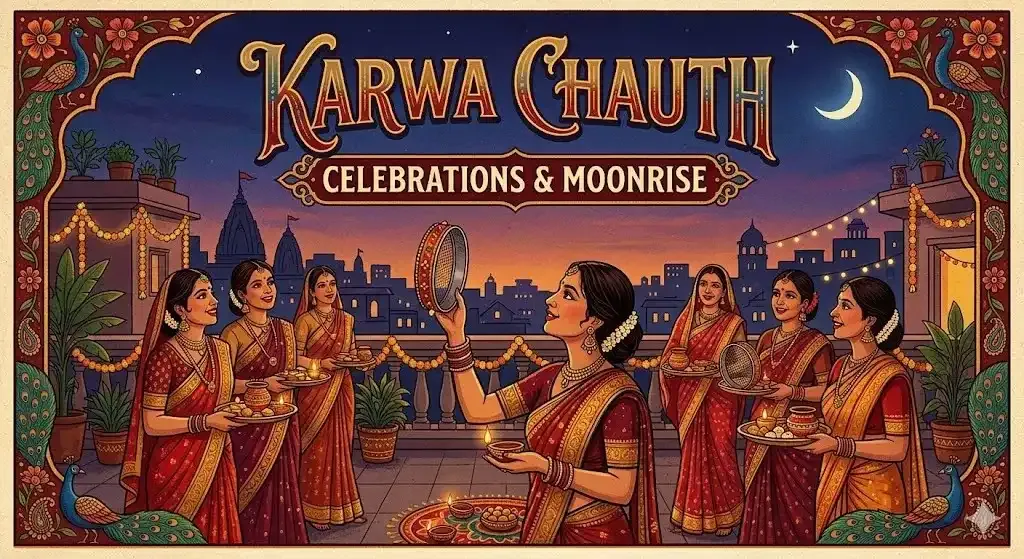
Karwa Chauth 2026 in the UK is on Thursday 29 October, the same day as India. Moonrise is 6:22 PM in London and Birmingham, 6:17 PM in Leicester, 6:15 PM in Manchester, 6:09 PM in Leeds and 6:00 PM in Glasgow (GMT).
Quick answer: Karwa Chauth 2026 in the UK is on Thursday 29 October 2026, the same day as India. The Karwa Chauth 2026 UK moonrise time is 6:22 PM in London, 6:17 PM in Leicester, 6:22 PM in Birmingham, 6:15 PM in Manchester, 6:09 PM in Leeds and 6:00 PM in Glasgow (GMT). The fast runs from sunrise until the moon is seen.
These are standard astronomical moonrise times. Drik Panchang and phone apps may show a time a few minutes later, and in a street of terraced houses the moon can take a little longer to appear. Women break the fast on actually seeing the moon.
Where the times come from: the UK date is from Drik Panchang. City times are calculated by HinduTone's calculator: sunrise and sunset by the Drik method, moonrise as the standard astronomical moonrise checked against the US Naval Observatory. UK clocks go back on Sunday 25 October 2026, so every time here is GMT.
Karwa Chauth 2026 UK moonrise time: city-wise table
The fast begins at local sunrise on Thursday 29 October 2026. Finish sargi before this time.
| City | Fast begins (sunrise) | Sunset | Moonrise |
|---|---|---|---|
| London | 6:46 AM | 4:40 PM | 6:22 PM |
| Leicester | 6:53 AM | 4:42 PM | 6:17 PM |
| Birmingham | 6:56 AM | 4:45 PM | 6:22 PM |
| Manchester | 7:00 AM | 4:44 PM | 6:15 PM |
| Leeds | 6:58 AM | 4:40 PM | 6:09 PM |
| Glasgow | 7:14 AM | 4:45 PM | 6:00 PM |
For Southall, Wembley, Harrow, Slough, Coventry, Bradford or anywhere not listed, the nearest city gives a rough guide, but check Drik Panchang for your own town. Drik's moonrise will usually be a few minutes later than ours.
With GMT back in force, the evening is dark early: the sun sets around 4:40 PM, and the moon rises between about 6:00 PM in Glasgow and 6:22 PM in London and Birmingham. In London the fast runs from 6:46 AM to 6:22 PM, a little over eleven and a half hours, and the long dark wait after sunset is the part to plan for.
Why the UK keeps Thursday 29 October, like India
Karwa Chauth is Kartika Krishna Chaturthi in the purnimanta calendar (Ashvin Krishna Chaturthi in the amanta calendar). Normally it is kept on the day when the Chaturthi tithi is running at local moonrise.
2026 is an unusual year for Britain. A tithi starts and ends at the same instant everywhere, and this year Chaturthi falls between the two UK moonrises: it has not begun when the moon rises on Wednesday evening in the UK, and it has ended before the moon rises on Thursday evening. So the moonrise rule alone does not pick a UK day. Drik Panchang lists Thursday 29 October for the UK, which is also India's date, and UK families follow Drik's Thursday 29 October.
This also explains why your relatives in the USA and Canada fast on Wednesday 28 October: their evenings fall later on the world clock, when Chaturthi has already begun. If you hear different dates from family abroad, both can be right for where they live. Follow your own temple's or family's calendar if it says otherwise.
Do not copy India's moonrise time to the UK; every city has its own. For Indian city times, see our Karwa Chauth 2026 date and city-wise moonrise times guide.
The listed moonrise and the moon you actually see
- Astronomical moonrise (our table): the moment the upper edge of the moon reaches a flat, open horizon, allowing for refraction in the atmosphere, as published by the US Naval Observatory.
- Drik Panchang and apps: usually a few minutes later, often about 4 to 7 minutes, because of a different convention.
- The real sighting: roofs, chimneys, trees and tower blocks can hide a low moon for some minutes. An upstairs window facing east, or an open park, gives the best chance.
Go to your viewing spot a little before the listed time, face east and wait for the moon itself. If British cloud or drizzle hides it, follow your family's custom: some wait, some complete the arghya facing the moon's direction, and some see the moon on a live video from relatives with a clearer sky.
Sargi, the fast and the evening puja
Sargi before dawn
The day begins with sargi, the pre-dawn meal often given by the mother-in-law in Punjabi families: fruit, dry fruits, mathri, pheni or sevaiyan in milk, and water or tea. In London, finish before 6:46 AM; in Glasgow you have until 7:14 AM. Include something with protein and drink plenty of water.
The fast
The traditional fast is nirjala, without food or water until the moon is seen. Many women in the UK keep it fully; others take water or fruit, especially at work. Women dress in red or bridal colours, with mehendi applied the evening before, bangles and sindoor.
Evening puja with the karwa and sieve
Because sunset comes so early, the puja can be held in the early evening, well before moonrise. The thali holds a lit diya, roli, rice, sweets and a sieve (channi). The karwa, a small earthen or metal pot with a spout, is filled with water. Ganesha is worshipped first, then Gauri (Parvati) or Chauth Mata. In Punjabi gatherings women sit in a circle, pass their thalis round while singing the traditional Karwa Chauth songs, and listen to the katha told by an elder.
Moon arghya
When the moon appears, the woman looks at it through the sieve, then at her husband's face through the sieve. She offers arghya, pouring water from the karwa towards the moon, and prays for her husband's long life and the family's wellbeing. Her husband gives her the first sip of water and the first bite of food, and the fast ends. Many husbands now fast alongside their wives.
The Veeravati katha, as commonly told
The most widely told Karwa Chauth story is that of Queen Veeravati, as commonly told. She was the only sister of seven brothers who adored her. She kept her first Karwa Chauth at her parents' home, and by evening she was faint with hunger and thirst. Her brothers could not bear it. They lit a fire behind a tree (or, in other versions, held up a lamp or a mirror) so that it looked like the rising moon.
Veeravati broke her fast, and news soon arrived that her husband had died. In most versions Goddess Parvati showed her that the moon had been false, and Veeravati kept the vrat with full devotion until the next Karwa Chauth, when her husband was restored to life.
The story is told with many variations. Its point suits a year of careful moonrise tables: the fast ends with the real moon, not with something that only looks like it.
Practical tips for Karwa Chauth in the UK
- A working Thursday: 29 October is a normal working day for most people. Keep the afternoon light and avoid heavy exercise.
- Dark, cold evening: it is dark by about 4:40 PM and often damp. Wear a warm coat over your outfit, and watch from an east-facing window where you can rather than standing outside for long.
- Hydration: drink well the evening before and at sargi. If you feel faint or unwell, take water straight away.
- Health exemptions: pregnant or breastfeeding women, diabetics, and anyone on medication or with heart or kidney conditions should speak to a GP and keep a fruit or water fast, or the puja alone.
- Video call with family in India: India fasts on the same Thursday. Its moon rises during the UK afternoon, so you can join your family's arghya by video from work or home, then keep your own a few hours later.
- Community puja: many mandirs and community groups hold Karwa Chauth gatherings. Check your local temple's own announcements; we do not list events or timings.
After Karwa Chauth: Ahoi Ashtami and Diwali
Ahoi Ashtami, the mothers' fast for children, is on Sunday 1 November 2026 in India by Drik Panchang; check Drik for your UK city (see our Ahoi Ashtami 2026 guide). In the UK, Dhanteras is on Friday 6 November and Diwali on Sunday 8 November 2026. For local Lakshmi Puja times see Diwali 2026 in the UK: Lakshmi Puja muhurat city by city, and for the whole month our October 2026 Hindu festival calendar.
Relatives in North America fast a day earlier, on Wednesday 28 October: see Karwa Chauth 2026 USA moonrise times and Karwa Chauth 2026 Canada moonrise times.
Frequently asked questions
What time is moonrise on Karwa Chauth 2026 in London?
On Thursday 29 October 2026, moonrise in London is at 6:22 PM GMT (standard astronomical moonrise). Sunset is at 4:40 PM and the fast begins at sunrise, 6:46 AM. Drik Panchang and apps may show a time a few minutes later, and buildings can hide the moon for a little longer. Break the fast when you actually see the moon.
What time is moonrise on Karwa Chauth 2026 in Leicester?
6:17 PM GMT on Thursday 29 October 2026. Sunset in Leicester is 4:42 PM and the fast starts at sunrise, 6:53 AM.
Is Karwa Chauth 2026 on 28 or 29 October in the UK?
Thursday 29 October 2026, the same day as India. In the UK the Chaturthi tithi is not running at local moonrise on either Wednesday or Thursday, so the usual rule does not settle it. Drik Panchang lists Thursday 29 October for the UK, and UK families follow that. Note that the USA and Canada keep it a day earlier, on Wednesday 28 October.
Has the clock change affected Karwa Chauth times in the UK?
Yes. UK clocks go back one hour on Sunday 25 October 2026, so on Karwa Chauth all UK times are in GMT. That is why the moon rises around 6 PM rather than around 7 PM. Our table already uses GMT.
Why does my app show a later moonrise than this table?
We give the standard astronomical moonrise, when the top of the moon touches a flat horizon, checked against the US Naval Observatory. Drik Panchang and many apps follow a different convention and usually show a time about 4 to 7 minutes later. The custom is to break the fast on actually seeing the moon, whichever number you use.
Can pregnant or diabetic women fast on Karwa Chauth?
Speak to your GP or midwife first. Many pregnant, breastfeeding or diabetic women, and anyone on regular medication, keep a gentle fast with water, milk or fruit, or keep the puja and katha without fasting. Health comes first.
Editor's note
Editor's note (6 October 2026): This guide has been restored at its original address after the earlier version was lost. The UK date of Karwa Chauth (Thursday 29 October 2026) is from Drik Panchang; by our calculation the Chaturthi tithi is not running at UK moonrise on either 28 or 29 October, and we follow Drik's Thursday. City sunrise, sunset and moonrise times are calculated by HinduTone's calculator: sunrise and sunset by the Drik method, and moonrise as the standard astronomical moonrise checked against the US Naval Observatory. Drik Panchang usually shows moonrise a few minutes later because of a different convention. Please confirm for your town on Drik Panchang, follow your mandir or community committee, and break the fast on seeing the moon. We do not list temple events or timings.
Related guides
- Karwa Chauth 2026: date and city-wise moonrise times (India)
- Karwa Chauth 2026 in the USA: moonrise time city by city
- Karwa Chauth 2026 in Canada: moonrise time city by city
- Ahoi Ashtami 2026: vrat katha and puja vidhi
- Diwali 2026 in the UK: Lakshmi Puja muhurat city by city
- October 2026 Hindu festivals: dates and rituals
You might also like
Karwa Chauth 2026 in Europe: Date (Thursday 29 October) and Moonrise Time in 18 Cities
Dhanurmasam 2026 in Europe: Dates, Dhanu Sankranti Time and Tiruppavai Routine City by City
Gita Jayanti and Vaikuntha Ekadashi 2026 in Europe: Date City by City (Sunday 20 December)