How to Perform Ugadi Puja at Home: Step-by-Step Guide
Ugadi, the traditional New Year celebrated in Andhra Pradesh, Telangana, and Karnataka, holds special significance.
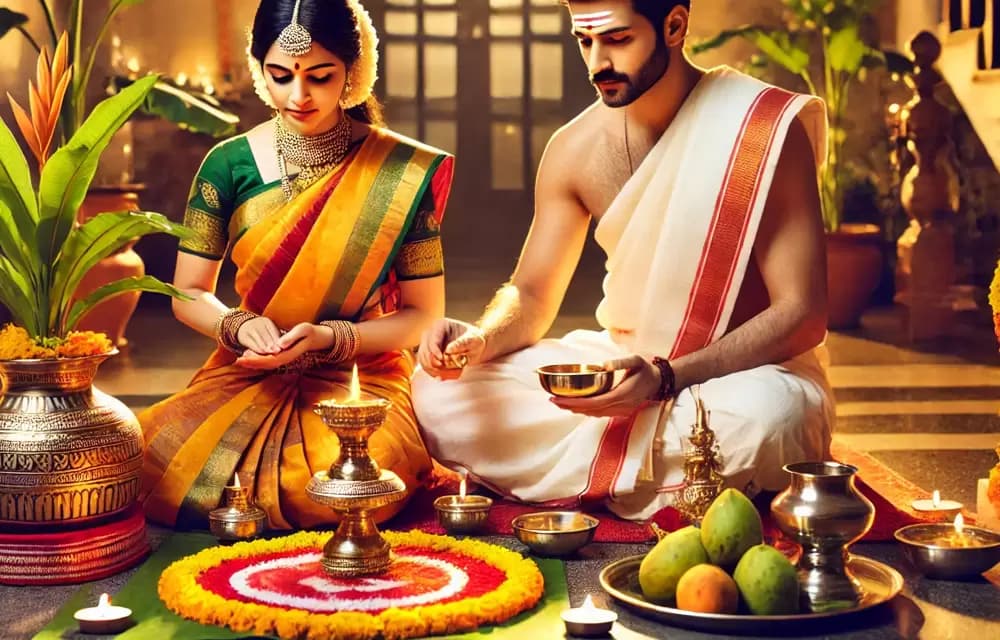
Ugadi, the traditional New Year celebrated in Andhra Pradesh, Telangana, and Karnataka, holds special significance.
Ugadi, the traditional New Year celebrated in Andhra Pradesh, Telangana, and Karnataka, holds special significance. It marks the beginning of a new year according to the Hindu lunisolar calendar. Performing the Ugadi puja at home is a way to invite prosperity, peace, and happiness. In this detailed guide, we will walk through the Ugadi puja rituals at home.
Items Required for Ugadi Puja Rituals at Home
1. Sacred Items
- Kalash (Copper or silver pot)
- Mango leaves
- Coconut
- Raw rice
- Turmeric
- Kumkum
- Camphor
- Betel leaves
- Betel nuts
- Flowers (jasmine, marigold)
- Sandalwood paste
2. Puja Thali (Plate) Items
- Oil lamps (diya)
- Incense sticks
- Fruits
- Naivedyam (offering, usually sweet dishes like jaggery-based food)
3. Special Ugadi Items
- Neem flowers
- Mango pulp
- Jaggery
Preparations Before Ugadi Puja
1. Clean the House
Ensure the home is thoroughly cleaned, as it signifies removing old negativity and making space for positive energy.
2. Create a Rangoli
Design a beautiful Rangoli at the entrance with colored powders to welcome good fortune.
3. Set Up the Altar
Arrange all sacred items on a clean altar or puja area. Set up the Kalash and decorate it with mango leaves and a coconut placed on top.
Step-by-Step Guide to Ugadi Puja Rituals at Home
1. Kalash Sthapana
Start the puja by placing the Kalash filled with water on the altar. Adorn the Kalash with turmeric and kumkum. Decorate with mango leaves and place a coconut on top.
2. Lighting the Lamps
Light the oil lamps to signify the removal of darkness and to invite divine blessings.
3. Offering Flowers and Naivedyam
Offer flowers and Naivedyam (usually sweet dishes or fruits) to the deities.
4. Recite Ugadi Puja Mantras
Chant special mantras such as "Om Namo Narayanaya" or "Om Shree Ganeshaya Namah" to invoke the blessings of Lord Vishnu and Ganesha.
5. Neem and Mango Mix Offering (Ugadi Pachadi)
Prepare a special Ugadi dish called "Ugadi Pachadi" made with neem, jaggery, tamarind, and mango. Offer this mix as it symbolizes the various flavors of life.
6. Aarti and Camphor Lighting
Perform Aarti using camphor, and wave it before the deities while ringing a bell, signifying the end of the puja.
Post-Puja Rituals
- Distribute the prasad (offered food) among family members and neighbors.
- Conclude by seeking blessings from elders.
Conclusion
Performing Ugadi puja rituals at home is a great way to connect with your traditions and start the new year on an auspicious note. By following this guide, you can ensure that the rituals are carried out with devotion and sincerity.
What is the spiritual significance of Ugadi Pachadi and its six tastes?
Ugadi Pachadi is not merely a ceremonial dish — it is a philosophical statement encoded in flavor. The six ingredients represent the Shadruchulu (six tastes) of life: neem flowers for bitterness (duhkha), jaggery for sweetness (sukha), raw mango for sourness (surprise or new beginnings), tamarind for tanginess (disgust or challenge), salt for saltiness (fear), and green chili for pungency (anger). By consuming all six in a single offering, the devotee consciously accepts that the coming year will bring a full spectrum of experiences.
This practice echoes the Vedantic teaching found in the Taittiriya Upanishad, which describes food (anna) as Brahman itself — the source of all life and experience. Offering Pachadi to the deity before consuming it reinforces the principle that we receive life's joys and sorrows as prasadam, divine grace, rather than as reward or punishment. Families in Andhra Pradesh and Telangana traditionally prepare this dish before sunrise and offer it to Lord Brahma, the presiding deity of Ugadi, who is believed to have begun creation on this very tithi.
Why is Lord Brahma specifically worshipped on Ugadi and what does Panchanga Sravanam mean?
According to the Brahma Purana, Lord Brahma commenced the creation of the universe on Chaitra Shukla Pratipada — the very day celebrated as Ugadi. This makes Ugadi uniquely connected to Brahma, a deity rarely worshipped through dedicated temples or festivals across the Hindu calendar. Invoking him on this day through Kalash Sthapana and mantra recitation is therefore considered especially meritorious and cosmologically aligned.
Panchanga Sravanam — the ritual listening to the new year's almanac — is one of the most important acts performed on Ugadi morning, often overlooked in simplified home-puja guides. A Panchanga is a detailed lunisolar almanac that outlines the Samvatsara (year name, one of a 60-year cycle), Ayana (solar half-year), Ritu (season), Masa (month), and Tithi (lunar day). Priests or knowledgeable elders read out predictions for rainfall, harvest, health, and governance for the coming year. Listening to this recitation is itself considered a form of worship, invoking the blessings of Surya Deva and Chandra Deva who govern the calendar.
How should the Kalash Sthapana be completed with the correct Sankalpa?
The Kalash — filled with clean water, adorned with five mango leaves arranged in a circle, and crowned with a coconut smeared with turmeric and kumkum — represents Varuna Deva, the deity of water and cosmic order, as well as the sacred confluence of the Ganga, Yamuna, Saraswati, Godavari, Narmada, Sindhu, and Kaveri. Placing the Kalash correctly orients the entire puja space and invites these river goddesses as witnesses to the household's new-year vow.
Before beginning any puja action, the worshipper should recite a Sankalpa — a formal declaration of intent. While holding water and akshata (unbroken rice grains mixed with turmeric) in the right palm, one states the current Samvatsara name, the month Chaitra, the tithi Pratipada, one's gotra (lineage), and the purpose of the puja. Even a simple Sankalpa in one's own language — 'I perform this puja for the welfare of my family and to mark the beginning of the new year' — fulfills the scriptural requirement of conscious, dedicated action (sankalpa-yukta karma) as described in the Bhagavad Gita (Chapter 17, verse 11).
Which deities should be invoked during home Ugadi puja and in what sequence?
The traditional sequence of invocation begins with Lord Ganesha (Ganapati Puja) to remove obstacles, followed by the Navagrahas (nine planetary deities) whose positions at the start of the new year are believed to influence the coming twelve months. A brief recitation of the Navagraha Stotra or even the simple 'Om Suryaya Namah' through 'Om Ketuye Namah' for each planet satisfies this step at home.
Lord Vishnu is then worshipped in his aspect as Jagannatha or as the presiding deity of the household — often represented by a shaligrama stone or a framed image. The Vishnu Sahasranama or the abbreviated Dwadasha Nama Stotra (twelve names of Vishnu) may be recited. Finally, the household's Kula Devata (family deity), who may be a regional goddess such as Kanaka Durga of Vijayawada or Chamundeshwari of Mysuru, receives flowers and naivedyam. Maintaining this sequence ensures that the puja moves from universal to personal, from macrocosm to the intimate life of the family.
What are the traditional foods prepared as Naivedyam on Ugadi and why?
Beyond Ugadi Pachadi, the primary naivedyam offered on this day in Telugu households is Bobbatlu (also called Puran Poli in Maharashtra), a sweet flatbread stuffed with chana dal and jaggery. Its golden color symbolizes prosperity, and jaggery — harvested at the end of the sugarcane season — connects the offering to the rhythm of agricultural abundance that underlies Hindu festival calendars.
Raw mango rice (Mamidikaya Pulihora) is another standard offering, utilizing the tender mangoes that appear exactly at this season, tying the feast to the living landscape. In Karnataka, Obbattu and Holige serve the same ritual and culinary role. All naivedyam should first be placed before the deity, formally offered with the words 'Naivedyam samarpayami,' and only then distributed as prasadam to family members. The Agni Purana specifies that food offered without this dedication does not constitute a true puja action.
How can families with limited time or resources perform a meaningful short-form Ugadi puja?
For households where elaborate ritual is not possible, the Smriti tradition permits a condensed puja that preserves the essential spiritual core. The minimum observance consists of three actions: a bath before sunrise (symbolizing purification), the preparation and tasting of at least a small portion of Ugadi Pachadi (the philosophical acceptance of life's flavors), and the lighting of a single lamp before the household deity with a heartfelt Sankalpa for the new year.
Even chanting a single powerful mantra — such as the Gayatri Mantra (Rigveda 3.62.10) twenty-one times — while facing east at dawn qualifies as meaningful worship on Ugadi. Many acharyas note that sincerity of intent (bhava shuddhi) carries more weight than the quantity of ritual materials. What matters most is that the household consciously pauses to mark the new year as a sacred threshold, carrying the awareness of Dharma, Artha, Kama, and Moksha — the four Purusharthas — into the months ahead.
Frequently Asked Questions
When is How to Perform Ugadi Puja at Home?
How to Perform Ugadi Puja at Home is observed on its traditional tithi in the Hindu lunar calendar; refer to the year's panchang for the exact date in your region.
What is the significance of How to Perform Ugadi Puja at Home?
Ugadi, the traditional New Year celebrated in Andhra Pradesh, Telangana, and Karnataka, holds special significance. It marks the beginning of a new year according to the Hindu lunisolar calendar.
How is How to Perform Ugadi Puja at Home celebrated?
Devotees observe it with puja, fasting or special offerings, visiting temples, chanting mantras, and gathering with family. Customs vary by region and tradition.
What should devotees do on How to Perform Ugadi Puja at Home?
Take a sacred bath, perform the day's puja and charity (dana), observe any prescribed fast, and chant mantras with sincere devotion.
You might also like

Purushottam Maas 2026: Lord Vishnu's Sacred Gift of Spiritual Multiplication & Divine Grace
Hindu Priest Jobs New Zealand 2026 — Auckland, Wellington, Christchurch Vacancies & NZ Religious Worker Visa Guide

Hindu Priest Jobs Malaysia 2026 — Batu Caves, KL, Penang Vacancies & Tamil Hindu Career Guide