Why Is Lord Ganesha Worshipped First? The Meaning Behind Every Hindu Puja
Discover why Lord Ganesha is the Prathama Pujya — worshipped before every other deity — through the Puranic race around his parents and the boon of first worship.
Discover why Lord Ganesha is the Prathama Pujya — worshipped before every other deity — through the Puranic race around his parents and the boon of first worship.
Quick answer: Lord Ganesha is worshipped first because, in the Puranic tradition (Shiva Purana and Ganesha Purana), Shiva and Parvati granted him the boon of Prathama Pujya — the first-worshipped one — after he won a race by reverently circling his parents. As Vighnaharta, the remover of obstacles, he is invoked at the start of every puja and undertaking.
Before almost any Hindu ritual begins — a wedding, a housewarming, a new business ledger, or a grand festival puja — the very first invocation goes to one deity: Lord Ganesha. He is addressed as Prathama Pujya, "the first to be worshipped," and Vighnaharta, "the remover of obstacles." This is not a casual custom but a principle woven deep into Hindu tradition, explained through beloved stories in the Shiva Purana and Ganesha Purana.
The reason Ganesha receives this honour rests on two pillars of tradition: a boon granted by Shiva and Parvati, and the wisdom Ganesha displayed in a famous race against his brother Kartikeya. Together these narratives teach that beginnings are sacred, that obstacles should be acknowledged before they are overcome, and that devotion and understanding matter more than raw speed or strength.
The boon of first worship (Prathama Pujya)
According to the Puranic tradition, when the gods and sages sought a way to ensure every ritual would be free of hindrance, it was decided that one deity should be honoured at the very outset of all worship. In the Shiva Purana and Ganesha Purana, Lord Shiva grants Ganesha the boon that he shall be worshipped before all other deities — including Shiva himself — at the commencement of any auspicious act.
The logic of the tradition is elegant: Ganesha is the lord of thresholds and beginnings. Since he governs whether an undertaking proceeds smoothly or meets obstruction, invoking him first is understood as clearing the path so that the worship of any other deity, and the task at hand, may unfold without impediment. This is why you will hear the words "Shuklambaradharam Vishnum" or "Vakratunda Mahakaya" chanted at the start of countless pujas.
The famous race around the world
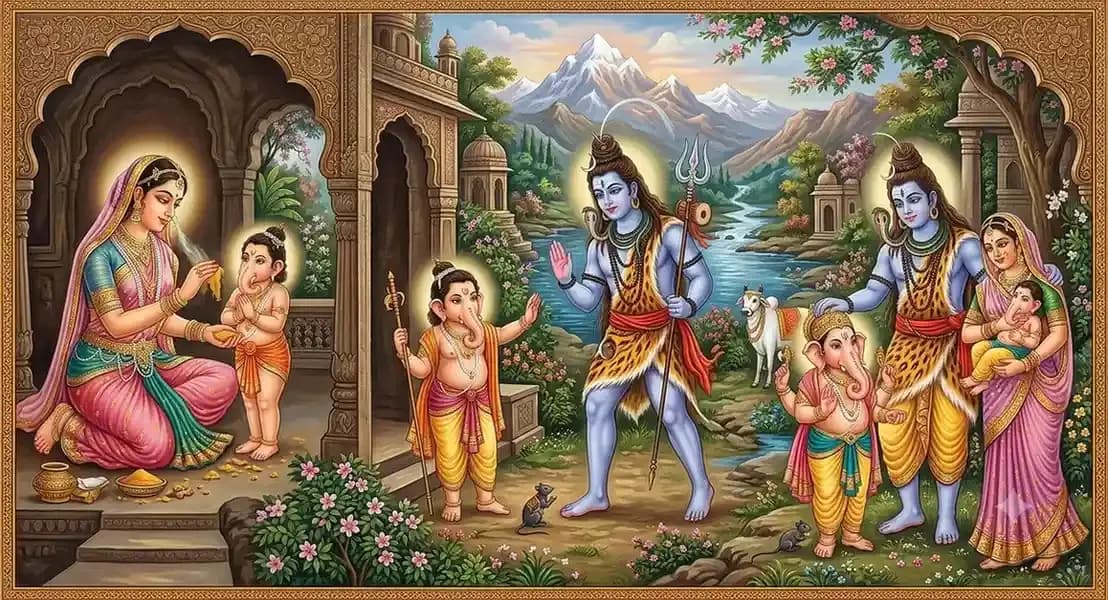
The most cherished story explaining Ganesha's precedence is the race between him and his brother Kartikeya (also called Skanda, Murugan, or Subrahmanya). As tradition recounts it, Shiva and Parvati proposed a challenge: whoever could circle the entire world three times first would win a special prize — in many tellings, a divine fruit, and in others, the very boon of being worshipped first.
Kartikeya, swift and confident, mounted his peacock and sped off to circumambulate the physical earth. Ganesha, riding his small mouse (Mushika), knew he could never match that speed. Instead, he paused, reflected, and then walked slowly and reverently around Shiva and Parvati, joining his palms in devotion. When asked why, he replied that his parents were his whole world — for a child, mother and father contain the entire universe. Circling them, he said, was equal to circling all of creation.
Moved by this insight, Shiva and Parvati declared Ganesha the winner. The tradition holds that this act of devotion and understanding is what earned — or confirmed — his status as Prathama Pujya, the deity honoured before all others.
| Aspect | Kartikeya (Skanda) | Ganesha | ||
|---|---|---|---|---|
| Vahana (mount) | Peacock | Mushika (mouse) | ||
| Approach | Speed — circled the physical earth | Wisdom — circled his parents | ||
| What he honoured | The outer world | Mother and father as the whole world | ||
| Outcome | Completed the physical journey | Won the boon of first worship |
Vighnaharta: the remover of obstacles
The second reason Ganesha comes first is his role as Vighnaharta (remover of obstacles) and Vighnesha (lord of obstacles). In tradition, he both removes hindrances for the sincere and, when needed, places them in the path of those who act without proper intent. Invoking him at the start is therefore understood as seeking a clear, blessed beginning.
- pHe is invoked before weddings, so the union begins auspiciously.
- pHe is honoured at the opening of a new home, shop, or account book.
- pHe is worshipped first in festival pujas, including the grand Ganesh Chaturthi celebrations.
- pStudents and artists invoke him before study, exams, or a new creative work.
- pTravellers and those beginning a journey seek his blessing for a smooth path.
What this tradition teaches us
Beyond ritual, the story of Ganesha's first worship carries practical wisdom that devotees have cherished for generations. It reframes how we think about beginnings, priorities, and the values that truly matter.
- pHonour your beginnings: how you start shapes what follows, so begin with intention and reverence.
- pWisdom over haste: Ganesha won not by being fastest but by understanding what the race truly meant.
- pDevotion to parents and roots: he saw the infinite in what was near, teaching gratitude for those who nurture us.
- pAcknowledge obstacles first: naming and honouring the possibility of hindrance is the first step to moving past it.
- pHumility of the small: riding a mouse, Ganesha reminds us that greatness is not about size or speed but insight.
This is why, at Ganesh Chaturthi — which in 2026 falls on Monday, 14 September (Bhadrapada Shukla Chaturthi) — households across India install Ganesha with such joy. Whether you follow Maharashtrian, Telugu, Tamil, Kannada, or North Indian customs, the shared thread is the same: the deity of beginnings is welcomed before all others. For exact muhurat timings, always confirm with a reliable local panchang, as auspicious windows vary by city.
Related reading
- p[object Object]
- p[object Object]
- p[object Object]
- p[object Object]
- p[object Object]
Frequently Asked Questions
Why is Ganesha worshipped before all other gods?
In the Puranic tradition of the Shiva Purana and Ganesha Purana, Lord Shiva granted Ganesha the boon of Prathama Pujya — to be worshipped before every other deity at the start of any auspicious act. As Vighnaharta, the remover of obstacles, invoking him first is understood as clearing the path for the ritual and the task to proceed smoothly.
What is the story of the race between Ganesha and Kartikeya?
Tradition recounts that Shiva and Parvati challenged their sons to circle the world three times. Kartikeya raced on his peacock around the earth, while Ganesha simply circled his parents, saying they were his entire world. Moved by this devotion and wisdom, Shiva and Parvati declared Ganesha the winner and honoured him with first worship.
What does Prathama Pujya mean?
Prathama Pujya means "the first to be worshipped." It is a title given to Lord Ganesha because tradition holds that he is honoured at the very beginning of every puja, ritual, and important undertaking — before any other deity is invoked. This reflects his role as the lord of beginnings and thresholds in Hindu worship.
What does Vighnaharta mean?
Vighnaharta means "remover of obstacles." Lord Ganesha is invoked by this name because tradition holds that he clears hindrances from the path of sincere devotees at the start of any venture. He is also called Vighnesha, lord of obstacles, since he governs whether an undertaking proceeds smoothly or meets obstruction.
Which Puranas tell why Ganesha is worshipped first?
The tradition of Ganesha's first worship is drawn mainly from the Shiva Purana and the Ganesha Purana. These texts narrate the boon granted by Shiva and Parvati, the race with Kartikeya, and Ganesha's role as Vighnaharta. Present these as revered Puranic tradition, cherished across regions and retold in many local versions.
Why did Ganesha circle his parents instead of the earth?
Riding his small mouse, Ganesha knew he could not outrun Kartikeya's peacock across the earth. Instead he reverently walked around Shiva and Parvati, explaining that for a child, mother and father contain the whole universe. Circling them, he said, equalled circling all creation — an act of devotion that won him the boon of first worship.
When is Ganesh Chaturthi in 2026?
Ganesh Chaturthi in 2026 falls on Monday, 14 September, on Bhadrapada Shukla Chaturthi. On this day households across India install and worship Lord Ganesha with great joy. Exact puja muhurat timings vary by city, so always confirm the auspicious windows with a reliable local panchang before beginning your worship.
What does worshipping Ganesha first teach us?
Beyond ritual, the tradition teaches that beginnings are sacred, that wisdom matters more than haste, and that devotion to one's roots is precious. Ganesha won not by speed but by understanding. Riding a humble mouse, he reminds devotees that insight, humility, and honouring obstacles before overcoming them are the true marks of greatness.
You might also like
Bathukamma Songs & Nine-Day Rituals: Naivedyam, Folk Songs & Aatapata Guide
Ganesh Visarjan 2026 in North India: Delhi, Lucknow & NCR Immersion Guide
Champa Shashthi 2026: Date, Khandoba Worship & Jejuri's Golden Festival