Why Is Modak Lord Ganesha's Favourite Sweet? The Story and Meaning
Modak is beloved by Lord Ganesha, who is called Modakapriya. Explore the story behind this sweet, its symbolism of hidden knowledge, its regional forms and why 21 modaks are offered.
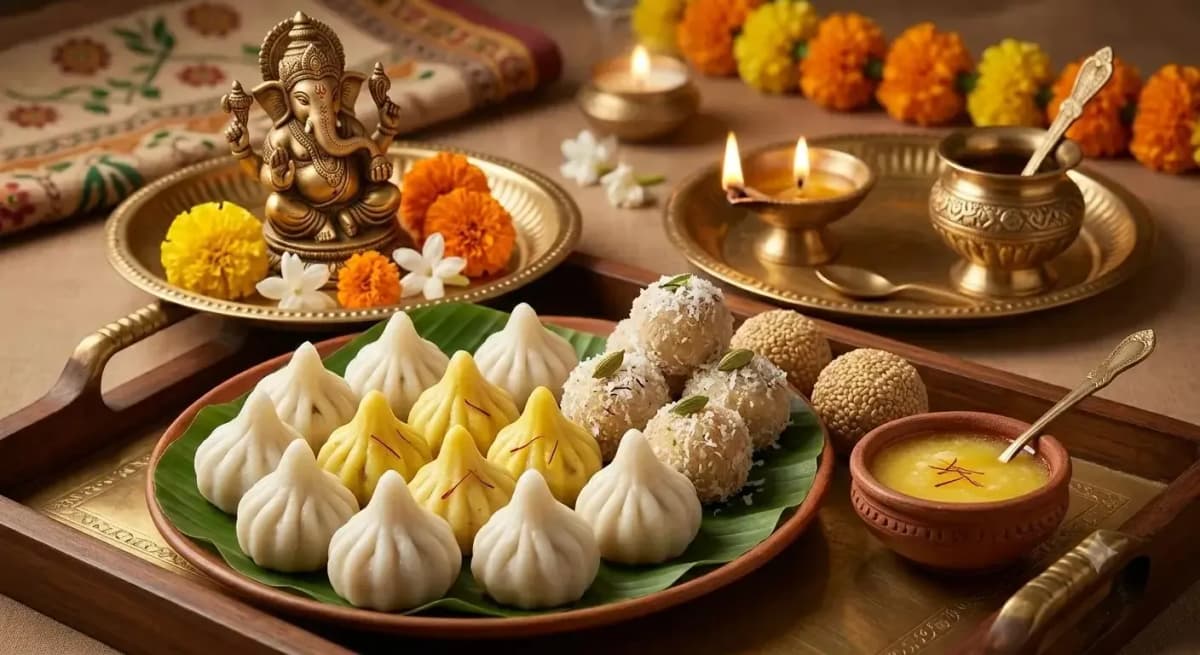
Modak is beloved by Lord Ganesha, who is called Modakapriya. Explore the story behind this sweet, its symbolism of hidden knowledge, its regional forms and why 21 modaks are offered.
Quick answer: Modak is Lord Ganesha's favourite sweet because tradition celebrates him as Modakapriya, 'the one who loves modak.' The soft outer shell hiding a sweet jaggery-coconut filling symbolises the sweetness of self-realisation and knowledge concealed within. Devotees offer modak — often 21 pieces — during Ganesh Chaturthi as a cherished naivedya.
Few images of Hindu devotion are as instantly recognisable as Lord Ganesha holding a modak in one of his hands. Across Maharashtra, the Telugu states, Tamil Nadu, Karnataka and North India, this dumpling-shaped sweet is the naivedya (offering) most closely tied to the elephant-headed lord. So beloved is it that one of Ganesha's traditional names is Modakapriya — 'the one who is fond of modak.' But why this particular sweet, and what does it mean beyond taste?
The answer weaves together devotional stories, deep symbolism and a rich regional cuisine. In this guide we explore the associations that made modak Ganesha's cherished sweet, the meaning hidden inside its folds, the many regional forms it takes, and the tradition of offering twenty-one modaks. Everything here is presented as living tradition, honoured for centuries by devotees rather than as any guarantee of results.
The name Modakapriya: Ganesha and his beloved sweet
In devotional literature Ganesha carries hundreds of names, each pointing to a quality or story. Among the most affectionate is Modakapriya. The word modaka itself carries a lovely double meaning in Sanskrit: it names the sweet, and it also derives from a root suggesting that which delights or brings joy (moda). To call Ganesha Modakapriya is therefore to say both that he loves the sweet and that he is fond of joy itself.
This is why, in classic depictions and in the recitation of his many names, Ganesha is so often shown cradling a bowl of modaks or holding a single modak in his lower hand while his trunk curves towards it. The gesture expresses contentment and grace — the lord who removes obstacles is himself pictured in a mood of sweet satisfaction.
How the association is remembered in tradition
Devotional storytelling connects modak to Ganesha in several affectionate ways. One well-loved thread tells of the gods presenting a divine modak said to hold the essence of all knowledge; when Ganesha received and honoured it, the sweet became forever linked with him. Another familiar association appears in the tales around his mother Parvati and the festive kitchens of Kailasa, where modak is prepared as the offering dearest to her son. These narratives circulate in several regional versions, and each community treasures its own retelling — all of them equally valid expressions of the same devotion.
The symbolism: sweetness hidden within
Beyond story, Hindu tradition reads the modak as a small teaching in edible form. Consider its structure: a plain, unassuming outer shell of rice flour, and inside it a rich filling of jaggery and coconut. You cannot see the sweetness from outside; you reach it only by opening the shell.
Tradition interprets this beautifully. The outer covering is likened to the ordinary, effortful surface of life and spiritual practice — the study, the discipline, the seeking. The hidden sweet core represents the bliss of self-realisation, the sweetness of true knowledge (jnana) that reveals itself only to those who go within. Ganesha, as the lord of wisdom and remover of obstacles, is fittingly associated with the sweet that must be uncovered to be enjoyed.
The pointed, rounded shape of the classic steamed modak is sometimes compared to a flame or a tuft, and its folds are seen as pathways gathering to a single point — a gentle visual reminder that many efforts converge on one realisation. None of this is dogma; it is the contemplative meaning devotees have long attached to a humble kitchen offering.
Regional forms of modak
One reason modak is so universally loved is that nearly every region shapes it in its own way. All these forms are equally cherished; there is no single 'correct' modak.
| Form | Region / tradition | Character |
|---|---|---|
| Ukadiche modak | Maharashtra | Steamed rice-flour shell with jaggery-coconut filling; the classic Ganesh Chaturthi offering |
| Fried modak (talniche) | Maharashtra & beyond | Wheat-flour shell, deep-fried; keeps longer, crisp exterior |
| Kudumulu / Undrallu | Telugu tradition | Steamed rice-flour dumplings, often savoury with chana dal, offered to Vinayaka |
| Kozhukattai | Tamil Nadu | Steamed rice dumplings with sweet coconut-jaggery (or savoury) filling |
| Kadubu | Karnataka | Steamed stuffed rice dumplings offered during Ganesha puja |
| Chocolate / dry-fruit modak | Modern homes | Contemporary variations for children and gifting |
In the Telugu-speaking tradition the offerings of choice are undrallu and kudumulu — steamed rice-and-lentil dumplings — prepared alongside sweet modaks for Vinayaka Chavithi. In Tamil Nadu the kozhukattai plays the same beloved role, and in Karnataka the kadubu. What unites them is the steaming method, the rice base and the joy of offering something made lovingly at home.
Why 21 modaks are offered
A widespread custom is to offer twenty-one modaks (ekavimshati) to Ganesha, especially during Ganesh Chaturthi. The number twenty-one recurs throughout Ganesha worship and is considered auspicious in his tradition.
- The number 21 appears across Ganesha ritual — for example in the offering of 21 durva grass blades and 21 types of leaves (patri) — so 21 modaks harmonise with this pattern.
- Twenty-one is read as 3 × 7, and both three and seven carry rich symbolic weight in Hindu thought, from the three gunas to the seven realms.
- Offering a generous, specific count expresses wholehearted devotion rather than a token gesture.
- In many homes the 21 modaks are shared as prasad afterwards, so the offering becomes a blessing distributed among family and guests.
As with all such customs, the exact count and manner vary by family and region, and each way is honoured. The heart of the practice is not arithmetic but the loving intention behind the offering.
Offering modak during Ganesh Chaturthi
Modak reaches its peak of importance during Ganesh Chaturthi, which in 2026 falls on Monday, 14 September 2026 (Bhadrapada Shukla Chaturthi). On this day and through the festival, freshly made modaks are placed before the Ganesha idol as naivedya, offered with the recitation of his names and aarti, and then shared as prasad.
- Prepare modaks fresh on the morning of the puja where possible; steamed ukadiche modak or regional undrallu/kozhukattai are traditional choices.
- Arrange them on the offering plate, commonly in a count of 21, alongside other naivedya.
- Offer with devotion during the main puja; specific muhurat timings are location-specific, so confirm the puja time from a reliable local panchang.
- Distribute the modaks as prasad after the aarti so the sweetness is shared.
Whether you make the delicate steamed shell or a simpler fried version, the offering itself — made with care and given with love — is what tradition values most.
Related reading
- p[object Object],[object Object],[object Object]
- p[object Object],[object Object],[object Object]
- p[object Object],[object Object],[object Object]
- p[object Object],[object Object],[object Object]
- p[object Object],[object Object],[object Object]
Frequently Asked Questions
Why is modak considered Lord Ganesha's favourite sweet?
Modak is considered Lord Ganesha's favourite because tradition celebrates him as Modakapriya, meaning 'the one fond of modak.' Devotional stories and centuries of practice link the sweet to him, and its hidden sweet filling symbolises the bliss of knowledge. This is why devotees offer modak as the cherished naivedya during Ganesh Chaturthi.
What does the word Modakapriya mean?
Modakapriya is a traditional name of Ganesha combining modaka (the sweet, also connected to joy or moda) and priya (dear or fond). It affectionately means 'one who loves modak' and, by extension, 'one who delights in joy.' The name appears in devotional recitations and reflects the deep association between Ganesha and this beloved sweet.
What is the symbolism of the modak?
The modak's plain outer shell hides a rich jaggery-and-coconut filling, so tradition reads it as a teaching: the sweetness of self-realisation and true knowledge lies within, reached only through inner effort. The outer covering represents disciplined practice, the core represents the bliss of wisdom — fittingly linked to Ganesha, the lord of wisdom.
What is the difference between ukadiche and fried modak?
Ukadiche modak is the Maharashtrian steamed version with a soft rice-flour shell and jaggery-coconut filling, considered the classic Ganesh Chaturthi offering. Fried modak (talniche) uses a wheat-flour shell that is deep-fried, giving a crisp exterior that keeps longer. Both are equally valid offerings; families choose based on preference and tradition.
What are undrallu and kudumulu in the Telugu tradition?
In the Telugu tradition, undrallu and kudumulu are steamed rice-flour dumplings offered to Vinayaka during Vinayaka Chavithi. They are often savoury, made with chana dal, and prepared alongside sweet modaks. They fill the same beloved role that ukadiche modak plays in Maharashtra and kozhukattai plays in Tamil Nadu.
Why are 21 modaks offered to Ganesha?
Offering 21 modaks (ekavimshati) is a widespread custom because the number 21 recurs throughout Ganesha worship — as in 21 durva blades and 21 patri leaves — and is held auspicious in his tradition. It is also read as 3 × 7. The exact count varies by family and region, and each way is honoured.
When is Ganesh Chaturthi in 2026 and when is modak offered?
Ganesh Chaturthi in 2026 falls on Monday, 14 September 2026 (Bhadrapada Shukla Chaturthi). Fresh modaks are offered as naivedya before the Ganesha idol during the main puja and shared as prasad afterwards. Muhurat timings are location-specific, so confirm the exact puja time from a reliable local panchang.
Can I offer modak variations like chocolate or dry-fruit modak?
Yes. While steamed ukadiche modak and regional forms like undrallu and kozhukattai are the traditional choices, modern homes also prepare chocolate or dry-fruit modaks, especially for children and gifting. Tradition values the loving care behind the offering more than a single fixed form, so devotees may choose what they can prepare well.
You might also like
Bathukamma Songs & Nine-Day Rituals: Naivedyam, Folk Songs & Aatapata Guide
Ganesh Visarjan 2026 in North India: Delhi, Lucknow & NCR Immersion Guide
Champa Shashthi 2026: Date, Khandoba Worship & Jejuri's Golden Festival