
Where Did Hanuman Go After Ramayana? The Chiranjivi Story of Sri Hanuman
When Sri Rama returned to Vaikuntha after the Ramayana, Hanuman did not go with him — and what he chose instead is one of the most moving devotional stories in Hindu tradition. The complete Chiranjivi story of Sri Hanuman: Gandhamadhana tapas, the encounter with Bhima in the Dvapara Yuga, the Kapidhwaja flag on Arjuna's chariot at Kurukshetra, and Hanuman's continuing presence wherever the name of Rama is heard.
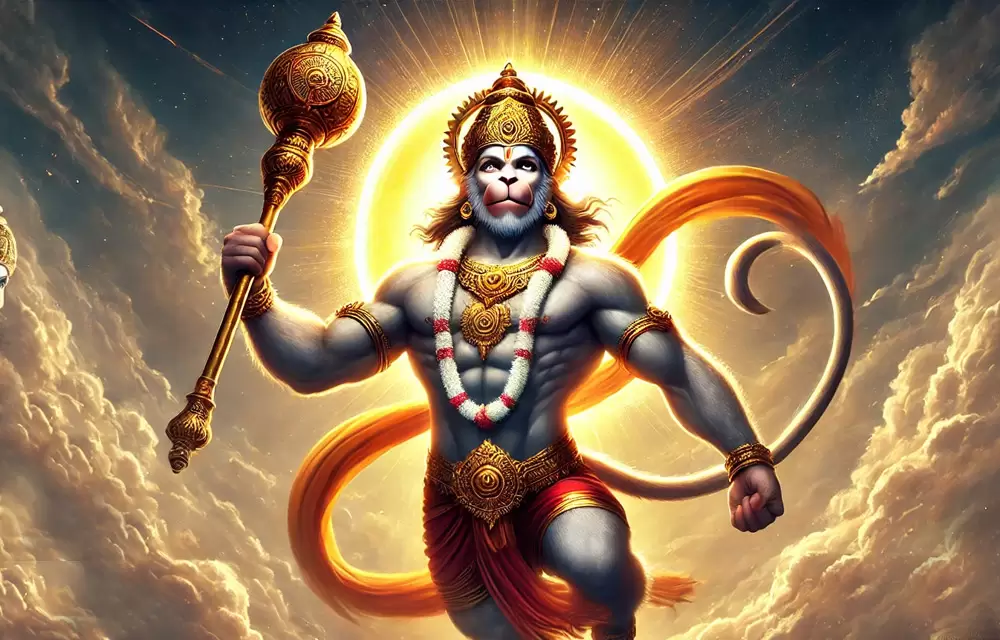
After the great Ramayana war ended and dharma was restored on Earth, Sri Rama prepared to end his avatara and return to Vaikuntha. He wished to take Hanuman with him. But Hanuman — the most devoted of all his devotees — chose differently. And what he chose has become one of the most moving stories in the entire Hindu spiritual tradition.
Hanuman's Reply to Sri Rama
As Sri Rama prepared for the journey to Vaikuntha, he turned to Hanuman and said: 'Come, dear Anjaneya, you too should return with me.' Hanuman fell at Rama's feet and spoke words that have echoed through every recitation of the Ramayana since:
"Rama, as long as your sacred name is heard on this Earth — even one syllable of it — I have no need for Vaikuntha. The pleasures of Vaikuntha are nothing compared to the joy of hearing your name. Let me stay here, in this world. Let me meditate on you. Let me be present wherever your name is chanted."
And so, Hanuman did not return to Vaikuntha with Rama.
Hanuman on Gandhamadhana — The Tapas Continues
Even today, the Puranas tell us, Hanuman performs his tapas on Gandhamadhana mountain in the Himalayas, chanting the name of Rama. He is the eternal Rama-devotee — and the eternal Rama-bhakta listens for every devotee who calls his name with sincerity.
Hanuman in the Mahabharata — The Encounter with Bhima
Even after the Treta Yuga ended and the Dvapara Yuga began, Hanuman remained on Earth. In the Mahabharata, when the Pandavas were in their forest exile, Bhima — proud of his immense strength — entered a forest in search of a divine flower for Draupadi.
Hanuman, knowing Bhima was his own brother (both being sons of Vayu, the wind god), took the form of an old, weakened monkey lying across the forest path. His long tail blocked Bhima's way.
Bhima, irritated, demanded the old monkey move his tail. The 'old monkey' said: 'I am too feeble. Move it yourself.' Bhima tried — and could not lift the tail with all his strength. He tried again with the full force of his arms. The tail did not move an inch.
Bhima then understood. He fell at the feet of his elder brother. Hanuman revealed his divine form, blessed Bhima, and counselled him to use his strength always in the service of dharma — not for pride.
Hanuman at Kurukshetra — Kapidhwaja on Arjuna's Chariot
During the Kurukshetra war, when Arjuna stood on his chariot before the great battle, Hanuman was present in the form of the Kapidhwaja — the monkey-flag on Arjuna's chariot. From that position, Hanuman protected the chariot, Arjuna, and the Pandavas from the most dangerous astras (divine weapons) hurled by the Kauravas.
Every time you read the Bhagavad Gita's first chapter — where Krishna and Arjuna stand on the chariot before the war — Hanuman is silently there, on the flag above them. The protection of the Pandavas in their darkest hour was Hanuman's silent, unseen gift.
One of the Seven Chiranjivis — Immortals of Hinduism
In Hindu tradition, Hanuman is one of the seven Chiranjivis — the immortals who do not die. The traditional list of Chiranjivis is:
- Ashwatthama — son of Drona
- Bali — the daitya king blessed by Vamana
- Vyasa — the sage who compiled the Mahabharata + Puranas
- Hanuman — son of Vayu, eternal Rama-bhakta
- Vibhishana — Ravana's brother, granted boon by Rama
- Kripa — the acharya
- Parashurama — sixth avatar of Vishnu
Hanuman received the boon of remaining on Earth until the end of Kali Yuga. He lives — not in a hidden cave, not in a separate world, but right here in this world, present wherever Rama's name is chanted with sincerity.
Wherever Rama's Name Is Heard, Hanuman Is There
There is a beautiful spiritual saying: "Wherever Rama's name resounds, there sits Hanuman — with folded hands, tears of joy in his eyes, listening." This is why, in the traditional Hindu Ramayana recitation (Ramayana Parayana, Akhanda Ramayana), it has become customary to set aside a special seat — a chair, a cushion, a simple asana — for Hanuman. The seat is offered to him, and the devotees believe that Hanuman comes to listen.
We may not see him with our eyes — but the tradition teaches that any Rama-devotee who calls Hanuman with sincerity is heard. Hanuman is the bridge between the Rama-bhakta on Earth and Sri Rama in Vaikuntha. He responds. He always has.
The Devotional Practice Today
- Chant Hanuman Chalisa on Tuesdays and Saturdays — the days traditionally sacred to Hanuman.
- Recite the Sundara Kanda (the fifth book of the Ramayana, the book most associated with Hanuman's deeds) — especially during difficult times.
- At Ramayana recitations, reserve a clean seat for Hanuman and offer flowers + tulasi as an invitation.
- When you chant Sri Rama's name, know that Hanuman is present, listening, blessing.
Frequently Asked Questions
Why didn't Hanuman return to Vaikuntha with Sri Rama?
Hanuman told Rama that as long as Rama's name is chanted on Earth, he has no need for Vaikuntha. The joy of hearing Rama-nama is greater than the pleasures of Vaikuntha. Rama granted him this wish.
Where does Hanuman live today?
The Puranas say Hanuman performs tapas on Gandhamadhana mountain in the Himalayas, chanting Rama-nama. He is one of the seven Chiranjivis — granted the boon of living on Earth until the end of Kali Yuga.
How did Hanuman meet Bhima in the Mahabharata?
During the Pandavas' forest exile, Bhima ventured deep into a forest seeking a divine flower for Draupadi. Hanuman took the form of an old monkey lying across the path with his tail blocking the way. Bhima — proud of his strength — couldn't lift the tail. He then realised he was facing his own elder brother (both being sons of Vayu) and received Hanuman's blessing.
What is the Kapidhwaja on Arjuna's chariot?
Kapidhwaja means 'monkey-flag.' Hanuman was present in the form of the flag atop Arjuna's chariot during the Kurukshetra war, protecting Arjuna and the Pandavas from dangerous astras. Every reading of the Bhagavad Gita's first chapter implicitly includes Hanuman as the silent guardian above.
Why do we reserve a seat for Hanuman at Ramayana recitations?
Because the tradition teaches that wherever Rama's name is chanted, Hanuman is present — with folded hands and tears of joy, listening. The reserved seat is the devotee's invitation to Hanuman to attend the recitation in person.
Is Hanuman truly immortal?
In Hindu tradition, yes — Hanuman is one of the seven Chiranjivis, granted the boon of remaining on Earth until the end of Kali Yuga. He lives wherever Rama's name is chanted with sincerity.
🙏 Jai Sri Ram · Jai Hanuman · Bajrang Bali Ki Jai 🙏
Share this with family and friends
Send it on WhatsApp, post it, or copy the link.
More from Lord Hanuman
- Rama Avatar — The Seventh Incarnation of Vishnu: Ramayana, Ayodhya, the Ideal Man & Eternal Dharma Lessons for 2026
- Must Visit Temples on Saturday: Top 12 Shani & Hanuman Temples in India for Powerful Shanivar Blessings
- Telugu Hanuman Jayanti 2026 Today: Grand Celebrations Across Telangana & Andhra Pradesh on May 12
- Telugu Hanuman Jayanti 2026 Celebrations Today: Grand Festivities Across India & USA on May 12
- Tirumala May 2026 Festival Calendar: Day-Wise Guide to Lord Venkateswara Sevas, Darshan & Summer Travel Tips
You might also like
Sundar Kand: Complete Guide to Tulsidas's 5th Book of Ramcharitmanas, 7-Day Saptaha Paath & Benefits
Hanuman Worship on Saturday: Powerful Rituals & Remedies for Shani Dosha
Lord Hanuman Names for Baby Boy (with Meanings)