Hindu Gods and Science: Ganesha’s Elephant Head – Mythology Meets Genetic Science
Lord Ganesha, one of the most beloved and revered deities in Hinduism, is easily recognized by his elephant head.

Lord Ganesha, one of the most beloved and revered deities in Hinduism, is easily recognized by his elephant head.
Lord Ganesha, one of the most beloved and revered deities in Hinduism, is easily recognized by his elephant head. Beyond its mythological and symbolic significance, Ganesha's unique appearance invites fascinating interpretations through the lens of modern science, particularly genetic engineering and neuroscience.
The Mythology of Ganesha’s Elephant Head
According to Hindu mythology, Ganesha's elephant head was the result of an extraordinary event:
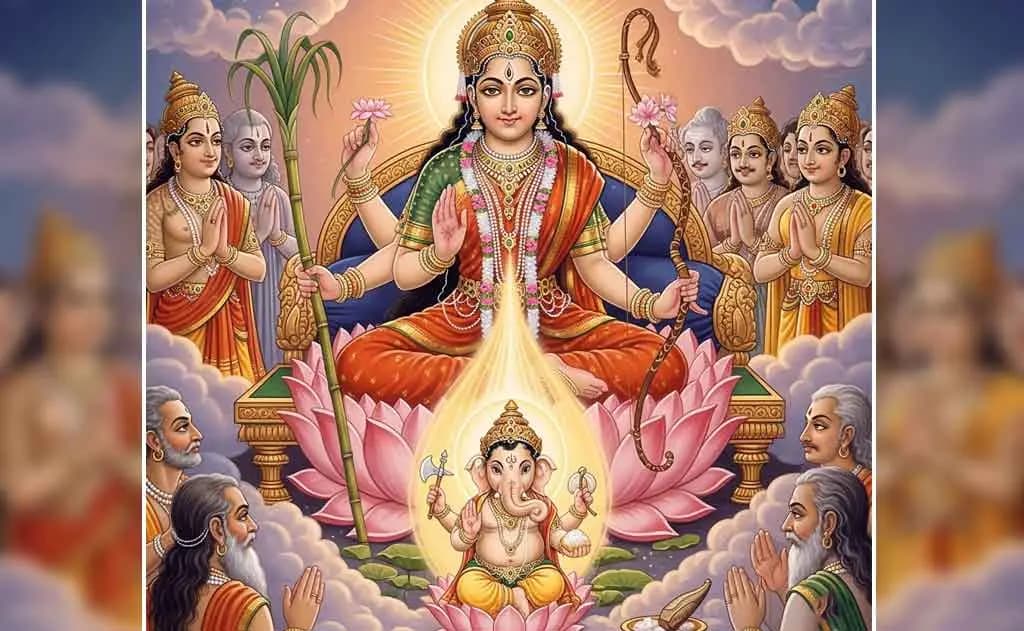
The Birth of Ganesha: Created by Goddess Parvati from her body’s sandalwood paste, Ganesha was tasked with guarding her privacy. The Beheading: When Lord Shiva attempted to enter, Ganesha denied him entry, leading to a confrontation in which Shiva beheaded him. The Restoration: Upon Parvati’s insistence, Shiva replaced Ganesha’s head with that of the first living being he encountered—a sacred elephant.
This story is rich in symbolism:
The elephant head represents wisdom, intelligence, and memory. Ganesha’s hybrid form signifies the integration of human and animal qualities, embodying harmony between mind, body, and nature.
Genetic Engineering: A Modern Lens on the Myth
Head Transplantation and Genetic Manipulation
The myth of Ganesha’s head replacement mirrors modern scientific endeavors like organ transplantation and genetic modification. Recent advancements in xenotransplantation (using animal organs for humans) and breakthroughs in neural grafting hint at the possibilities of cross-species integration, similar to the concept in Ganesha’s story.
CRISPR and Gene Editing
Techniques like CRISPR-Cas9 allow scientists to edit genetic material with precision. Ganesha’s elephant head could be seen as an ancient metaphor for genetic engineering—altering human anatomy by integrating traits from other species.
Neuroscience and the Symbolism of Ganesha
Elephant Brain and Intelligence
Elephants are renowned for their exceptional memory and intelligence, traits also associated with Lord Ganesha. The enlarged brain size of an elephant, especially its cerebral cortex, aligns with the qualities of wisdom and decision-making attributed to Ganesha.
The Role of the Human Brain
Ganesha’s large head is symbolic of a heightened intellect and problem-solving ability. The fusion of human and elephant traits may represent the ideal balance between emotional intelligence and rational thinking.
Cultural and Scientific Reflections
Harmony Between Science and Spirituality
The story of Ganesha emphasizes the need for balance between technological advancements and ethical considerations. Just as Shiva used an elephant’s head to save Ganesha, modern science must strive for innovations that sustain and enhance life while respecting nature.
Lessons for Modern Science
Ganesha’s transformation can inspire interdisciplinary research, blending biology, technology, and philosophy. It serves as a reminder of the potential of science to transcend limitations when guided by wisdom and compassion.
Conclusion: Mythology Inspires Science
The tale of Ganesha’s elephant head is more than a myth; it is a profound narrative that bridges the ancient and the modern, the mystical and the empirical. As genetic science advances, stories like this remind us of the timeless wisdom embedded in mythology and its ability to spark curiosity and innovation in the scientific community.
Through Ganesha, we learn not only to embrace challenges with intellect and creativity but also to approach science with a sense of wonder and responsibility.
What do the Puranas actually say about Ganesha's elephant head?
The most detailed account of Ganesha's birth appears in the Shiva Mahapurana, specifically in the Rudra Samhita (Kumara Khanda). Here, Parvati shapes Ganesha from the turmeric paste (haridra) she uses to cleanse her body — not merely sandalwood paste — and breathes life into the figure before Shiva's arrival on Mount Kailasa. The Linga Purana and Varaha Purana offer parallel but slightly differing versions, reminding us that Puranic tradition preserves a living, layered theology rather than a single fixed narrative.
In the Brahmavaivarta Purana, a distinct variant records that Shani (Saturn) inadvertently destroyed Ganesha's original head when his inauspicious gaze fell upon the infant at the naming ceremony. Vishnu then retrieved the head of Airavata's young one — the divine elephant born from the churning of the cosmic ocean — to restore the child. This version emphasises the motif of divine sovereignty over fate and the redemptive role of Vishnu, adding a cosmological dimension absent from the more commonly cited Shiva Purana account.
Why an elephant head? The deep symbolism of Gaja in Vedic and Tantric thought
The Sanskrit word for elephant, gaja, carries the root meaning 'that which goes' or 'that which has attained,' linking the animal to movement and spiritual accomplishment. In Vedic literature, Airavata — the white elephant of Indra — is described in the Aitareya Brahmana as emerging from cosmic water and representing the abundance of rain clouds. By giving Ganesha the head of this most auspicious of animals, the mythic imagination grafted the Vedic vocabulary of power, prosperity, and cosmic order directly onto the deity.
In Tantric worship, particularly within the Ganapatya sampradaya, the elephant head is read through the framework of the Mudgala Purana, which lists eight distinct forms of Ganesha — the Ashtavinayaka — each associated with a specific cosmic function and a different vahana (mount). The large cranium of the elephant is specifically linked in these texts to Brahmarandhra, the subtle energy centre at the crown of the skull through which a yogi's prana is said to exit at liberation (moksha). The physical anatomy of the elephant thus becomes a map of inner spiritual geography.
How does the elephant brain compare neurologically to what Ganesha symbolises?
Elephant brains weigh approximately 4.5 to 5 kilograms — nearly three times the mass of a human brain — and contain a dense concentration of neurons in the cerebral cortex and cerebellum. Neurobiological research has confirmed that elephants demonstrate episodic memory, self-recognition in mirrors, empathetic responses to distressed herd-mates, and the ability to use tools. These are precisely the cognitive faculties that Ganesha's iconography celebrates: his ekadanta (single tusk) is said to be the instrument with which he wrote down the Mahabharata as dictated by Vyasa, symbolising the capacity to absorb, process, and transmit vast bodies of knowledge.
The hippocampus, the brain region most associated with long-term memory consolidation in mammals, is proportionally large in elephants. Ganesha is invoked as Buddhipriya ('the one who loves intellect') and Buddhividhata ('the giver of intellect') in the Ganesha Sahasranama. The neurological reality of the elephant's exceptional memory thus provides a scientifically grounded underpinning for the ancient theological choice of the elephant as the emblem of wisdom — though Puranic authors arrived at this association through direct observation of living elephants rather than neuroscience.
Xenotransplantation today: how close is modern science to the Ganesha motif?
Xenotransplantation — the transplantation of living cells, tissues, or organs from one species to another — has moved from theoretical discussion to clinical trial in recent years. Surgeons at NYU Langone Health have successfully attached genetically modified pig kidneys to human recipients in experimental procedures, and pig heart valves have been used in cardiac surgery for decades. CRISPR-Cas9 editing is now routinely employed to knock out porcine retroviral genes that would otherwise trigger human immune rejection, making the donor tissue more compatible at a molecular level.
However, a full cross-species cranial or neural transplant of the kind implied by Ganesha's mythology remains categorically beyond present capability. The blood-brain barrier, the complexity of neural connectivity (the human brain contains roughly 86 billion neurons with trillions of synaptic connections), and the profound immunological challenges of central nervous system tissue make head transplantation — even within the same species — an unresolved scientific problem. The mythological narrative should therefore be understood as theological and symbolic in intent: it is not a historical record of a surgical event but a precise articulation of the idea that divine intelligence transcends ordinary biological limits.
Ganesha's role as Vighnaharta: why he is worshipped before every sacred beginning
The Rigveda (2.23.1) addresses Brahmanaspati — a deity of sacred speech and intellect whom later tradition identifies as a precursor to Ganesha — as the remover of obstacles and the lord of prayers. By the time of the Yajurveda's Shri Rudram, the Gananam tva verse explicitly names Ganapati as the leader of the ganas (divine hosts) and petitions him to be invoked first among the gods. This textual lineage establishes Ganesha's priority in worship not as a medieval innovation but as a practice rooted in Vedic liturgical logic.
In practical devotional life, this priority is observed across Hindu traditions regardless of sectarian affiliation — Shaiva, Vaishnava, Shakta, and Smarta households all begin puja, weddings, construction of temples, and scholarly undertakings with a Ganesha invocation. The Ganesh Chaturthi festival, most elaborately celebrated in Maharashtra — particularly in Pune at the Shrimant Dagdusheth Halwai Ganapati temple and the Kasba Ganapati temple — and across Andhra Pradesh and Tamil Nadu, re-enacts the cyclical installation and immersion of the deity as a cosmic metaphor for creation, sustenance, and dissolution, mirroring the Shaiva concept of the Panchakritya (five divine acts).
What is the significance of Ganesha's single tusk, the ekadanta, in philosophy and iconography?
The broken tusk — ekadanta, literally 'one-tusked' — is one of Ganesha's most distinctive physical attributes and carries layered philosophical meaning. The Mudgala Purana devotes an entire section to Ekadanta as one of Ganesha's eight primary forms, describing him as blue-complexioned and riding a mouse, and associates this form specifically with the conquest of Mohasura, the demon of delusion. The single tusk thus signals the destruction of maya, the cosmic illusion that prevents the individual self (jiva) from perceiving its identity with Brahman.
Iconographically, Ganesha is almost invariably depicted holding the broken tusk in his lower right hand, indicating that he himself wielded it as a writing instrument to transcribe the Mahabharata. The Narada Purana recounts that when the sage Vyasa required a scribe capable of keeping pace with his dictation without pause, Brahma recommended Ganesha alone as possessing sufficient intellect and speed. Ganesha agreed on the condition that Vyasa never pause; Vyasa countered that Ganesha must understand every verse before writing it — a condition that, according to the text, is why the Mahabharata contains verses of such extraordinary depth that they still reward scholarly commentary millennia later.
Frequently Asked Questions
Who is Hindu Gods and Science?
Lord Ganesha, one of the most beloved and revered deities in Hinduism, is easily recognized by his elephant head. Beyond its mythological and symbolic significance, Ganesha's unique appearance invites fascinating interpretations through the lens of modern science, particularly genetic engineering and neuroscience.
How is Hindu Gods and Science worshipped?
Through daily puja, mantra chanting, aarti and offerings of flowers, lamps and prasad — on dedicated days and festivals associated with the deity.
What are the benefits of worshipping Hindu Gods and Science?
Devotees seek blessings for protection, prosperity, health, wisdom and inner peace, and a deeper connection with the divine.
Which day is dedicated to Hindu Gods and Science?
Each deity has an associated day and festivals; worshipping on that day, with fasting and mantra, is considered especially auspicious (see the guide above).
You might also like
Shani Deva Temples Worldwide & Must-Performed Rituals — Complete Devotee's Guide
Matsya Avatar — The First Incarnation of Vishnu: Story, Significance, Sacred Geography & Lessons for 2026
Shani Deva Is Not Evil — He Is the Cosmic Judge of Karma