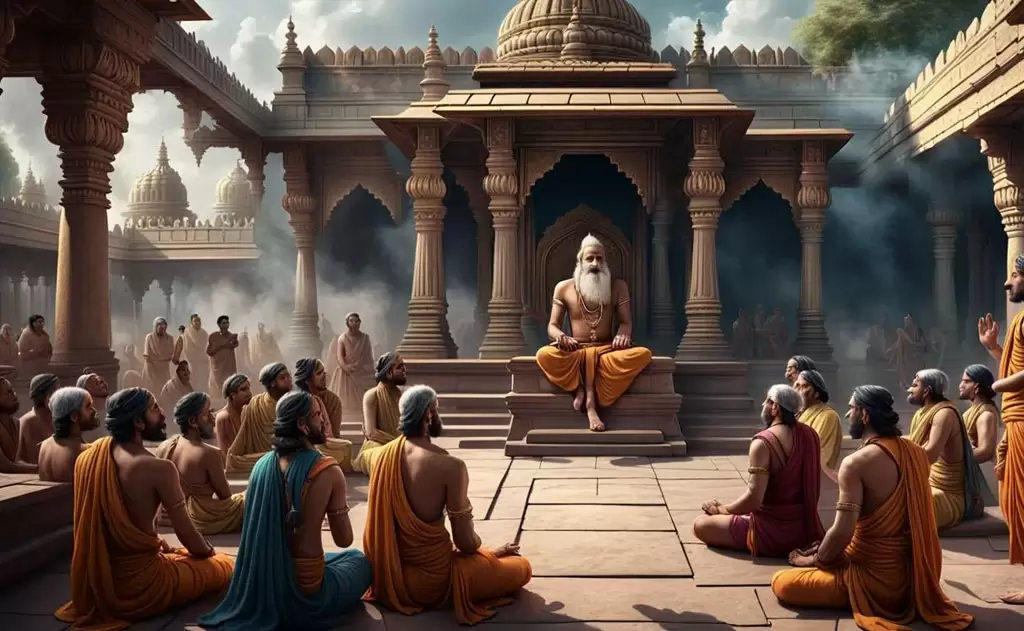
12 great sages of Hinduism
This image is titled "12 Great Sages of Hinduism". The image shows artistic depictions of 12 sages.
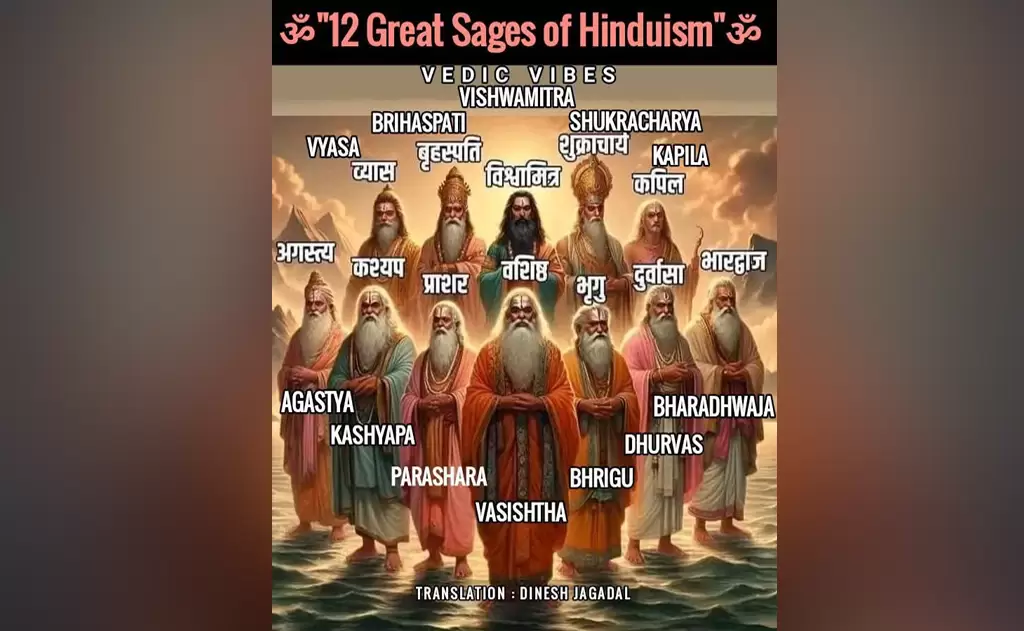
This image is titled "12 Great Sages of Hinduism". The image shows artistic depictions of 12 sages. They all appear to be standing on water, with a sunset scene in the background.
Each sage's name is written above their depiction. They are:
- Vyasa
- Brihaspati
- Vishwamitra
- Shukracharya
- Kapila
- Agastya
- Kashyapa
- Parashara
- Vasishtha
- Bhrigu
- Durvasa
- Bharadvaja
The sages shown in the image are highly revered and influential in Hinduism. They are renowned for their wisdom, penance, and spiritual accomplishments.
This image illustrates the importance and role of the great sages in Hinduism.
What makes these twelve sages uniquely foundational to Hindu civilization?
These twelve sages are not merely religious figures but the architects of Hindu thought, literature, and social order. Vyasa composed and classified the Vedas into four collections — Rigveda, Samaveda, Yajurveda, and Atharvaveda — and authored the Mahabharata and the eighteen Mahapuranas, earning the title Veda Vyasa, the 'arranger of the Veda.' Brihaspati, the preceptor of the Devas, authored the Brihaspatismriti and is credited with codifying political philosophy and statecraft, making him as much a founder of governance thought as of theology.
Bhrigu is one of the Saptarshis (seven great seers) and the progenitor of the Bhargava lineage. The Bhrigu Samhita, a celebrated astrological text, is attributed to him, and it is Bhrigu who is said to have tested the Trimurti in the well-known episode recounted in the Srimad Bhagavata Purana. Kashyapa is perhaps the most cosmologically significant of all — the Mahabharata and multiple Puranas name him as the father of Devas, Asuras, Nagas, and Garuda, making virtually all living beings his descendants.
How did Vishwamitra and Vasishtha shape the Rigveda and the concept of Brahmarshi?
Vishwamitra and Vasishtha represent one of the most celebrated rivalries in Hindu tradition, yet both are among the principal seers (drashtas) of the Rigveda. Vishwamitra is credited with revealing the Gayatri Mantra — the twenty-fourth verse of the third Mandala of the Rigveda — which remains the most widely recited Vedic hymn in daily Hindu worship. Born a Kshatriya king named Kaushika, he earned the status of Brahmarshi through unrelenting tapas (austerity), making his story the definitive scriptural proof that spiritual rank transcends birth.
Vasishtha, on the other hand, was the Rajaguru (royal preceptor) of the Ikshvaku dynasty and thus of Rama himself. The Yoga Vasishtha, a philosophical text of the Advaita Vedanta tradition, records his teachings to the young prince Rama on the nature of consciousness, liberation, and the illusory quality of the world. The seventh Mandala of the Rigveda is known as the Vasishtha Mandala, as most hymns in it are attributed to him and his family lineage.
What are the distinct spiritual and literary contributions of Agastya and Parasara?
Agastya holds a singular position as the sage who carried Vedic civilization southward across the Vindhya mountains into the Indian subcontinent's southern regions. Tamil literary tradition venerates him as Agattiyar, the father of the Tamil language and grammar, and the Agattiyam is held to be the earliest Tamil grammatical work. His ashrama is traditionally located near Pothigai Hills in present-day Tamil Nadu, and temples dedicated to him exist across South India, including a famous shrine at Agastyarkoodam in Kerala.
Parasara is the author of the Vishnu Purana, which the philosopher Adi Shankaracharya's tradition regards as the most authoritative of all Puranas on the nature of Vishnu and creation. He is also the father of Veda Vyasa, born of his union with Satyavati on the banks of the Yamuna. Parasara's Brihat Parasara Hora Shastra is the foundational text of classical Jyotisha (Vedic astrology), and every major school of Indian astrology traces its principles back to this work.
Who are Shukracharya and Kapila, and why do they represent contrasting streams of Hindu wisdom?
Shukracharya is the preceptor of the Asuras and the author of the Shukraniti, a treatise on statecraft, economics, and military science. Unlike the other sages in this grouping, his role is often morally ambiguous in the Puranas — he opposes the Devas and their allies — yet his intellectual stature is never diminished. The Srimad Bhagavata Purana records that it was Shukracharya who possessed the Mritasanjivani Vidya, the knowledge to restore the dead to life, which Brihaspati lacked.
Kapila Muni is the founder of the Samkhya school of philosophy, one of the six classical darshanas (systems of Hindu philosophy). The Samkhya system's enumeration of Purusha (pure consciousness) and Prakriti (primordial matter) and its twenty-five tattvas (principles of reality) laid the metaphysical groundwork upon which the Yoga philosophy of Patanjali was built. The Srimad Bhagavata Purana's third canto contains the Kapila Gita, in which Kapila teaches his mother Devahuti the path of devotion and discrimination.
What is the spiritual significance of Durvasa and Bharadvaja in the Puranic and Vedic traditions?
Durvasa, a partial incarnation of Shiva according to the Matsya Purana, is renowned for the severity of his tapas and the potency of his curses and blessings. His curse upon Indra for disrespecting a garland of parijata flowers is recorded in the Srimad Bhagavata Purana as the event that triggered the churning of the cosmic ocean (Samudra Manthan), making Durvasa indirectly responsible for the emergence of Amrita, Lakshmi, and other divine gifts. His apparent anger (krodha) is understood in esoteric commentary as a pedagogical instrument to precipitate karma-resolving events.
Bharadvaja is among the most prolific seers of the Rigveda, with the entire sixth Mandala attributed to his family lineage. He is also credited in the Charaka Samhita tradition with being one of the early transmitters of Ayurveda, having received the knowledge of medicine from Indra. His ashrama at Prayagraj (Allahabad), at the Triveni Sangama where the Ganga, Yamuna, and the invisible Saraswati converge, is mentioned in the Valmiki Ramayana as the place where Rama visited Bharadvaja during his forest exile.
How do these sages continue to live in Hindu ritual, pilgrimage, and daily practice today?
The living presence of these sages in Hindu daily life is most visible in the Sandhyavandana ritual, where the practitioner invokes the names of the Saptarshis and recites gotra (lineage) declarations tracing ancestry back to sages such as Kashyapa, Vasishtha, Bharadvaja, or Agastya. Every Hindu family's gotra connects it to one of these great rishis, meaning millions of people understand themselves as belonging to a spiritual-genetic lineage descending from these figures.
Pilgrimage circuits across India are structured around the ashramas and associated sites of these sages. The Naimisharanya forest in present-day Uttar Pradesh is traditionally described in the Puranas as the gathering place where Suta Goswami recited the Bhagavata Purana to an assembly of sages including many on this list. Temples such as the Kapileshwar Temple in Puri and the Agastyeshwara Temple in Varanasi keep devotional memory of individual sages alive as living shrines rather than historical monuments.
Frequently Asked Questions
Who are the 12 great sages of Hinduism?
They are Vyasa, Brihaspati, Vishwamitra, Shukracharya, Kapila, Agastya, Kashyapa, Parashara, Vasishtha, Bhrigu, Durvasa and Bharadvaja.
Which sage revealed the Gayatri Mantra?
Vishwamitra is credited with revealing the Gayatri Mantra, the twenty-fourth verse of the third Mandala of the Rigveda. Born a Kshatriya king named Kaushika, he became a Brahmarshi through tapas.
What did Sage Vyasa compose?
Vyasa arranged the Vedas into four collections: Rigveda, Samaveda, Yajurveda and Atharvaveda. He also authored the Mahabharata and the eighteen Mahapuranas.
Who founded the Samkhya philosophy?
Kapila Muni founded Samkhya, one of the six classical darshanas. It describes Purusha and Prakriti and twenty-five tattvas, and it laid the groundwork for Patanjali's Yoga philosophy.
How are these sages connected to gotras?
Every Hindu family's gotra traces to a sage such as Kashyapa, Vasishtha, Bharadvaja or Agastya. In Sandhyavandana, practitioners recite gotra declarations naming these lineages.
What is Agastya's link with South India?
Agastya is the sage who carried Vedic civilization south across the Vindhya mountains. Tamil tradition reveres him as Agattiyar, father of Tamil grammar, with his ashrama near the Pothigai Hills.
Share this with family and friends
Send it on WhatsApp, post it, or copy the link.
More from Hinduism
- Can a Robot Perform Puja? Robot Aarti, AI in Rituals and What Hindu Tradition Says
- GitaGPT and AI Bhagavad Gita Chatbots: How Accurate Are They, and What Does Hindu Tradition Say?
- Robotic Elephants and AI in Hindu Temples: Kerala's Mechanical Tuskers, Tirumala's AI Command Centre and the Debate
- Quantum Computing Explained for Hindus: Qubits, Superposition and Entanglement, with Vedanta Analogies (Not Equivalences)
- Madhava of Sangamagrama and the Kerala School: The Infinite Series for Pi, Sine and Arctangent, Worked Out Step by Step
You might also like
The Great Inventions and Pioneers of Science from Ancient India
Ayodhya’s Ram Mandir Gates to Be Named After Great Saints
Chhatrapati Shivaji Maharaj Jayanti 2026: Honouring the Great Protector of Hindu Dharma