
Karma Quotes
Karma is not punishment or reward; it’s simply the natural consequence of your actions. What seeds are you planting today?
Karma is not punishment or reward; it’s simply the natural consequence of your actions. What seeds are you planting today?
Every thought, word, and action we take is like planting a seed in the soil of our lives. Over time, these seeds grow into the experiences we face. Karma isn’t about judgment—it’s about the natural flow of cause and effect. The energy you put into the world will come back to you in some form, whether it’s love, kindness, or negativity.
Take a moment today to reflect: What seeds are you planting in your thoughts, your relationships, and your actions? The future is shaped by the choices you make now. Make them wisely.
🌱 #Karma #Mindfulness #CauseAndEffect #PlantGoodSeeds #ReflectAndGrow
Your present reality is a reflection of your past actions. If you want to change your future, start with the choices you make today.
The power to shape your tomorrow lies in your hands right now. Every decision you make, no matter how small, contributes to the reality you’ll experience in the future. Whether it’s cultivating positive habits, showing kindness, or embracing new opportunities, your actions today will pave the way for the life you desire.
Start making conscious choices that align with the future you envision—because change begins with what you do in this very moment.
✨ #Karma #Mindfulness #PositiveChoices #FutureStartsNow
Do you believe in instant karma?
Karma is often thought of as something that unfolds over time, but sometimes, the effects can be felt immediately! 🌱 Whether it’s a kind gesture coming back to you right away, or the universe balancing the scales in real-time, instant karma is real.
Share a moment when you saw karma in action in your life! Was there a time when your good deed came back to you quickly, or when a negative action led to a swift consequence? We’d love to hear your story!
👇 Drop your experience in the comments! #InstantKarma #CauseAndEffect #KarmaInAction #ShareYourStory
"In the end, your actions, not your words, define your karma. Live with intention, act with kindness."
Words can inspire, but it’s our actions that truly shape the energy we put into the world. Every choice, every interaction, and every act of kindness we offer is a reflection of our inner values. Let your actions be a true expression of your soul’s intentions, and watch how the universe responds in kind.
💫 #KarmaQuotes #SpiritualWisdom #LiveWithIntention #KindnessInAction
Karmic Relationships:
"Karmic relationships are powerful teachers, often arriving in our lives to guide us toward growth and self-awareness. Have you ever experienced a relationship that felt destined to teach you something profound? These connections, while intense and sometimes challenging, can lead to transformative personal development. Share your stories or thoughts about karmic relationships below. 💫 #KarmaAndLove #SpiritualGrowth"
The Power of Gratitude: "Want to create good karma? Begin with gratitude. When we appreciate the blessings in our lives, we align ourselves with positive energy and open the door to more abundance. Gratitude isn’t just an attitude—it’s a magnet for good fortune. 🌟 What are you grateful for today? Share in the comments and inspire others. 🙏 #Gratitude #GoodKarma"
What Do the Vedas and Upanishads Actually Say About Karma?
The concept of karma is not a modern motivational idea — it is one of the most rigorously defined philosophical doctrines in Sanatana Dharma. The Brihadaranyaka Upanishad (4.4.5) states plainly: 'Yat karma kurute tad abhisampadyate' — 'One becomes exactly what one's actions make of oneself.' This is not metaphor; it is the Upanishadic declaration that consciousness itself is shaped by the accumulation of intentional action.
The Rigveda speaks of 'Rta,' the cosmic order that governs all phenomena, and karma operates as the personal dimension of that universal law. Later, the Mimamsa school of philosophy formalised karma into a precise system, distinguishing between Nitya karma (obligatory daily duties), Naimittika karma (occasion-based duties), and Kamya karma (desire-driven actions). Each carries a different quality of result, or 'phala,' demonstrating that the Vedic tradition understood karma with far greater nuance than a simple equation of good deeds equalling good fortune.
The Three Types of Karma: Sanchita, Prarabdha, and Agami Explained
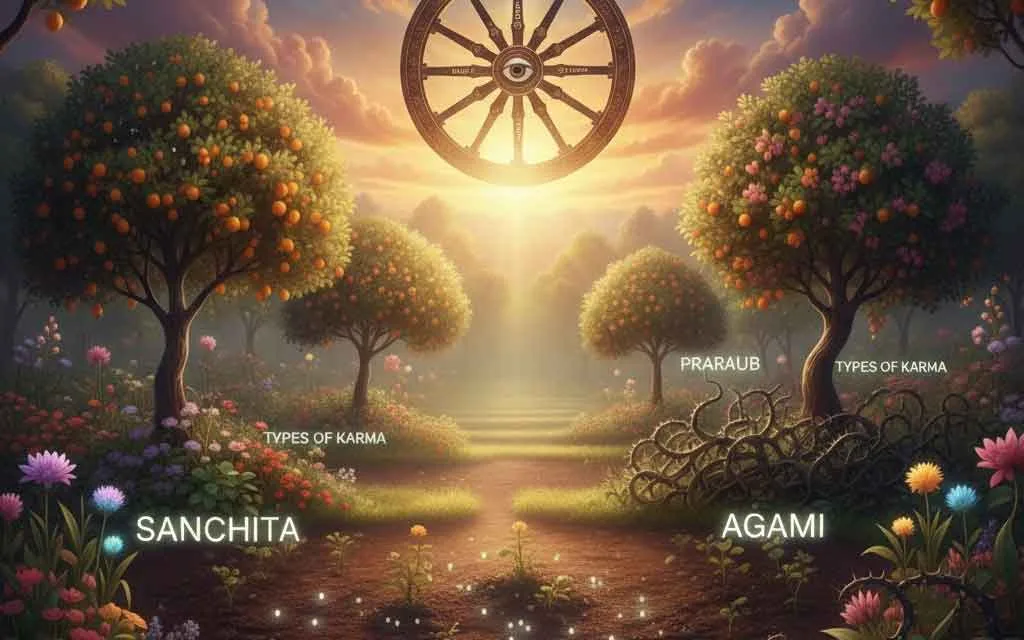
Classical Vedanta identifies three distinct categories of karma that together account for both the life we are living and the lives yet to come. Sanchita karma is the entire accumulated storehouse of karmic impressions from all past lives — a vast reservoir of unspent cause and effect. Prarabdha karma is the specific portion of that storehouse that has already been 'activated,' forming the circumstances of the present birth: the family one is born into, the broad contours of one's physical constitution, and the major junctures of one's life.
Agami karma, sometimes called Kriyamana karma, is the karma being freshly generated by the choices one makes right now — which is precisely why the quotes in this article carry such weight. The Yoga Vasishtha elaborates that while Prarabdha karma must be lived through, Agami karma is entirely within the grasp of one's free will and self-awareness. This is the theological basis for why self-reflection and conscious action are considered spiritually transformative, not merely psychologically helpful.
How the Bhagavad Gita Reframes Karma as a Path to Liberation
Perhaps the most profound teaching on karma in any single text comes from Sri Krishna's discourse to Arjuna on the battlefield of Kurukshetra. In the Bhagavad Gita (2.47), Krishna declares: 'Karmany evadhikaras te ma phaleshu kadachana' — 'You have a right to perform your prescribed duty, but you are not entitled to the fruits of your actions.' This verse is not passive resignation; it is a radical redefinition of karma as an act of inner freedom rather than transactional bargaining.
Krishna goes further in Chapter 4 (Gita 4.17), warning that 'the nature of action is very difficult to understand,' distinguishing between karma (prescribed action), vikarma (forbidden action), and akarma (actionlessness within action). The concept of Nishkama Karma — desireless action performed as an offering to the Divine — is the Gita's answer to the question of how one can act fully in the world without accumulating binding karmic debt. This teaching directly underpins the idea that how and why you act matters as much as what you do.
Karma Across the Itihasas: Lessons from the Ramayana and Mahabharata
The two great Itihasas of Hinduism are, among other things, extended meditations on karma in action. In the Ramayana, the exile of Sri Rama is often cited as an example of Prarabdha karma unfolding — not as punishment, but as the necessary ground through which dharma would be demonstrated and adharma defeated. Valmiki's text makes clear that Rama embraced each circumstance not with resentment, but with complete equanimity, embodying the very principle of acting without attachment to outcome.
In the Mahabharata, the story of Draupadi's vastraharan (disrobing) and its catastrophic consequences for the Kauravas illustrates collective karma — the idea that communities and lineages, not just individuals, accumulate and bear the fruits of their collective moral choices. The sage Vidura, often called a master of Niti (statecraft and ethics), repeatedly warns Dhritarashtra that adharmic actions will produce inescapable consequences. His counsels, preserved in the Vidura Niti section, remain among the most direct scriptural statements on the mechanics of karma in worldly life.
Sacred Pilgrimage and Karma: Why Kshetras Are Considered Karma-Dissolving
The Hindu tradition holds that certain sacred geographies possess the power to accelerate the dissolution of karmic burden. Kashi (Varanasi), considered the city of Lord Vishwanatha, is described in the Kashi Khanda of the Skanda Purana as a place where even Prarabdha karma can be mitigated through sincere devotion and the grace of Mahadeva. The concept is not magical bypass — it is understood that the concentrated spiritual energy of a Kshetra creates conditions in which the soul's awareness deepens rapidly, and deeper awareness itself reduces the binding power of past karma.
Similarly, the Char Dham pilgrimage — encompassing Badrinath, Dwarka, Puri Jagannath, and Rameshwaram — is traditionally understood as a journey through the four cardinal directions that symbolically cleanses karmic accumulation from all four stages of life. Tirtha-yatra (pilgrimage) is classified in the Dharmashastra literature not as tourism but as a deliberate form of karma yoga, in which the austerity of travel, the surrender of comfort, and the absorption in sacred darshan together constitute transformative action.
Karma and Rebirth: What the Garuda Purana and Manusmriti Describe
The doctrinal link between karma and reincarnation (punarjanma) is most vividly detailed in the Garuda Purana, a text traditionally recited during the period of mourning in Hindu households. It describes in elaborate detail how the quality of one's karma determines the nature of the subtle body's journey after death and the conditions of subsequent rebirth. While some of its imagery is cosmological and symbolic, its core theological assertion — that no karmic action is ever simply 'lost,' but is carried forward in the causal body (karana sharira) — is consistent across all Vedantic schools.
The Manusmriti (12.3–12.9) classifies actions by their predominant quality — Sattvic, Rajasic, or Tamasic — and correlates these with corresponding experiences in future lives. A being dominated by Tamas (inertia and ignorance) moves toward lower forms of existence, while one cultivating Sattva (purity and clarity) progresses toward higher states of consciousness and eventually toward moksha, liberation from the cycle entirely. This framework makes karma simultaneously a moral, psychological, and cosmological law — one that the quotes we encounter daily only begin to hint at.
Frequently Asked Questions
What are the three types of karma in Vedanta?
Classical Vedanta names Sanchita (the accumulated storehouse from all past lives), Prarabdha (the portion already activated in the present birth) and Agami or Kriyamana (karma being created by present choices).
Which part of karma can we change today?
Agami karma, the karma generated by the choices made right now, lies within one's free will and self-awareness. Prarabdha karma must be lived through, which is why conscious action is considered spiritually transformative.
What does Bhagavad Gita 2.47 say about karma?
Krishna tells Arjuna, 'Karmany evadhikaras te ma phaleshu kadachana': you have a right to perform your duty but not to the fruits of your actions. It redefines karma as an act of inner freedom rather than transactional bargaining.
What is Nishkama Karma?
Nishkama Karma is desireless action performed as an offering to the Divine. The Gita presents it as the way to act fully in the world without accumulating binding karmic debt.
Can pilgrimage reduce karmic burden?
Tradition holds that sacred kshetras such as Kashi can help dissolve karma; the Kashi Khanda of the Skanda Purana says even Prarabdha karma can be mitigated through sincere devotion. Tirtha-yatra is treated as a form of karma yoga, not tourism.
Share this with family and friends
Send it on WhatsApp, post it, or copy the link.
More from Hinduism
- AI and the Sanskrit Revival in 2026: Language Models, Manuscript OCR, Translation Tools and What AI Still Gets Wrong
- Can a Robot Perform Puja? Robot Aarti, AI in Rituals and What Hindu Tradition Says
- GitaGPT and AI Bhagavad Gita Chatbots: How Accurate Are They, and What Does Hindu Tradition Say?
- Robotic Elephants and AI in Hindu Temples: Kerala's Mechanical Tuskers, Tirumala's AI Command Centre and the Debate
- Quantum Computing Explained for Hindus: Qubits, Superposition and Entanglement, with Vedanta Analogies (Not Equivalences)
You might also like
Karma Explained: The Hindu Law of Cause and Effect — A Complete Devotional Guide
Shraddha Karma for Daughters – Garuda Purana Validation & Guide
Avoid These Mistakes in Shraddha Karma – Garuda Purana Warnings