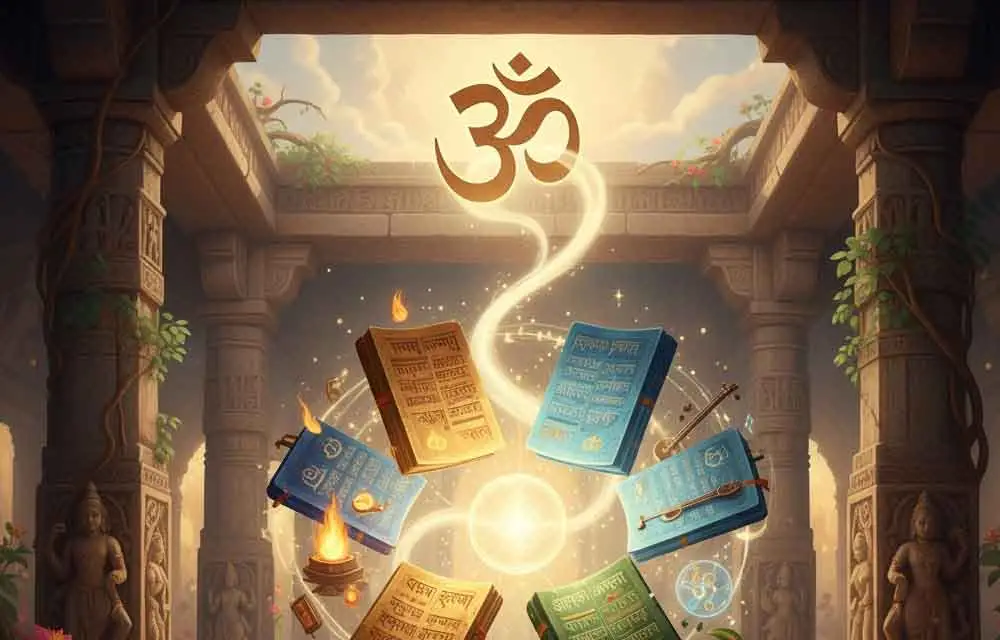
Quantum, AI & Vedanta: Ancient Hindu Wisdom Meets Science
Quantum Physics, Quantum Computing, AI, and Ancient Hindu Wisdom: Parallels in Vedanta and Modern Science In an era where artificial intelligence (AI), quantum…

Quantum Physics, Quantum Computing, AI, and Ancient Hindu Wisdom: Parallels in Vedanta and Modern Science
In an era where artificial intelligence (AI), quantum computing, and quantum physics are reshaping our understanding of reality, many are turning to ancient Hindu philosophies for deeper insights. The Vedas, Upanishads, and Advaita Vedanta offer profound concepts like Brahman (universal consciousness), Atman (individual self), and Maya (illusion) that strikingly parallel modern scientific discoveries. This article explores the fascinating connections between Hinduism and these cutting-edge fields, revealing how ancient rishis intuited truths now validated by science.
Quantum Physics and Hinduism: Echoes of Non-Duality
Quantum physics challenges classical notions of reality, showing that particles can exist in superposition (multiple states at once) and entanglement (instantaneous connection across distances). These ideas resonate deeply with Hindu philosophy.
- Observer Effect and Consciousness: In quantum mechanics, observation collapses a particle's wave function, influencing reality. The Upanishads teach that consciousness shapes perception, with the world as Maya—an illusion projected by the mind. As Erwin Schrödinger, a pioneer of quantum mechanics inspired by Vedanta, noted: "Quantum theory will not look ridiculous to people who have read Vedanta." He drew from the Upanishads' idea of unified consciousness, where Atman equals Brahman ("Tat Tvam Asi" – Thou art That).
- Entanglement and Interconnectedness: Quantum entanglement, dubbed "spooky action at a distance" by Einstein, mirrors the Vedic view of universal oneness. Everything is interconnected through Brahman, with no true separation. The Rig Veda proclaims "Ekam Sat Viprah Bahudha Vadanti" (Truth is one, sages call it by many names).
- Wave-Particle Duality and Maya: Particles behave as waves or particles depending on observation, echoing Maya as the illusory veil over ultimate reality (Brahman). Werner Heisenberg and Niels Bohr, influenced by Eastern thought, found Vedanta helpful in grasping quantum paradoxes.
Schrödinger, Heisenberg, and Oppenheimer openly credited Vedic texts for making quantum ideas more intuitive. Advaita Vedanta's non-dualism (Advaita) aligns with quantum non-locality, suggesting reality is a unified field of consciousness.
Quantum Computing and Ancient Indian Insights
Quantum computing uses qubits in superposition and entanglement for exponential processing power, enabling solutions to complex problems beyond classical computers.
Hindu scriptures describe multidimensional realities and cyclical time, paralleling quantum principles:
- Superposition and Multiple Realities: Qubits exist in multiple states simultaneously, akin to the Yoga Vasistha's multiverses or Maya's overlapping illusions.
- Entanglement and Unity: Instant correlations in quantum systems reflect "Aham Brahmasmi" (I am Brahman), emphasizing oneness.
Ancient concepts like the 64 dimensions in Vedanta foreshadow string theory's extra dimensions. While not literal predictions, these parallels highlight Hinduism's intuitive grasp of probabilistic, interconnected reality.
AI, Consciousness, and Vedanta: The Eternal Self
Artificial intelligence raises questions about machine consciousness. Can AI achieve true awareness, or is it mere simulation?
Advaita Vedanta distinguishes pure consciousness (Chit) from mind processes:
- Atman vs. Emergent Intelligence: Consciousness is Brahman—eternal, non-dual, and uncreated. AI, no matter how advanced, emerges from algorithms and data, lacking the self-luminous Atman. As Vedanta teaches, true consciousness reflects in subtle bodies but isn't produced by matter.
- Maya and Simulated Reality: AI-generated worlds echo Maya, where perceived reality is illusory. Ethical AI development could draw from dharma, warning against ego-driven (Ahamkara) intelligence.
Hinduism views AI as a tool within Maya, not a rival to divine consciousness. Future "sentient" AI might mimic jiva (individual soul) but remains dependent, unlike self-existent Brahman.
Bridging Ancient Wisdom and Modern Science
The convergence of quantum physics, computing, AI, and Hinduism isn't coincidence—it's a reminder of eternal truths. Pioneers like Schrödinger found solace in Vedanta amid quantum's mysteries, stating: "The unity of consciousness is singular; all happenings play out in one universal consciousness."
As science probes deeper, Hindu concepts like Brahman as the unified field offer philosophical grounding. Exploring these parallels enriches both spirituality and technology, guiding ethical innovation.
For deeper study, delve into the Upanishads or works by Schrödinger. Hinduism and science together illuminate the ultimate reality: We are all expressions of one conscious universe.
Keywords: Quantum Physics Hinduism, Vedanta Quantum Mechanics, AI Consciousness Vedanta, Quantum Entanglement Maya, Ancient Indian Science, Advaita Non-Duality, Schrödinger Upanishads
Published on www.hindutone.com – Embracing Eternal Wisdom in the Modern World.
Also read: quantum computing explained for Hindus and AI Gita chatbots.
Frequently Asked Questions
How does Vedanta relate to quantum physics?
Vedanta's non-duality (Advaita) is compared with quantum ideas such as superposition, entanglement and the observer effect. Brahman as unified consciousness parallels a unified field, though the parallels are philosophical rather than literal predictions.
What did Schrödinger say about Vedanta?
Erwin Schrödinger, a pioneer of quantum mechanics inspired by Vedanta, is quoted as saying quantum theory will not look ridiculous to people who have read Vedanta. He drew on the Upanishadic idea that Atman equals Brahman.
How is quantum entanglement compared to Hindu philosophy?
Entanglement, which Einstein called spooky action at a distance, is likened to the Vedic view that everything is interconnected through Brahman. The Rig Veda line Ekam Sat Viprah Bahudha Vadanti says truth is one and sages call it by many names.
What does Maya mean in relation to wave-particle duality?
Maya is the illusory veil over ultimate reality (Brahman). Particles behaving as waves or particles depending on observation is compared to this veil, and Heisenberg and Bohr are said to have found Vedanta helpful for grasping quantum paradoxes.
Can AI become conscious in Advaita Vedanta's view?
Advaita holds that consciousness is Brahman, eternal and uncreated, and is not produced by matter. AI emerges from algorithms and data, so it may mimic a jiva (individual soul) but stays dependent, unlike self-existent Brahman.
Does Hinduism offer guidance on ethical AI?
Ethical AI development can draw on dharma, which warns against ego-driven (Ahamkara) intelligence. Hinduism views AI as a tool within Maya, not a rival to divine consciousness.
Share this with family and friends
Send it on WhatsApp, post it, or copy the link.
More from Hinduism
- AI and the Sanskrit Revival in 2026: Language Models, Manuscript OCR, Translation Tools and What AI Still Gets Wrong
- Can a Robot Perform Puja? Robot Aarti, AI in Rituals and What Hindu Tradition Says
- GitaGPT and AI Bhagavad Gita Chatbots: How Accurate Are They, and What Does Hindu Tradition Say?
- Robotic Elephants and AI in Hindu Temples: Kerala's Mechanical Tuskers, Tirumala's AI Command Centre and the Debate
- Quantum Computing Explained for Hindus: Qubits, Superposition and Entanglement, with Vedanta Analogies (Not Equivalences)